Crypto Commerce
Zoom H4essential four-track recorder or F3 for an interview recording kit
Compare Zoom H4essential four-track recorder by interview mic plans, 32-bit float, media, power, and monitoring.
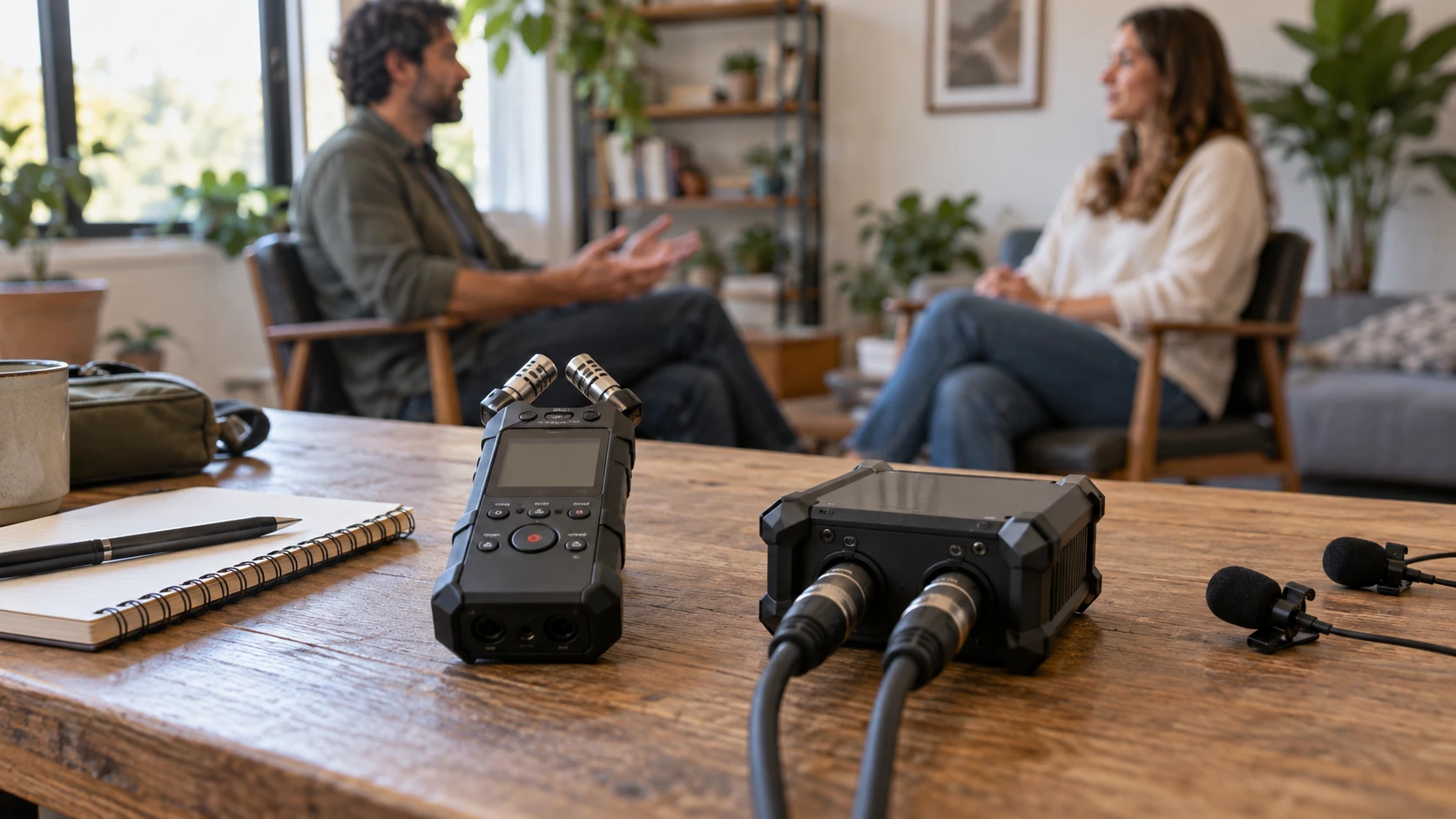
The Zoom H4essential four-track recorder combines built-in X/Y stereo microphones with two XLR/TRS combo inputs. It can capture a room and accept external microphones in one compact recorder, subject to the recording mode selected. Zoom's F3 is a smaller two-channel field recorder built around locking XLR inputs. It asks the operator to bring microphones for the actual interview and puts less emphasis on an all-in-one handheld microphone position. Both list 32-bit float recording, but the microphone plan matters more than a shared bit-depth label.
The published guide to an interview audio check before recording is relevant to either recorder. A ten-second test can reveal a mic rubbing on clothing, a distant voice, an unrecorded channel, or a background appliance that looked quiet during setup. Decide where the interviewer and guest will sit, how many voices need independent tracks, and who will listen while recording. The saved product rows describe hardware and bundles; neither provides a tested result in the actual room.
The Zoom F3 two-channel field recorder listing names two balanced, locking XLR mic/line inputs with switchable 48-volt phantom power. Its bundle includes a Zoom ZDM-1 podcast microphone pack, a 64GB microSDXC card, an XLR cable, four AA batteries with charger, and several travel accessories. That describes one supplied microphone pack, not a guaranteed two-microphone interview kit. Check the exact packing list and budget for a second microphone and cable when two speakers need separate close mics.
Draw the channels before choosing a recorder — Zoom F3 two-channel field recorder
H4essential's four-track description, onboard stereo X/Y pair, and two combo inputs open several possibilities. A conversation can use close external mics while the onboard pair captures room sound, or the recorder can be placed where its built-in microphones get an acceptable group recording. The exact combinations of tracks, monitoring, and file formats depend on its current mode and manual. Confirm the intended arrangement before assuming every input stays active in every USB or SD-card configuration.
The F3's two channels are a natural fit for a two-person interview when each voice has its own external microphone. Its locking XLR connectors can help prevent accidental unplugging while cables are moved, though the mic mounts and cable routing still need attention. If a third speaker joins, the F3 listing does not supply a third isolated input. A mixer or different recorder may be required, and the operator should decide that before arriving at the location.
Built-in microphones are useful when there is no time to rig two separate mics, but their position controls the result. An H4essential on the center of a large table will hear the room along with the voices. Move it close enough to both speakers without placing it beside an air vent or rustling papers, then listen to the test. The source row says its X/Y microphones can handle up to 130 dB SPL; that loud-source specification does not promise clear dialogue from across a room. A quiet interview still benefits from careful distance and pointing.
The F3 has no onboard microphone named in its saved row. Its supplied ZDM-1 pack may suit one close voice, but check the microphone's mounting, cable, and placement for the interview setting. If lavalier or shotgun microphones are used instead, confirm power and connector requirements. The F3's switchable phantom power can support compatible condenser mics, while a dynamic mic may not need it. Use each microphone's documentation; the presence of an XLR jack does not make every mic and line feed interchangeable.
Understand what 32-bit float can and cannot rescue — Zoom F3 two-channel field recorder
Both product listings promote 32-bit float as reducing the need to adjust gain during a take. F3's row also names dual A/D converters, and H4essential's row says wide dynamic range helps avoid clipped recordings. Those features can protect against some level-setting errors in the recorded digital file. They cannot move a microphone closer to a distant voice, remove room echo, stop clothing noise, or restore sound that overloaded earlier in the microphone or input path. Treat "without clipping" as a claim to test within the complete signal chain.
Record a rehearsal with the same people, microphones, and distance planned for the full conversation. Have each person speak at their quietest and loudest expected level. Listen for distortion, wind, plosives, handling noise, and channel imbalance through the intended headphones. A 32-bit file can be adjusted in postproduction, but that adds editing work and does not replace monitoring at the location. If a guest turns away from a table mic, a safer bit depth will not make the off-axis speech equally clear.
F3 lists uncompressed Broadcast Wave Format files at sample rates up to 192 kHz. H4essential's saved excerpt does not give a comparable maximum sample rate, though it says it can stream 32-bit float audio and record to an SD card at the same time. Ask the editor or client for the required format and sample rate, then set both devices to a compatible mode. Large high-rate files consume more storage, and a delivery workflow may down-convert them. There is little value in a setting that complicates transfer without improving the actual assignment.
Keep a separate note of what each track represents. Label the interviewer and guest microphones, mark a safety or room track if used, and capture a short spoken slate. The H4essential's extra tracks can make an edit more flexible only if the editor knows which channel contains which voice. The F3's two-track setup is simpler to hand off, but still needs a file-naming and backup plan when several interviews are recorded on one card.
Check media, power, and control in the field — interview audio check before recording
F3's listing says it records to microSD cards up to 1TB and can run on AA batteries, a USB-C battery pack, or Zoom's AD-17 adapter. Claims in Republeq's catalog up to eight hours on AA cells; actual runtime will depend on microphones, phantom power, monitoring, media, and conditions. The bundle lists four AAs and a charger, but the saved description does not establish the chemistry or runtime of those supplied cells. Perform a powered rehearsal for the expected interview length and carry a tested spare power plan.
H4essential's saved row mentions SD-card recording and USB-C connection to computers and mobile devices, but not a specific card capacity or field runtime. It functions as a four-input, two-output audio interface when connected to a supported device, according to the listing. Confirm operating-system compatibility, power draw, SD-card support, and what happens if the USB cable disconnects. The bundle includes a Bluetooth adapter, yet the row does not define every remote-control function it enables. Test the exact app and adapter pairing before relying on remote operation.
The F3 row describes wireless remote-control capability, but it does not state whether the delivered bundle contains every accessory required for it. A remote start can be convenient when the recorder is mounted away from a camera operator. Before relying on it, check the actual accessory, range, status display, and recovery after connection loss. The physical record indicator and a recorded test file remain the most reliable evidence that a take was captured.
Both choices need a transfer routine. At a location, confirm the card is formatted and has room for the planned duration. After a take, stop recording properly, verify that a file exists and plays back, then copy it to another storage location before clearing the card. The F3 bundle includes a card reader; the H4essential listing describes USB-C but does not name a card reader in its two-item package. A reader is inexpensive compared with an irreplaceable interview, so settle the transfer path in advance.
Match monitoring and access to the operator — Zoom F3 two-channel field recorder
H4essential's listing describes audible menu explanations for blind or visually impaired users through its speaker or headphones. That is a meaningful control feature to try in person if the operator relies on spoken menus. Confirm the spoken navigation covers the settings needed for the production and that the prompts do not enter the recorded audio. The F3 source does not describe an equivalent menu feature. Test its controls with the operator; a two-input layout alone does not establish ease of use.
For either unit, the operator needs to hear a trustworthy monitor feed. The H4essential row mentions headphones for audible menu descriptions but does not provide a full monitoring-output map. The F3 row in this listing does not describe its headphone socket or supplied headphones. Consult the exact manual and plug in the planned headphones during a test. Monitoring should reveal each microphone individually or in a clear mix so a silent guest channel is caught before the conversation starts.
Physical handling also differs. H4essential can sit on a table using its onboard microphones or take external cables; placement must avoid vibrations and contact with papers. F3 can be kept near a camera or interviewer with two XLR cables routed to microphones. Secure cable slack and leave a visible path to stop and review the recording. A recorder hidden for a clean frame is a risk if nobody can check its status during a long session.
Which kit fits the interview? — interview audio check before recording
Choose H4essential when built-in stereo microphones, a possible room track, two external combo inputs, USB interface use, or audible menus serve the production. Verify the exact four-track mode, supported SD media, power plan, and how the bundled Bluetooth adapter works. It is a flexible starting point for solo recording and small conversations when a short mic-placement test is part of setup.
Choose F3 when the crew already plans two close external microphones and wants a two-channel, locking-XLR recorder with 32-bit float files and several listed power options. Confirm the supplied ZDM-1 pack, any second mic, microSD media, remote accessory, and monitoring path. Both recorders can be part of a strong interview kit. The clearer choice is the one whose microphones, channels, and verification routine match the people in the room.