Learning & Creative
Zero pivot repair: swap the complete equations
Repair a zero-first-pivot worksheet by interchanging complete equations, preserve the solution set and check the answer against the original system.
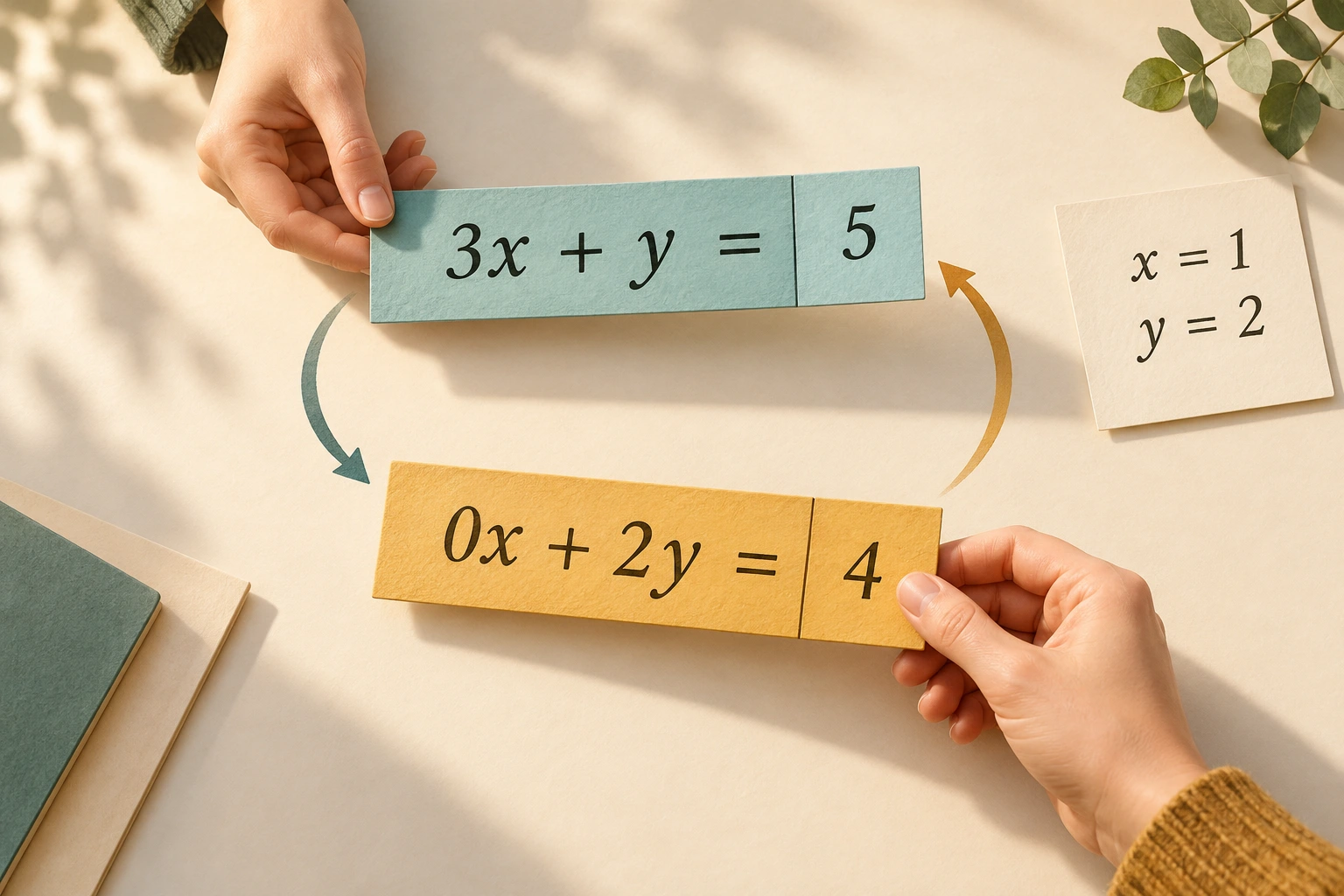
A zero at the first division step does not tell you whether a system of equations has a solution. It tells you that the proposed division is invalid. Zero pivot repair begins by preserving the original equations and identifying which step actually needs to change. In this exact paper worksheet, exchanging two complete equations creates a legal first coefficient without changing the solution set. The repaired calculation ends with a check in the original equations, so a tidy result cannot hide a changed problem.
The multicolor mixing bowl account is separate catalog context. Its native YICHENG label and alternate description name are retained in the source evidence without authenticating a maker relationship. All five photographs show three complete patterned bowls. Food, herbs and a fork do not establish supplied contents. The pictures do not authenticate material, dimensions, capacity, food safety or care claims. None supplies a coefficient in the worksheet.
Keep both equations and both unknowns visible
Use real unknowns x and y. The first equation is zero times x plus two times y equals four. The second is three times x plus y equals five. Write them as 0x + 2y = 4 and 3x + y = 5. These are stipulated exact numbers, rather than measurements with an unstated error range. A solution must be one ordered pair that satisfies both equations at once. Solving one while ignoring the other would leave the task incomplete.
For a compact record, put the coefficients and right-hand side of each equation on one strip. The first strip reads [0, 2 | 4] and the second reads [3, 1 | 5]. The first coefficient always belongs to x and the second always belongs to y. The bar separates the right-hand side; it is not an extra variable or an instruction to divide. Keep that column meaning fixed during every movement. Moving a whole equation is different from renaming its unknowns.
Suppose a proposed workflow starts by dividing the first equation by its x coefficient. Here that coefficient is zero. Writing x = (4 − 2y) / 0 does not create a permissible expression. No real division by zero is defined, so the workflow must stop before that line is used. Do not replace the zero with a small number, silently discard the first equation, or announce that the whole system is inconsistent. None of those steps follows from the failed division.
Exchange the complete rows
The second equation has x coefficient three, which is nonzero. Exchange the two complete strips, including their right-hand sides. The reordered record is [3, 1 | 5] followed by [0, 2 | 4], or 3x + y = 5 followed by 0x + 2y = 4. The failed first division now has a nonzero divisor. The exchange has changed which equation appears first; it has not changed the equations themselves or introduced a new condition on x and y.
The reason the exchange preserves solutions is direct. Any ordered pair satisfying the original first and second equations still satisfies those same two equations when their order is reversed. Conversely, a pair satisfying the reordered equations satisfies the original equations when they are read in their original order. This gives both directions of the argument. Exchanging the rows again restores the exact original record. The reversible movement is the certificate of equivalence here; visual neatness alone would not supply that certificate.
In this example the reordered system is already triangular: its second equation contains no x term. Dividing that second equation by two gives y = 2. Substitute this into the first equation to obtain 3x + 2 = 5, then 3x = 3 and x = 1. Each division used a stated nonzero number. The candidate solution is therefore the ordered pair (1, 2). Record both entries with their variable names so the result cannot be mistaken for x = 2 and y = 1.
There is a useful distinction between changing row order and changing column order. Our exchange leaves the x and y columns fixed and carries each equation's constant with it. Swapping the x and y coefficient columns would instead change which unknown each written coefficient multiplies unless the variable names were also tracked. That is not the operation used in this repair. A movement described only as a swap is underspecified: identify the objects being exchanged, the information attached to each one and the labels that remain fixed before claiming the resulting worksheet is equivalent.
Check the candidate in the original system
Return to the saved original equations, rather than checking only the rearranged strips. In the first, 0 times 1 plus 2 times 2 equals 4. In the second, 3 times 1 plus 2 equals 5. Both required right-hand sides are obtained exactly. This independent substitution establishes that the candidate works for the original problem. A check against a mistakenly copied replacement system could confirm the copying mistake instead, which is why the untouched first record matters.
There is only one real solution. To show that, suppose two solutions exist and subtract their coordinates. Call the differences dx and dy. Subtracting the first equations gives 2dy = 0, so dy = 0. Subtracting the second equations gives 3dx + dy = 0. With dy already zero, 3dx = 0 and dx = 0. Both coordinate differences vanish, so the solutions are identical. This argument establishes uniqueness in addition to the explicit pair's existence.
A swap is not the only valid way to solve these two equations. The original first equation already gives y = 2 directly; that value can be substituted into the original second equation to find x = 1. Row interchange repairs the particular workflow that insisted on beginning with an x coefficient in the first row. It is not a requirement for every legitimate solution method. Retain that distinction when describing the fault: the invalid step was division by zero, while the original system itself remained solvable.
Use an incomplete swap as a failure control
Now make a deliberately incorrect copy. Exchange only the two coefficient pairs while leaving the right-hand sides in their old positions. The record becomes [3, 1 | 4] and [0, 2 | 5]. That is the different system 3x + y = 4 and 2y = 5. It gives y = 5/2 and x = 1/2. Those calculations can be internally correct while answering the wrong question. A plausible-looking ordered pair is not evidence that the transformation was allowed.
Substitute this incorrect-copy result into the saved original first equation. Twice 5/2 equals 5, rather than the required 4, so the check fails immediately. The original second equation also gives 3 times 1/2 plus 5/2 equals 4, rather than 5. Both failures identify the consequence of detaching constants from their equations. The repair is to recover the complete original rows and exchange them intact, not to alter the required answers until the candidate happens to pass.
The frozen-row cue replacement guide compares a positionwise lookup from unchanged input with successive replacements that read newly written labels. That is a different operation. Here a row represents a complete equation, and the two-way solution-set argument justifies moving it intact.
Check whether a swap can expose a nonzero coefficient
A zero first coefficient does not always have a nonzero coefficient beneath it. Consider the different system 0x + 2y = 4 and 0x + 3y = 6. Both x coefficients are zero, so swapping rows cannot create a nonzero one. Yet the equations are consistent: both require y = 2, and neither restricts x. Every ordered pair with y = 2 and real x satisfies both. The issue is lack of a restriction on x, not a contradiction and not a hidden divisor to discover.
Change only the second right-hand side to seven. The system is now 0x + 2y = 4 and 0x + 3y = 7. The first still requires y = 2, which makes the second left side six, not seven. No ordered pair can satisfy both. This version is inconsistent. The two boundary examples share zero x coefficients throughout but have different solution sets. A report that says only “zero pivot” cannot distinguish an unrestricted coordinate from a genuine conflicting requirement.
These checks keep the repair's promise precise. Interchanging complete rows preserves solutions, but it creates a usable first-column divisor only when a nonzero coefficient is available in that column. It cannot manufacture one where every candidate is zero. After a valid exchange, any later division still needs its own nonzero check. This article proves the steps for its stated two-variable cases. It makes no claim about floating-point stability, rounding behavior, a software solver, or a general elimination procedure for arbitrary systems.
Audit a small family with exact arithmetic
The same structure can be inspected with symbols before trying other examples. Suppose the reordered equations are ax + by = c and dy = e, with a and d both nonzero. The second equation gives y = e/d. Substitution gives x = (c − b(e/d))/a. Putting those expressions back into both equations recovers c and e. The denominators are permitted because the nonzero conditions were declared. Omitting those conditions would leave precisely the kind of invalid division that started our worksheet.
For a finite arithmetic control, exact rational calculations were checked for every a and d chosen from minus three, minus two, minus one, one, two and three, with b, c and e each chosen from the integers minus three through three. That makes 12,348 systems. Each computed pair satisfied both corresponding equations exactly. These checks are useful for catching arithmetic or sign mistakes in that finite collection. The reversible-row argument and symbolic substitution provide the explanation beyond the tested entries; a large test count alone would not establish a theorem.
The silver bowl account has a sparse Tools & Gadgets title, while its native description explicitly identifies a mixing bowl. Its three images show a complete plain bowl, salad staging and a dimension graphic. The graphic is not an independent measurement, and material, capacity, finish, care and performance claims are not authenticated. The pictured ladle and food do not establish supplied stock.
The modular inverse back-substitution guide builds an integer identity and checks a residue representative. Its permitted inputs and conclusion differ from this real-variable system. Shared substitution notation does not make an integer inverse witness a proof of a legal equation swap.
A reader considering a real item order on republeq.com should examine that offer and its checkout separately from the worksheet. Exchanging complete equations proves no fact about a merchant, payment route or order being accepted. If USDT is being considered, first verify whether the current checkout actually offers that cryptocurrency method for the intended purchase. An article mention supplies no availability evidence. Before authorizing a transfer, clarify the requested asset, network, amount, receiving destination and order reference with the responsible service. Review the exact item identity, quantity, delivery details, total charge and applicable terms using the actual order. Any fee, conversion term or exchange rate needs its own current evidence; none is supplied by the equation strips. Determine the applicable cancellation, return and refund process before relying on one, including how a refund would be handled for the selected method. Keep the relevant instructions and transaction records, including dates and any confirmed references. If an order or payment status remains uncertain, reconcile that status with the responsible service before considering another transfer. A failed arithmetic step does not show that a payment failed, and a correct ordered pair cannot verify a receiving destination. The model provides no wallet address, transfer guarantee, recovery procedure or assessment of a counterparty. Completing the exercise requires no purchase and no payment. Decide whether to proceed only after the relevant conditions for that particular transaction are clear. Retain the transaction evidence independently of the invented coefficients, row movements and solution checks, so each later question can be tied to the record that actually supports it.
Retain the invalid step and the verified repair
Save the original two equations, the rejected division by zero, the complete row exchange and the candidate (1, 2). Keep the two original-equation substitutions beside them. The uniqueness argument explains why another ordered pair cannot also work. The incomplete-swap control shows why constants must travel with their equations, while the dependent and inconsistent examples show why a zero coefficient alone cannot classify a system. A finished repair identifies the legal changed step and verifies the original requirement.