Office Supplies & Stationery
Modular inverse by back substitution: find and check 38
An integer identity turns a Euclidean remainder calculation into a checked modular inverse, with a uniqueness argument and a common-divisor failure case.
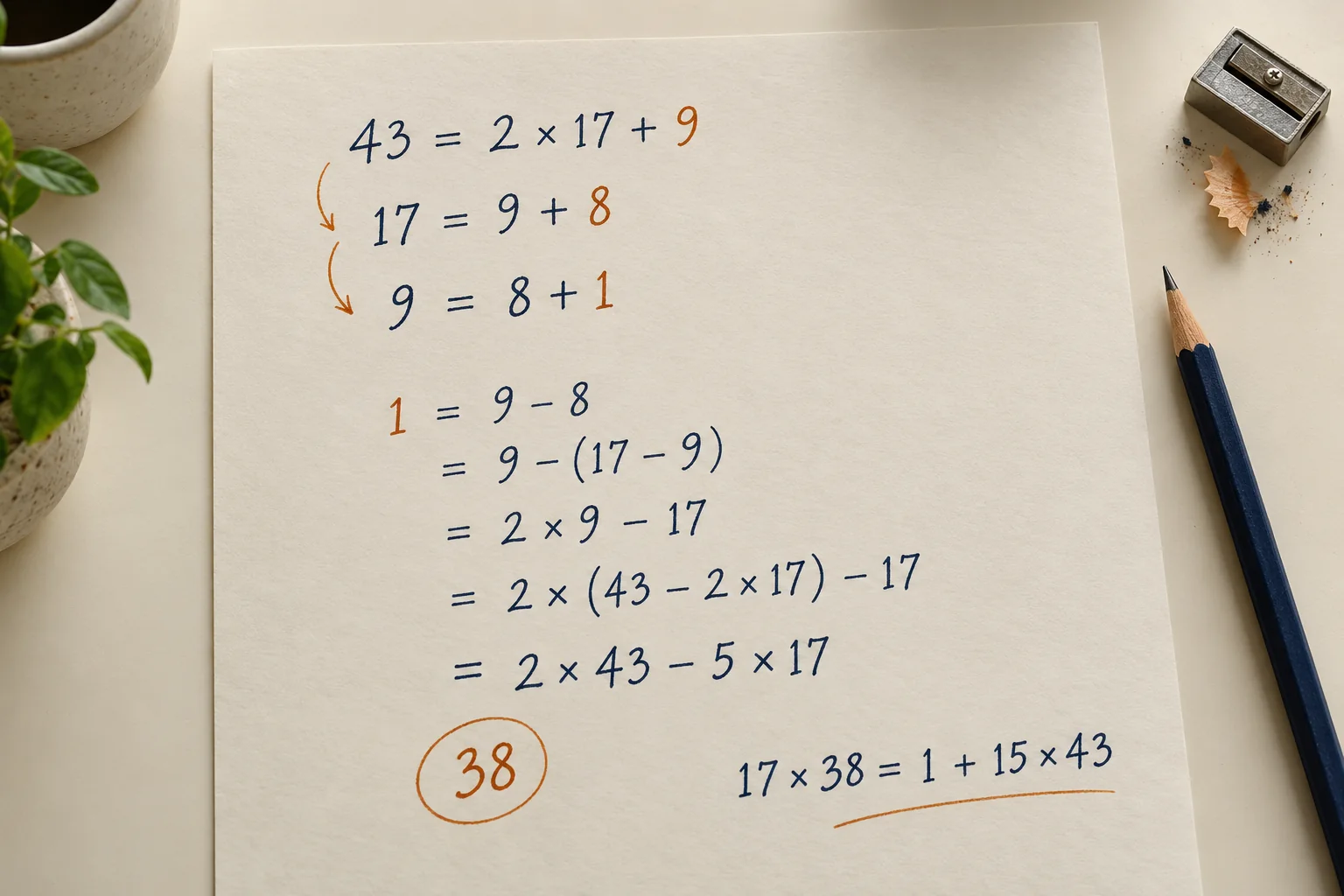
A modular inverse answers a precise integer question. For the number 17 and modulus 43, which integer x makes 17x leave remainder 1 when divided by 43? Guessing residues can eventually find an answer, but it gives little explanation of why the answer exists or why another representative should count as the same answer. Back substitution supplies that explanation. It turns the divisions used to find a greatest common divisor into an identity that can be checked with ordinary multiplication.
The calculation here uses chosen integers. Its answer is 38 within the representative range from 0 through 42. The important work is showing where that value comes from, checking it independently, and recognizing a case where the same request has no solution. A small paper worksheet is enough. Keep the modulus, the number being inverted and the desired remainder visible throughout; exchanging any of those changes the problem.
State the integer equation first
Writing “17x is congruent to 1 modulo 43” means that 17x minus 1 is an integer multiple of 43. Equivalently, there must be integers x and k with 17x = 1 + 43k. Both variables are integers. The real reciprocal 1/17 certainly makes 17 times 1/17 equal 1, but it does not answer this integer question. Putting a fraction into the blank would change the permitted inputs rather than solve the stated problem.
Representatives differing by 43 have the same remainder behavior. If one x works, then replacing it with x + 43t adds 17 times 43t to the product, an integer multiple of the modulus. We can therefore seek one representative in the range 0 through 42 without discarding other integer solutions. That range is a reporting convention, while the congruence is the actual requirement. Keep those two roles separate when a negative coefficient appears later.
Save the divisions that reach remainder one
Start with 43 divided by 17: 43 = 2 × 17 + 9. Next divide 17 by the remainder 9: 17 = 1 × 9 + 8. Then 9 = 1 × 8 + 1, followed by 8 = 8 × 1 + 0. Each line includes its quotient and remainder. Merely saving the final remainder would lose the information needed to reconstruct an integer combination of the original two numbers.
These divisions also explain the greatest common divisor. In an equation a = qb + r, any common divisor of a and b divides r = a − qb. Conversely, any common divisor of b and r divides a = qb + r. The common divisors are therefore preserved when the pair is replaced by b and r. Positive remainders decrease until division reaches zero; here the last nonzero remainder is 1. This Euclidean background supports the inverse calculation that follows.
Copy the saved lines into a narrow column with one equation per row. Leave a second column for substitutions. This arrangement makes a useful error check possible: every occurrence of 9 must be replaced by the same expression, 43 − 2 × 17, and every occurrence of 8 by 17 − 9. A changed sign or a missing coefficient should be corrected at its line of origin, before the final coefficient is interpreted as an inverse.
Work backward from the remainder
The last useful division says 9 = 8 + 1, so 1 = 9 − 8. The preceding line supplies 8 = 17 − 9. Substituting that whole expression gives 1 = 9 − (17 − 9) = 2 × 9 − 17. The parentheses matter: subtracting the expression for 8 changes the sign of both terms inside it. At this stage, 9 remains an intermediate remainder rather than one of the original inputs.
Now replace 9 by 43 − 2 × 17. The result is 1 = 2 × (43 − 2 × 17) − 17 = 2 × 43 − 5 × 17. Check the expansion directly: two copies of 43 give 86, and five copies of 17 give 85. Their difference is 1. This exact identity is the witness. It contains the original number and modulus with integer coefficients, so no rounding or division by an unapproved quantity has entered the argument.
Rearrange the witness as 17 × (−5) = 1 − 2 × 43. The coefficient −5 therefore solves the congruence, although it sits outside the chosen representative range. There is no contradiction between a negative integer inverse and a positive reported representative. The next step changes the representative while keeping its residue class. It does not repair a failed equation or discard the negative answer as mathematically invalid.
Normalize and check independently
Add one modulus to −5: −5 + 43 = 38. This lies between 0 and 42. Multiply the original number by the proposed representative: 17 × 38 = 646. Since 15 × 43 = 645, we have 646 = 1 + 15 × 43. That final division check uses the original question directly. It is worth doing even when the substitution looked tidy, because an arithmetic error in a coefficient can survive several lines of otherwise correct algebra.
The complete integer answer is x = 38 + 43t for any integer t. For example, t = −1 returns −5, while t = 1 gives 81. Their products with 17 differ by multiples of 43, so they all leave remainder 1. Reporting only 38 is appropriate when the task requests a representative in 0 through 42. Reporting that it is the only integer solution would be incorrect; uniqueness applies to the chosen range.
Prove the representative is unique
Suppose x and y both solve the congruence, and write d = x − y. Subtracting their equations shows that 17d is divisible by 43. The same witness identity now does a second job. Multiplying 1 = 2 × 43 − 5 × 17 by d gives d = 2 × 43d − 5 × 17d. Both terms on the right are divisible by 43, so d is divisible by 43 too.
If x and y are both in 0 through 42, their difference lies between −42 and 42. The only multiple of 43 in that interval is zero. Therefore d = 0 and x = y. This proves uniqueness without testing all 43 representatives or assuming that cancellation always works in modular arithmetic. The ability to cancel 17 here has been justified by the explicit identity, which is exactly what a problem with a common divisor may lack.
Use a failure case before generalizing
Try the same question for 6 modulo 15. An inverse would require integers x and k with 6x − 15k = 1. Every term on the left is divisible by 3, so the left side must be divisible by 3. The right side is not. No choice of x can fix this conflict. A longer residue search would only rediscover the obstruction; it cannot create an inverse that the integer equation excludes.
The broader criterion follows from the same reasoning. A common divisor greater than 1 prevents an integer combination from equaling 1. When Euclid reaches greatest common divisor 1, back substitution expresses that 1 as an integer combination of the original number and modulus, supplying an inverse coefficient. This statement concerns integer moduli greater than 1. It makes no claim about the speed or security of a software system, and it does not turn an inverse into a real reciprocal.
An efficient written answer therefore keeps four pieces together: the original congruence, the saved divisions, the witness identity and the product check using the normalized representative. Add a common-divisor explanation when no inverse exists. Include the reason for the answer and finish with the product check. Here the trail ends with a specific verified statement: 38 is the unique representative in 0 through 42 whose product with 17 leaves remainder 1 modulo 43.
Keep the supporting references separate
The account for the The Pencil Grip Sharpener provides optional manual writing-tool context. Its five galleries show complete colored sharpeners with integral blades, caps and receptacles. Catalog The Pencil Grip and pictured EISEN labels are retained without a maker-equivalence claim. The views do not authenticate bundle quantities, origin, materials, fit, safety or sharpening performance, and a pictured pencil is not confirmed supplied.
The account for the Prismacolor 2006685 pencil sharpener shows one complete black manual sharpener with cap and receptacle. That image does not establish the catalog bundle quantity, exact materials, dimensions, blade performance or pencil compatibility. Neither native product provides the arithmetic proof, and neither must be purchased to carry out the integer calculation.
The guide on greatest common divisor on paper uses a common divisor for largest-square tiling. Euclidean division is shared background. Here back substitution supplies an inverse witness, followed by normalization, verification and a uniqueness proof.
The guide on an inverse position map reconstructs a fixed permutation by lookup. Its inverse is a map between positions. The integer inverse here concerns multiplication leaving remainder one, so neither the card arrangement nor its repeated-index failure test establishes our congruence result. The shared word “inverse” does not make the two procedures interchangeable.
Keep a purchase decision independent of the proof
If a reader chooses to buy a manual writing accessory after doing this exercise, the purchase should be assessed separately from the arithmetic. A mathematically correct worksheet cannot establish that a particular listing has the desired contents or that an offered sharpener fits a particular pencil. Before placing an order on republeq.com, confirm the exact item, delivered quantity, condition, shipping destination and total shown for that transaction. Keep the final order details together rather than relying on a cover photograph or a catalog label to settle a question the seller has not answered. If cryptocurrency is being considered, first determine which payment methods the actual checkout offers for the specific order. Do not assume that USDT, a particular network or a particular wallet is available merely because a guide mentions the token. Where a cryptocurrency payment option is actually presented, check the token and network, the destination address, the amount requested, any network charges and the quoted timing before approving a transfer. An address copied from an unrelated message is not proof of the intended merchant destination. A low displayed token amount also does not settle the complete cost after shipping, taxes or transaction charges. Save the order reference and payment confirmation so that a later question can be tied to the exact transaction. Questions about cancellation, returns or support should be resolved through the applicable order terms before payment. None of those steps changes the inverse of 17 modulo 43: the proof depends on the integer identity and its product check, while the buying decision depends on the actual item and checkout evidence available at the time.