Learning & Creative
Keep routine cue replacement to one declared pass
An original routine-cue worksheet freezes its old labels while writing a new row. Two mappings show how same-pass feedback changes the recorded result.
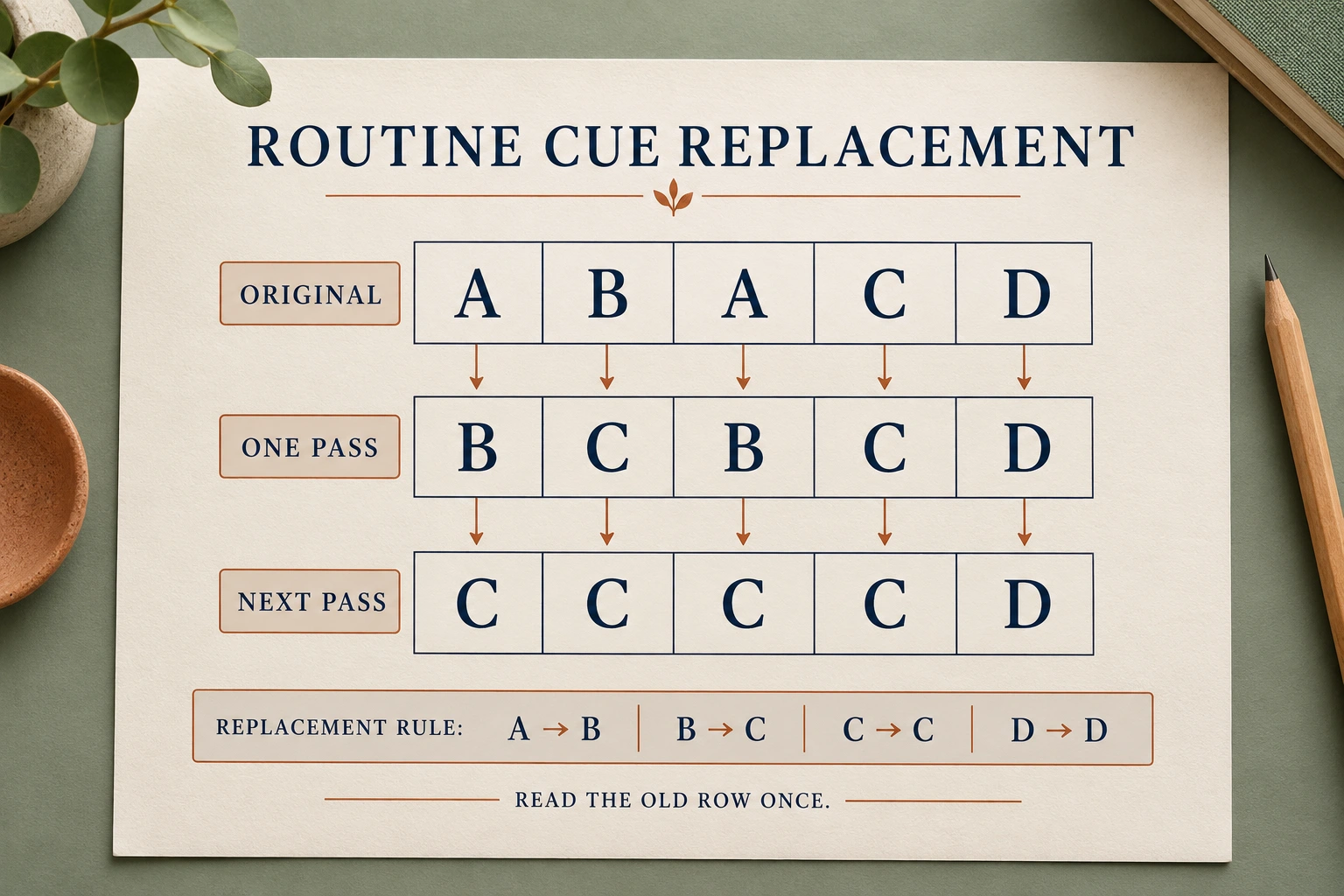
Routine cue replacement needs a clear rule about when a new label becomes available to read. In this original paper exercise, keep an old row unchanged while writing a new one. Each new entry comes from the label at the same position in the old row. A label just written cannot trigger another change during that pass.
The worksheet represents an invented set of household routine cues. It makes no claim that changing a cue changes anyone's behavior, memory or time spent on a routine. We are checking a written replacement operation, with no application, reminder service or automatic feature assumed.
Define the old row and its complete replacement table
Use four labels, A, B, C and D. They are arbitrary cue names for this exercise, without an assigned duration or required household action. Our table sends A to B, B to C, C to C and D to D. Every permitted old label has exactly one stated result.
Write the original row as A B A C D. Spaces separate entries on the page; they are not extra cues. Number the five positions from left to right. Repeated A labels at positions one and three are separate occurrences, and both must receive their own result.
Draw an empty result row beneath it. Leave the original five entries legible. For each position, look only at its old label, consult the table once, and write that table result below the same position. This defines one simultaneous pass even if your hand writes the entries one after another.
Simultaneous here describes which version supplies the input. It does not require writing five characters at the same physical instant. You can pause between entries without changing the operation, provided every lookup still reads the unchanged original row.
Read each original position once
Position one contains A, whose table result is B. Write B below that first A. Leave the old A where it is. You now have one completed result entry and four empty result positions, rather than a partially overwritten original row.
Position two contains B in the original row. Its result is C. Write C in result position two. The B you wrote at position one is irrelevant to this lookup: it belongs to the result row, not the old row that the pass reads.
The old A at position three produces B. The old C at position four produces C because the table explicitly keeps C as C. Finally, the old D at position five produces D. Read the complete new row as B C B C D.
There are still five positions. This table changes labels without adding, deleting or moving entries. The two old A occurrences became two B occurrences in their original positions. Keeping an occurrence's position is different from keeping its old label.
Give a later pass its own input row
Suppose you explicitly request a second pass using the same table. The first result, B C B C D, now becomes that second pass's old row. Copy it into a separate input line or label the existing result clearly before beginning another set of lookups.
The B at position one becomes C. Position two already contains C and stays C. Position three contains B and becomes C, while position four stays C and position five stays D. The second result is C C C C D.
This is a result after two declared passes. It does not replace the first result in the record. Keep A B A C D, B C B C D and C C C C D on separate numbered lines so another reader can see which input supplied each transformation.
A third pass would leave C C C C D unchanged under this particular table. Each C maps to C and D maps to D. That observation follows from the actual entries and rules; it is not a claim that every replacement table eventually stops changing.
Identify feedback that changes the first pass
Consider a different procedure on a separate copy of A B A C D. First replace every A with B in that same working row. It becomes B B B C D. Then replace every B in that modified row with C. It becomes C C C C D.
The second instruction has read B labels created by the first instruction. Its result therefore differs from our frozen-row first pass, B C B C D. Both procedures can be described and checked, but they use different input rules.
Do not call the cascading result a copying error merely because it differs. Ask which operation was requested. If the request was to apply the complete table once to each original entry, same-pass feedback violates it. If the request explicitly specified those two successive replacements, record that different procedure accurately.
The cascading result happens to equal our two-pass result in this example. Equal final rows do not establish equal histories. One account used two frozen-row passes, while the other used two ordered instructions that read a changed working row. Preserve the procedure beside the output.
Use a swap to expose the difference again
Define another small table on a fresh sheet: A becomes B and B becomes A. Its entire permitted alphabet is A and B. Start with A B A. Under a frozen-row pass, the two old A entries become B and the old B becomes A, giving B A B.
Now try ordered replacements on a separate working copy. Replace every A with B first. The row becomes B B B. Replacing every B with A next gives A A A. That is not the frozen-row swap result.
Reverse the instruction order in another copy. Replacing B with A turns A B A into A A A. Replacing A with B then gives B B B. The two ordered procedures produce different rows, and neither produces the frozen-row B A B.
This three-entry comparison does not supply a universal workaround for a particular program. It simply makes the worksheet's rule visible. No software command, search setting or account behavior is established by these invented rows.
Check that writing order does not choose the result
You can fill the five result positions from right to left while reading the same original A B A C D row. Old D gives D at five, old C gives C at four, old A gives B at three, old B gives C at two, and old A gives B at one. Read the finished result from left to right: B C B C D.
The result agrees with the earlier left-to-right trace because each lookup uses its own original position and the same table. No lookup reads a neighboring result or consumes a label needed by another position. This explanation depends on the declared positionwise rule. If a different exercise made a result depend on a neighboring entry, its input version and update conditions would need their own definition before this conclusion could apply.
Keep unchanged entries and undefined entries separate
In the four-label table, C and D remain unchanged because their results are explicitly supplied. An unchanged result is still a completed lookup. Record it in the new row so a blank space cannot be mistaken for an entry you have not examined.
If an old row contains E, the four-label contract no longer provides a result for every entry. Do not silently copy E or invent its replacement. Preserve the unexpected input and the missing rule as the issue to resolve before claiming a complete pass under that contract.
You could define an expanded table later, but give that version its own record. A newly supplied E rule would describe a changed exercise. It would not prove that the earlier table already covered an input it never mentioned.
Leave the two folder accounts within their evidence
The MyOfficeInnovations 116723 account names letter-size single-tab manila folders and 100/BX. Its four images show complete straight-tab folders, including Staples ST56676 packaging. The catalog brand is Unbranded; a maker relationship or model equivalence is not established. No delivered count is verified here.
The Pendaflex 1007029 account names orange letter-size folders and 50/Box. All seven images show the folder form, assorted third-cut tabs and attached fasteners. Its catalog brand is TOPS Products, without maker authentication here. No material, durability or delivered-count result follows from the pictures.
Distinguish replacement from other label exercises
The graph-coloring exercise checks different labels at connected endpoints and establishes three labels for its five-point cycle. Our table can merge A and B into later C labels. It supplies no adjacency requirement or minimum-color result.
The erasure-poem prompt keeps selected word occurrences in source order while deleting others. This worksheet retains every position and replaces its label. A permitted deletion-only selection and a completed replacement pass answer different questions.
Keep any purchase enquiry separate from the worksheet
If you separately consider an order on republeq.com and want to ask about USDT, begin with the exact offer and intended quantity. The letters and position numbers in this exercise are invented paper inputs, not prices, token amounts or directions to send funds. A completed replacement pass establishes no payment method or seller commitment. Read the choices and conditions actually presented for the intended transaction, and ask the responsible support contact to clarify essential missing information before deciding whether to proceed. If a cryptocurrency option is offered, establish the specified asset and network, requested amount, any stated validity period and the reference associating payment with that order. Do not infer a transfer destination from an illustration, a previous transaction or a message about another proposed purchase. Resolve necessary item or supplied-contents questions separately from the payment discussion. Ask about applicable delivery, cancellation, return and refund conditions, including the denomination of an approved refund and relevant deductions. Keep each answer with the offer and quantity it concerns. A changed basket may require reviewing the resulting transaction information again. If an instruction has expired, obtain current information before making a transaction decision. This article promises no present USDT availability, conversion result, fee level, processing time, refund amount or delivery outcome. You can complete every position check without placing an order. Preserve any eventual acknowledgement and transaction record separately from the worksheet. A correct replacement row cannot confirm that a transaction was authorized, completed or reconciled. If transaction status remains uncertain, resolve it through the responsible merchant before considering another payment.
Retain the table, input version and resulting row
For the four-label example, the first frozen-row pass gives B C B C D and the second gives C C C C D. For the two-label swap, one frozen-row pass changes A B A into B A B. Keep each result with its own table and pass number.
Routine cue replacement is reproducible when a reader can identify the exact old row behind every lookup. Preserve that row while writing the new one, and explicitly declare any later pass. A changed result then has a traceable rule and input rather than an unexplained replacement history.