Learning & Creative
Try an erasure poem prompt with one original sentence
A new eighteen-word sentence supplies two deletion-only poem trials. Keep the selected word occurrences in source order, saving additions or rearrangements as different projects.
Begin with one sentence you can keep beside the poem
An erasure poem prompt gives you words to remove before you decide what to keep. For this original exercise, use one short sentence written for the page: “At dawn the quiet station held one blue cup while the last train carried our unfinished story home.” The station, cup, train and story are fictional. The sentence records no actual journey or railway event.
Our working rule is specific: delete word occurrences while keeping every selected occurrence in its original order. Do not add a word, change its spelling, move it ahead of an earlier selection or use one occurrence twice. Line breaks and presentation punctuation can change. This defines the prompt used here, without claiming that every erasure poem must follow these rules.
You can work with an available sheet and a writing tool. There is no need to alter a printed book or purchase either bookmark offer discussed later. Keep a clean copy of the original sentence so that a selected poem can be checked against the actual source you started with.
Treat repeated words as separate occurrences
The original sentence contains eighteen words when its final period is kept outside the word count. Give each occurrence a position from left to right. Dawn is second, quiet is fourth, station is fifth and home is eighteenth. These positions identify particular occurrences rather than ranking the words by importance.
The word the appears twice, at positions three and eleven. Those are two available occurrences. Quiet appears only once, at position four. A list of distinct words would hide that difference, so keep the complete sentence available while selecting. The rule concerns what you can retain from this particular sequence.
For a first pass, mark words you might keep without immediately covering everything else. A working selection can remain tentative. If you remove words from your only copy and later want one back, you may lose track of what changed. The clean original gives you a stable reference for comparing the trials.
Read a complete first selection
One possible first selection is “the quiet station / held one blue cup / our unfinished story / home.” The slashes in this description mark proposed line breaks, not additional words. Written as four lines, the trial contains eleven retained words from the original eighteen.
The first seven retained words come from consecutive source positions three through nine: the quiet station held one blue cup. Then the selection jumps to positions fifteen through eighteen: our unfinished story home. Every selected occurrence remains to the right of the one selected before it.
The removed words include the opening At dawn and the later train phrase. The retained fragments can suggest a different page from the full sentence. You do not need to explain one correct meaning for the cup, station or final home. The prompt provides an authored selection for you to consider, rather than a report that readers understood a particular story.
Keep this whole trial visible before revising it. A note saying “the cup version” would not retain the actual words or their order. The complete eleven-word copy lets you inspect what stayed, what disappeared and which parts you might want to reconsider.
Try a shorter selection from the same source
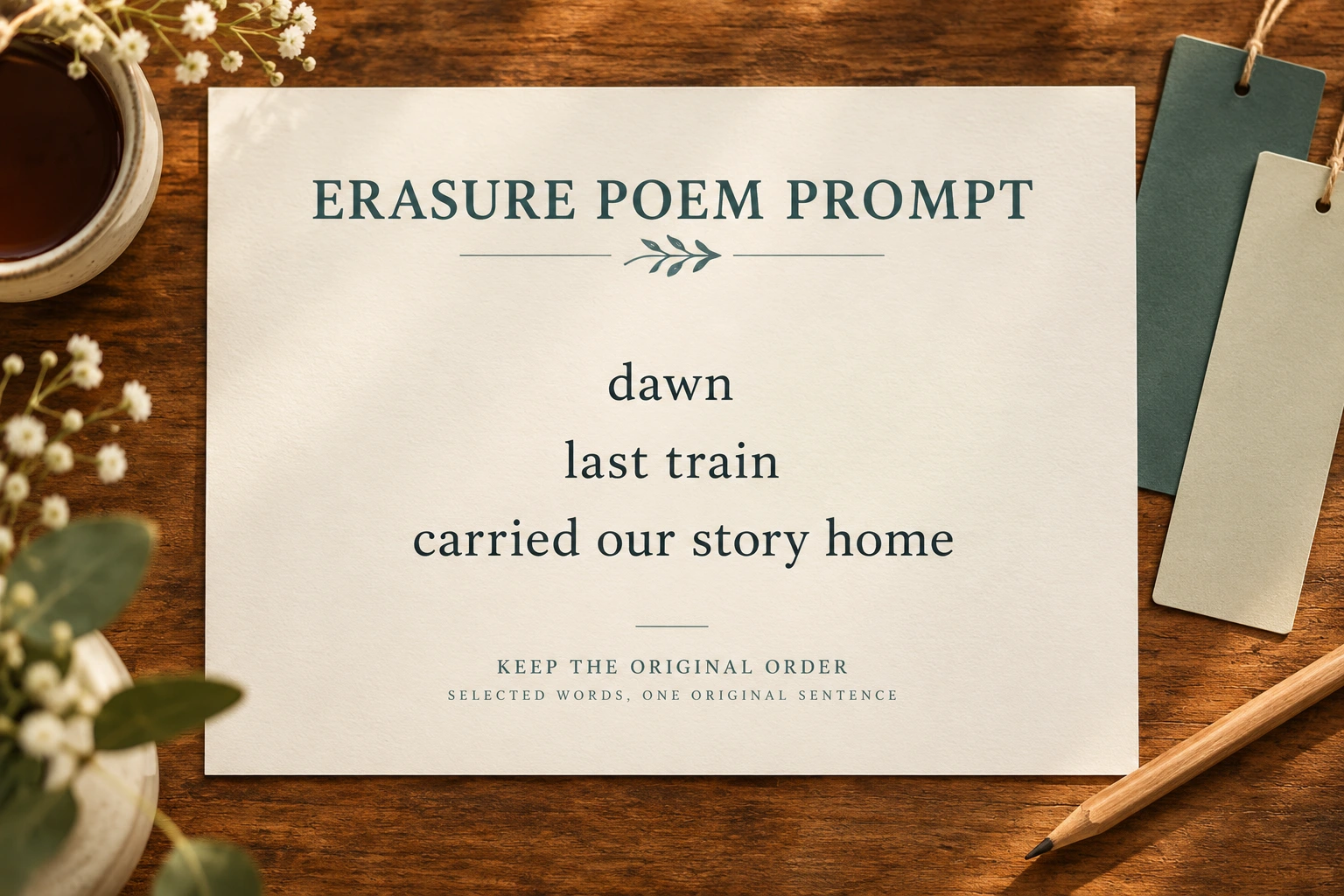
A second complete selection reads “dawn / last train / carried our story home.” This version has seven words in three proposed lines. It keeps dawn from position two, last and train from positions twelve and thirteen, carried and our from fourteen and fifteen, then story and home from seventeen and eighteen.
The second trial removes unfinished as well as the station and cup. It still retains the selected occurrences in source order. You have changed which words remain, not merely moved the breaks within the complete original sentence. That difference is the central writing choice in this prompt.
Compare the actual eleven-word and seven-word copies. You might prefer the station and cup fragments, or you might prefer the shorter train selection. A smaller word count does not establish a better poem. The count identifies the two versions accurately while your preference remains a separate authorial decision.
If you choose the seven-word trial, retain the longer one as an alternative rather than rewriting the record as though only one selection had been possible. The same original sentence supports both. This exercise does not attempt to list every possible selection or prescribe how short your own result should be.
Check the order before changing the layout
Read the source positions of a selected copy from beginning to end. For the seven-word version they are two, twelve, thirteen, fourteen, fifteen, seventeen and eighteen. Each position is greater than the one before it. This is a direct check that the printed selection follows the chosen source from left to right.
Now consider the proposed phrase “home carried our story.” All four words occur in the sentence, but their source positions would be eighteen, fourteen, fifteen and seventeen. The move from eighteen back to fourteen reverses the source order. Word membership alone therefore does not establish that a selection follows this prompt.
You can like that rearranged phrase and keep it for a different project. It simply uses a different operation. Label it as a rearrangement rather than claiming that deletion alone produced it. A new line break cannot repair the reversed occurrence order while leaving those four words in the same sequence.
Do not reuse an occurrence that appears only once
The trial “quiet quiet” would need the single occurrence at position four twice. It cannot be made by keeping that occurrence once and deleting others. Writing it twice is an addition under this working rule, even though quiet is a word found in the source.
The two occurrences of the are different. You may retain both if they appear in their original order in your selection. The issue is not a ban on repeated words. It is whether each retained occurrence has its own place in the original sequence and whether those places move forward rather than backward.
Likewise, changing train to trains would create a spelling not supplied by that occurrence. You may choose a free revision later, but keep it separate from the deletion-only trial. This small distinction prevents a desired new phrase from being described as though it had already been present in the original.
Let line breaks serve the selected words
Once you have selected the words, try the seven-word version as three lines: dawn, then last train, then carried our story home. This is the arrangement chosen for the example. The line breaks do not add a word or change the occurrence order that was already checked.
You could place those same seven words in another line arrangement and inspect it separately. That would be a layout choice made after the deletion choice. Keep the selected word sequence visible so that a change of breaks does not quietly introduce an extra word or swap two words.
Presentation punctuation can also be explored under the stated rule, but it should not alter a word's spelling or identity. Keep the plain selected copy beside a punctuated trial. You can then say which version you retained without treating punctuation as evidence that a different word was available in the source.
Follow Imani's fictional choice
Imagine Imani copying the original sentence, then preparing both complete selections on separate notes. She checks the occurrence positions before deciding which poem she wants to retain. Imani is a fictional writer in this example; this is not a report of a completed workshop or another person's response.
She chooses the seven-word version because she wants to keep the train phrase and end at home. That preference belongs to the imagined author. It does not show that the shorter selection is more moving, easier for everyone to read or more successful than the station-and-cup trial.
Imani keeps the original sentence and both notes together. She also saves the rearranged home phrase on a different page, labeled as a free-word trial. That page remains available without being used as proof that the selected deletion-only poem followed its source order.
Keep nearby poetry decisions distinct
The line-breaks guide compares different printed groups while retaining a complete sentence's words. This prompt first removes word occurrences to create a smaller sequence. Moving breaks through all eighteen original words would be a different exercise from either selection printed here.
The harmonica acrostic guide fixes opening letters at line positions and authors words within those lines. Our source sentence supplies the available occurrences instead. There is no required initial-letter word, refrain or last-to-first word handoff in this prompt.
Retain every supplied stock in the native accounts
The native Unbranded teacher gift set describes 30 bookmarks, 30 thank-you tags and 30 organza bags. All three supplied stocks remain part of its account. The seven gallery images do not authenticate delivered counts, materials, endorsements or performance.
The native angel bookmark offer describes individually gift-boxed markers. Its eight images show angel forms with tassels, boxes, ribbon and attached thank-you tags as assembled presentation. They establish no silk authenticity or loose extra gift stock. Neither offer supplies our original sentence.
Keep a cryptocurrency enquiry outside the poem
If you separately consider a bookmark order on republeq.com and want to ask about USDT, begin with the actual offer and quantity rather than the poem's word count. The eighteen-word source and the two selected versions create no purchase requirement, price or payment instruction. This article does not establish that a payment method is currently offered for an account, location or basket. Read the choices and conditions actually presented for the intended order, and ask the responsible support contact to clarify essential information that remains missing. If a cryptocurrency option is offered, establish the specified asset and network, the requested amount, any stated validity period and the reference associating payment with that order. Do not infer a transfer destination from a bookmark image, a gift tag, a previous transaction or the position numbers on a writing sheet. Keep the offer's supplied contents separate from its payment information. The teacher set includes bookmark, tag and bag stocks; the angel account shows its own individually presented bookmarks. An answer about one does not automatically govern the other. Ask separately about applicable delivery, cancellation, return and refund conditions, including how an approved amount would be determined, its denomination and any deductions. If the selected quantity changes, review the resulting order information before relying on an earlier explanation. No present USDT eligibility, discount, conversion result, fee level, refund amount, processing time or delivery outcome is promised here. You can complete the writing prompt with materials already available and leave a shopping enquiry undecided. Preserve any eventual order acknowledgement and payment record separately from the original sentence and selected poem. A transaction record cannot establish that a reader preferred your poem, and a rule-compliant verse cannot confirm an uncertain payment or delivered inventory.
Finish with a source and a selection you can inspect
Keep the original sentence beside the seven-word version: dawn, last train, carried our story home. Its selected occurrences move forward through the source, with no added or reused word occurrence. Retain the eleven-word alternative if you want it available. The finished prompt records both the rule you used and the particular poem you chose, without requiring another reader to share your preference.