Office Supplies & Stationery
Understanding wood construction labels: surface, veneer, and panel
Learn what veneer, MDF, and decorative wood-grain wording describes, then read two desktop organizer offers without guessing their construction.
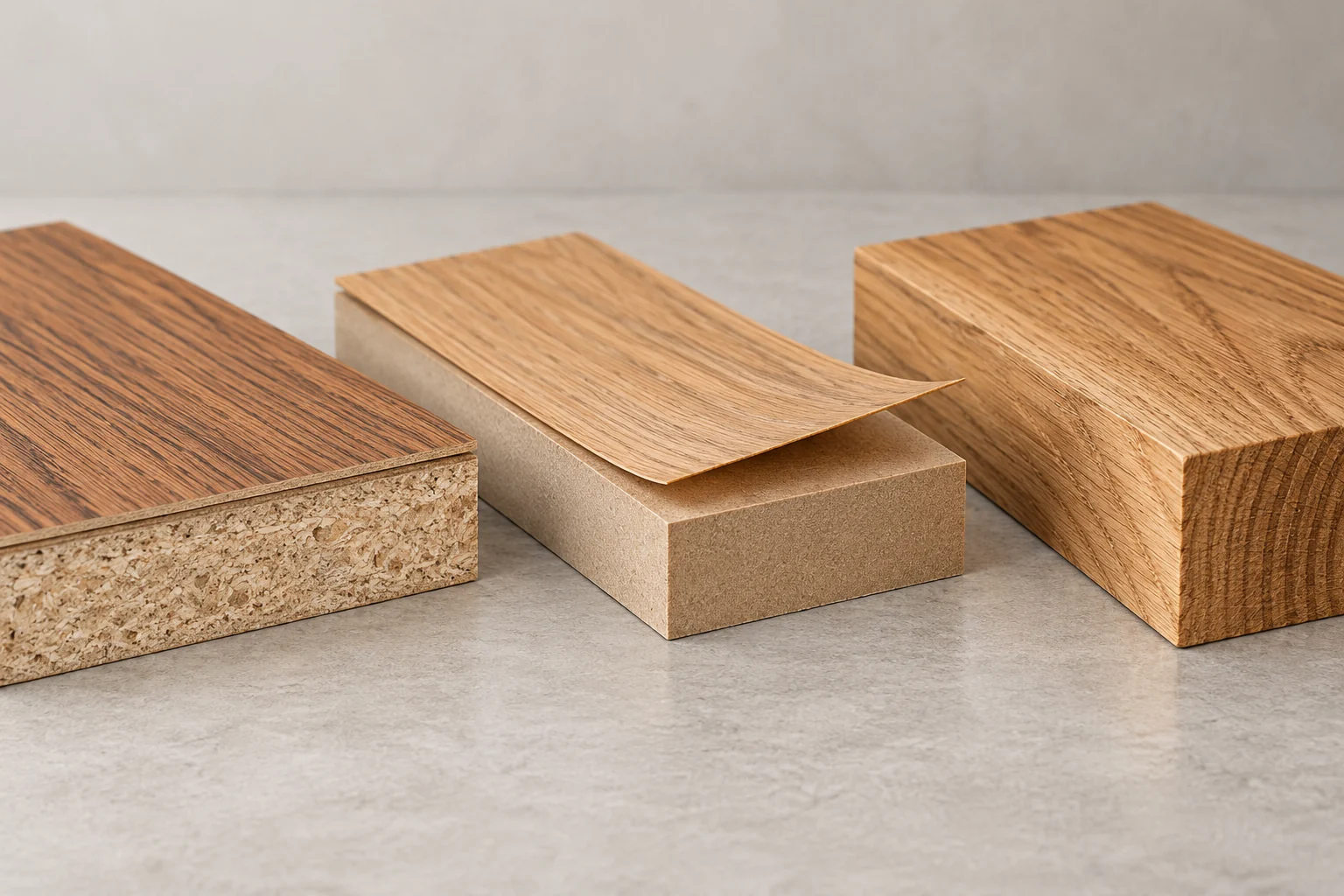
Wood construction labels can answer different questions about the same organizer. You may want a particular appearance on your desk, a stated material for the box itself, or enough information to ask about its care. Start by naming the question you need answered. This explainer reads material terms at the level they actually describe, then returns to two current organizer offers. The illustrated samples are generic teaching examples; they do not show the hidden construction of either offered product.
What real wood veneer describes
Penn State Extension describes hardwood veneer as a thin layer sliced or peeled from a hardwood log. Its account follows veneer from log preparation through cutting, drying, and joining into larger sheets. That definition gives the word a specific material meaning: a real wood layer can form the visible face of a product whose remainder uses something else. A wood surface therefore need not mean solid timber throughout the component.
The publication also distinguishes actual veneer from artificial imitations, including printed pictures under plastic or vinyl. When reading an offer, ask whether “veneer” names real wood or whether the seller is describing a wood-like decoration. A short color name cannot answer that construction question. Penn State’s manufacturing explanation does not identify the material in an unrelated organizer photograph. Keep the distinction as vocabulary for your enquiry, and ask the seller which layer its material wording covers. No cutting thickness or wood species is assigned to either organizer here.
MDF names a panel beneath its finish
Natural Resources Canada describes medium-density fibreboard, or MDF, as an engineered non-structural panel made from wood fibres. Its production account combines fibres with wax and a resin binder, then forms panels with heat and pressure. The page explains that MDF may be concealed within a finished object or covered with a decorative coating, such as wood veneer or resin-impregnated paper. A visible face and an MDF core can consequently belong to the same component.
If a seller names MDF, retain that term instead of shortening the description to “solid wood.” Then look for a separate statement about the exposed face. Ask whether the stated material applies to the base, sides, dividers, or every relevant part. The Canadian description concerns the material generally; it supplies no organizer-specific thickness, fastener arrangement, load rating, or care approval. Its discussion of machining and finishing is not an instruction to modify an unknown purchased box. For this comparison, identifying a panel type stops short of deciding how the finished organizer will perform.
Particleboard and plywood describe other constructions
NC State Extension’s construction and furnishings publication describes particleboard as made from small particles, while oriented strand board uses strands. Its plywood entry describes layers made with veneers and adhesive. These accounts distinguish construction vocabulary that a general “wood” description leaves open. They do not make particleboard, plywood, and MDF interchangeable names for one panel. If the precise panel matters to you, ask for its actual identification.
The publication’s furniture examples are also useful for reading the scope of a claim. Its cabinetry entry lists solid wood, MDF, particleboard, and plywood among possible raw materials. Its wooden-tray entry includes solid wood, plywood, and MDF. The authors caution that many products in the publication have no single production process or fixed set of characteristics. Thus, an object category such as tray or cabinet cannot settle construction by itself. Apply that caution to the wording of your enquiry, without assigning a construction from a different example to the organizer you intend to order. Ask about the actual component and selected offer.
A veneer can be bonded to several substrates
The Timber Veneer Association of Australia uses “substrate” for the material to which a veneer layon is bonded. Its substrates page describes pressing with specialized equipment, generally using heat and pressure. It identifies particleboard and MDF as substrate options and explains that plywood can also receive face veneers. In that account, plywood itself consists of three or more bonded veneer layers. A face veneer and the material immediately beneath it are therefore separate parts of the description.
A useful seller question is: what is the facing, and what is the substrate for this particular panel? An answer naming only the facing may leave the second part unanswered. Conversely, a substrate name does not fully describe the exposed decorative surface. Keep both statements beside the part they concern. The association discusses several options and their intended applications; it does not certify which one appears in a retail photograph. Nothing in this general process description establishes the bond quality, supplied finish, or construction of the two organizer offers below.
Wood-grain decoration can use décor paper
The Composite Panel Association explains that thermally fused laminate, or TFL, is made by fusing resin-impregnated décor paper directly to a substrate. Its account identifies particleboard and MDF as substrates for this process. It also describes steel press plates embossing the overlay to create textures that heighten the realism of wood grain, stone, or abstract designs. The resemblance to wood can therefore be a deliberately produced decorative effect.
When an offer says “wood-grain,” ask whether that phrase describes appearance and whether the construction is stated elsewhere. A photograph of a convincing grain pattern cannot supply the missing layer description. TFL is one documented example of a decorative surface system, not a diagnosis of every wood-look object. This article does not identify either organizer as TFL. The association’s general performance and application statements also remain separate from the exact retail products. To assess a particular organizer, request its own material and finish information instead of transferring a decorative-panel family’s advertised properties to an unidentified surface.
Composite is a broad family description
The USDA Forest Service’s public abstract for the Wood Handbook chapter on wood-based composites describes materials bonded together with adhesives. It groups panel products such as plywood, particleboard, and fibreboards alongside structural timber products and wood–nonwood composites. That range explains why “composite” alone leaves substantial detail open. It is a broad family description rather than a complete specification for a small storage box.
The abstract identifies both structural and nonstructural applications and emphasizes that mechanical properties matter to proper use. Read those points together: knowing a family name does not supply the properties of a particular finished component. Ask for the specific construction and applicable product information if those details decide your purchase. Here the evidence is the chapter’s public abstract, not a test of either organizer or a design calculation. No structural grade, supported weight, outdoor-use permission, or engineering value is inferred from the handbook’s category list. An unspecified panel remains unspecified until evidence for the actual item resolves it.
A photograph leaves identification limits
Michigan State University Extension’s introduction to wood identification explains that identification takes practice and familiarity with wood structure. It notes that a stain or other finish can make the task harder, as can being unable to examine all sides. It also warns that printed grain, overlays, laminates, and plastic made to resemble wood can mislead an unfamiliar observer. A retail image with one visible face gives you less access than an examination of the object.
Use photographs to record what you can actually see, such as a drawer arrangement or a visible color. Keep material identification attached to the product’s explicit account or other suitable evidence. The MSU introduction discusses identification aids and limits; it is not permission to cut, scrape, or damage an item to settle an online shopping question. Nor does this article offer a species-identification key. If the seller cannot establish the relevant construction, you can leave that field unknown and decide whether you are comfortable proceeding with that uncertainty.
Construction does not diagnose a surface problem
A separate USDA Forest Service diagnostic report concerns surface distortions in veneered furniture and cabinetry. Its public abstract describes buckling or cracking in finishes and sometimes in veneer, and says moisture changes cause most of the distortions it addresses. The report is intended to help narrow down a problem’s source. That stated diagnostic purpose is more specific than recognizing a material name in a shopping description.
For a purchased object with a damaged surface, record the actual condition and obtain advice appropriate to its construction and finish. The abstract does not diagnose a photographed organizer or prescribe a household repair here. A word such as veneer cannot identify the cause of every crack, and a smooth-looking new surface cannot establish future resistance to changes in use. Keep condition questions with the exact item and its instructions. This explainer uses the report only to distinguish naming a construction from investigating an observed surface defect; no moisture threshold, repair method, or durability ranking is supplied.
Read the two organizer offers literally
The Homemaxs Beige desktop organizer description makes a wood-construction claim. Its original gallery shows an empty rectangular box divided into open compartments with a wood-like appearance. The listing account does not identify a species or establish solid timber, veneer, or an engineered-panel construction. Retain “wood” as the seller’s statement and leave those narrower questions open.
The Frcolor White desktop organizer offer describes two storage boxes with three-layer drawers. Its original gallery shows two white, partly translucent drawer units. The reviewed description does not explicitly identify their material. Appearance alone is insufficient to add “plastic” or another material to that account. These offers have different forms and different amounts of material detail disclosed. No comparative durability, carrying capacity, or cleaning result is established for the pair.
Keep the related tasks separate
The guide to wood stain that remains tacky addresses a finishing problem and the history needed to seek appropriate product guidance. Its repair context does not turn this vocabulary explainer into a stain-removal procedure.
The coaster-materials explainer asks whether a pack supplies craft blanks or items presented for direct use. That preparation decision differs from identifying a facing and core. Read the organizer’s own contents and instructions for the task you intend.
Save the question that remains unanswered
Before ordering, write the exact unanswered material question beside the product URL and selected option. You might ask which part the word “wood” describes, or request the construction account for the base as well as the dividers. Save the response with the offer you actually choose. If the answer remains vague, keep your note equally precise: material not established for this component. You can then decide whether that unresolved detail changes your willingness to buy. A preference for a certain look and a requirement for a specified construction can be recorded separately in your own purchase notes. When a reply gives only a brand or color, ask the component question again; that reply leaves the requested construction detail unresolved.
Review the live checkout instructions
If you plan to purchase an item on republeq.com, check the particular offer and current checkout before ordering. This guide does not establish that any cryptocurrency payment option is available. If USDT is offered for the intended order, verify the requested asset, network, amount, receiving destination and order reference with the responsible service before authorizing a transfer. Review the actual product identity, selected variant, quantity, delivery details, total charge and applicable terms. Use the confirmed order details when checking the payment instructions. Confirm any fee, conversion term or exchange rate from the current transaction information. Determine the applicable cancellation, return and refund process, including how a refund would be handled for the selected payment method. Keep the relevant instructions and transaction records, with dates and confirmed references. If essential instructions change, ask the responsible service to confirm the change against the exact order. An acknowledgement should identify the order and the agreed details; it does not replace checking whether the selected product is the one you intended to buy. If payment or order status remains uncertain, reconcile that status before considering another transfer. Do not treat an unresolved transaction as evidence that nothing happened. This article supplies no wallet address, transfer guarantee, recovery procedure or assessment of a counterparty. A product enquiry does not authorize a payment or resolve an uncertain order. If support provides an answer, retain the exact question and response so a later reviewer can understand what was confirmed. Decide whether to proceed only when the conditions of the particular transaction are clear, and retain the confirmed transaction information with the exact order.