Home & Living
Understand wire food slicer parts and their separate roles
Understand wire food slicer parts by distinguishing the moving cutting frame, supporting cradle and independent shaping pieces.
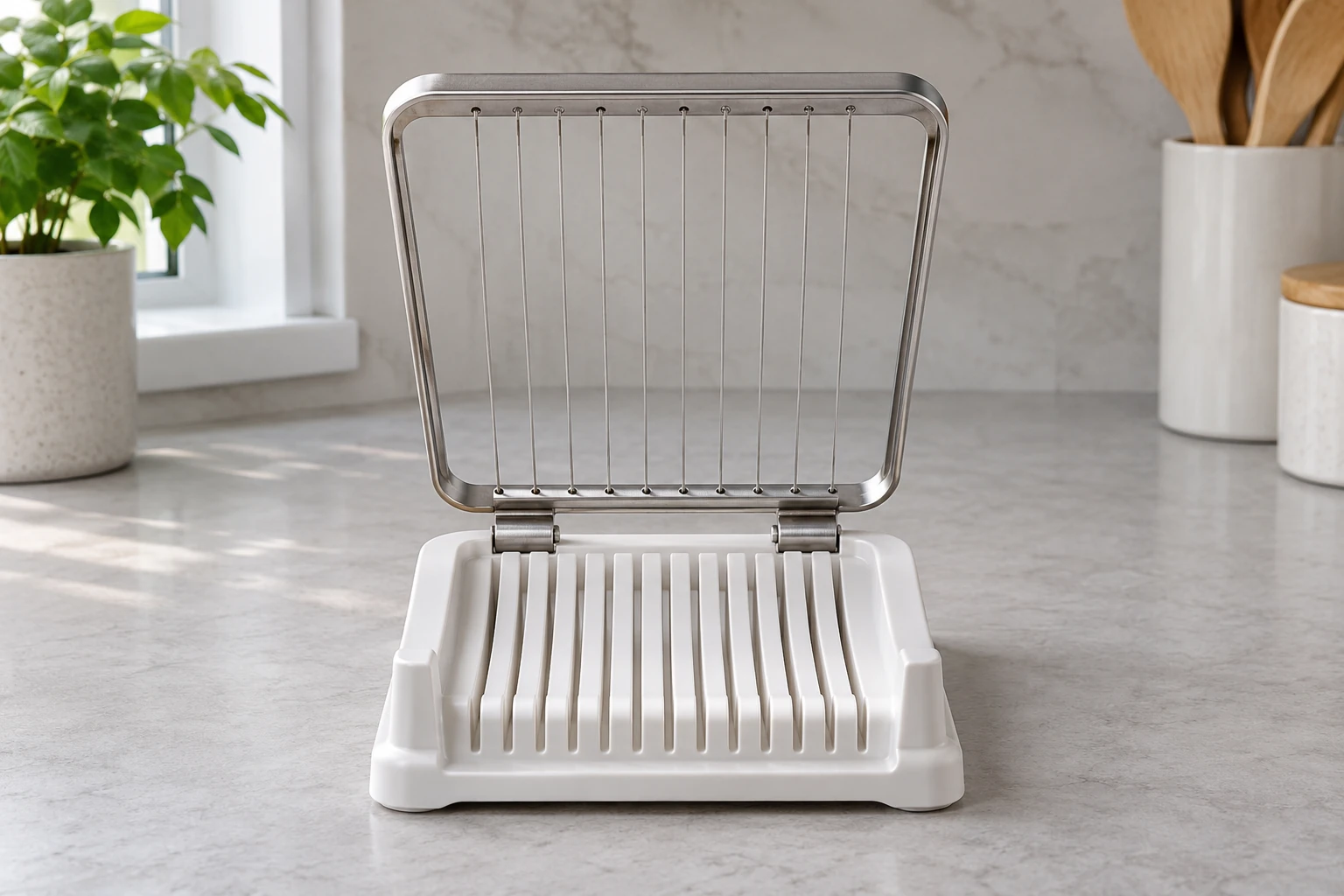
A wire and its supporting frame are different parts of a described cutting arrangement. Understanding wire food slicer parts means following how those named elements belong together, while keeping the complete tool distinguishable from an individual component. The examples below make that relationship concrete. They explain the structures described in specific accounts and preserve the boundary of each example. The reader can follow the mechanism being discussed without treating every item beside a tool as part of it.
The terms cutting frame and supporting cradle are descriptive labels here. Manufacturer terminology varies, so each example keeps its own component names where the source supplies them. Read a part as one element in a relationship. A carrier holds the cutting element in the described assembly, while a support provides the other side of that arrangement. The examples make those relationships concrete instead of treating every item beside a slicer as another wire-bearing part.
The native pair has two different support arrangements
The Dujiujun wire-and-board account shows a single wire on a hinged arm above a white board. Its eight-image gallery also shows the board serving cake and fruit with the arm absent. That establishes an independently pictured cutting-and-serving-board role alongside the wire assembly. An image with two open positions depicts the same unit, not a two-unit pack. The listing calls the board marble and the wire stainless steel. Those remain attributed material descriptions.
The Quest slicer and mold account shows parallel wires over a slotted supporting body. Its six-image gallery separately shows a rectangular shaping ring and a handled press. These have an independent forming role beside the wire-cutting unit. The title and pictures support that distinction. Its unrelated yard-task description supplies no kitchen-tool explanation. Blue and white forms appear without establishing an exact delivered colour or count. The separate ring and press are not another wire carrier.
A slotted dish and hinged carrier have different jobs
Wikipedia's general egg-slicer description identifies a slotted dish that holds the egg and a hinged plate bearing wires or blades. That account supplies two different structural roles. The dish supports the item, while the plate carries the cutting elements. The hinge describes their movable relationship. Calling the entire object a wire grid would omit the support underneath it. Calling the dish another cutting element would also miss the distinction in the source. This is a general secondary description, without identifying either retail model.
The important relationship is between the slotted support and the wire-bearing plate, rather than two unrelated pieces that happen to appear together. The supporting cradle label in this article refers to that support role. The cutting frame label refers to the wire carrier under discussion. A reader can therefore distinguish a statement about what holds the ingredient from one about what holds the wires. The general description does not establish the material, supplied accessories or exact arrangement of a particular seller's product.
One named design has two cutting frames
Westmark's own Combined 10752260 account describes two frames for slicing and wedging, together with individually tensioned wires. In that account, two frames are two cutting arrangements within the named design. They are different from a cutter accompanied by a separate shaping ring. The word “combined” does not eliminate the distinction between the two frames, and the word “wire” does not turn all the surrounding structure into the cutting element. The account concerns Westmark's named product, without establishing a match to the native pair.
Individually tensioned wires also identify a smaller component level within Westmark's description. The frame is the larger carrier, and the wires belong to its cutting arrangement. A phrase about the frame can therefore concern the assembly as a whole, while a phrase about a wire concerns one of its elements. That distinction explains why a list of parts needs both names. It does not establish that another tool has the same tensioning construction, that the frames are interchangeable or that an owner can substitute one manufacturer's component for another.
A shaped base provides clearance in a named account
GEFU's official TOSCANA 12370 account connects the cutting wires with the shape of the plastic base. The maker says the base is shaped to allow a complete cut through the supported item. This is a concrete explanation of why the lower structure matters to that named design. It is more informative than describing the base merely as the part underneath the wires. The account identifies a relationship between the cutting path and the supporting form, with both belonging to the same tool.
That explanation concerns clearance in GEFU's own account. It does not turn the base into a second set of cutting wires or make it an independent shaping mold. The distinction is between supporting the item and leaving room for the described cutting path. The maker's completeness statement remains attributed to TOSCANA, without becoming a tested result for the native products. This structural account supplies no universal slice thickness, ingredient guarantee or permission to transfer GEFU's instructions to another slicer that happens to have a slotted body.
A board, pivoting bar and wire can form one mechanism
The description in US patent 3,766,817 provides a more detailed board-style example. Its base has a flat surface, a transverse slot and a passageway below that surface. One leg of a U-shaped bar sits in the passageway, establishing the bar's pivot. The cutting wire spans the base and is received in the transverse slot. Those are distinct features with distinct relationships. The passageway locates the pivoting bar, while the surface slot receives the cutting element. A slot and a pivot passage therefore have different meanings in this particular design.
The same patent describes a wire attachment at the bar's lower leg and another at a pin in the handle. Its handle also participates in the tensioning arrangement. This makes the handle part of a specified mechanical connection, beyond its appearance as a grip. The description belongs to the patent's illustrated construction. It does not identify the hidden attachment or tensioning mechanism of either native product. No wire replacement, screw adjustment or assembly procedure is supplied here.
A hand-held wire slicer is another arrangement
Westmark's Rollschnitt-Gallant 29272260 account describes a hand-held rotary cheese cutter with a cutting wire and a soft-touch handle. That account has a different starting point from a board-mounted cutter. The handle belongs to a tool held separately from a supporting board, instead of naming the moving arm of a pictured board assembly. The maker also describes the wire as replaceable and lists replacement wires. Those statements concern the identified Westmark product and do not establish compatible spares for another wire slicer.
This example explains why “wire slicer” is too broad a name to identify an exact mechanical layout. The product account includes a handle and cutting wire without presenting the named unit as an integrated board-and-arm assembly. Its handle description therefore belongs to that hand-held arrangement. The material list also covers more than one material across the product, so the article keeps the wire and handle descriptions separate. Nothing in this account authenticates the materials of the retail pair, proves a shared frame or supplies a replacement procedure for them.
Separate structural relationships from accessory groupings
These examples answer different questions about a part. One question concerns the item being discussed, another concerns the larger assembly it belongs to, and another concerns its relationship to the support. Those questions can be answered in ordinary prose without pretending that every manufacturer has adopted the same naming system. The phrase “part of the cutter” identifies an assembly relationship. The phrase “beside the cutter” identifies a pictured grouping. The two phrases leave the reader with different information.
For a fictional picture index, Jo could put one heading above the complete tool and separate labels beside the particular assemblies. The labels would be useful only if a reader could tell which piece each one names. Jo would keep an independent accessory under its own heading instead of placing it inside an imaginary exploded view. This example concerns how to communicate an already described relationship. It adds no new component, physical connection or product capability to the actual accounts.
Neighbouring guides have different reader decisions
The rotary-grater mounting guide addresses a base that will not hold and where movement occurs. That is a mounting-fault description. The present article explains component relationships without diagnosing a fault, transferring that guide's enquiry sequence or reporting a problem with either native product.
The holiday-cookie occasion guide addresses occasion, motif and assortment decisions. A shaping piece appears here to distinguish an independent kit role from a wire-cutting assembly. It does not introduce a recipe, holiday plan or purchasing-quantity framework into the mechanical explanation.
Read the relationship behind the part name
A useful account of wire food slicer parts identifies the particular element and explains its place in the described assembly. It also keeps a separate accessory outside that assembly when the evidence shows a separate role. A reader should finish with a clearer understanding of what each sentence concerns. Product-specific operation, compatibility and performance would each require evidence answering those particular questions. The structural explanation is complete when the relationships are intelligible and the cited examples retain their own identities.
If this explanation later leads to a purchase, keep the payment decision separate from the description of the tool. A person considering crypto should first establish whether the actual checkout for the intended order offers that method. This article does not establish that republeq.com accepts cryptocurrency, that a particular seller supports USDT or that any payment option is available in a particular country. A product page, a photograph and a general reference about a kitchen tool cannot answer those questions. In a hypothetical order, Jo would read the current checkout terms before choosing a method and would keep the order identity distinct from the payment destination. If USDT were genuinely offered, the token name alone would not identify the correct network or address. Those details would have to come from the actual authorized payment instructions for that order. Fees, conversion terms, refund handling and the amount due would also need their own current confirmation. No transfer is proposed here, and no wallet address or network is supplied. Sam would retain the order and payment records only after understanding which merchant and order they refer to. The same caution about describing evidence applies to the transaction. A displayed option would establish what that checkout presents at that moment, while a completed order would need its own confirmation. Neither would demonstrate that the slicer has a particular material, accessory count or cutting result. Choosing how to pay would remain a separate decision from understanding the pictured assemblies. If an offered method or its instructions were unclear, the hypothetical purchase would remain pending until the relevant order information was clear.
Concept cover for wire food slicer parts, showing a cutting frame above a supporting cradle without a demonstrated cutting result.