Cooking & Food Prep
Rotary grater base won't hold: check the mounting first
Investigate an idle manual grater's mounting problem through its actual surface requirements and base controls, keeping food preparation and parts changes separate.
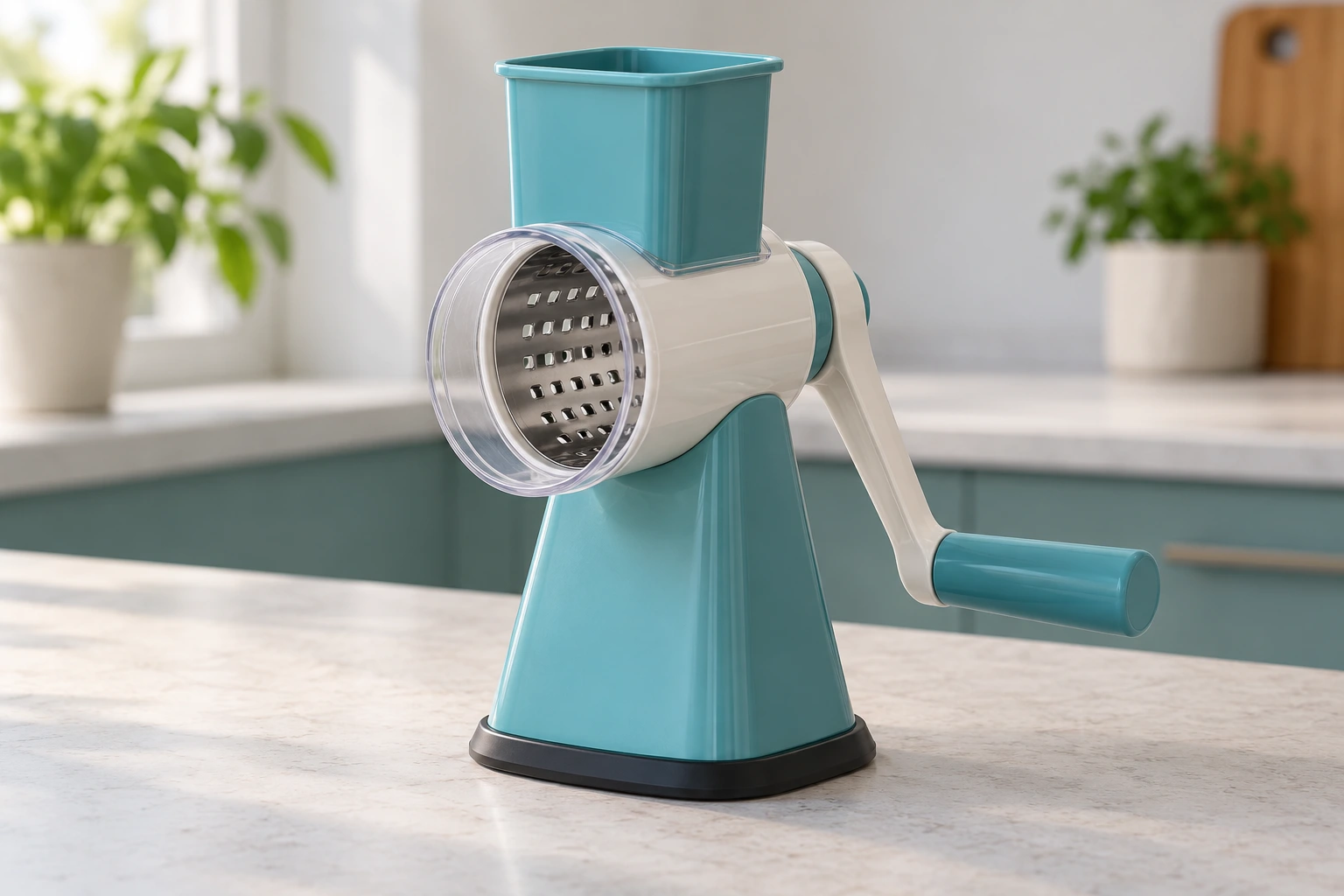
A Rotary grater base that will not stay attached needs a mounting check before another food-preparation attempt. Begin with the actual tool, its matching instructions and the place where it is intended to stand. Describe the first movement you notice. A base that never establishes a hold raises a different question from an upper part moving while the foot stays put. Neither observation, by itself, identifies a failed component.
Read the actual mounting arrangement
The NOBRAND three-drum grater offer shows a white hand-cranked tool bearing Geedel marks; retain that unresolved relationship between the listing name and pictured label when seeking instructions. Its images show a broad foot and a knob marked LOCK and RELEASE. The VALORE Produce Pro offer names five cutting cones and a suction base. Its gallery shows a crank, integral hinged pusher and contact feet. It supplies no close underside view or complete base-control procedure.
Those pictures do not establish a common locking movement. A label beside one knob does not give the operating sequence for another arrangement, and a crank belongs to a different question from the base attachment. Obtain instructions for the actual supplied tool before moving an uncertain control. This guide has not tested either offer’s hold or authenticated a manufacturer relationship from the visible mark.
Understand the contact before blaming a part
Schmalz’s vacuum-knowledge account explains a basic pressure relationship through industrial suction cups. Ambient air pressure presses a cup toward a workpiece when it exceeds the pressure in the space between them. Its industrial example uses a vacuum generator. It is not an inspection of a grater or evidence of a generator inside either selected tool.
The same account makes the side boundary important: contact prevents air entering from the sides while the vacuum is generated. This explains why a contact question deserves attention separately from the appearance of the upper tool. It provides no holding-force value, permitted kitchen surface, care procedure or measured result for these graters. No calculation or comparison of cup sizes is needed for this guide’s mounting enquiry.
A maker example separates the attachments
GEFU’s TRANSFORMA 19080 manual identifies a crank, a drum-casing fastener, a base and a table clamp as separate parts. Its illustrated assembly mounts the grater using the suction foot on smooth surfaces, or its table clamp. The product page likewise presents those mounting provisions for that system. These instructions identify the named GEFU system.
Read the word “or” within that particular instruction. It identifies alternatives supplied for that system; it does not make an unspecified clamp a remedy for every loose grater. A control that secures a housing and a method that attaches a base also answer different questions. Keep the component named in an instruction visible while reading it, instead of treating every tightening action as the same operation.
Look at the place where contact is intended
With the tool inactive and handled as its instructions permit, identify the intended contact area from outside. Note an obvious seam, edge or added layer beneath it without declaring that feature the cause. A towel or mat would change the contact surface; its usefulness elsewhere does not establish permission here. Return to the actual tool and worktop requirements before changing that interface. The industrial explanation supplies no kitchen-material approval.
Record what you can identify about the proposed location. Name the worktop or other supporting surface and any information you have about its finish. If the relevant directions name a condition you cannot establish, leave that part of the check open. Do not replace an unknown surface with a confident description such as suitable merely because it looks tidy in a photograph. Ask a question about the actual location.
Keep this first enquiry off the food task. You do not need to grate an ingredient to explain that a base moved during the permitted mounting stage. Give the support contact the order of events: what had been identified, which documented step had been completed and what moved next. Report an incomplete step as incomplete. This helps distinguish an unanswered setup question from a claim that a documented procedure has been completed unsuccessfully.
Describe the first loss of hold
Consider an original fictional example involving Ren, who cannot identify the base control from the information supplied with a tool. Ren stops the enquiry at that point and requests the matching instructions. The useful observation is the missing control information, rather than a declaration that the mechanism is broken. This example gives no permission to experiment with a lever or knob and reports no actual product test.
Now imagine Sol, who can identify the applicable mounting directions but notices the entire base move after the documented setup stage. Sol describes that event and the location involved, without assigning a cause or announcing which replacement part to order. The two fictional enquiries need different answers. One asks what the mounting procedure is; the other reports what happened after an identified procedure. Neither establishes a defect or a verified repair.
Avoid adding a dramatic test to make the report sound decisive. This article provides no pull force, load, retention interval or acceptable movement threshold. Use any check the actual maker specifies, with its limits intact. If no applicable check has been established, state that plainly. Repeatedly increasing force would not supply the missing specification, and a momentary impression of attachment is not a result this guide has measured.
Be more precise than saying the tool slipped. If it was visible, describe whether the whole base changed position, one edge lifted or the tool turned around a point. Leave out a movement you did not actually observe. These are descriptive categories for an enquiry, not three diagnoses or instructions to reproduce the event. They help another person understand which visible boundary to investigate without requiring you to push the equipment in several directions.
Keep the supporting surface in that description too. In a hypothetical example, the worktop or a separate support moves with the tool while the observer calls the event a loose base. That account needs clarification before anyone decides which connection lost its hold. Identify the visible reference that moved and which part remained in place. This example does not establish that a particular table is suitable or give a method for repairing furniture; it simply keeps the support and the attachment identifiable.
When a control’s position is part of the observation, describe it before and after the permitted mounting stage. Did the identified control remain where the documented procedure left it, or was its position uncertain? This guide assigns no normal position or expected resistance to an unidentified mechanism. Do not hold a control forcibly in place to make an account look successful. Report the uncertainty instead, with the actual part name and the instruction you were following.
Consider the space needed to reach an identified control before choosing a location. A tool can stand beside a wall while leaving an awkward approach to a knob or lever. A fictional buyer might notice that problem while reading the setup directions, before attempting a movement. Keep that observation separate from a claim that suction has failed. The relevant question is whether the actual permitted mounting sequence can be completed at the proposed location; this guide provides no universal clearance measurement.
Check whether the base is the part that moved
GEFU’s illustrated parts distinguish the drum casing and its fastener from the base. That maker-local example gives a clear language distinction: a housing attachment is a separate connection from the mounting interface. That illustration supplies no diagnosis of another assembly. Use the actual part names for your own arrangement when asking whether the observed movement concerns the whole base or an upper connection.
For an original off-tool sketch, draw only the parts you can identify and label the place where movement was noticed. Keep the paper beside the tool, rather than putting it under the contact area. An arrow on the sketch can identify the reported movement without prescribing a repair. If the observation was uncertain, write that next to the arrow instead of turning a rough drawing into a claim about hidden parts.
A second person can read the description back to you before you send an enquiry. Ask whether they can identify which part moved and at what stage. If they have to guess what “it” refers to, replace that pronoun with the part’s name. This is a communication exercise, not an additional equipment test. Do not ask someone to hold an uncertain assembly in place so that another person can continue the food task.
Keep other mounting decisions in their own setting
The parked-car phone-mount guide separates suction attachment, arm position and phone grip while addressing vehicle sightlines and permitted placement. Its car-specific installation and safety decisions do not apply to a grater. The narrow connection is the need to identify which attachment is being discussed; a statement about one connection does not settle all the others.
The mounted can-opener setup-cost guide asks what a complete proposed workstation includes and what installation information remains unresolved. It provides no mounting method for these graters. An identified purchase or a complete package is still a different finding from an observed hold at the intended location. Keep the actual mounting question open rather than using a new order to label an unverified fault as repaired.
Make the next enquiry specific
Retain the exact product reference and the instructions you actually consulted. Describe the proposed supporting surface, the named base control if identified, and the first movement observed. State whether the whole base moved or whether that remained unclear. Ask for the applicable mounting or service information for that exact arrangement. A reply about another model should remain a reply about that other model, not an assumed approval of yours.
If the response asks for another observation, establish the relevant method and limits before proceeding. Do not interpret an informal suggestion as permission to dismantle a base, change a contact material or improvise an attachment. This guide specifies no adhesive, added liquid, replacement cup, internal repair or tightening value. The next step may be a clarified setup instruction or a service enquiry; it need not be an immediate parts purchase.
Close the enquiry with what was actually established. You may have identified a missing instruction, described a location that still needs approval or reported movement after a documented mounting stage. Keep an unresolved point in that account. Before returning to food preparation, obtain the applicable answer for the actual tool and supporting surface. The useful result is a specific mounting decision, with a verified repair recorded only when one has genuinely been established.
Read the conditions of the separate purchase
If you plan to purchase an item on republeq.com, check the particular offer and current checkout before ordering. This guide does not establish that any cryptocurrency payment option is available. If USDT is offered for the intended order, verify the requested asset, network, amount, receiving destination and order reference with the responsible service before authorizing a transfer. Review the actual product identity, selected variant, quantity, delivery details, total charge and applicable terms. Use the confirmed order details when checking the payment instructions. Confirm any fee, conversion term or exchange rate from the current transaction information. Determine the applicable cancellation, return and refund process, including how a refund would be handled for the selected payment method. Keep the relevant instructions and transaction records, with dates and confirmed references. If essential instructions change, ask the responsible service to confirm the change against the exact order. An acknowledgement should identify the order and the agreed details; it does not replace checking whether the selected product is the one you intended to buy. If payment or order status remains uncertain, reconcile that status before considering another transfer. Do not treat an unresolved transaction as evidence that nothing happened. This article supplies no wallet address, transfer guarantee, recovery procedure or assessment of a counterparty. A product enquiry does not authorize a payment or resolve an uncertain order. If support provides an answer, retain the exact question and response so a later reviewer can understand what was confirmed. Decide whether to proceed only when the conditions of the particular transaction are clear, and retain the confirmed transaction information with the exact order.