Outdoors & Mobility
Wheelbarrow replacement wheel fit: match bore and hub width
Measure the old wheel, axle and frame opening before comparing two flat-free 4.80/4.00-8 wheel listings with different center-hub lengths.
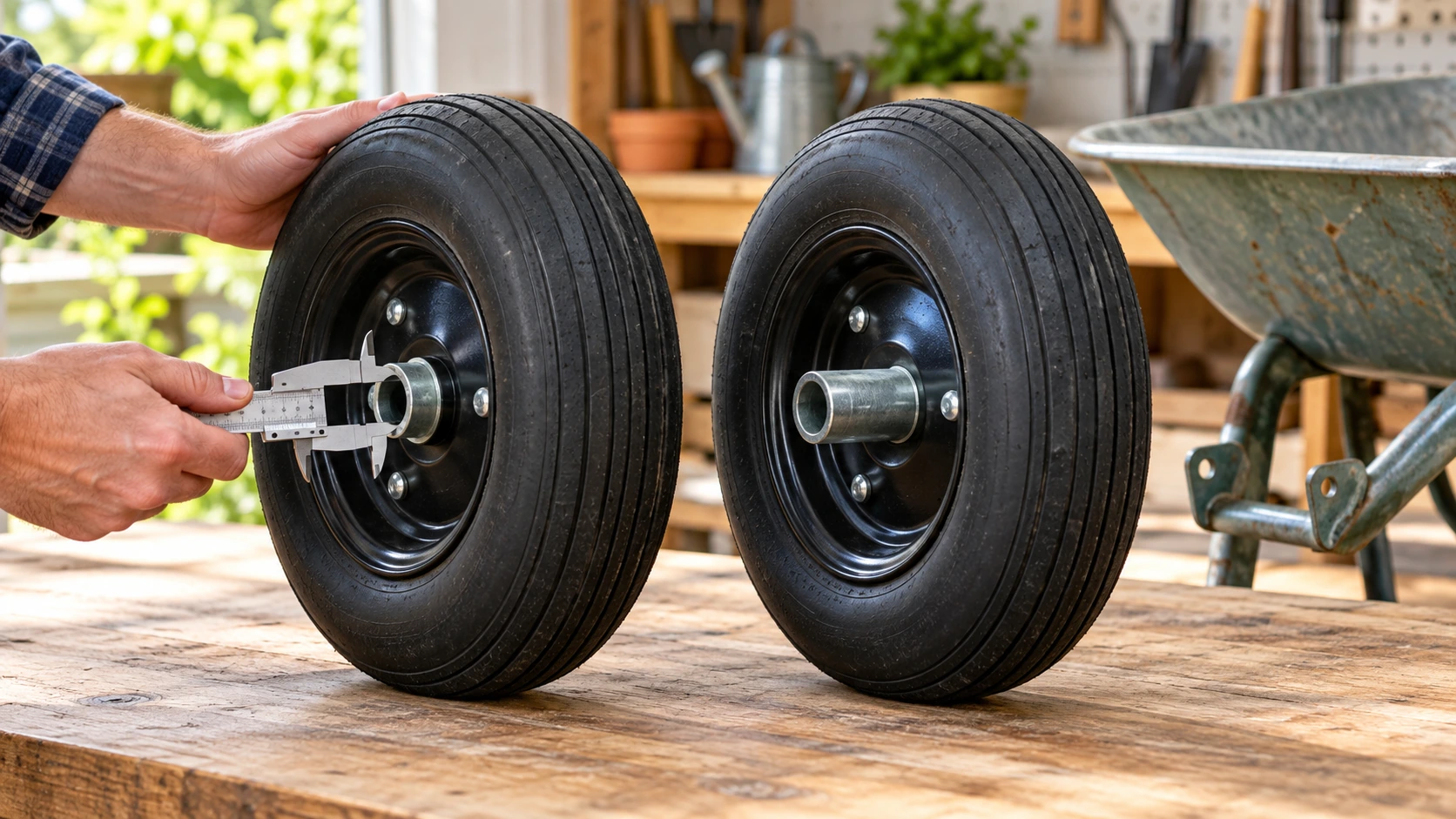
Wheelbarrow replacement wheel fit starts at the axle, not the tire label. Two wheels can both say 4.80/4.00-8 and still leave very different amounts of space inside the fork. The listings examined here give one wheel a 3-inch hub and the other a 6-inch center hub. Both name a 1-inch opening or bearing. Before choosing either, measure the wheel you removed and the space available on your own wheelbarrow. Those measurements give the tire marking a useful context.
Record the old wheel before shopping
Set the wheelbarrow on stable ground and follow its maker's directions for removing or replacing the wheel. Keep the old axle hardware together and take photographs before separating anything. Record the tire marking, wheel diameter if you can measure it reliably, the axle diameter, the distance between the supports that hold the wheel, and the width of the old hub where it sits between those supports. Write down any spacers or washers and where they belonged. A photograph beside a ruler helps when a listing uses a different name for the same dimension.
Do not infer the opening size from the outside tire dimensions. The 4.80/4.00-8 marking identifies a tire size convention, while the center opening determines how the wheel meets its axle. A bearing can also be part of the opening. If the old wheel or axle is too damaged to measure, use the wheelbarrow manufacturer's parts information for the exact model. A wheel that merely resembles the original in a photograph leaves the mounting question open.
Make an axle bore check
The axle bore check compares the axle or shaft with the replacement wheel's stated opening. One selected 3-inch-hub wheel listing names a 1-inch ball bearing and a 3-inch hub. Its title says “1 inch axle,” while the description describes the bearing. Treat those as seller statements about the listed wheel, and confirm the actual bearing opening against your axle and the seller's current specifications. The description also mentions a 3-inch “axle shaft” in another line. That wording should not replace a measurement of your wheelbarrow's shaft.
The other 6-inch-center-hub wheel listing states a 1-inch bore in its title. It gives little more than a flat-free description. The shared 1-inch number is a starting point for checking an axle, not proof that the two products use identical bearings or that either one fits a particular wheelbarrow. Ask the seller for the complete mounting dimensions if the listing does not show how its bore is measured or what hardware comes with it.
Measure the axle with a tool suited to the job and check whether the original wheel turned on a bearing, bushing, or another arrangement. Keep any wear or damage in view. A replacement wheel should be assessed against the manufacturer's instructions for that wheelbarrow, including how the wheel is retained. This guide does not specify a substitute axle, bearing, washer stack, or torque. An improvised fit can make the wheel bind or leave it insufficiently secured.
Compare center hub width with the frame
Center hub width is the major difference between these two offers. The first seller states a 3-inch hub length. The second title states a 6-inch center hub. Measure between the wheelbarrow's supports where the hub or its intended spacer assembly sits, then compare that actual space with the current product drawing or seller dimensions. Measure the old wheel's effective assembly as removed, including original spacers, rather than using the tire's outside width as a proxy.
A longer hub can prevent the wheel from seating between narrow supports. A shorter hub can leave space that the wheelbarrow's intended hardware may or may not accommodate. Neither listing establishes that a buyer may cut a hub, add arbitrary spacers, or change the axle. When the measured frame spacing does not match the offered assembly, pause and obtain the correct part specification. If the seller offers versions with different hubs, bind your order to the exact version and its part number rather than the shared tire size.
The surrounding fork, tray, and fasteners also matter. Check clearance around the mounted wheel through its normal path without assuming that the wheel in a product photograph reflects your frame. The first gallery image places the wheel beside several types of equipment and advertises broad use. That montage cannot prove fit on any one of those machines. The second image shows a wheel face and center opening, but does not make the 6-inch hub measurable from the image alone.
Keep tire size and wheel type separate
Both listings use the 4.80/4.00-8 tire marking. The first describes a solid rubber, no-flat wheel and makes broad claims about cushioning and outdoor exposure. The second calls its wheel flat-free. Those descriptions tell you what the sellers claim about their own products; they do not provide a comparative test of rolling effort, traction, carrying capacity, or service life. No load rating or speed limit for your wheelbarrow is established by this pair of pages. Check the current seller information and the wheelbarrow maker's limits before using a replacement.
Look at the tread and the existing wheel as practical clues about the work you do, but do not turn appearance into a performance rating. A hard path, loose soil, and a loaded tray impose different demands. The current sources do not test either selected wheel on those surfaces. If your old wheel was pneumatic, a flat-free alternative is a change in construction as well as a replacement. Check whether the wheelbarrow maker permits that change and whether the replacement's dimensions and stated capacity suit the tool.
A separate guide on the wheelbarrow's lever arrangement explains how load position and handles affect lifting effort. Its mechanical explanation does not certify a replacement wheel or set its carrying limit. Use it to understand the tool's layout, then return to the exact axle, hub, and manufacturer requirements for the part you intend to buy.
Compare the two listings without assuming a universal fit
For a wheelbarrow whose documented replacement calls for a 1-inch opening and a 3-inch hub, the first listing is a candidate to investigate. For one whose documented assembly calls for a 1-inch bore and a 6-inch center hub, the second is a different candidate. These are conditional examples, not fit approvals. The first page's broad equipment list and the second page's sparse description leave other dimensions and limitations unresolved. Match the exact current item, not a family of similar-looking wheels.
Write a short comparison in your notes: original wheelbarrow model; original axle diameter; original hub or assembly width; tire marking; needed bearing or bushing arrangement; seller's exact part or variant; and unresolved questions. Mark a field “unknown” when it is unknown. If a seller replies with additional measurements, keep that response with the order record. A generic “universal” label does not fill any blank in the comparison.
The same discipline appears in a guide about matching office-chair casters to a chair base: a wheel's visible diameter does not describe its connection. Chair caster stems are a different mounting system from wheelbarrow hubs, so those product measurements cannot be transferred here. The relevant lesson is to identify the actual mating interface of the equipment being repaired.
What to ask before checkout
Ask the seller to confirm the precise center opening or bearing bore, hub length, overall wheel dimensions, included hardware, and any documented load or use limits for the exact listing. For the 3-inch-hub offer, ask about the description's separate “axle shaft” wording. For the 6-inch-hub offer, ask for a dimensional drawing or verified measurements because its short description does not provide them. Check whether the image, title, description, and selected variant all refer to the same physical wheel. Keep the answer tied to the product URL and date.
Confirm the return terms before ordering a part whose fit remains uncertain. That is particularly useful when the old wheel has no readable model number and the seller cannot supply a complete drawing. A return policy is not evidence of compatibility; it changes what happens if the item arrives and the documented measurements still do not match. Do not install or modify a questionable part merely to resolve a purchasing uncertainty.
If the original wheelbarrow has a bent axle, damaged supports, or missing retainers, the new wheel alone may not restore safe operation. Use the wheelbarrow maker's service information or a qualified repairer for those conditions. This article compares retail wheel listings and a measurement workflow. It does not diagnose structural damage or prescribe repair steps for an axle or frame.
Flat-free wheel limits at checkout
Record what each listing actually says about its flat-free wheel limits. The first page describes its solid rubber wheel as resistant to flats and lists several possible equipment uses. The second supplies a much shorter flat-free claim. Neither page, as captured for this guide, gives a verified fit chart for your wheelbarrow model. A buyer should not read “flat-free” as “maintenance-free under every load” or as proof of a particular riding feel. Retain the exact seller response when a limit matters to your use.
Payment and order record
At a republeq.com checkout, keep the replacement wheel decision separate from the payment decision. First confirm the exact product variant, seller's stated bore and hub dimensions, quantity, shipping destination, and current return terms. If the checkout then offers a cryptocurrency method such as USDT, read the displayed network, receiving address, amount, and any time limit in that live checkout before authorizing payment. Do not copy an address from an old email or another order, and do not assume that the same token name means the same network. A buyer considering cryptocurrency should understand the wallet's own confirmation process and whether a mistaken transfer can be reversed; this guide does not make a claim about a particular provider's recovery service. Save the order confirmation and the transaction reference only through a secure record you control. If the checkout offers another payment method, compare its current terms in the same way. Payment convenience does not resolve an unknown hub width, a missing load specification, or a conflict between a product title and description. Do not buy a 3-inch hub because a checkout is fast when your measured assembly calls for another width. If the seller later sends a fit clarification, connect it to the exact order and product version. Keep personal wallet credentials and recovery phrases outside messages to the seller. This payment note is conditional: it does not assert that USDT or any particular network is available for this wheel at the time you shop. Recheck the live options instead of treating a past screenshot or this article as a promise of checkout behavior.
A fit decision you can explain
Choose a candidate only when its current documented bore and hub length match the wheelbarrow's actual mounting arrangement and the remaining dimensions and limits have been checked. If the old wheel measures differently from both offers, neither becomes a fit because its tire marking is familiar. Preserve your measurements and ask for the correct part. The useful outcome is an order tied to a measured wheelbarrow and a specific listing, with any uncertainty resolved before the wheel is put into service.