Educational & Explainer Articles
Wheelbarrow lever explained: load, wheel and lifting effort
Follow a wheelbarrow's ideal lever balance, effort arm and force-distance exchange. Read Ames S4U30 and R6TC14 descriptions without inventing load limits.
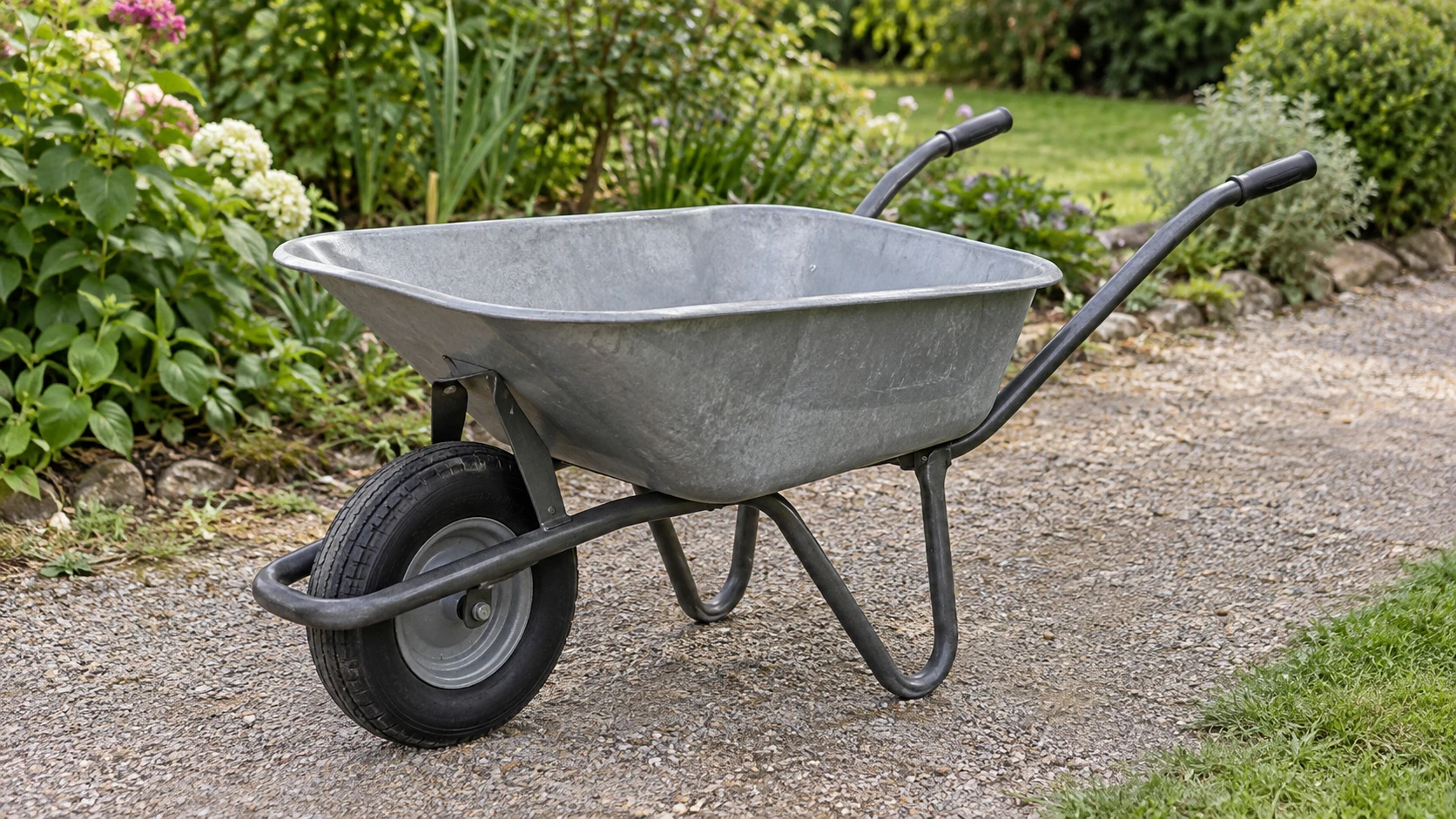
A wheelbarrow lever explanation starts with three places: the wheel's axle, the load and the handles where an upward effort is applied. In the ordinary lever model, the load lies between the pivot and the effort. That arrangement lets the wheel support part of the weight while the handles supply the force needed to balance the turning effect.
The model explains a mechanical relationship. The Ames S4U30 and The AMES Companies R6TC14 offers below identify actual wheelbarrow products, but neither account supplies the geometry needed to calculate an individual's lifting force. Keep an ideal example separate from a measured result or a load recommendation for either product.
Identify the wheelbarrow as a second-class lever
A second-class lever has its load between the pivot and the point where the input force acts. For the familiar wheelbarrow model, the wheel's axle is the pivot, the supported weight acts in the intervening region, and the lifting effort acts at the handles. The classification names that order of roles.
OpenStax's College Physics account places the wheelbarrow's load between the axle and the applied force. It contrasts that arrangement with a shovel model in which the input acts between the pivot and the load. Those different orders matter to the force relationship. An object having a handle does not, by itself, identify which lever arrangement is being considered.
Look at the lifting model from the side. The wheelbarrow body and handles act together as the lever being considered, while the wheel provides the axle location used as the pivot. Keep that reference point fixed in the explanation. Changing to a different question about wheel rotation or travel would require identifying the relevant system again.
Define the wheelbarrow effort arm from the force
The wheelbarrow effort arm is the perpendicular distance from the pivot to the line along which the lifting force acts. The load has its own corresponding arm. OpenStax distinguishes these perpendicular lever arms from a general distance to an application point. The relevant turning effect depends on the force and its perpendicular arm.
For a simple side-view model, imagine both the effort and weight acting vertically. Their perpendicular arms are then horizontal distances from the axle to their respective lines of action. That assumption makes the geometry easy to follow. A retail length measurement taken along some other part of the product would not automatically describe either distance.
The word arm therefore needs its force attached. The distance to the handles concerns the applied lifting force in this model. The distance to the weight's effective line of action concerns the load. Giving both distances the same convenient overall product measurement would erase the relationship the explanation is meant to examine.
Balance the two turning effects
Bertha May Clark's public-domain General Science explains the lever using a force arm and a weight arm. Its wheelbarrow section places the fulcrum at the wheel, the applied force at the handles and the weight between them. The balance relation multiplies each force by its corresponding arm.
Write the ideal balance as F × L = W × d. Here F is the upward effort at the handles, L is its perpendicular arm, W is the downward weight represented in the model, and d is the weight's perpendicular arm. The two products describe turning effects about the same pivot. They must balance for the chosen ideal static condition.
Rearranging gives F = W × d ÷ L. When the weight's arm is shorter than the effort arm, the calculated effort is less than the represented weight. The ratio matters as well as the weight itself. State the geometry before announcing a force, so the reader can see which relationship produced the result.
Follow one hypothetical example
Suppose a deliberately simplified model has a total represented weight of 400 newtons, a weight arm of 0.30 metres and an effort arm of 1.20 metres. These are invented teaching values, unrelated to the two listed products. They describe vertical forces and the perpendicular distances used in the balance.
The weight's turning effect is 400 × 0.30, or 120 newton metres. Dividing by the 1.20-metre effort arm gives an upward handle force of 100 newtons. Multiplying back checks the answer: 100 × 1.20 also gives 120 newton metres. The smaller force has the longer arm in this example.
The result applies to the total weight represented by that model. If the model includes only the contents while leaving out the wheelbarrow body's weight, it has omitted a contribution. Identify what W contains when reading any example. A correctly performed division can still answer an incomplete model if the stated weight leaves something relevant out.
Account for the wheel's support
The handles do not provide all the upward support in the example. In the simplified vertical force balance, the upward support from the wheel and the upward handle effort together balance the downward 400-newton weight. With 100 newtons at the handles, the wheel's remaining support is 300 newtons.
That second balance explains where the rest of the support enters. The wheel is part of the supported arrangement, and its reaction matters even though a force acting through the chosen pivot has no turning arm about that pivot. Keep force balance and turning balance together when interpreting why the handles carry only part of the represented weight.
The calculation assumes the static model stated above. It describes neither a person accelerating the equipment nor a wheel encountering uneven ground. Those situations introduce questions beyond the balance just calculated. Retain the example as an explanation of how the lever shares vertical support under its specified assumptions.
Less force can involve more movement
Clark also explains the force-and-distance exchange in a lever. A longer effort arm can require its end to move farther while the shorter load arm moves less. The ideal machine changes how an effort is applied. The distance involved belongs in the account when discussing mechanical work.
Using the same four-to-one arm ratio, imagine a very small movement in the ideal arrangement. If the handle end moves four centimetres while the represented load rises one centimetre, the corresponding work amounts agree: 100 newtons through 0.04 metres and 400 newtons through 0.01 metres each give four joules. This is a local ideal illustration, with losses and additional motions left outside its assumptions.
A smaller lifting force therefore needs to be read alongside the movement through which it acts. The calculation does not establish a person's comfort, endurance or ability to control a real wheelbarrow. Those are different questions from whether the two ideal work products agree. Keep the scope of the arithmetic visible when describing its meaning.
The torque-wrench range guide explains why a moment of force and an amount of energy need their own quantity names, even when their units have related dimensional expressions. Here, 120 newton metres names a turning effect, while four joules names work in the hypothetical movement. Keep that distinction when writing the calculation. The wrench guide supplies no test or specification for either wheelbarrow.
Read the short Ames S4U30 offer literally
The Ames S4U30 wheelbarrow offer names True Temper, steel, four cubic feet and Black in its title. Its description consists of the phrase ribbed tread tires. That short account identifies the offer but provides no axle-to-effort distance, weight-arm measurement or total equipment weight.
Ask for the applicable specifications and instructions when an actual product decision depends on those details. Four cubic feet is a volume expression, while the ideal calculation above requires force and distance. Filling that volume with different materials would introduce a separate weight question. This guide supplies no density assumption, fill instruction or permissible load for the item.
The R6TC14 listing supplies other dimensions
The The AMES Companies R6TC14 wheelbarrow offer identifies SKU sku-51715969 and UPC 049206111301. Its description names a gray wheelbarrow with a steel bin, a six-cubic-foot capacity and a handle described as Steel/Poly Reson. The catalog also lists Multicolor and size one; retain those fields separately from the gray description.
The stated dimensions are twenty-seven inches high, twenty-five and a half inches wide and fifty-eight and three-quarter inches deep. These describe the listed product's overall dimensions. They do not identify the perpendicular arms in the lever equation. In particular, overall depth cannot replace the distance between the axle and the line of an actual lifting force.
A dimension supplied for R6TC14 answers a question about that product. Ask for S4U30 information separately when the corresponding detail is absent from its short offer.
The tape-measure numbers guide keeps length, width, quantity and accuracy attached to the features they describe. Apply that reading habit to the wheelbarrow dimensions. A width statement and a depth statement answer different questions about the object. Neither supplies the load's effective line of action. Any measurement intended for a force calculation must identify the relevant points and force direction as well as the unit.
Keep the ideal explanation with its assumptions
The effort needed to hold an ideal wheelbarrow in balance and the effort needed to move a real one across a surface are different questions. State whether an account concerns upward handle support, forward travel or another motion before comparing force claims. The lever calculation above addresses only its specified lifting balance.
Resolve the equipment description before payment
When considering a wheelbarrow order through republeq.com, keep the actual product identity beside the questions your purchase needs answered. The Ames S4U30 title and short tire description provide a different record from The AMES Companies R6TC14 dimensions and bin account. A preference for USDT does not establish either product's lever arms or confirm a permissible load. Ask for the applicable specifications and instructions before using an ideal mechanics example to guide an equipment choice. Inspect the methods offered for the selected basket only after resolving the details that matter to that choice. If a cryptocurrency option is available, use the actual checkout to establish its supported asset, network and receiving information. Retain any answer from the merchant with the exact model reference so it remains clear which offer the answer concerns. Review delivery information for the order instead of turning a planned garden task into an assumed arrival date. Read the current return terms before authorizing payment. Under the merchant's published terms, a crypto payment is non-refundable; an exchange remains conditional on the stated requirements and availability. Consider those terms while deciding whether the available equipment information is sufficient for your purchase. Save the order confirmation together with the record supplied by the payment route. If the merchant's payment status is uncertain, resolve that record through its process before arranging another transfer. On delivery, check the supplied item's identity against the confirmed order and retain the instructions supplied for it. Ask about any discrepancy through the applicable merchant process. The educational model can remain useful while a particular product question stays unanswered. Continue to label the model's force values and distances as hypothetical rather than attributing them to the delivered wheelbarrow.