Educational & Explainer Articles
Tape measure numbers: length, width, quantity and accuracy
Understand tape measure numbers using the actual Keson and Crescent listings, with NIST guidance on length units and how accuracy differs from scale divisions.
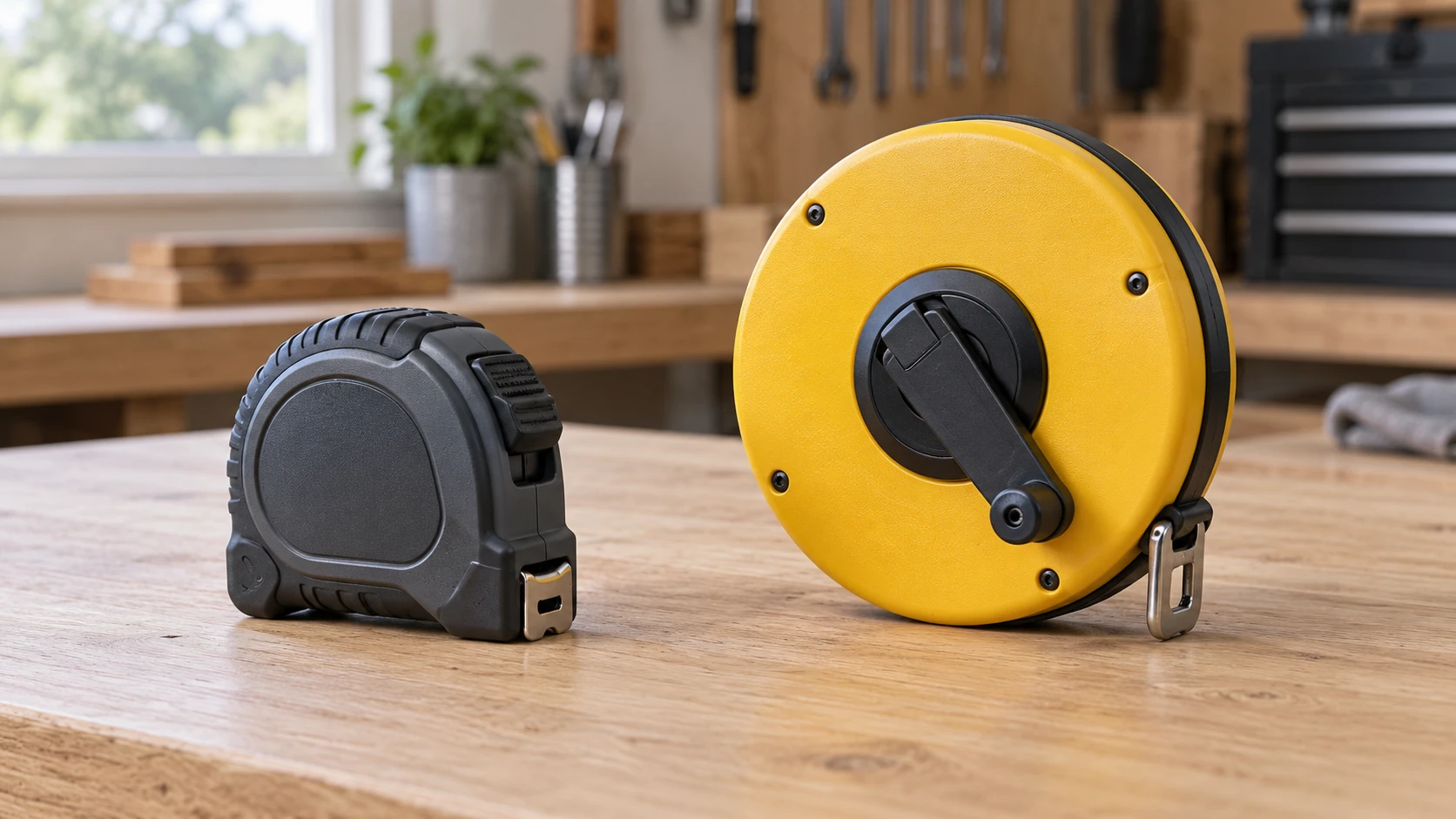
Tape measure numbers can describe the length available to measure, the width of the blade, the number of units in an order or the divisions printed along the tape. Those numbers answer different questions. A longer tape is not automatically more accurate, and a pack quantity does not extend the length of an individual instrument. Read the number with the feature and unit it actually describes.
The Keson NR10-100 and Crescent L625N listings provide useful examples. Keson identifies a 100-foot engineer's tape with a three-eighths-inch blade. Crescent identifies a 25-foot Lufkin tape in a listing for eight units. Their descriptions establish length and quantity details, while scale divisions and accuracy need separate confirmation. The National Institute of Standards and Technology, or NIST, explains how length units and tape-accuracy checks work, helping distinguish those missing details from information the listings actually supply.
Separate tape length and blade width
Tape length and blade width concern different directions on the instrument. Length describes the available measuring extent stated for the tape. Blade width describes the width of its strip. A width in inches should not be read as an additional measuring length or as the space required for the entire case. The label attached to the number determines which comparison you can make.
The Keson NR10-100 engineer's tape measure has a stated length of 100 feet and a blade width of three-eighths of an inch. Keep those two specifications together with their meanings. Its description calls the tape double-sided and gives an SAE/engineers scale. It does not specify the smallest graduation on either side, the usable case dimensions or an accuracy tolerance.
A narrow blade dimension does not tell you how far that tape can extend unsupported. Nor does a long stated measuring length demonstrate a particular technique for spanning a space. Questions about support, tension and operation need the applicable instructions and actual product details. This explanation does not prescribe a tension, an anchor method or a safe unsupported reach for the Keson.
The same distinction matters when a product description combines two different units in a short line. Feet attached to overall tape length and inches attached to blade width describe different physical attributes. Keeping only the digits would discard the information that makes the specification usable. Record the feature name and unit when sending a question to a supplier or comparing an alternative.
Read the pack count separately from the measuring length
The Crescent L625N Lufkin tape measure listing describes a 25-foot tape in Hi-Viz Orange. It expressly gives a quantity of eight and also says the catalogue size is eight. Here the quantity statement concerns the order. It does not make an individual tape eight feet long or turn eight tapes into one uninterrupted measuring scale.
A catalogue's size field can be misleading if read without its accompanying description. In this case the description separately states the 25-foot length and the quantity of eight. Retain both facts. The SKU sku-3832555190 identifies the listing when asking whether an order contains the expected number of units. The description does not give a blade width or a graduation interval for this offer.
Pack size matters when several people or locations need equipment. It answers how many instruments are supplied, without determining whether their scale and other specifications suit the work. Buying more units does not supply a missing tolerance or establish that all units have been checked against a particular standard. Those are different questions to resolve for an actual purchase.
The Keson listing, meanwhile, identifies model NR10-100, SKU sku-476120614 and UPC 052837002207. Its short description does not give the same explicit multi-unit quantity statement as the Crescent offer. Do not assume that the offers have matching pack contents because both appear under a Moving Supplies catalogue label. That label is not a shared specification for the two instruments.
Keep the unit attached to the reading
A length number needs its unit. A note containing only “25” could refer to a printed mark, a catalogue length, a quantity or something else entirely. Write down what the number describes. If a specification uses feet and a project drawing uses millimetres, recognise the difference before comparing the values. A matching pair of digits is not evidence of equal length.
NIST's SI length guidance explains the metric relationships: ten millimetres make one centimetre, ten centimetres make one decimetre, and ten decimetres make one metre. These are changes of unit within the same measurement system. Expressing a length in smaller units makes its numerical value larger without making the object itself longer. Unit choice changes the description, not the physical distance.
NIST also gives the exact modern relationship between the inch and metric length: one inch is exactly 25.4 millimetres. That definition supplies a conversion factor. It does not establish how closely a mark on a particular tape agrees with the defined length. Keep the exact unit relationship separate from the uncertainty of a physical measurement made with an actual instrument.
For example, three-eighths of an inch is a fraction of the inch unit, while three-eighths of a foot is a fraction of a different unit. They are not interchangeable expressions. In the Keson description, the three-eighths figure belongs specifically to blade width in inches. Do not attach it to the engineer-scale wording and infer that it names the distance between graduations.
A graduation describes divisions on a scale
Printed marks divide a measuring scale into intervals. To interpret a reading, establish which unit and division the actual scale uses. The words double-sided and SAE/engineers do not, on their own, describe every printed marking on the selected Keson tape. Its supplier can provide the scale detail or matching documentation needed for the task you intend to carry out.
A catalogue length is different from a graduation interval. One describes the extent of the tape; the other describes how its scale is divided. A tape can have a long measuring extent without that fact telling you the smallest marked division. Likewise, a product photograph may suggest a detailed scale without supplying a readable, confirmed statement of every marking.
The guide to weather-station readings and ranges makes a related distinction between a stated range and the information in a particular observation. Here, keep the tape's length, scale divisions and an actual reading separate. The weather-station products do not establish tape performance or supply a measurement procedure for either selected listing.
If you need to pass a measurement to someone else, include the unit and a clear description of what was measured. Do not add decimal places merely to make the note appear more exact. A different way of writing the same length is not evidence of a better measurement. The instrument, the measurement conditions and the applicable procedure remain relevant.
Tape measure accuracy needs its own evidence
Tape measure accuracy concerns how the instrument's indications agree with the length being measured under the relevant conditions. The existence of clear markings does not by itself establish that agreement. NIST's explanation describes manufacturers comparing printed tape marks with a reference measurement. A claim about the size of the divisions and a claim about accuracy therefore require different support.
In NIST's account, some manufacturers use accurate reference tapes to produce markings, and some use computer-controlled ink printers. After printing, manufacturers test random samples. The described check holds a tape on a flat bench at a specified tension while a microscope moves along its marks. A laser interferometer measures the distance associated with the microscope's movement, allowing the marks to be compared with a reference.
These details explain why checking accuracy involves more than looking at the largest number on the tape. The comparison has a reference and controlled conditions. It does not follow that either product listing discussed here includes an individual calibration certificate or has undergone the particular laboratory process described by NIST. Neither short retail description supplies that evidence.
The tension in NIST's laboratory explanation is also not a general instruction to pull a household tape as tightly as possible. The source describes a controlled check with a specified setup. Applying an invented force to a different instrument would not reproduce it. Use the matching instructions when operating the instrument and obtain appropriate verification if the work requires documented accuracy.
Why a laser can check a printed tape
NIST describes a laser interferometer splitting light into a reference beam and a measuring beam. The measuring beam travels to a reflector associated with the moving microscope and returns to combine with the reference beam. As the reflector moves, the combined signal changes between bright and dark. Counting those cycles, with the known wavelength, yields a distance for comparison with the tape marks.
This is background on how a reference measurement can be made. A laser in a calibration laboratory does not make the tape itself a laser distance meter. Nor does the description establish that a tape with a longer span uses a different definition of length. The method gives context for the accuracy question without adding a feature to either retail offer.
NIST also distinguishes the capability of its laboratory reference work from the total uncertainty of a tape measurement. Additional contributing factors make the total uncertainty larger, including the challenge of obtaining repeatable readings from many individual marks. A very capable reference system therefore does not make every ordinary measurement exact. The conditions and instrument still need to suit the purpose.
For a purchase requiring a particular documented tolerance, ask for evidence tied to the exact model or instrument and the required conditions. A general account of national measurement standards cannot stand in for it. This article supplies no legal-for-trade approval, calibration service or certified error limit for the Keson or Crescent offer.
Use dimensions to answer the actual product question
The holiday reading shelf guide gives a practical reason to retain dimension labels and limits: a bookend's stated measurements are different from a shelf load rating or proof that particular books will be supported. Measuring available space can answer a space question, while the suitability of the complete arrangement needs its own evidence. A tape's length alone does not settle both.
For the two tape listings here, begin with the information supplied. Keson gives a 100-foot length, a three-eighths-inch blade and an engineer-scale description; Crescent gives a 25-foot length and an eight-unit offer. Ask for the remaining scale, package or accuracy details that matter to your work. Use those questions to decide what documentation to request from the supplier.
Check the order after understanding the numbers
A tape-measure order on republeq should preserve the difference between the measuring specification and the quantity being purchased. For the Crescent offer, verify that the basket still identifies the 25-foot L625N listing and its stated eight-unit quantity. For Keson, retain NR10-100 with any answers you obtain about its scale or supplied contents. Buyers considering crypto, such as USDT, should inspect the payment methods offered in the actual checkout after resolving those equipment questions. The captured product records name cryptocurrency as an accepted category; they do not identify every supported token, payment network or wallet arrangement for a future order. Do not let an available payment method conceal a missing graduation or tolerance specification. A successful payment would concern the transaction, while the measuring task still depends on an appropriate instrument. If the checkout wording leaves a requested payment detail uncertain, obtain clarification directly before authorizing a transfer. This article does not furnish an address or identify a network to select. Keep any supplier response about the eight-unit package with the product reference so that the order you approve matches the information you checked. Retain the order confirmation and the confirmation supplied by the chosen payment route for later reference. A note containing only a transferred amount would not, by itself, explain which tape model or package the order concerned. Read the current delivery and return information applicable to that purchase as well. Those terms need their own review and should not be inferred from a measurement label. You can leave the purchase open while seeking scale details, rather than using a payment choice to hurry an unresolved equipment decision. The useful next step is the one that establishes whether the actual tape meets the measuring requirement.
Read tape measure numbers with their labels: length, width, unit, graduation or order quantity. Keep accuracy evidence alongside those specifications when the task requires it. For these offers, confirm the missing scale details before choosing equipment for work that depends on particular divisions or a documented tolerance.