Seasonal & Holiday Content
A holiday reading shelf for new books and old favourites
Plan a holiday reading shelf with suitable book support and winter storage, plus the confirmed details and limits of elephant and eagle-head bookends.
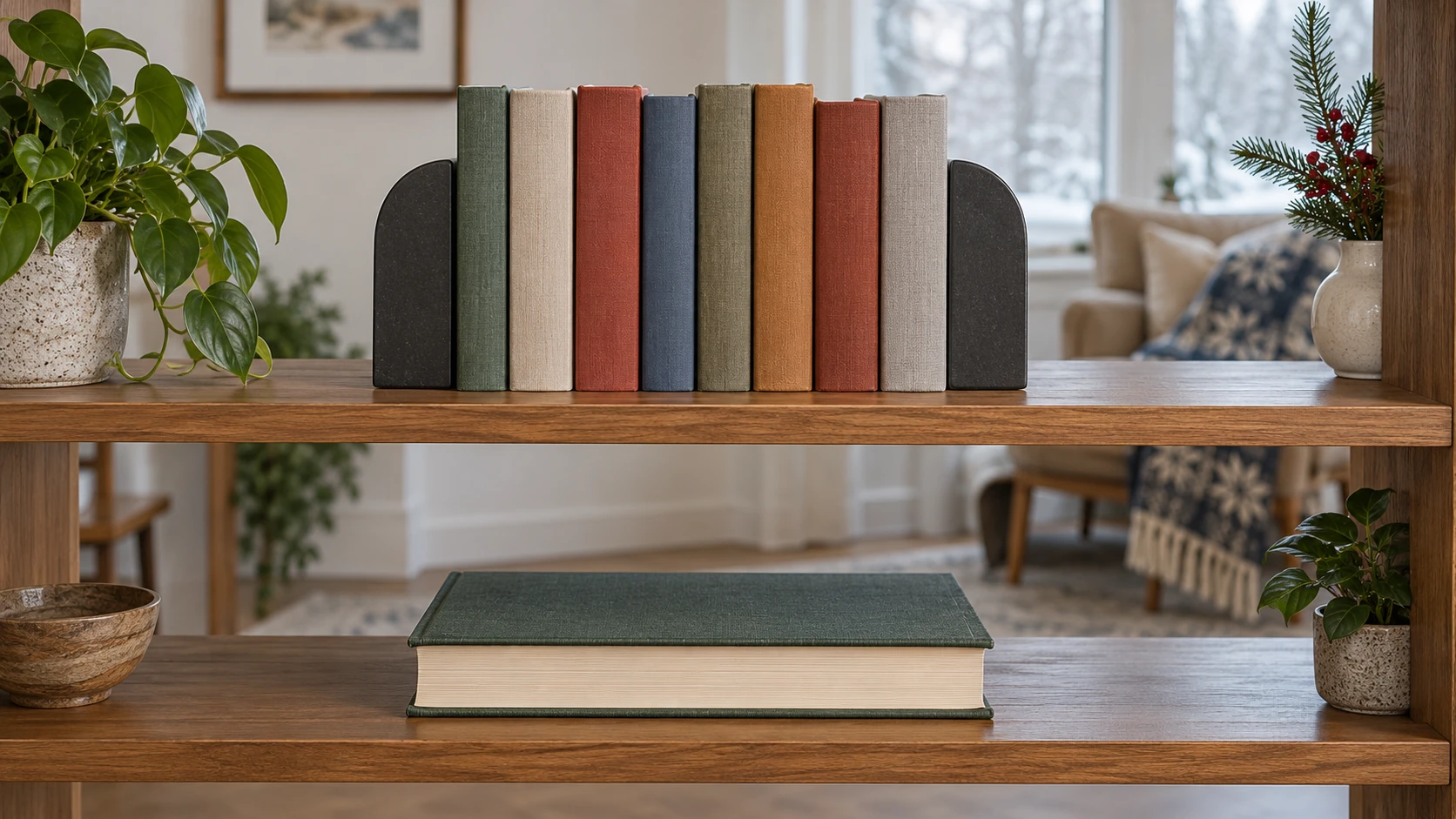
A holiday reading shelf can hold the novel you hope to finish during the break, a familiar story you reread each December and a newly received book you want to start soon. Those books need a suitable place to stand between readings. Begin with the books and the available shelf, then choose any decorative support around them. An animal-shaped bookend may suit the room, but its appearance cannot establish that the shelf, the bookend or the room is suitable for every volume you own.
Preparing winter book storage means making room for arrivals without squeezing them into an already crowded row. You can choose a small group for the coming weeks while leaving the rest in their usual appropriate storage. The Library of Congress guidance on storing and handling books gives this arrangement useful boundaries: upright support for ordinary books, full support for large books stored flat, and a stable environment away from damaging extremes. A damaged binding can require attention beyond these preventive choices.
Choose books for the holiday reading shelf
Pull together the books you actually expect to open over the holiday. A long novel and a short collection might both belong, even if their covers do not coordinate. A large illustrated gift book can need a different place from either. Resist using the shelf as a temporary destination for every new arrival. The purpose of selecting a small group is to keep the books accessible without making the available space do more than it can accommodate.
Keep the reading selection separate from a decision about permanent storage. A borrowed paperback may stay nearby until you return it; a fragile family volume may need a protective enclosure and more considered storage. Placing both in the same seasonal display does not make their needs equal. If a book already has loose parts or a damaged structure, do not make it a display experiment. Library of Congress advice includes suitable containers or additional support for vulnerable books, and a decorative bookend supplies no equivalent conservation assessment.
Seasonal preference can still shape the group. You might put a reread within reach because that is the book you want on a quiet morning, or keep an unread gift visible so you remember to begin it. Those are personal reading choices. They do not require seasonal accessories around every volume. Leave sufficient usable space for retrieving a book and putting it back without having to dismantle an arrangement first.
Find suitable winter book storage before decorating
The Library of Congress recommends cool conditions, 70°F or below, a relatively dry environment of 30–55 percent relative humidity, and stability for most books. Avoid placing the holiday selection next to a radiator or in the path of a heating vent. A spot that becomes convenient when furniture moves for visitors can have different conditions from the ordinary bookshelf. Consider what happens while the heating runs, rather than judging the location only when the room feels comfortable for a moment.
Its guidance also warns against storing valuable objects in poorly insulated or uninsulated basements, attics and garages, where environmental extremes and leaks can be concerns. A holiday clear-out should not move important books into an unsuitable overflow location simply to free a visible shelf. If an appropriate place is unavailable, reduce the display group and keep valuable or vulnerable material in its existing suitable storage while you resolve the space problem.
Understanding a displayed number helps when you already monitor a room. The guide to weather-station readings, ranges, totals and forecasts explains why a current reading, an instrument's stated range and a forecast have different meanings. That distinction is useful here: a device's listed operating range does not prove that your book location has remained within the Library of Congress recommendations. The linked guide does not certify an instrument's accuracy or your storage environment.
Light deserves a separate check. The Library of Congress recommends minimal exposure, ideally avoiding direct or intense light, and discusses options such as shades, curtains and boxes for sensitive material. An attractive winter window can still be a poor reason to place a book in a bright beam. Choose an appropriate location before working out how its covers will look against seasonal decorations. No particular bookend compensates for an unsuitable environment.
Use a shelf that supports the books
Look at the supporting surface itself. Library of Congress advice calls for flat, solid shelves rather than lattice or slats, without protruding splinters or nails. This is a more useful starting point than the colour of a new accessory. Do not interpret the size of a visible gap as proof that the shelf can take additional weight. Neither of the decorative product descriptions discussed below supplies a rating for your shelf or its installation.
Shelve books of similar size together where practical so their neighbouring covers provide support. Keep upright books standing straight rather than leaning or slumping; use bookends as needed. This does not mean forcing a miscellaneous collection into a rigid row. A tall volume beside a much shorter one may need a different grouping, and a book that is too large for the available shelf may need an appropriate flat position elsewhere.
For large books stored horizontally, the Library of Congress specifies full support. A projecting cover or unsupported edge should not become part of a seasonal styling choice. Think about where the entire book will rest, including during retrieval, before assigning it a place. A photograph of an appealing shelf does not tell you its usable dimensions, its structural capacity or whether a particular book is fully supported.
Planning the room also matters in the guide to a jigsaw puzzle evening with friends: an activity has to work with the surface available in the room. Here the surface must support books appropriately and leave room to handle them. The puzzle article concerns different products and activities; its descriptions do not supply a book-handling technique, a shelf load limit or dimensions for your holiday arrangement.
What the two decorative bookend listings actually tell you
The A&B Home 73636-DS73636 elephant bookends are described as a set of two brown resin pieces. Each measures 4.3 inches by 4 inches by 6 inches. Preserve that stated order when comparing the listing with your available space; the description does not label those measurements with axes. Its SKU is sku-309106469 and the UPC is 805845702894, useful identifiers when checking that a later question or order still refers to the same product.
The description says their compact size and light weight make them easy to reposition while keeping books and files upright. That is a retail description of their intended use. It does not supply a tested load rating, the weight of each piece, or an assurance that a particular group of heavy books will stay upright. The confirmed set count does let you distinguish this listing from an accessory whose delivered quantity is unclear.
The Bey-Berk eagle-head bookends have a much shorter description: cast metal, an eagle design, a bronzed finish, a wood base and a stated weight of six pounds. A bronzed finish is not evidence that the object is solid bronze. The description does not allocate the six pounds between individual pieces, a complete set or a packed shipment, so it should not become a per-piece comparison.
The Bey-Berk description also gives no dimensions or explicit piece count. A plural product name is insufficient evidence of the exact quantity delivered. If your planned row requires support at both exposed ends, obtain the package quantity and usable dimensions before deciding whether this listing meets that need. Do not infer a larger supporting capacity from the stated weight or the cast-metal description. Neither establishes performance with your particular books.
The missing information affects which purchase questions you can settle now. The elephant listing supplies a confirmed set of two and individual measurements; the eagle-head listing supplies different material and finish information but leaves quantity and size unresolved. A reader who needs those missing details has a concrete enquiry to make. Someone choosing only by the animal design still needs an appropriate shelf and satisfactory book support.
Decorative bookends for a reading shelf should leave room to read
Decorative bookends for a reading shelf should leave the books accessible when you want to use them. Consider the next time you take a volume out. The Library of Congress recommends a clean, unobstructed landing area before retrieving a book. Clear that place before you start moving volumes. A seasonal ornament, wrapping supplies or a pile of incoming mail should not leave you holding a book while searching for somewhere appropriate to put it.
For removing a book from a row, its handling guidance describes pushing neighbouring books inward and gripping both sides of the spine around the middle, rather than pulling at the top. This is a useful reason to avoid an arrangement that is too crowded to handle sensibly. It is not a reason to force a fragile volume through a tight gap. Vulnerable structures may require more suitable support and individual advice.
Clean, washed and dried hands are part of the Library of Congress recommendations. It advises against lotion and does not advocate gloves for handling its paper collections. For an ordinary reading shelf, prepare your hands and the landing area before taking out a book. Avoid turning that guidance into a promise that every kind of book or surface can tolerate the same treatment; special materials and existing damage can require a different assessment.
When reading, do not force a book open flat. Support its covers and reduce the opening angle as needed, as the Library of Congress advises. Let the binding determine how far the book comfortably opens. This article does not prescribe a homemade cradle, weights or a repair procedure. A decorative bookend's presence on the shelf does not qualify it as a handling aid for an open volume.
Keep decorative choices within their evidence
A holiday arrangement may look finished before its practical questions are answered. Check whether the actual books stand upright, whether the large volume has full support and whether your chosen objects leave a usable route for retrieval. If the arrangement depends on an unconfirmed package count or dimensions, resolve those facts before relying on it. The confirmed resin material of one listing and wood base of the other do not establish archival suitability for either.
The Library of Congress explains that terms such as archival or conservation grade are not legally defined guarantees. Its advice on suitable enclosures includes more specific material considerations, but neither decorative listing provides a conservation-contact certification. Do not apply a storage label to an animal ornament because it looks substantial or comes in a familiar finish. Valuable and fragile books can warrant suitable enclosures and professional attention beyond this seasonal arrangement.
Buying the selected bookends for the season
If the elephant or eagle design suits your holiday shelf, finish checking the order details before choosing how to pay on republeq. For the elephants, match the named model and the confirmed set of two to the item in the basket. For the eagle-head listing, settle the delivered quantity and dimensions while you can still reconsider the arrangement. Readers considering crypto, including USDT, should then inspect the methods actually offered for that order. The product records identify cryptocurrency as an accepted payment category; they do not establish that a particular token, network or wallet will be available in the checkout you reach. An animal-shaped accessory does not become a better match for the books because a preferred payment option appears. Keep any answer about the eagle package with your order information so the transaction corresponds to the product details you confirmed. A planned shelf that needs two supports remains dependent on the delivered contents, whichever payment route you use. Before approving a transfer, read the checkout's own instructions and verify the requested payment details. A mention of USDT in an article cannot supply a destination address, identify a supported network or settle a checkout question for you. If the displayed instructions are unclear, obtain clarification before sending funds. Retain the order confirmation and whatever payment confirmation the chosen method provides so you can refer to the same transaction if you need help. Check the delivery information for the actual order against the dates that matter to you; a seasonal reading plan is a preference, not a delivery guarantee. You can keep reading from an existing suitable shelf while deciding whether either decorative product has enough confirmed information for your intended use.
After the holiday, review the selected books as reading material again. Return borrowed titles when due, keep a favourite nearby if you are still enjoying it, and find suitable storage for new arrivals you plan to retain. An appropriate shelf can stay useful after the seasonal grouping changes. The decoration earns its place when the books still have proper support and you can take one down to read without disturbing the rest of the room.