Home & Living
how to match replacement office chair casters to the chair base
Measure the removed caster stem and chair socket before comparing wheel diameter, clearance, set quantity and load.
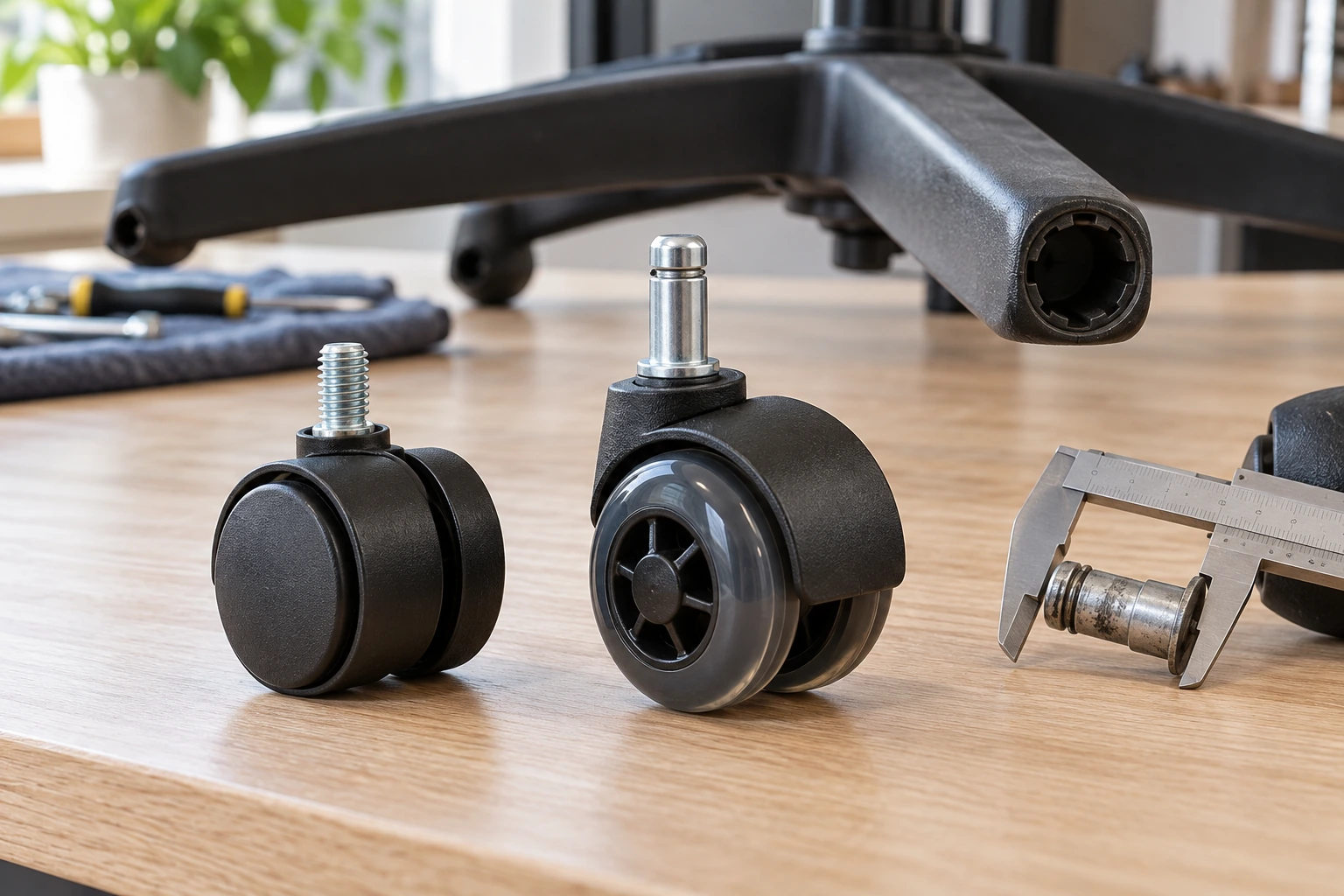
An office chair caster can look interchangeable until its stem reaches the chair base. A wheel diameter printed on a listing does not tell you whether the stem threads into the socket, presses into it, or has the right length to seat securely. This guide explains how to match replacement office chair casters to the chair base by starting with the caster you remove, measuring its connection, and checking clearance and load before you buy a set. It is a selection guide for a chair with a sound base, not a repair for a cracked leg or damaged socket.
Keep the old caster beside the chair while you compare replacements. Photograph the stem and the empty socket, then measure them rather than relying on the chair's brand name alone. Some chairs have been fitted with a different base or replacement wheels during their life. The wheel that actually came out is better evidence of the current connection than a catalog photo of the original chair. If it is stuck, do not damage the socket just to obtain a measurement; use the chair maker's removal instructions or qualified help.
Two native listings illustrate why the connection comes first. The eight-piece twin-wheel caster listing describes a 1.5-inch wheel and an M8 × 15 mm threaded stem. The five-piece swivel caster listing describes a 2-inch wheel and an 11 × 22 mm, or 7/16 × 7/8-inch, stem. Its description calls the stem threaded but also says installation is a pull-and-push operation. Those statements do not establish one unambiguous connection type. Examine the delivered stem and ask the seller to resolve that conflict before treating it as compatible. Do not assume it is a grip-ring stem from the installation sentence alone.
Identify the connection before measuring the wheel
Turn the chair on its side only if you can do so safely without crushing the seat, controls, or floor. A second person can hold a heavy chair steady. Look at how one original caster joins a leg: a threaded shank may turn out of a threaded insert; a push-in stem may pull from a socket and may have a retaining ring or other feature. A plate-mounted caster has a different connection altogether. If a decorative cover hides the joint, remove it only as the chair instructions allow. Never force a threaded part straight out or turn a press-fit part with enough torque to break the base.
Once the old caster is free, place it on a clean surface. Record the stem's shape, retaining feature, diameter and usable length. Diameter is measured across the shank, not across a shoulder or wheel housing. Length is measured from the relevant seating shoulder to the end that enters the base, excluding parts that do not enter the socket. For a threaded stem, compare thread diameter and pitch as well as length; an M8 label alone does not establish that every threaded insert has the same pitch. For a push-in stem, check where the retaining feature sits and whether the socket is shaped to receive it.
Inspect the empty chair socket in good light. Look for threads, a smooth bore, a metal insert, looseness, cracks, or debris. Clean loose dirt according to the chair maker's instructions, but do not enlarge a socket to accept the wrong stem. If the insert turns freely in the plastic base or the leg is split, replacing the caster cannot restore the chair's structural strength. Stop and address the base or seek the maker's replacement part. A wheel that seems to stay in a damaged socket during a quick test can release under ordinary seated movement.
Measure with calipers if available and note whether the result is metric or imperial. A ruler can give a first approximation, but small diameter differences can decide whether a stem seats or strips an insert. Compare the old stem and the replacement specification side by side in the same units. Do not round an approximately 11 mm stem into M8 or assume that 7/16 inch and 8 mm are equivalent. If the old part has no clear designation and the seller gives only a photo, request a measured drawing or a compatible original part before ordering.
Resolve the listing's stem ambiguity
The first example explicitly calls its M8 × 15 mm installation threaded. That gives a useful starting specification, but still check pitch, seating shoulder and actual delivered piece. The second example describes its 11 × 22 mm stem as threaded and then instructs the buyer to pull the old caster out and push the new one in. A threaded stem and a push-in stem normally require different socket arrangements. The listing alone cannot settle which one arrives in the box. Treat both descriptions as seller claims requiring physical confirmation, rather than choosing the more convenient sentence.
Before installing the second example, inspect the delivered shank under good light. Visible helical threads and a matching threaded insert point to a screw-in connection; a smooth shank with a retaining feature points to a different fit. Photograph the actual part and ask the seller or chair maker to confirm the connection if it remains unclear. Do not cut off a ring, add a nut, wrap the stem with tape, or force it into a socket to make a mismatch appear to work. Return an incompatible set under the applicable seller policy instead of altering a load-bearing chair connection.
The caster's stem can also be the right diameter and the wrong length. A short shank may fail to reach its retention point; a long threaded shank may bottom out before the shoulder seats. Compare the removed part's installed position with the replacement's geometry. The wheel housing should swivel without striking the chair leg, and the stem should remain fully seated through a gentle unloaded rotation test. If the maker specifies a washer, spacer, or particular installation method, follow that specification rather than improvising a stack of hardware.
Check wheel diameter and chair-base clearance
After the stem is matched, compare wheel diameter. The example listings describe 1.5-inch and 2-inch wheels. The larger wheel may raise the chair slightly, but the actual change in seat height depends on the whole caster assembly, including housing and stem seating. Measure from the chair-base connection to the floor for the old caster and the proposed replacement. A wheel can be larger while its housing places the axle differently. Do not promise a specific seat-height gain from wheel diameter alone.
Rotate an old caster through a full circle and note the gap between its housing and the chair leg. A replacement with a wider wheel or larger swivel radius may strike the base even when the stem fits perfectly. Check the underside of the chair at the lowest seat setting and through its normal tilt range if the manufacturer's instructions permit it. Leave room for the wheel to swivel without rubbing the base, a gas-lift cover, a footrest, or a floor mat edge. A wheel that jams on one leg can make the chair move unpredictably.
Match the wheel material and profile to the floor and chair use. A seller's claim that a wheel rolls quietly or does not mark a surface is not a guarantee for every finish. Test a small hidden area and follow the flooring maker's guidance, especially on soft wood, delicate coatings or thick carpet. A chair mat may still be useful. If the existing chair feels hard to push, the public guide on a caster that is not rolling covers the diagnostic question. Here the decision is whether a proposed replacement is physically compatible before it is fitted.
A brake is another fit and use detail. The first example's title includes a brake; verify which wheels in the delivered set actually have one, how the control is reached under the chair, and whether it can engage without contacting the base. Do not assume a brake makes the chair safe as a step stool or substitutes for stable seating. If the current chair has a maker-specified wheel arrangement, keep that arrangement unless the maker authorizes a change. A control hidden under the seat is not helpful if the user's hand cannot reach it safely.
Compare set quantity and supported load
Count the chair-base legs and the number of casters they need. A common five-leg base needs five compatible casters, but inspect the actual chair. The first example is sold as an eight-piece set; the second describes five pieces. A larger pack does not mean the chair should receive extra wheels. Keep unused pieces as spares only if they are the same specified type and can be stored safely. Mixing old and new caster heights or connection styles on one chair can leave the base uneven.
Read load statements cautiously. The first listing mentions 15 kg for an individual caster and also states a lower total for four casters, explaining that an uneven floor may leave only three carrying weight. The second lists 50 kg or 110 pounds, but the wording does not clearly establish whether that is per caster or per set. Do not multiply an ambiguous number into a chair rating. The chair maker's overall capacity, base condition, caster rating and intended user load all matter. Ask for the exact per-caster and assembled-chair ratings when the listing is unclear.
Think about where the load goes in use. Leaning, rolling over a floor transition, or sitting down abruptly can put more load on some casters than others. A nominally strong wheel cannot compensate for a cracked plastic leg or loose metal insert. For a heavy chair or a user near the chair's stated capacity, the original maker's approved caster set is the safest reference. Do not rely on a seller's isolated wheel capacity to increase the chair's certified capacity.
If several replacements look similar, make a small comparison table for yourself: connection form, stem diameter, usable length, thread pitch or retaining feature, overall height, swivel clearance, wheel material, pieces per pack and clearly stated load basis. Mark any unknown as unknown. A missing dimension should prompt a question to the seller or maker, not a guess based on color or a broad “office chair” label. That short list often rules out a tempting option before the box arrives.
Fit one safely, then fit the matched set
When the delivered parts match the old connection and maker guidance, fit one caster using the specified method. A threaded stem should start by hand without cross-threading; stop if it binds immediately. A push-in stem should seat in the correct socket without trimming or bending its retention feature. Check that the housing swivels and the stem remains secure. Perform this first fit with the chair unloaded. If it fails, preserve the part and packaging and resolve the mismatch rather than trying the same force on every leg.
Once one fits correctly, install the full matched set if the chair requires replacement as a set. Confirm every caster seats to the same depth and turns without striking the base. Return the chair upright carefully and check that all intended wheels touch the floor on a level surface. Sit gently, then test a short controlled roll while keeping feet close to the floor. Stop if one wheel pulls out, drags, rocks or makes the base lean. That is an installation or compatibility issue to resolve before ordinary use.
Moving a chair across a room involves a different decision from caster selection. The public guide on clearing a route for furniture mover wheels concerns movement paths and floor obstacles. Use it when planning a room move, but do not infer that a furniture mover's wheels share an office chair's stem or load design. Keep the parts and their jobs separate even when both roll on the same floor.
Retain the old caster until the new set has passed normal use for a short period. Its stem measurements and chair-base fit are useful records for the next replacement. Save the ordered specification and a photo of the installed stem, not merely the product title. If the chair is later moved to a different floor, reassess wheel material and floor protection while keeping the connection requirements intact. Replacement selection gets faster once the actual base geometry is documented.
The practical answer to how to match replacement office chair casters to the chair base is to work outward from the removed stem: identify its connection, measure its diameter and usable length, inspect the socket, then compare wheel height, clearance, set quantity and supported load. The two example listings show that an office-chair label and a wheel diameter cannot settle compatibility. Where a listing contradicts itself, inspect the delivered part and obtain clarification before installation. A caster that seats securely and moves freely on a sound base is the goal.