Furniture & Home Organization
What to check when an office chair caster stops rolling
A practical wheel-by-wheel check for a dragging office chair, from floor debris and tangled fibers to brake, stem and compatible replacement.
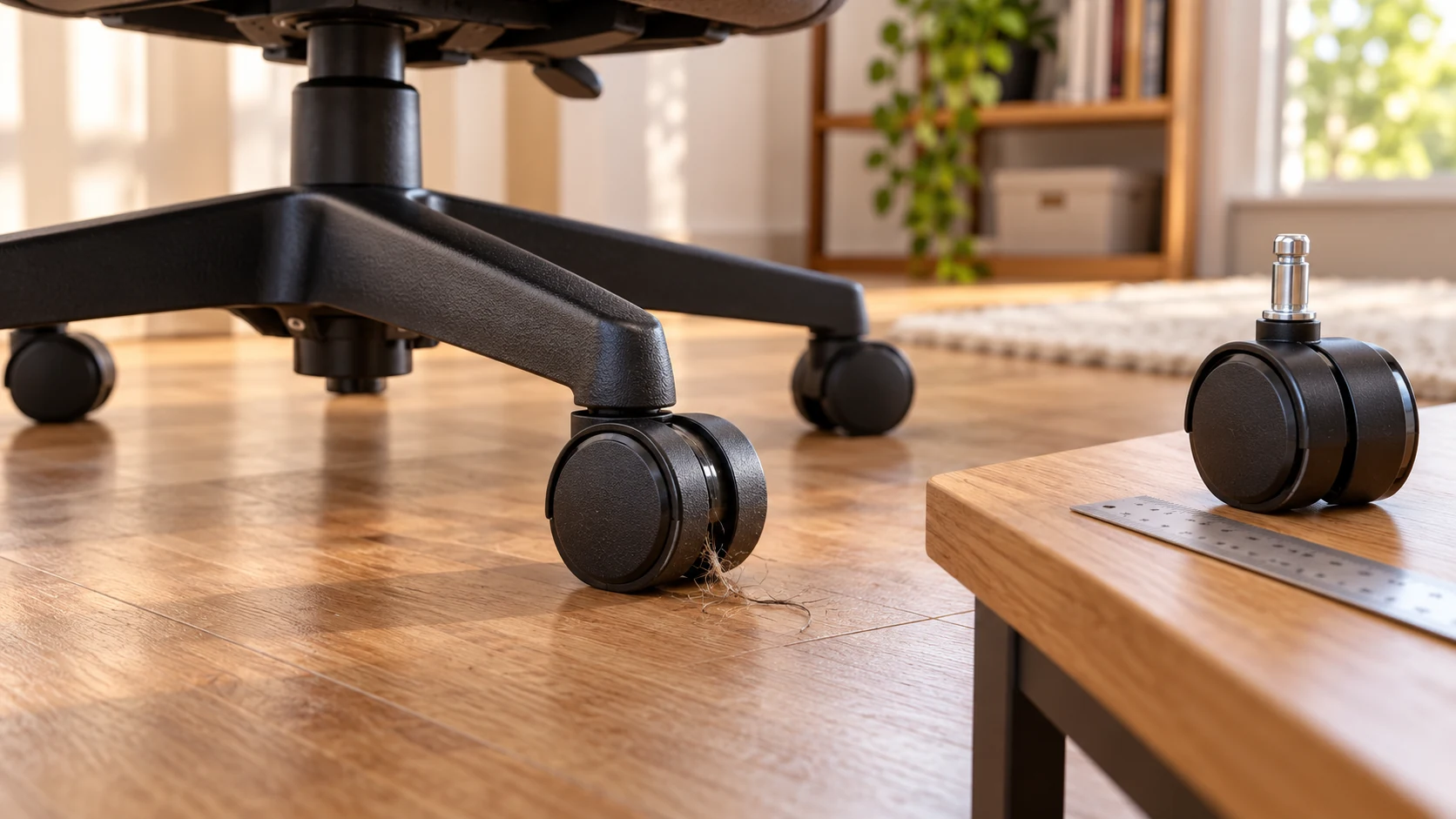
An office chair caster that drags can make the whole chair feel broken. The fault may be a thread caught at one wheel, a brake left engaged, a floor obstruction, a loose mounting stem or damage inside the caster. Replacing every wheel before locating the cause wastes effort and can introduce a fit problem. Start by finding exactly which wheel hesitates and under what surface and load conditions.
Two native replacement listings show why a match matters. One offers soft rubber rollerblade-style chair wheels and describes double ball bearings and a no-tools installation claim. Another offers swiveling rubber casters with a listed 11 × 22 mm circlip stem, several wheel diameters and a brake described in the product text. Neither listing proves that its stem fits your chair, that its wheel is right for every floor, or that a jammed old caster must be replaced.
Find the wheel that causes the drag
Clear a small area so the chair can move without cables, paper clips or carpet fringe in the way. Roll it slowly in a straight line, then turn in place. Notice whether the drag follows one wheel, occurs only when the chair swivels, or appears only on one patch of floor. Do not force the chair through resistance. A cable under a wheel can look like caster failure and can be damaged by repeated rolling.
Check the floor first. A desk area collects grit and loose objects, especially beside a mat edge. The floor-debris collection guide focuses on how bristles gather loose material; its broom-specific methods are not chair-repair instructions. For this task, remove visible debris using a method suitable for the floor and recheck the wheel path. If the chair rolls freely after that, do not dismantle a caster that was working.
Mark the hesitant wheel with a small removable note on the chair base, not on the rolling surface. Try moving the unloaded chair just enough to see whether that wheel rotates and swivels normally. A caster has two motions: the wheel rotates around its axle, and its fork turns to follow the direction of travel. A wheel may spin yet its swivel may bind. Recording which motion fails prevents a vague diagnosis such as “the chair feels stiff.”
Before reaching under the chair, choose a safe inspection position. Do not tip a loaded chair while someone is seated. If it must be placed on its side, protect the floor, keep fingers away from moving joints and get help when the chair is too heavy or awkward to handle safely. Follow the chair maker's maintenance instructions for its specific base. An unstable chair or cracked base is a separate structural issue; stop using it until it is assessed.
Take a quick photo of the chair base before removing anything. It records which caster was installed at each leg and how the chair sat on the floor. If all wheels look alike, number the legs on a separate note rather than marking the parts permanently. This is particularly useful when one wheel has an unusual brake or different stem. The record keeps a replacement decision tied to the actual failed position and helps you notice if the problem follows the wheel or stays with the socket.
Check the caster without hiding damage
With the chair stable and unloaded, look around the wheel axle and inside the fork. Hair, thread and fine fibers can wrap tightly enough to slow rotation. Remove only what you can reach safely without cutting a bearing, axle, tire or brake. Do not assume a blade can be slid against the wheel without damage. If the tangle cannot be removed by the chair maker's approved method, replacement may be safer than prying the caster apart.
Turn the wheel by hand only when it is safe to do so. Compare it with a working wheel on the same chair. Does it rotate smoothly, pause in one position, wobble sideways or make a scraping sound? Then swivel the fork and compare that motion too. The comparison is more useful than expecting a new wheel's advertising language to describe your old mechanism. If the wheel is cracked, separated from its tire or has a visibly bent fork, cleaning will not restore the missing material.
Check for a brake control before declaring a wheel seized. The selected Gamvdout listing describes a double-brake button, although its variants and gallery need exact package confirmation. A brake set on one replacement caster can make the chair pull to one side. Disengage a brake only as its maker directs, then test the unloaded chair. If the control does not move or the caster still binds, do not force it. The other listing does not establish that every rollerblade-style caster has a brake.
A loose stem can mimic wheel trouble. Watch whether the whole caster shifts in the base socket while the wheel turns. If the stem is partly out or the socket is damaged, stop using the chair until the mounting condition is understood. A wheel that falls out under load is more serious than a little rolling resistance. Do not glue an unidentified stem into a socket or wrap it to imitate a larger diameter. The joint must match the chair's designed retaining method.
Keep inspection and repair separate. Observing a wobble does not tell you whether the stem, its retainer, or the chair base is worn. If the same socket remains loose with a known-correct caster, the chair base may need attention. If a caster is loose in every sound socket, that caster is the more likely suspect. Make only comparisons the manufacturer permits, and do not keep seating and removing a stem repeatedly just to test a guess; that can change the fit you are trying to evaluate.
Measure before buying a replacement
Use the chair model information and the original caster specification when available. If the maker permits removal, record the stem type, diameter, length and retaining shape of one intact wheel. The Gamvdout listing names an 11 × 22 mm circlip stem, but that is a property of the listing, not the size of your chair's socket. Another caster may look similar in a product photo and still fail to seat securely. A screw-in stem, plate mount and grip-ring stem are not interchangeable by appearance alone.
Compare wheel diameter and installation height as well as stem fit. The Gamvdout description lists 50, 63 and 75 mm wheel diameters with different installation heights. A taller caster can change the chair's overall height and how all wheels share the floor. The rollerblade-style listing emphasizes its wheel form but its saved description does not provide the full dimensional match for every chair. Check the exact selected variant, not just the product family name.
Do not trust “universal” in a title as a measurement. Verify the actual chair base, stem and floor conditions before ordering. If the original chair has one failed wheel, mixing a new height with older smaller wheels may leave uneven contact. If the manufacturer recommends a complete matched set, follow that guidance. If it allows one replacement, confirm equal height and load specification. The source listings here do not establish a universal weight rating for your chair or its base.
Check the floor too. A hard caster on a delicate surface, a rug over a threshold or a damaged mat can affect rolling. The first listing markets soft rubber wheels for hardwood floors, but that is not proof of scratch-free performance on every finish. Follow the flooring maker's guidance and use a suitable protective surface if needed. A wheel with grit embedded in it can mark a floor even when its material was advertised as gentle.
When comparing a set, list the practical dimensions side by side: the original stem, the proposed stem, wheel diameter, total installed height and any brake clearance. Add the chair maker's approved load and floor guidance if available. A vendor's attractive photograph cannot replace that table. If one required value is missing, ask the seller or manufacturer for the exact variant specification before ordering. Do not fill the gap with an assumption borrowed from another product in the same search results.
Test the repair under ordinary use
After any approved cleaning or replacement, place the chair upright on a clear floor. First roll it unloaded. Watch that every wheel rotates and swivels, that none is loose, and that the chair base remains level. Then test it under normal seated use only if the chair is stable and the installation instructions have been satisfied. Stop immediately if a caster pulls out, the base rocks, a brake catches unexpectedly or the chair tips.
Move across the same floor path that exposed the problem. A successful repair should remove the specific hesitation without a new scrape or wobble. If the chair still drags at one mat edge, the floor transition may be the cause. If it drags everywhere after a new set is installed, inspect the common stem fit and wheel height before blaming every individual wheel. Keep the old functioning parts labeled until the new fit has been confirmed, unless the maker directs otherwise.
Look around the workspace while the chair is moved. A loose under-desk cable can enter the wheel path. The under-desk cable-routing guide addresses a separate cable-layout decision; use it for context if cords routinely reach the chair base. Cable routing does not repair a damaged bearing, and caster replacement does not fix a trailing cord. Keep those two causes distinct.
Recheck the repaired wheel after several days. Fibers can accumulate again, a poorly fitted stem can work loose, and a brake may be inadvertently engaged. The inspection takes less time when you know which wheel caused the first problem and what changed. Record the chair model and exact replacement dimensions for the next maintenance cycle. Avoid relying on a generic title that omits the stem and installation-height details you actually need.
If a new wheel changes the chair's feel, compare it with the pre-repair note rather than accepting the change as normal. A chair that suddenly sits higher, rocks on one leg or needs more force to roll may have a mismatched caster or a floor obstruction. Remove it from use until the cause is clear. The goal of replacement is to restore stable movement, not merely to make a wheel spin while the chair is off the floor.
The useful sequence is floor, wheel rotation, swivel, brake, stem, then compatible replacement. It keeps a small debris problem from becoming an unnecessary purchase and keeps a damaged mount from being treated as harmless lint. A caster repair is complete only when the chair rolls normally, every wheel remains seated, the base is level and the chair is safe in its real workspace.