Home & Living
Choosing a wall shelf versus picture ledge for books and frames
Use your books, frames and viewing angle to decide whether an open shelf or a raised-front ledge better serves the display.
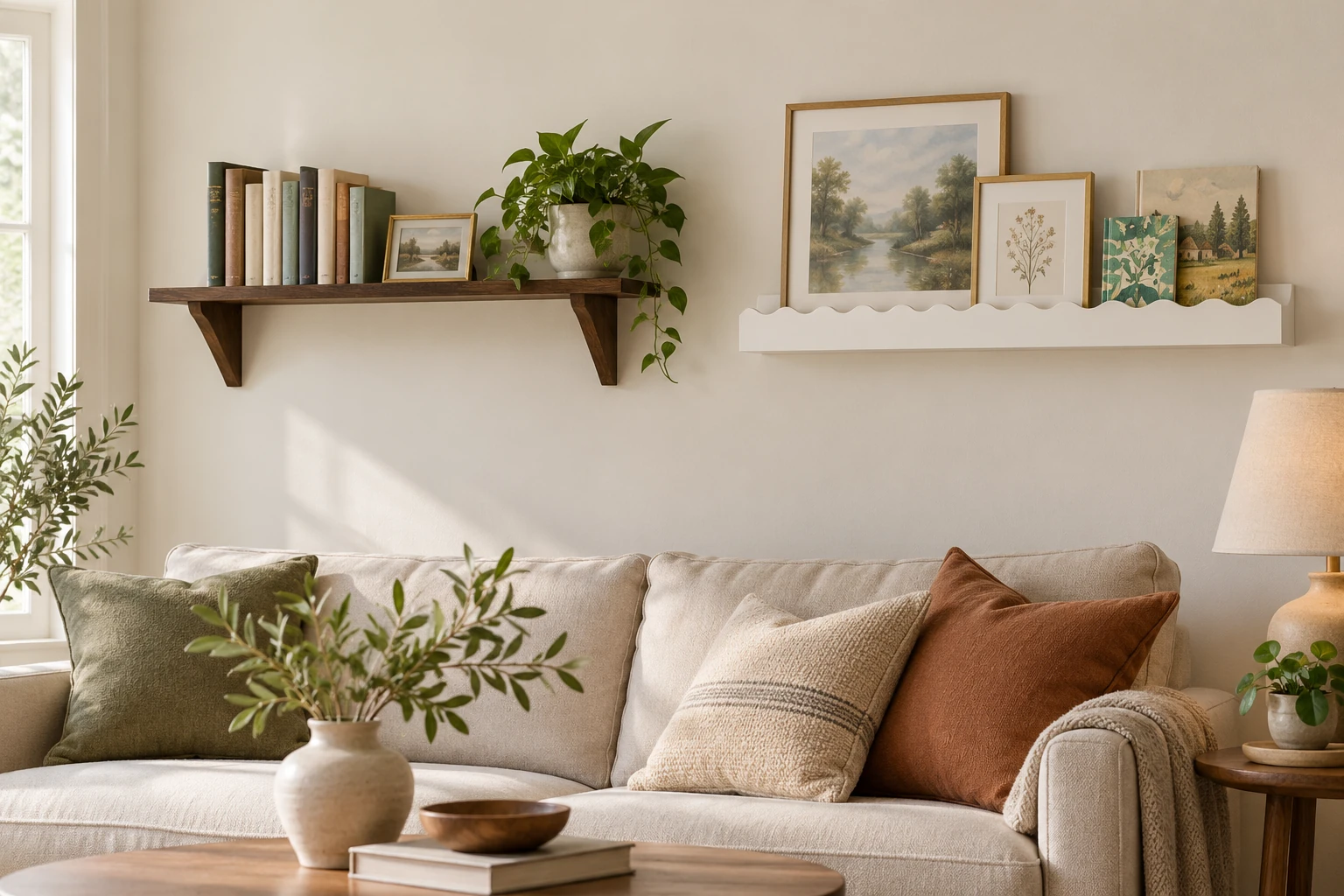
A shelf can hold a row of books, yet the way those books face the room changes the whole display. A conventional wall shelf leaves the front open. A picture ledge places a raised edge in front of the objects. If you are choosing between the two, start with the things you actually want to show: book spines, book covers, framed prints, or a changing mix of small objects. The useful question in a wall shelf versus picture ledge comparison is what the front edge allows you to see and arrange, not which listing uses a more appealing room photograph.
Two current product pages make the difference concrete. The Wallniture Ponza shelf listing describes a Paulownia shelf with triangular side brackets that can serve as bookends. The scalloped picture ledge listing shows a wall-mounted ledge with a raised front and a back mounting board, styled with outward-facing books and frames. These examples illustrate different display roles. Their listings also leave some variant and size details unsettled, so neither should be treated as a promise about the exact box you would receive.
Start with the face you want to see
Put the prospective display objects on a table before shopping. Stand the books and frames in roughly the order you would use on the wall, then step back to the distance from which you usually see that wall. A spine-out row needs accessible width and a way to keep the ends orderly. A cover-out group needs enough usable depth for each item to rest and enough visible height above a front edge to show the part of the cover or artwork that matters. This simple rehearsal tells you more than a styled image of objects whose sizes you cannot verify.
Consider how often you would change the arrangement, too. If books will be taken down and returned frequently, imagine lifting one out without disturbing the neighboring objects. If a few framed pieces are meant to stay on view, look at where their lower edges would sit relative to a lip. A raised front can make it easier to stage a row of pieces facing the room, but it can also cover part of a small cover or print. That is a visibility tradeoff, not a guarantee that objects will stay put. Neither display style substitutes for appropriate installation and loading.
Measure the real items you own. Record the depth of the largest base, the height of the image or title you want visible, and the width of the group with some room for rearranging. A nominal shelf length does not tell you how much practical room remains between side pieces, and a listing photo cannot establish your objects' scale. Keep those measurements beside the product information while you decide which shape has a useful front edge for your collection.
What an open shelf does well
The Ponza example has an open front and triangular side brackets. Its listing says the brackets have built-in bookend function and mentions books, frames, plants, DVDs, office items and jars as possible display contents. That makes it a reasonable example of a shelf for a spine-out book row or a mixed arrangement in which you want to see the full front of the objects. The brackets are part of its visible shape; they also define where the ends of a row can sit. Look at your proposed arrangement between those sides rather than assuming every inch of advertised length is freely usable.
The seller describes this Ponza shelf as 17 inches long and 4.5 inches deep and says it is made of Paulownia wood. Those figures are useful for a first comparison with the depth of a frame base or a small object. They do not tell you the safe load, wall suitability or the actual spacing available after you account for the brackets. A heavy book collection and a few light display pieces pose different questions, and neither can be approved from a product photo. Follow the delivered instructions and load guidance for the exact variant before putting anything on the wall.
The native page also has a naming conflict. The listing shown to a shopper says Black Wall Decor, while its source title refers to Gray and includes “20pcs.” Do not turn that conflicting language into a claim that this offer includes twenty shelves, or that a particular finish will arrive. Check the selected variant, seller confirmation and package details before ordering. If a precise color or quantity is central to a coordinated display, resolve that uncertainty before judging whether this product fits your plan.
An open front is especially appealing when the objects themselves provide the line you want to see. Upright books can show their spines without a rail crossing the lower portion. A framed print can show more of its face if its support and placement allow it to rest appropriately. The shelf's side brackets may make a tidy visual boundary for a short row. None of those display possibilities establishes how the item should be mounted or whether an unsupported frame is secure. Treat the pictured arrangement as an idea to test with the actual objects and instructions.
What a front-lipped ledge changes
The scalloped example is a different kind of wall shelf. Its front lip runs along the display area, and the page shows books and frames facing into the room. The back mounting board and raised front define a shallow display channel rather than an open-front platform. This can suit a group whose cover art or picture faces are the point of the arrangement. You may be able to change which front-facing item is displayed without reorganizing a row of spines. Work out whether each item fits and remains visible in the actual ledge before relying on that idea.
The ledge's lip creates a practical sightline question. Set a ruler or strip of card in front of a book or framed piece at approximately the planned edge height. View it from where you will normally stand or sit. If the title, signature or lower part of an image disappears behind the strip, the front edge may compete with what you want to display. A larger piece might rise comfortably above it; a small one might lose too much of its face. The answer depends on the object and viewing angle, not on the room style in a listing image.
The product page identifies a width of 15.7 inches in its Product information, while a gallery dimension card presents 16 inches. That is a small difference, but it matters if you are planning a tight wall position or a group of items with little spare width. Treat these as inconsistent seller measurements and confirm the dimensions of the selected variant before ordering or drilling. The “4P” text in the product name is not enough to certify a pack quantity, either. A gallery arrangement may contain several ledges without proving how many are supplied.
The seller describes rounded edges, a reinforced wooden frame and a coated surface. The page also makes promotional statements about durability and materials. Those statements are not a substitute for a verified load rating, a wall-specific mounting method or an assessment of use around children. For this comparison, the dependable visual feature is the continuous front lip and the way it changes the display. Decide whether that shape helps the objects you intend to show. Confirm performance and package details separately from the seller's exact instructions.
Try the two arrangements before committing to a wall
Make two short mock rows on a tabletop. In the first, stand the objects as they would appear on an open shelf: spines or fronts facing out, with room at the ends for side supports. In the second, place a straight strip in front to approximate the picture ledge's lip and arrange the books or frames so their faces are visible above it. You do not need to imitate the product's mounting; the purpose is to test what you can see and how much space the objects occupy. Record the widest arrangement and the deepest base.
Then compare the wall location with the arrangement. A narrow space might admit a single ledge, but do not choose by nominal length alone. The brackets on an open shelf and the width of a lip or end profile can change the usable display area. You also need enough clearance to lift objects off without hitting furniture or another shelf. If the display is above a seat or walkway, think through how people will use the space, then follow the product's mounting and load instructions for that location. A photograph cannot verify those conditions for your wall.
For a collection of novels, an open shelf's side brackets may be useful to test as bookends, provided the resulting row and load are appropriate under the delivered guidance. For a rotating selection of children's book covers, the ledge's front-facing presentation may better express the reason you are displaying them. Yet a lip is not a child-safety feature. If the intended setting has children or frequent contact, address mounting, access and load with the exact product instructions and appropriate professional advice where needed. Do not infer safety from a nursery-style photograph.
Frames make the comparison more subtle. A front lip can cross a picture's lower visible area, while an open shelf may leave that area unobstructed. At the same time, the frame itself can hide part of a print through its mat or aperture. If that is your problem, our guide to why a photo frame hides part of the picture addresses the frame's crop. Here the question is different: where does the shelf's front edge meet the framed object once it is displayed?
Keep display choice separate from mounting choice
A useful display design can still be wrong for a particular wall. The Ponza page says mounting hardware and instructions are included. The scalloped ledge page also says hardware and instructions are included. Neither page, on its own, establishes the wall construction in your room, the correct anchors for it, or a safe load for your exact arrangement. Check the contents and instructions of the delivered variant before drilling. If the instructions do not answer a wall or load question, resolve it with the seller or a qualified installer before proceeding.
Do not borrow an installation conclusion from an unrelated shelf. The published comparison of floating glass shelf length and bracket fit is about matching glass shelf dimensions and brackets. This article's decision is about an open front versus a raised front lip for a planned display. The physical pieces and their instructions are different. Reading both may help you separate visible arrangement from hardware fit, but neither can approve a wall installation for the other product.
It is tempting to use the photographs to answer everything at once: style, capacity and wall location. They are useful for seeing the forms, especially the Ponza's side brackets and the ledge's scalloped raised front. They cannot tell you what is behind the photographed wall or what load was placed on the shelf for the shoot. Treat a product image as evidence of the pictured design, not as a mounting test. Keep your object measurements and the delivered instructions as separate inputs to the decision.
Choose the edge that solves your display problem
Choose the open-shelf route when you want a spine-out row or mixed objects with an unobstructed front, and when the actual objects fit the usable area between its sides. Choose a picture ledge when you want covers or framed pieces to face the room and a continuous front edge works with their size and sightline. If the lower part of a small image matters, test it against a lip before deciding. A shelf can be attractive in a photograph and still obscure the very detail you hoped to show.
For these two examples, settle the seller's inconsistent details before purchasing: the Ponza's Black-versus-Gray and “20pcs” language, and the ledge's 15.7-versus-16-inch width and unclear “4P” count. After the delivered product is confirmed, use its own instructions and load guidance for installation. The display decision can be made now with the books, frames and sightline you have; the wall decision needs facts about the exact product and place where it will hang.