Home & Living
A wall clock story told backward: the late arrival
An original story follows a late guest through a reading evening in reverse, tracing an ordinary departure back to a tentative reply.
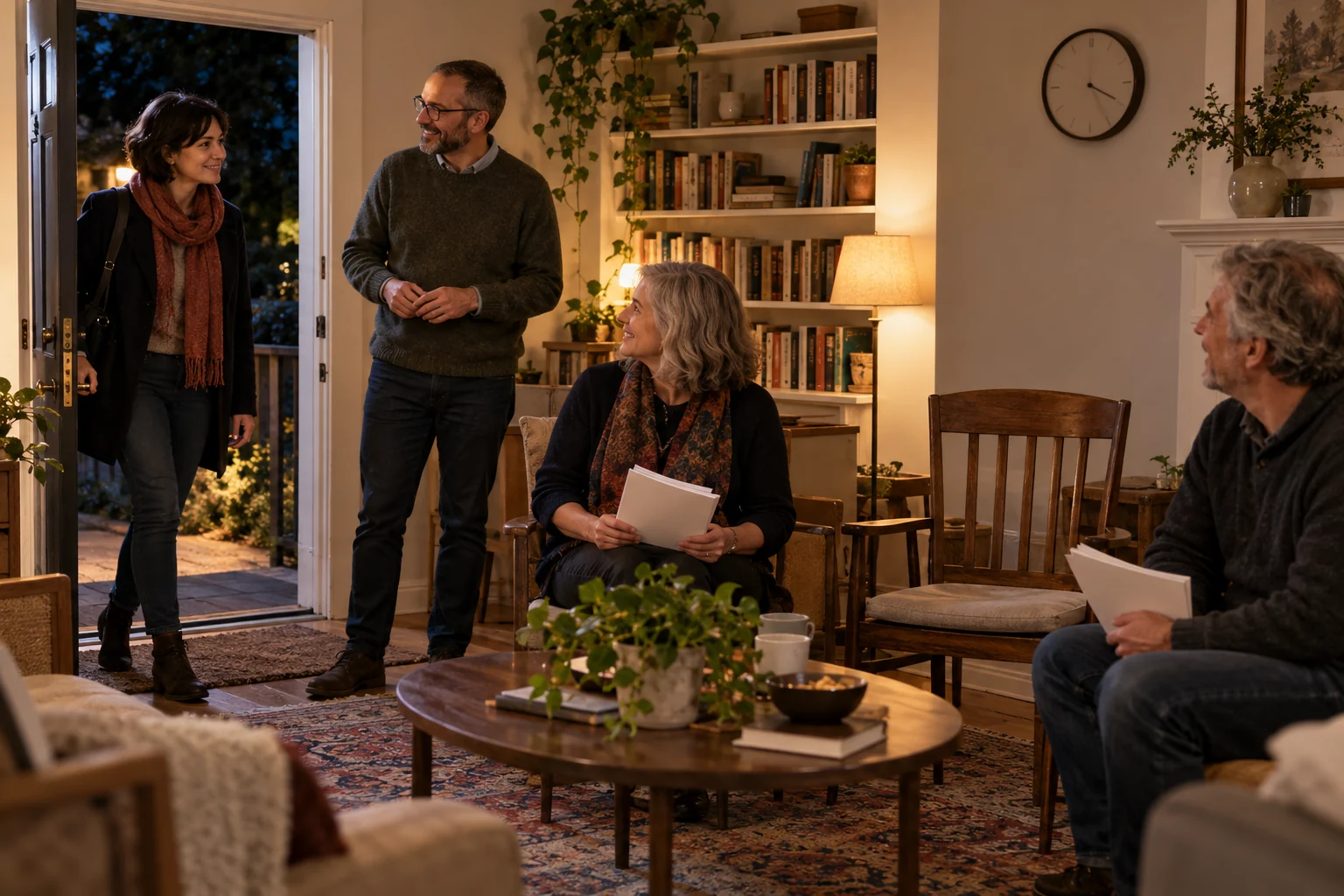
This original wall clock story is told backward through four parts of one evening. Iona, Niko, the other guests and every event are invented. Each new section begins earlier than the one before it. The room's generic clock is not either retail clock discussed separately below, and the story supplies no timekeeping test, calculation or rule about attending a real gathering.
After the reading
After the last reading, Iona carried two empty cups into Niko's kitchen. She had arrived late enough to worry about entering and stayed long enough to help put things away. A chair stood in the middle of the room, turned towards the others instead of towards the table. She recognized it as hers. When she lifted it, a folded scrap of paper slid from the seat and landed beneath her shoe.
It was the beginning of the piece someone had read near the end. She knew that because she remembered the first sentence, though the scrap held only a few words. Niko took it from her and put it beside the remaining pages. Iona asked whether he wanted the chair against the wall. He pointed to a space beneath the clock, then changed his mind and asked her to leave it near the table.
“I use that one in the morning,” he said. “The other one catches my sleeve.” Iona set it down carefully. The chair that had seemed like an invitation now had another ordinary life: Niko sitting with his breakfast, moving his arm past an inconvenient corner. She liked finding that out. It let her stop thinking of every object in the room as something arranged around her arrival.
At the door, she thanked him for letting her come halfway through. He said he was glad she had heard the last piece. She told him which detail she kept remembering: a character putting a shoe outside a closed bedroom without explaining why. They had no actual published story to identify. It belonged to the invented reading they had just shared, and she wanted to ask its writer about it next time.
Niko offered to send the writer her question. Iona said she would rather ask when they met again. Then she wondered whether that sounded as though she had invited herself to another evening. He went to the table, found the page where he had written the next date and read it to her. She put it into her phone. Neither of them settled whether she would be free.
Outside, she looked back once. Niko was moving the cups she had left beside the sink. Through the window she could see the clock and the chair beneath it, with nobody sitting there. The room no longer looked as though it was waiting for her to enter. She had been inside it. She pulled her coat closed and walked towards the corner, carrying the question about the shoe with her.
Earlier, during the pause
Earlier, when the reading paused, Niko had opened the door with a cup in his hand. Iona was standing on the small landing outside. She began apologizing before he had finished saying hello. He stepped back and asked her to come in. She wanted to explain the whole sequence of things that had delayed her, but he was already putting his cup down and finding somewhere for her coat.
She followed him into the room. Four people sat with loose pages on their knees. One was looking for a sentence she had marked. Another was using a biscuit as a bookmark until someone warned him about the crumbs. They looked up, said hello and returned to the small problem of finding the sentence. Iona had expected her entrance to become the subject of the room. It occupied a few ordinary moments and then ended.
Niko lifted his coat from a chair beside the table. He had been keeping it there rather than taking it to the hall. Iona sat down with her bag against her ankle. The clock was above her left shoulder, too high to remain in view without turning. She did turn once, then faced the people again. The woman with the marked page found her place and asked whether she should begin that paragraph again.
“Only if you want to,” Iona said, then realized the question had been for everybody. Someone else asked to hear it again. The woman read slowly, stopping at the point where her pencil mark interrupted the line. Iona listened without trying to reconstruct everything she had missed. There was a house in the passage and someone outside it. For that paragraph, those were enough things to know.
During the next conversation, she asked about the shoe. The writer looked down at her page and said she had not expected anyone to notice it. Iona nearly withdrew the question, as though noticing the wrong thing might be another kind of late arrival. Then the writer asked what she thought it was doing there. Iona described the small hesitation she had heard around it. The writer listened and asked her to say the last part again.
Iona did not leave that exchange with an explanation of the whole story. She left it knowing which question she wanted to keep. When someone began the next reading, she shifted her bag beneath the chair and settled back. Nobody had offered to restart the evening for her. She had not needed them to. This particular part was happening now, and she was there for it.
Earlier still, on the landing
Earlier still, Iona had climbed the stairs and stopped outside the closed door. A voice was reading inside. She could not make out the words, only the way the speaker paused and began again. She had imagined walking into a room where everyone was still finding a seat. Instead, the evening had acquired a shape without her. She put her hand on the rail and considered going back down.
There was no need to make her departure dramatic. She could send Niko a message when she reached the street and say she had been too late. It would be true that she had arrived after the beginning. The rest of the sentence was something she had supplied herself. She took out her phone and opened their earlier conversation. His last message was still there, shorter than the explanation she had been preparing.
She typed, “I'm outside. Is this still a good moment to come in?” Then she read it twice before sending it. There was a difference between asking and announcing that she had already decided what he would prefer. She did not know what he would answer. She stood beside the rail and waited, leaving enough room for someone to pass her on the stairs.
The reading continued. Iona heard a laugh, then the same voice returning to its sentence. She pictured a plate of biscuits she had not seen and a circle of faces she could not yet name. The picture was hers. It gave her no evidence about whether anyone was annoyed or whether Niko had noticed the message. She put the phone back into her pocket rather than sending a second explanation.
At the foot of the stairs, someone opened the building's outer door. Iona moved closer to the wall. For a moment she was ready to follow the sound down and leave with whoever had arrived. Instead, she stayed where she had said she was. Soon the voice inside stopped. Cups moved, someone asked for a page, and footsteps approached the door. She took her hand off the rail before it opened.
That afternoon, before the invitation became an arrival
That afternoon, Iona had been clearing the end of her own table when Niko's invitation appeared. A few friends were bringing short pieces to read aloud that evening. He thought she might enjoy listening. She had met him at another friend's lunch, where they had spent longer than either expected talking about a story neither could remember properly. The invitation referred to that conversation without pretending they already knew each other well.
Iona looked at the unfinished work spread across her table. She would not be ready when the others began. She could see herself arriving while someone spoke, carrying a coat she did not know where to put, apologizing to strangers before finding an empty chair. It was a complete little scene she had managed to invent before answering a message. In it, she always left again as quickly as possible.
She began a reply saying she could not come. Before sending it, she deleted the sentence and wrote the narrower thing she actually knew: she would be free later than the time he had named. She asked whether that would be awkward. The table still needed clearing. The work would still take as long as it took. A different reply could not make her available earlier.
Niko answered that they would pause between readings. If she wanted to come later, she could send him a message when she reached the door. He would let her in at a pause. It was an arrangement for that evening, with that host. Iona read it without turning it into a promise that she could enter any gathering whenever she pleased, or a demand that she must now attend.
She moved the unfinished work into a smaller pile. The invitation had not completed it for her, and she had not yet put on her coat. She could still decide to stay home. For the moment, she wanted to leave the possibility open. Beneath Niko's message, she typed, “I'll let you know when I'm outside.” Then she set the phone down and returned to the page in front of her.
Actual clocks outside the invented evening
The Coastal Shiplap wall clock offer has six original gallery views showing a complete blue-and-white round clock, its back, integral movement and a size graphic. A Banks Product mark appears on the back while the native brand field says “wall clock.” No manufacturer identity is substituted here. Its silence, accuracy and other promotional claims are not adopted as test results.
The FP-MIN-343 Old Town design clock is identified in the native account as an unbranded wall clock. Both gallery images show the complete decorative clock. Neither photograph authenticates operation, timekeeping accuracy, dial conventions or mounting suitability. Iona's fictional room contains a generic clock, not an observed installation of either offer.
Other ways a story can place an earlier event
The winter story flashback guide places an earlier scene inside a winter opening and then returns to that opening's present. This story instead moves to an earlier stage at each section and ends at its earliest event. It offers one selected piece of fiction rather than an exercise comparing possible outlines.
The keychain disclosure scene compares showing a location before a search with withholding it until discovery. There is no lost object or search here. Iona is named from the beginning, and the backward sections supply one invitation and its actual later arrival, pause and departure without an alternative version.
This invented reading evening does not create a reason to order a clock. If you independently consider an actual offer on republeq.com and prefer cryptocurrency, first review the payment choices presented for that particular order. Mentioning USDT here does not confirm that it is available, which network would apply or what amount a transaction would require. Keep the selected product, quantity and unresolved item questions with the current order details. A gallery view or a fictional room does not establish what will arrive, and an answer about one clock should not become an answer about another. Read the applicable delivery, cancellation, return and refund terms before deciding whether to proceed. If another person helps choose an item, agree who is responsible for ordering so a shared link does not lead to independent duplicate purchases. A proposed substitute needs its own review instead of inheriting the earlier product's identity or terms. This article provides no receiving address, transfer procedure, network recommendation, fee estimate or promised financial advantage. Obtain missing transaction instructions from the responsible merchant or payment provider before authorizing a payment. Retain the actual confirmation and order reference supplied after an authorized transaction. If payment or order status remains uncertain, reconcile that status before considering another payment; uncertainty is not evidence that nothing occurred. A transaction record identifies a purchase. It does not certify clock accuracy, silence, a mounting arrangement or the experience described in a work of fiction. You can finish the story, enjoy an object you already own or decide against a purchase while leaving unanswered product questions unresolved. Keep those questions attached to the exact offer that raised them.