Home & Living
A keychain short scene: reveal the clue before the search
Compare two original versions of one search: show the prop location first or retain it until discovery. Choose the narrated information for this particular scene.
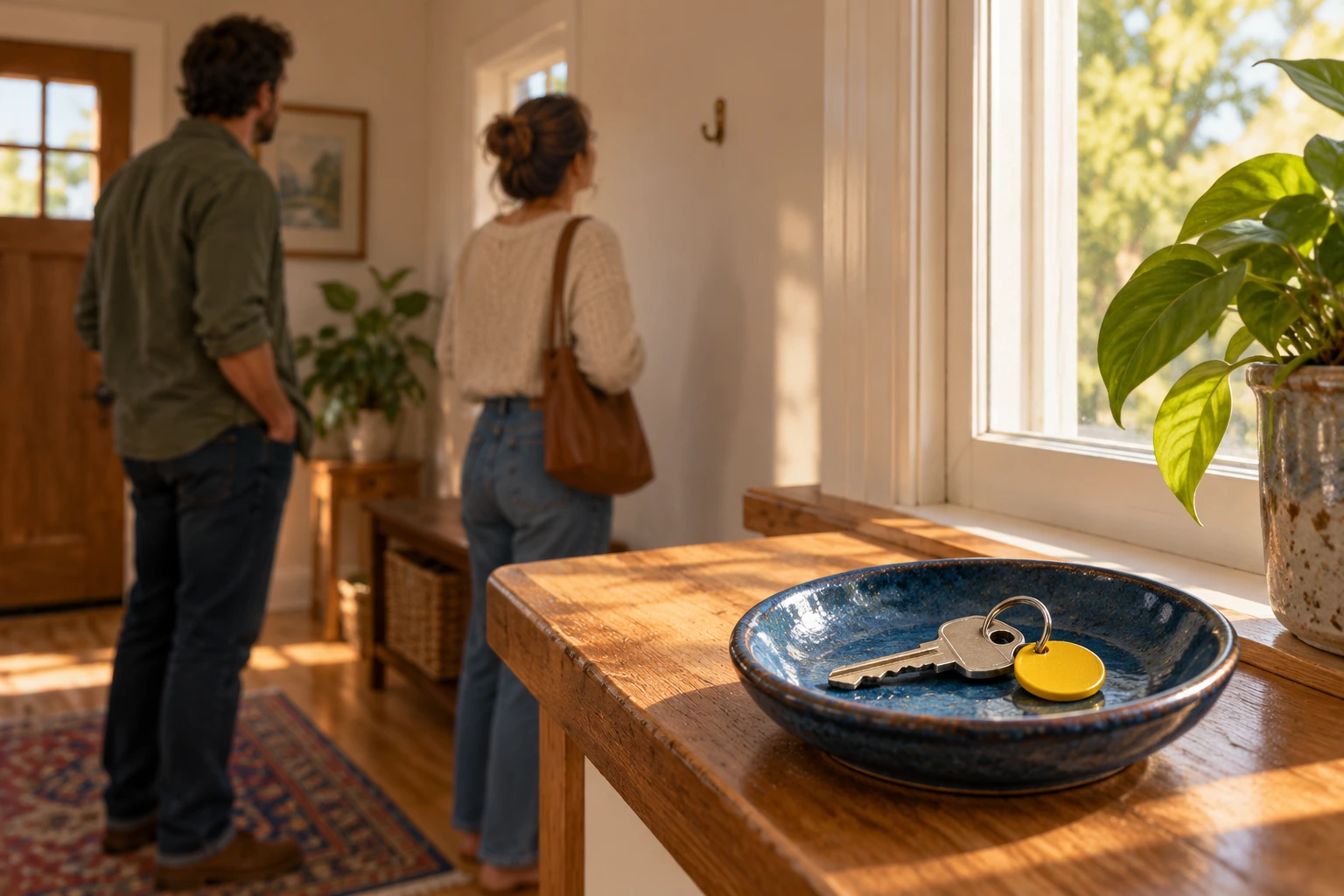
A keychain short scene can show the reader where the missing object is before the characters begin searching. For this original exercise, choose between that arrangement and a version that retains the location until discovery. The event is invented, and the comparison concerns the information explicitly printed in each version. It supplies no test of an actual reader's reaction or universal rule for writing a story. You can make this small prose choice with ordinary writing materials already available, without buying either keychain offer discussed separately below.
Choose the event before arranging its disclosure
Give the scene a few fixed conditions. Sana places a keychain in a shallow blue dish on the window ledge and leaves. Leda and Kiran arrive later, expecting to find it on a low wall hook. They did not see Sana move it. Both want to find the same object, and neither is concealing its location from the other. The keychain has one generic metal key and a small yellow circular tag. These are authored fictional details, not observations of a real room or instructions about anyone's access to a property.
Keep those conditions beside the draft. They let you distinguish a change in what is narrated from a change in what happened. If you later decide that Kiran secretly moved the keychain, you have changed the fictional event and one character's knowledge. That may become another story, but it would no longer be the same simple comparison. This exercise keeps the people and placement fixed while choosing when the location enters the written account.
Read one complete early-information version
Sana found the keychain beneath the folded drawing paper. She carried it to the window and laid it in the blue dish, where the yellow tag rested against the rim. The last empty cup was waiting by the door. She picked it up and left before Leda and Kiran came back from the garden.
Leda stopped at the low hook. A loop of string hung there, with nothing on its end. She moved the string aside, then looked down at the floor. Kiran stood behind her with the folded paper tucked under one arm. He had remembered the keychain hanging beside the string that morning. Neither of them had been in the room when Sana cleared the table.
“It was here,” Leda said. Kiran put the paper down and looked beneath it. The table held a pale rectangle where the stack had been, a pencil and a small curl of eraser. He lifted the pencil, set it back and checked the empty space again. Leda crouched beside the wall. From there she could see beneath the table but not onto the window ledge.
“Perhaps we took it outside,” Kiran said. Leda looked toward the open garden door. She remembered carrying the paper, then giving it to him when she went back for the cups. The memory did not include the keychain. She remained beside the hook while he turned his pockets out onto the table: a tissue, two blank slips and a button he had meant to sew back on.
The edge of the drawing paper lifted in the breeze. Kiran reached across to stop it and looked toward the window. The blue dish sat beyond the pencil jar. Its yellow crescent was the tag, tilted against the rim. He went to the ledge and lifted the keychain by its ring. Leda stood up. “We were both looking down,” she said. Kiran placed it on the cleared table, beside the string she had taken off the hook.
Trace the information the opening supplies
The first paragraph states the placement directly. Sana puts the keychain in the dish before the searchers arrive. Later paragraphs show Leda and Kiran inspecting the hook, floor, paper and pockets without having seen that action. The chosen version therefore gives its reader a concrete location while the two searchers still lack it. There is no need to infer a hidden motive or diagnose their attention. The gap is established by the actual sequence of sentences.
Notice what the early information does not settle. It does not tell us what Leda will say when the object is found, how long the search lasts or whether either person will blame Sana. Those details have not been supplied by the placement sentence. In this selected scene, nobody makes an accusation, and the ending gives Leda a small observation about where they were looking. Do not add a later argument merely because a missing object could support one in another story.
Compare a version that withholds the placement
For a separate alternative, omit Sana's opening paragraph and begin with Leda at the low hook. Retain the search through the paper and pockets, then keep Kiran's discovery at the window. The printed version now first identifies the dish as the keychain's location when Kiran looks toward it. The exercise's declared event can still include Sana having placed it there; that action is simply absent from the alternative's opening narration.
A compact original version could read: Leda moved the string aside and looked below the hook. Kiran checked the folded paper, then emptied his pockets onto the table. Neither found the keychain. When a breeze lifted the paper's edge, he reached to hold it down and glanced toward the window. A yellow tag rose above the blue dish's rim. He walked over and lifted the ring. Leda stood beside the hook with its loop of string in her hand.
Having read the first version, you already know the location. This comparison cannot erase that knowledge or reproduce somebody's first encounter with the alternative. Instead, inspect the sentences each version actually contains. One explicitly narrates placement before the search; the other first supplies the location at discovery. That difference is available on the page without claiming that a particular reader felt surprise, amusement or impatience.
Keep a changed event separate from withheld information
Now imagine revising the ending so that the keychain is in Kiran's pocket rather than the dish. That changes the declared location. To adopt it, you would need to reconsider the earlier placement and explain the new event through the actual version you write. Leaving Sana's dish placement untouched while quietly substituting a pocket ending would create an unanswered continuity question. Calling the change a later reveal does not establish how the object moved between those places.
You can choose to leave a movement unexplained in a different story, but name that as a new writing choice. For this exercise, keep the dish and the discovery at the window. The comparison remains manageable because you are deciding when to tell one location, rather than inventing a second movement, a concealed action or an unreliable account. Save the pocket idea separately if it interests you; it does not need to be completed before the selected scene can stand.
Keep real decorative offers outside the fiction
The angel keychain offer describes 100 integrated angel keychains, split into 50 light pink and 50 blue in its native account. Its complete gallery shows wing-and-bead decorations attached to rings and clips, including illustrated key and bag use. Those images do not authenticate the stated alloy, establish holding strength or approve the infant-related marketing scene. The described inventory names the keychains; the people, bags and other objects in usage images provide context for the accessory.
The kids keychain offer describes one set of 24 keychains. Its complete gallery shows fluffy characters with integrated rings and chains; some have decorative legs and boots. A usage image shows a key and bag context. The retail age wording is not adopted as a safety or suitability finding here. This article reports no retention, material or durability test and does not identify either offer as the keychain Sana moved.
The fictional metal key, yellow tag and blue dish belong to the authored scene. They are not claimed contents of either parcel. Decorative product photographs can be considered on their own terms while the story remains entirely invented. No ring attachment, lock operation, key copying, handling test or security procedure is taught through the scene. Its practical writing task is deciding what the narration discloses and when.
Choose the version this scene will keep
For the selected scene, retain Sana's opening placement. It gives the dish a clear place in the written account before the searchers look elsewhere. Keep Kiran's later glance and Leda's final observation as written. This is a specific editorial preference for this piece. It does not establish that early disclosure is better than a withheld clue in every story, or that the alternative is a failed draft.
The short story title guide keeps a completed workshop story fixed while comparing object and quotation titles. That choice concerns words placed before the story. Here, the comparison changes which event is explicitly narrated at the opening, while leaving the naming decision aside.
The sound-led prose scene guide compares audible and visible cues around an arrival. This keychain scene uses a known location and two characters who missed its placement. It does not borrow that arrival, its sounds or its sensory-focus decision.
Keep a possible order separate from the invented search
If considering a decorative keychain later leads you to republeq.com and you prefer cryptocurrency, treat that as a separate question about an actual order. An interest in USDT does not establish that the selected checkout offers it, which network would apply or whether a transaction has been completed. The fictional blue dish cannot serve as an order record, and Sana's imagined object does not identify either retail package. Retain the exact selected offer and any unresolved contents question before deciding whether to proceed. Read the payment information actually presented for that purchase rather than supplying details from a different transaction or a familiar asset name. If a necessary instruction remains unclear, seek clarification through the assistance provided for the order before authorizing payment. This paragraph gives no wallet address, transfer procedure, network recommendation, fee calculation or promised financial advantage. Review delivery and return terms for the same item and order, without treating a preferred payment method as a promise of arrival, suitability or a particular refund outcome. If another person is helping choose the goods, give them the actual product reference and explain what is still undecided. A page of fiction supplies neither a shopping list nor purchase authorization. Keep any eventual confirmation with the item actually selected so that later questions concern the same transaction. Should the offer or variant change, reconsider its own contents and the payment information it presents. You may leave the purchase open or make no purchase while still completing the writing exercise. Neither a chosen asset nor a transaction confirmation proves how a delivered item performs or how someone will respond to your story.
Finish with one complete selected account
Return to the early-information version and read its opening beside its discovery. The dish stays in the same place, Sana's action remains explicit, and Leda and Kiran learn the location later. Keep the withholding alternative and the unused pocket idea as separate drafts. A keychain short scene can finish with that particular order of information, without a real search, a new purchase or a promised reaction from its reader.