Writing & Documents
A sound-led prose scene begins before the arrival is visible
A sound-led prose scene compares original accounts of Ravi and Ada meeting, separating an audible approach, visible movement and a new event added during revision.
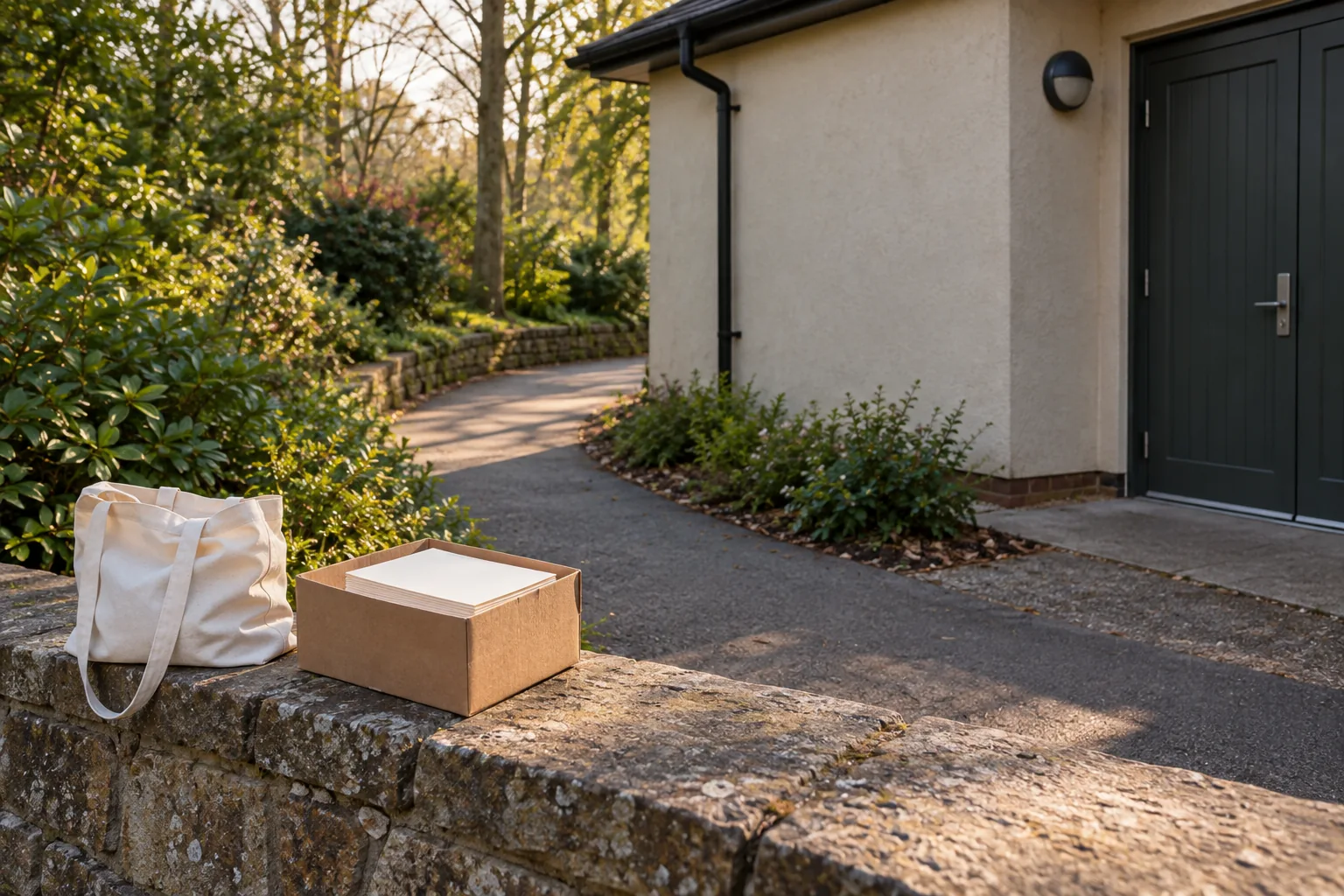
A sound-led prose scene can begin with something a character hears before they see its source. That gives a writer one way to arrange an ordinary fictional event. Try another version of the same event using movements and positions, then compare what each passage actually tells the reader. The choice concerns the writing on your page, without promising that one style produces the same response in everyone.
This exercise uses an original invented scene with two adults, Ravi and Ada. They are outside a closed community rehearsal room. Ravi has brought a cardboard box of paper programs from a previous event. Ada is expected to collect it. The room stays closed, no rehearsal begins and neither character handles a vehicle or repairs equipment. The small question is how Ravi recognizes that Ada has arrived.
Write the event before choosing its sounds
Give the scene a few declared facts. Ravi is sitting on a low wall near the door. The box is beside his feet. A narrow path turns behind the building, beyond his view. Ada approaches by that path and stops at the corner. She has an empty cloth bag. They will meet and move the programs into it. These invented conditions belong to this example, rather than to an actual place you need to investigate.
A plain event account could read: Ravi waited by the closed door with the programs. Ada came around the corner carrying a bag. She stopped when she saw him. He lifted the box from beside the wall, and she opened the bag. He passed the programs across in two stacks. They left the empty box folded on the wall while they decided where to take it.
That account establishes the whole small event. It has no puzzle about who arrived or what the box contained. Keep it nearby while writing alternatives. If a later version introduces a ringing phone, a departing train or an argument, you will have added a different event. You can choose to do that, but then the comparison is about more than the treatment of this same arrival.
For the first alternative, let Ravi notice Ada before he can see her. You now need to invent an audible detail that could come from behind the corner. The sound does not have to identify Ada by itself. Ravi can turn toward it and then recognize her when she comes into view. Keeping those moments separate avoids granting the character knowledge the passage has not supplied.
Begin with an audible detail
Here is the first version: Something brushed the gravel behind the corner. Ravi raised his head. A second scrape came closer, followed by the soft knock of a buckle against the wall. Then Ada appeared with the cloth bag over her arm. “I thought you had gone,” she said. Ravi reached for the box. Its loose lid tapped his wrist as he lifted it.
The paragraph gives a scrape, a knock, a spoken sentence and a tap. Each is attached to a particular moment. The first sound has an uncertain source until Ada appears. The buckle then connects the approach to something the scene actually contains. The lid belongs to Ravi's action after recognition. Those relationships are choices made inside this original passage, not observations from a real recording.
You could remove the buckle and retain the scrape. The arrival would still happen, with less detail between the first notice and Ada's appearance. You could also remove her spoken sentence if the exchange of programs should remain wordless. Decide which event deserves space before adding another sound merely to make the paragraph busier. In this version, the short sentence establishes that the two people had separate expectations about the meeting.
Keep ordinary objects separate from performance claims
The Strong Arm 6653 account describes two black hood lift support prop rods, UPC 719926121767, under Lift Supports and Components. Its gallery includes two supports and a cardboard box. The selected Strong Arm 6653 offer supplies bounded ordinary packaging context. The box in Ravi's fictional scene is invented; it is not a claim that the pictured package contains his programs or produces any particular sound.
The Strong Arm 4966 account describes two trunk lid lift supports, UPC 462030845370, and references 901166 and SG230019. The selected Strong Arm 4966 offer also pictures two supports and ordinary packaging. Its claims about engineering, weather operation and installation are outside the prose exercise. The two accounts remain different model identities, with no assumption of interchangeability.
Neither selected account establishes an actual sound made by the products, their packages or any vehicle. Their promotional statements do not provide a listening test for this article. Ravi's lid tapping his wrist is an authored fictional event. No installation diagram, tool-handling method, fitment judgment or repair procedure is being carried into the scene. You do not need to buy either offer to write an original paragraph.
Compare a sound detail in fiction with visible movement
For a sound detail in fiction, ask what becomes available at that particular moment in the passage. Ravi hears something before he sees Ada. That is the structure of the first version. A movement-led alternative can begin after she becomes visible, so his recognition occurs through a different described action. Keep the people, place, programs and eventual exchange the same for the comparison.
Here is that alternative: Ada's bag appeared around the corner before she did. Ravi sat forward on the wall. She took one more step, saw the box beside his feet and lowered her arm. He held the loose lid in place with his thumb while he stood. She opened the bag with both hands, leaving a space between its handles for the programs.
This paragraph uses no described sound and no spoken line. It also gives Ravi no warning before the bag appears. The details concern the bag, the position of his body, the loose lid and Ada's hands. Neither version explains what either person was thinking during the whole wait. Both keep the narrative close to the arrival and the preparation to move the programs.
The movement-led paragraph is not a transcript of silence. Events outside its sentences could have made sounds. The writer has simply chosen not to describe them. That distinction matters when comparing your own versions: an omitted sound is not the same fictional fact as a declared absence of sound. If you want the place to be silent, you need to decide whether to state that additional condition.
Sound detail in fiction
Now add one sound to the movement-led version at a chosen point: Ada opened the bag with both hands. One program slipped from the stack and struck the paving with a flat slap. Ravi kept the rest against his chest while she bent to retrieve it. The dropped page adds a new small event. It is not merely a different adjective for an action already present in the earlier paragraph.
You can keep that dropped page if you want a pause between arrival and exchange. It redirects attention from the initial meeting to the programs themselves. In the example here, leave it in a separate draft. The main comparison is still the first notice of Ada: an approach Ravi hears or an appearance he sees. Keeping the new page incident separate makes that choice easier to assess.
A different revision would add a sound to an existing action instead: Ada pulled the bag open; its fabric rasped against the buckle. That retains the bag-opening event while changing what is described about it. Compare the actual sentences rather than saying that all added sound does the same thing. One revision changes the event sequence, while the other supplies another detail of the sequence you already wrote.
Place a prose scene on the page without borrowing another activity
The wordless comic drawing session guide considers visible changes across pictures and a first reader's interpretation. Ravi's prose comparison instead chooses when an audible or visible cue enters a written paragraph. It supplies no panel layout or first-reader experiment, and an added sound would need its own written treatment if the example became a comic.
The Crayola Air-Dry Clay gift guide develops an imagined design through intended use, recipient preference and material limits. This example chooses between prose accounts of the same arrival. Its cloth bag and paper programs are invented scene objects, without a making brief, material experiment or gift-recipient decision borrowed from that separate project.
Read the first cue and the later recognition as separate sentences once more. If you replace Something brushed the gravel with Ada brushed the gravel, the narrator identifies her before Ravi turns his head. That is another available version, but it gives away information the chosen opening temporarily withholds. Keep Something here. The purpose is not to make Ada mysterious throughout the scene. Her appearance resolves the uncertain source almost immediately. The brief uncertainty is enough for the specific arrival being written, without inventing a threat, an unseen stranger or a dramatic discovery that the rest of this modest exchange does not contain.
Choosing a sensory focus for the same arrival
For choosing a sensory focus, return to the question you began with. If you want Ravi's attention to turn toward an arrival he cannot yet see, keep the first version. If you want Ada's bag entering view to initiate his response, keep the movement-led version. These are specific reasons grounded in the two written passages. Neither requires a general claim that sound is always more intimate or movement always more immediate.
For this scene, choose the audible approach. It creates a small interval between Ravi's first notice and his recognition of Ada, while keeping the source understandable once she appears. Keep the scrape and the buckle's knock, then retain her short sentence. Do not add the dropped program to this version. The exchange can follow without introducing a second interruption that competes with the arrival you chose to emphasize.
The final continuation can remain simple: Ravi passed the programs across in two stacks. Ada tucked the bag under her arm. He folded the empty box along its old creases and carried it away from the door. She waited at the corner until he caught up, and they took the narrow path together. No new explanation of their earlier expectations is necessary for this chosen ending.
A sound-led prose scene can finish with the event it began to describe. Here, an uncertain scrape becomes Ada's arrival, then the programs change hands. Keep the unused movement-led paragraph if you want another possible beginning. The finished version has its own selected order of information, and its invented sounds remain part of that writing rather than evidence about a real product or place.