Learning & Creative
Frame a winter story flashback and return to the table
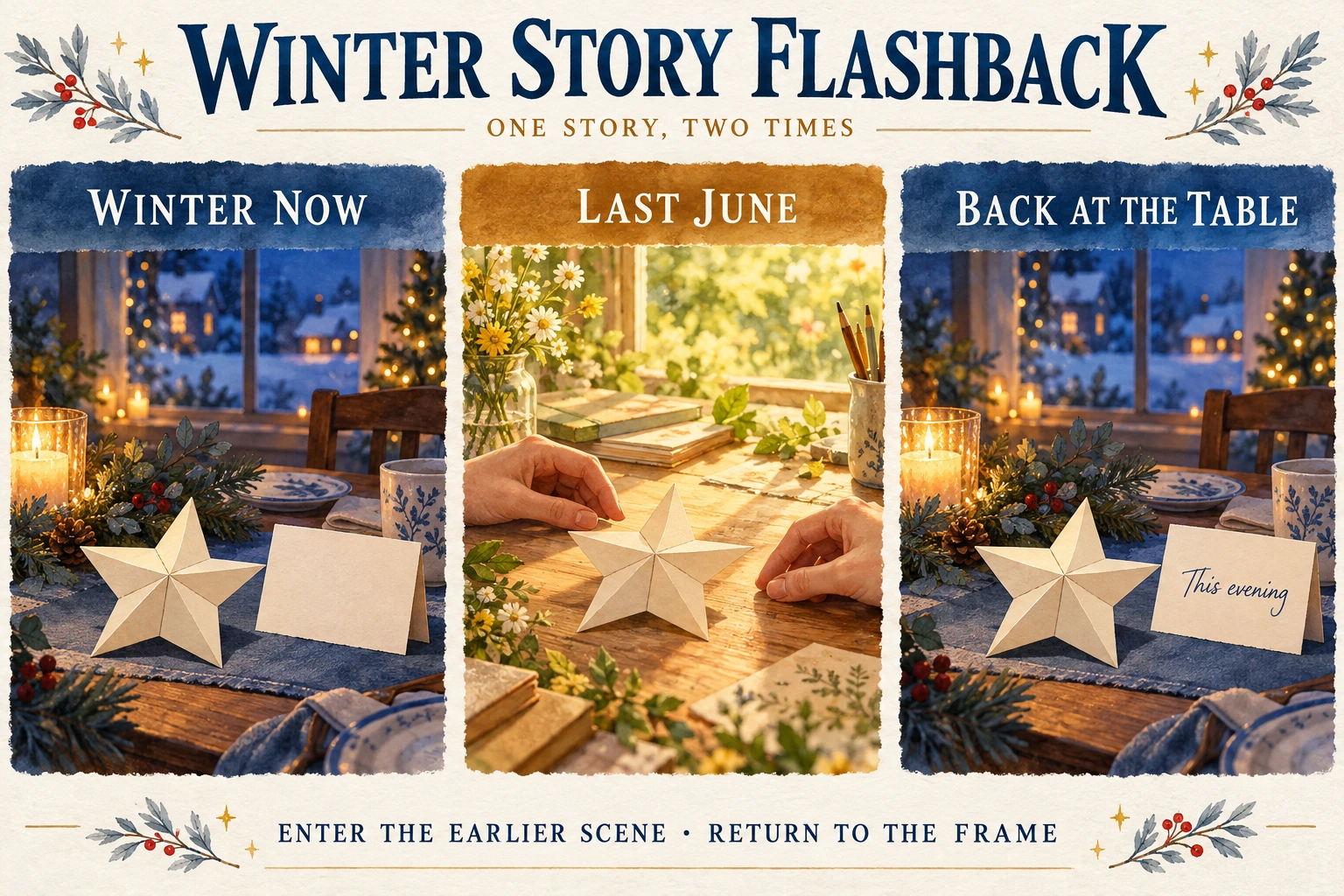
An original winter scene follows Nila from a gathering into an earlier June moment, then back to the same table. Entry and return anchors keep the two story times identifiable.
Keep the gathering as the story's present frame
A winter story flashback can leave a gathering for an earlier scene, then return to the table where the current action began. For this original writing exercise, follow Nila beside a paper star and an unwritten card. An earlier June moment belongs inside the same authored history. It is not a second possible explanation of a photograph or a report of someone's actual recollection.
The gathering, characters and every event below are invented. In this fiction, the June scene happened before the winter evening. We will tell the winter opening first, place the June scene inside it and then resume the winter action. Keep that order of presentation distinct from the order in which the fictional events occurred.
Use an available page for the manuscript. You can finish the passage by choosing its events and transitions, without a performance, observed reader response or claim about how everyone should write a memory. The exercise supplies one particular frame and a complete small scene to inspect.
Read the opening at the winter table
At the winter gathering, Nila stands beside a table that is still waiting for its stack of clean plates. A folded paper star lies near her sleeve. One corner carries no pattern. She turns an unwritten card sideways, then straightens it again. Across the room, someone moves a chair, but Nila stays with the star. She has brought a pen and has not yet decided what to write. Her finger stops at the plain corner, where the fold runs toward the center.
This opening gives the current action a place: Nila is at the winter table with the star, card and pen. The plain corner is a detail the next passage will revisit. It does not establish a real craft method, a tested object or a gathering that anyone has observed.
Keep the card unwritten at this point. Its later words will belong to the continuation after the earlier scene. Putting those words into the opening would change the sequence the complete version supplies. A small object can keep its own changing state across a story without being given an unexplained history.
Enter the earlier June scene explicitly
Last June, Nila sat opposite Oren at another table, with the same star between them. Afternoon light reached the edge of the page but stopped short of their hands. Nila drew a short line on one point and asked whether every corner needed a pattern. Oren turned the star slowly. “Leave this one plain,” Oren said, touching the unmarked corner. Nila set the pen down. They looked at the remaining blank space without choosing a name for it. Before they left, Nila slid the star into a folder of her own.
The words Last June locate this whole passage before the declared winter gathering. The table and Oren belong to that earlier scene. Nila remains the person we follow, and the star provides an object shared by the two times. The manuscript has not said that Oren is present at the gathering or explained where Oren is now.
The spoken sentence is original fictional dialogue. It is a choice about this authored star, not advice about folding, decorating or preserving an actual paper object. The scene contains no construction steps. Keep its small exchange attached to the earlier table rather than turning it into a procedure for the reader to follow.
Return to the same winter table
Now, beside the winter table, Nila draws her hand away from the plain corner. The stack of plates arrives at the other end, and she shifts the unwritten card enough to make room. She writes “This evening” across it, waits a moment and sets the pen down. Then she places the card beside the star, with the words facing the room. Someone asks where the plates should go. Nila points to the clear end of the table. The plain corner stays turned toward her.
The return phrase identifies the current table rather than introducing a second winter gathering. Action resumes after the opening's pause: the plates arrive and the card receives its words. Nothing in the June passage has already written those words or moved the winter plates.
Leave the ending at that point for this version. It supplies a card, a gesture and a continued gathering without explaining what every person thinks of the star. You may want another scene later, but its events should be written separately rather than treated as a conclusion already established here.
Put event chronology beside the telling order
Make a short outline of when the invented events happened. First comes June, when Nila and Oren inspect the star and leave one corner plain. Later comes the winter opening, with Nila beside the unwritten card. The winter continuation follows that opening, adding the plates and the words This evening.
The manuscript presents those parts in a different order: winter opening, earlier June, winter continuation. It visits two story times through three blocks of prose. Returning to the winter frame does not make the winter evening happen twice.
A chronological retelling could begin with the June table and proceed to the winter gathering. That would change the presentation, while the same declared events could remain available. This exercise retains the framed version so the earlier exchange arrives between Nila's initial pause and her next action at the gathering.
Keep those two outlines labeled. A list headed event chronology should not silently become a list of paragraphs. Likewise, a note saying June is the second passage identifies its place in the telling, not its place after the winter gathering in the fictional calendar.
Check the entry and return phrases in their passages
Read Last June with the whole earlier paragraph, including Oren's line and Nila putting away the star. The phrase has a full scene to introduce. It is not merely a date attached to the winter table. In this version the earlier passage has its own place, actions and stopping point.
Now read Now, beside the winter table with the whole continuation. Both now and the named table help locate the resumption. The arriving plates and the still-unwritten card connect it to the opening. Those details give this particular return more support than the single word now would provide on its own.
As a wording trial, consider beginning the earlier paragraph with At the other table instead. That phrase names a place but does not itself state that the scene happened in June. Other context might still establish the time, so it is not automatically an error. For this manuscript, retain Last June because that is the temporal information you want at the entry.
Similarly, She draws her hand away could begin an action without naming the winter location. This version keeps the explicit return phrase. The choice concerns these two passages; it supplies no rule that every story must repeat a month, use now or explain every transition in the same way.
Keep one viewpoint while the time changes
The earlier scene does not require a new narrator or a different person to take over the account. We follow Nila at both tables. Oren speaks in the June passage, but the manuscript does not switch into an account of Oren's private thoughts.
Changing the winter paragraphs from present to past would be another writing decision. It would not by itself remove the June event or put every event into chronological presentation. Grammatical tense and the placement of an earlier scene need their own checks rather than being treated as the same change.
For this version, keep the winter actions in present telling and the June scene in past telling as written. Preserve the entry and return anchors with them. If you revise the tense later, inspect the complete passages again so a broad verb change does not accidentally replace an event or erase the return to the card.
Leave unwritten history outside the selected scene
The manuscript establishes that Nila brought the star from the earlier table into the later winter setting. It does not say why Oren wanted the corner plain, how long the folder held the star or what happened between the two scenes. Those are available questions for another draft.
A note claiming that every guest understood the plain corner would add a response the story has not supplied. A note claiming that the scene came from a real memory would change its provenance. Keep the complete passage labeled as original fiction, including its quiet gaps.
You can prefer a more direct chronological version or a longer earlier scene. If you write one, save it as another version. The framed manuscript does not need to win a comparison with every possible telling before you can keep its three selected passages.
Keep other creative projects separate
The sound-journal guide separates the date of an entry from a remembered scene and connects that scene with an imagined musical sketch. Here the earlier scene belongs to openly authored fiction, with a written return to the current frame.
The two-caption drawing guide proposes alternative histories for one unchanged picture. The June event and winter table here belong to a single authored history. Their order in the telling changes without presenting two competing accounts of what happened.
Read the actual paperweight accounts
The native CC Gifts Papillon account has a brief description. Its sole image shows a faceted round weight, a dog motif and the printed name Papillon. No material or holding performance is verified.
The native CC Gifts Leonberger account is also brief. Its sole image shows a faceted round weight with a named dog motif. No dimensions, mass or protective effect is established here.
Keep a purchasing enquiry outside the fictional timeline
If you separately consider a paperweight order on republeq.com and want to ask about USDT, identify the actual offer and intended quantity before discussing payment. Nila's star, card and two story times are invented manuscript elements, not product identifiers, checkout prices or cryptocurrency amounts. This article does not establish that a payment option is currently available for an account, location or basket. Read the choices and conditions actually presented for the intended transaction, and ask the responsible support contact to clarify essential information that remains missing. If a cryptocurrency option is offered, establish the specified asset and network, the requested amount, any stated validity period and the reference associating payment with that order. Do not reconstruct a transfer destination from a photograph, an earlier transaction or a phrase inside a fictional scene. Keep each product question and answer attached to the actual offer it concerns. Information about one proposed order does not automatically describe another quantity or item, and a change may require reviewing the resulting order information again. Ask separately about applicable delivery, cancellation, return and refund conditions, including how an approved amount would be determined, its denomination and any deductions. No present USDT eligibility, discount, conversion result, fee level, refund amount, processing time or delivery outcome is promised here. You can complete every manuscript comparison using an available page without placing an order. Preserve any eventual order acknowledgement and payment record separately from the story. A clear transition between June and winter cannot confirm an uncertain transaction, authenticate payment instructions or establish the contents of an actual package.
Retain the earlier scene and its return together
Save the winter opening, the June paragraph and the winter continuation as one selected manuscript. Keep Last June at the earlier scene's entry and Now, beside the winter table at its return. The three passages tell one invented history out of chronological presentation, then bring Nila back to the card she had not yet written.