Computer Accessories
USB hub host cable replacement. Check the attachment
Check the host-lead attachment before shopping for a cable. Keep a separately connected lead and a built-in assembly with their own model information while leaving spare availability and any internal service question unresolved.
Find where the host connection begins
A frayed lead can send a buyer straight to a cable listing before they have identified what needs replacing. For USB hub host cable replacement, begin with a narrower question. Does the hub's own documentation describe a connection you make with a separate cable, or a cable already built into the assembly? That distinction changes the question you can reasonably put to the manufacturer. It does not establish that a replacement is sold, that a repair is available, or that an apparently similar lead will work.
Imagine Rowan preparing an inquiry about a hub on a shared desk. Ellis has suggested ordering something with the same-looking plug. Rowan instead wants to send a useful description of the connection. This is a fictional buying situation, without a damaged sample, a physical trial or a successful repair behind it. The task is to distinguish a separate host lead from a built-in cable using evidence tied to the actual model, then leave the remaining compatibility and service questions open.
Keep the device identity alongside the attachment question. A shopping result, an old order description and a hub on the desk may resemble one another without proving they are the same version. If those records disagree, resolve the identity before choosing an accessory. Rowan's useful first output is a short record of the model being discussed, the source of that identification and the wording that describes its host connection. A photograph can help frame the inquiry, but a partial view cannot supply a missing specification.
Separate the connection evidence from the photograph
For its 10G8A2CS-USB-C-HUB, StarTech's own product account describes a screw-locking USB-C host connection and a host cable included separately. The account also says there is no PD pass-through. Those are model-specific statements. They support asking about the documented host-cable arrangement, while leaving replacement availability and an alternative cable's suitability unresolved. The manufacturer's spelling differs from the compact catalog alias, so a useful inquiry retains both forms alongside the matching product identity instead of treating punctuation as proof of a different device.
Rowan can now write down exactly what that account establishes and exactly what still needs an answer. The inquiry might ask which currently offered part, if any, the manufacturer identifies for that model and intended use. The answer needs to address the proposed purchase directly. Availability remains a question for the party offering the item. If the seller cannot identify an appropriate item, an unresolved inquiry is a sounder outcome than selecting a plausible-looking lead from a search result.
The native StarTech ten-port hub listing identifies catalog model 10G8A2CSUSBCHUB and lists a hub, a separate USB-C host cable and a universal power supply with interchangeable AC prongs. Its sole gallery image shows the hub's front and side, without showing those separate supplied components or the host connection. The package account therefore adds information the photograph cannot confirm on its own. Its general power-delivery language does not resolve the manufacturer's explicit no-pass-through statement.
Recognize when the lead belongs to the assembly
The second native StarTech HB31C3ASDMB hub listing shows a compact hub with an attached lead and USB-C plug. Its account includes an integral card reader, without supplying a memory card, and expressly excludes a microSD adapter. These details describe this offered assembly. They do not establish that a loose host cable can be ordered or fitted, and the appearance of an attached lead does not reveal an internal repair method.
StarTech's own HB31C3ASDMB product account explicitly describes a built-in cable. That wording gives Ellis a specific starting point for the inquiry. It does not establish user serviceability, a replacement assembly, a warranty remedy or a repair entitlement. The practical next question is what support or replacement options the manufacturer currently identifies for that exact model and reported condition. No instruction to pull, open or detach the lead follows from this description.
Keep the comparison at that level. A built-in cable is an attachment description in this decision, not a verdict that the complete product must be discarded. A separate host lead is likewise no guarantee of an easy or available remedy. Rowan can distinguish the two inquiries without promising either outcome. If support requests more information, add that information to the same record. Avoid filling an unanswered service question with a conclusion drawn from another hub, an unfamiliar repair video or the presence of a familiar connector.
Write an inquiry that preserves the unknowns
A useful message begins with the exact model and the reason for asking about its host connection. Describe the reported condition plainly and label any uncertainty about the device identity. Quote the short attachment wording from the relevant documentation, retaining its source in your own notes. Ask whether the manufacturer identifies an appropriate replacement part or service option for this model. This keeps the conversation answerable without requiring Rowan to diagnose an internal fault or make a claim about how the assembly was manufactured.
Separate observations from interpretations in that message. “The lead appears attached in my photograph” describes the submitted view. “This cable is replaceable” states a conclusion that the view alone may not support. If the model label cannot be read, say so. If the available image omits the connection, say that as well. Clear limits give the recipient room to correct the identification. They also make it easier for Rowan to recognize when a reply addresses the actual question instead of a neighboring product's specifications.
Before placing an order, retain the precise part or assembly identification supplied in the reply and the use for which it was recommended. A general invitation to browse accessories does not answer the model-specific question. If a seller proposes an alternative, ask what connects that recommendation to the hub under discussion. Rowan's record should let another person see where the proposed purchase came from. It need not contain an invented diagnosis, a compatibility promise or an assumed entitlement to a free replacement.
Keep this decision separate from a hub upgrade
It is easy for an attachment inquiry to turn into a broader search for a newer dock. Pause that change of scope long enough to name it. Is Rowan trying to identify a supported remedy for the existing device, or selecting a different complete product? Either can become a separate purchasing task. Combining them prematurely makes it harder to tell whether a new accessory recommendation actually answers the original inquiry. Keep the existing model record intact even if the eventual decision is to consider another hub.
A comparison note can be simple prose. One entry records the attachment description supported by the exact model's account. A second records the question sent to support. A third records the current answer and what remains unresolved. This is a communication aid, not an electrical assessment or a repair procedure. It gives Ellis a way to review the proposed purchase without reconstructing a trail of browser tabs. It also preserves a useful distinction between a documented product feature and a later statement about available parts or service.
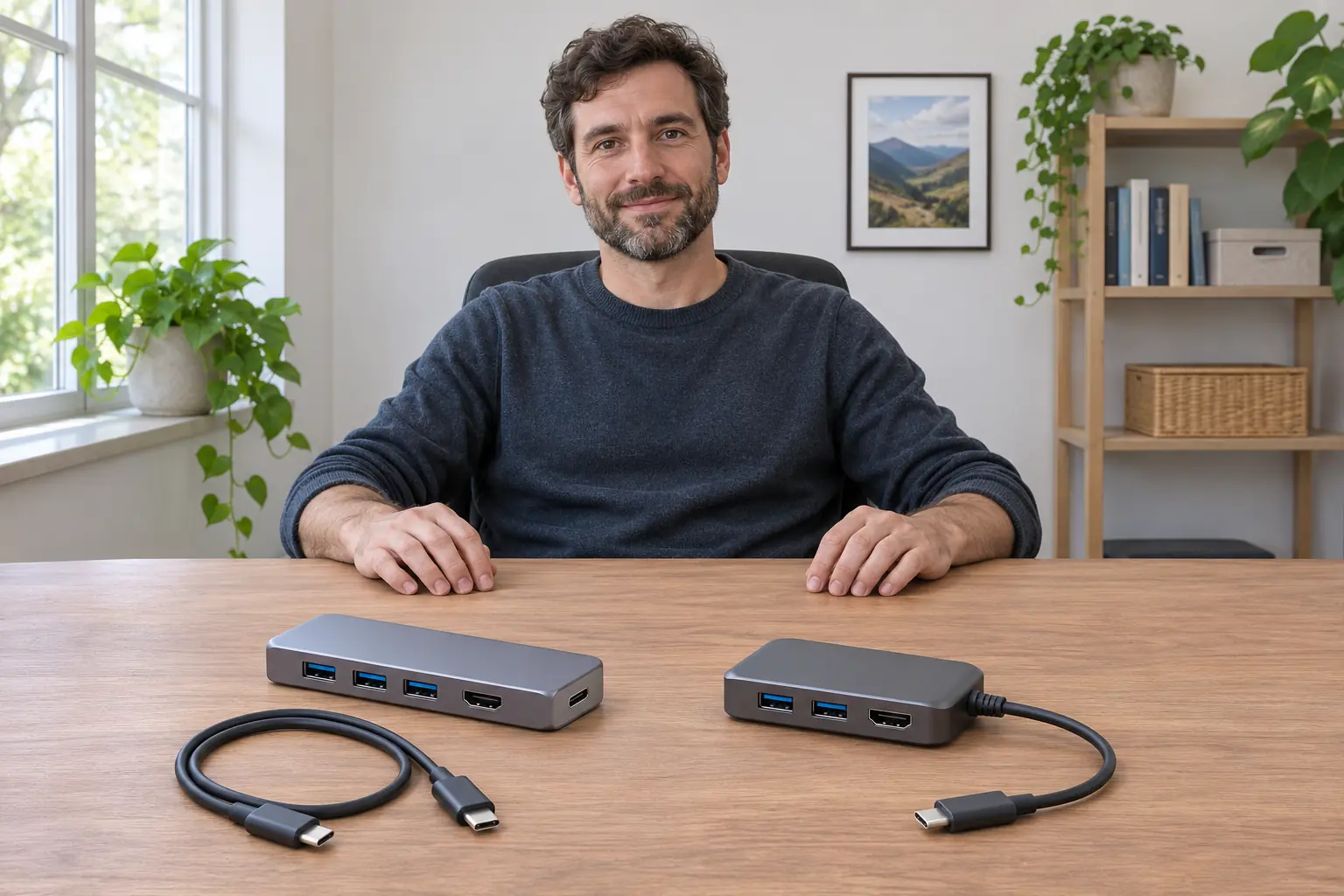
A photograph used for that inquiry should be described honestly. If it is an example image from a listing, identify it as such instead of presenting it as the buyer's device. If it is a conceptual illustration, keep it separate from evidence of the actual connector. Rowan's fictional desk scene does not authenticate a retail product or demonstrate a repair. This article's cover likewise illustrates two attachment arrangements generically. Its role is to explain the question, while exact-model documentation and a responsive support answer carry the purchasing decision.
Use neighboring guides for their own questions
The guide to USB-C hub port roles for charging and data addresses port-role distinctions. Consult that separate discussion when the question concerns which role a connection serves. A port-role explanation does not itself establish spare-part availability or authorize detaching an attached lead from this article's example models.
The guide to USB4 and Thunderbolt dock compatibility with a laptop host addresses a different compatibility decision. Keep that host-selection question separate from identifying the attachment arrangement on an existing hub. Neither a compatibility discussion nor a familiar connector supplies an unanswered model-specific service or replacement offer.
Once the attachment inquiry has an answer, check whether the proposed purchase actually matches it. Retain the seller's exact item identity, the model it was recommended for and any stated limitations. If the answer remains incomplete, keep the purchase pending. The aim is a defensible decision about the offered item, with the remaining unknowns visible to everyone involved. More open tabs do not necessarily improve that decision. A short, traceable answer to the exact question can be more useful than a broad catalog of similar-looking accessories.
Keep checkout conditional on a resolved item
If you later consider purchasing through republeq.com with USDT or another cryptocurrency, keep the payment decision separate from the unresolved host-lead inquiry. First identify the exact offered item and establish what the seller says about its suitability for the model and intended use. A cryptocurrency payment cannot supply missing compatibility evidence, establish that a spare is available or turn a conceptual illustration into a product specification. At checkout, inspect the payment methods actually presented for that order. Do not assume a method is available because it was discussed in an article or appeared during a different visit. If USDT is offered, verify the exact token, network, recipient details and transaction instructions shown in that current checkout before deciding whether to proceed. Retain the item description, the relevant seller response, the order terms and any transaction reference so the purchase record remains understandable afterward. Ask about unclear delivery, cancellation, return or support terms before authorizing payment, and avoid treating a wallet confirmation as proof that an order has been accepted or dispatched. In Rowan's fictional inquiry, there is no completed order, supported replacement recommendation or payment result to report. The next step remains obtaining an answer tied to the actual hub and offered item. If that answer identifies no suitable purchase, checkout has no role in resolving the attachment question. If the item is established and you choose to buy, follow the live order instructions and preserve the resulting records. Payment is a later part of the transaction, with its own current terms and evidence, after the model-specific purchasing question has been answered.
For USB hub host cable replacement, finish with the attachment description you can support and the purchasing answer you actually received. Rowan and Ellis have a clear next inquiry, rather than a tested repair outcome. The separate-lead and integral-lead examples show why that inquiry needs an exact model. Leave availability, suitability and service options open until the relevant party answers them. That is enough to move the decision forward without inventing an internal repair method or buying on the strength of a matching plug alone.
Keep the resulting record with the device information for whoever handles the next conversation. If the manufacturer corrects the model identification or changes the proposed option, preserve that correction alongside the earlier question. A later reader should be able to see which evidence supported the final choice. Stop short of describing an untried part as a successful fix. The completed task here is a clearer, model-bound purchasing decision, with any unanswered questions still visible.