Tools & DIY
A touch latch and strike plate: what each cabinet part does
A cabinet touch latch, its base, and a matching strike plate form a model-specific contact pair; product labels alone cannot establish interchangeability.
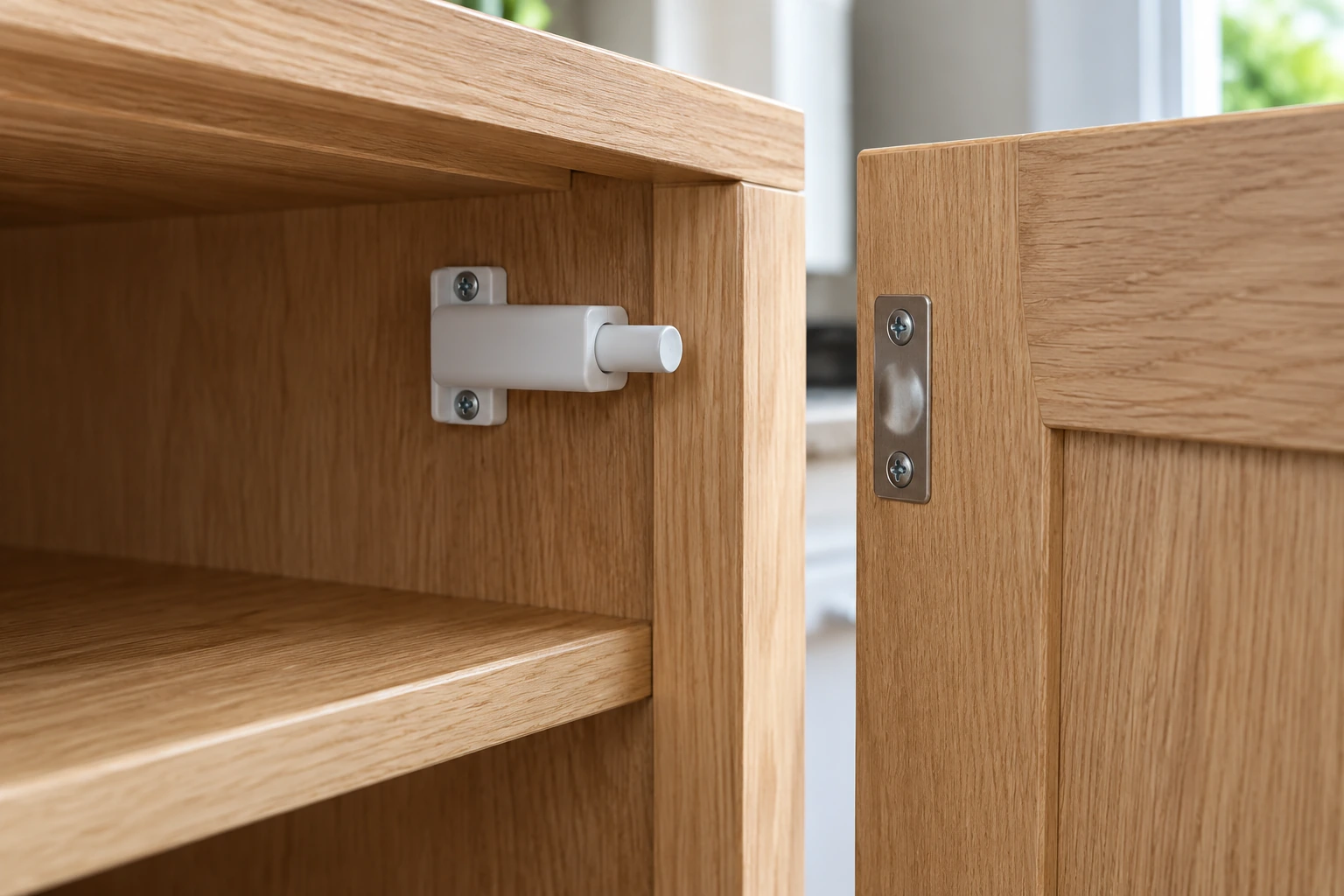
A touch latch and strike plate are two parts of a cabinet-door meeting. One part sits on or inside the cabinet; the other travels with the door until it reaches the latch. A push-to-open setup can look simple from the outside because the door has no visible pull, but the contact between those parts still depends on the exact hardware and the way the door closes. Understanding the parts helps you read a listing or installation sheet without treating every “touch latch” as the same mechanism.
This is an explanation of the contact pair, not a repair procedure. A cabinet that will not catch needs its own observation and model-specific instructions. The separate push-to-open cabinet latch troubleshooting guide covers that symptom. Here the reader's question is more basic: which object does what, what can a product page actually establish, and why must the latch and strike be considered together?
Follow the door to the touch latch and strike plate
Picture the door almost closed. The door carries a plate or another specified contact piece toward the cabinet-mounted latch. The latch has a body that fixes its position, and the matching contact piece reaches a particular face or moving element. When the door is pressed as the maker intends, the mechanism changes state and the door can release. That sequence is a useful mental model, but the actual moving parts and required clearances belong to the installed model's instructions.
The strike plate is not merely a decorative metal patch. It defines where and how the door-side component meets the latch-side component. Its size, shape, thickness, mounting position, and material may matter to that specific system. A similar-looking plate from another package cannot be assumed to work. Nor does a visible metal plate prove that the installed latch uses a magnet; some systems pair a plate with a spring-driven catch or a different contact arrangement.
It helps to name the fixed and moving sides separately. The cabinet frame or interior panel usually gives the latch its reference position. The door brings the strike toward it along an arc determined by the hinges. If the door moves on a different path, the two pieces meet differently even when neither part has changed. The cabinet hinge and overlay guide owns the distinct question of door geometry. This explainer stays with the latch-and-strike interface.
Product pictures often show loose components side by side. That can help identify what comes in a pack, but it is not a full-scale installation diagram. A photo taken at an angle may hide the depth of a plunger, the underside of a base, or the way a plate fastens to a door. Use a diagram or instruction sheet for the exact product when those details matter. The picture can start a question; it should not settle the fit.
Read push-to-open cabinet latch descriptions carefully
A seller may use “push latch,” “touch latch,” “magnetic catch,” and “push-to-open” in one listing. Those words overlap in ordinary shopping language, but they do not describe every internal detail. A spring can provide a push-out action. A magnetic component can help retain a door against a matching piece. The exact balance of those functions varies by product. Read the native description and maker instructions rather than translating one marketing label into a universal mechanism.
For example, an eight-piece push-latch listing describes a spring plunger, magnetic catch, mounting base, and iron plate. Its seller also describes an installation sequence using holes in the base. Those are claims about that offered set. They do not prove that another cabinet has the same base, the same plate, or the same mounting clearance. They should not be copied into instructions for unidentified hardware.
A separate Sugatsune touch-latch listing describes its own spring-loaded release, matching strike, and stated throw. It also says mounting screws are not included. The presence of a strike in that listing answers a package-content question for that item; it does not establish that its strike is a replacement for a different latch. Even two products described as magnetic touch latches may have different body heights, travel, and fixing points.
Look for a model identifier before relying on any number. A throw dimension or magnetic pull value is meaningful only for the specified assembly and the conditions in which that value was stated. It cannot predict the force at your particular door without installation context. The seller's broad heavy-door language for one set is not an independent load test for every cabinet. Keep numerical and performance claims attached to the exact source that makes them.
Understand cabinet strike geometry and mounting points
The latch body needs a fixed place to work from. A mounting base or bracket can set its height and depth relative to the approaching door. The plate on the door sets the other half of that relationship. This is why a change to one part can affect the contact even when the other part is untouched. The explanation is geometric: two positioned objects must meet in a defined path. It is not permission to move either part without the appropriate model instructions.
The eight-piece seller page distinguishes oval holes used while locating its base from round holes used to fix the chosen position. That description helps explain why a base might have more than one kind of hole. It does not tell you where to drill an existing cabinet, which fastener suits a material, or whether the pictured parts match your installation. Those decisions need actual part identity, the mounting surface, and the manufacturer's procedure.
The Sugatsune listing's note about screws shows another boundary. “Strike included” does not mean every item needed for a safe installation is in the box. “Screws not included” means fastener choice cannot be inferred from the product photo alone. The correct fastener depends on the exact cabinet material, mounting location, and maker guidance. A product page can supply a component inventory while leaving a practical installation question open.
Depth matters as well as visible alignment. A plate can appear centered when viewed from the front but fail to reach a latch set too far back, or meet it sooner than the mechanism expects. An image rarely gives the complete closing clearance. An exact installation drawing may specify a gap or throw for that model. Do not transplant a dimension from a second product simply because the two pictures resemble one another.
Keep package contents separate from compatibility
A multipack answers how many units a seller offers. It does not answer how many doors in your home have the same hardware. If two cabinets were installed at different times, their latches may differ despite similar door fronts. Before treating a package as a replacement supply, compare the maker and model, body and base dimensions, strike design, screw pattern, and required door movement for each actual location.
Take particular care with parts sold as accessories. A plate, base, or replacement spring may have a name that resembles the complete latch but serve only one position in one system. Read the listing's “what is included” text as literally as possible. Product photos can include props or show only a representative assembly. The native descriptions for the two linked examples are more useful than the broad label “touch latch,” yet even they cannot identify a cabinet you have not inspected.
Brand can narrow a search but does not finish it. A manufacturer may sell several related latches with different strokes or mounting bodies. A generic unbranded set may have a detailed description but no guarantee that its dimensions match an old part. Model numbers, measured part dimensions, and the manufacturer's current installation sheet are stronger evidence for a specific fit than a shared color, package size, or casual product title.
Use the contact model without turning it into a repair guess
Understanding the pair can organize observations. You can ask whether the door-side part reaches the latch-side part, whether the parts are the ones specified for each other, and whether the mechanism changes state as its own instructions describe. Those are questions, not conclusions. A door that will not stay shut might have a latch fault, a door-position problem, an obstruction, or an incompatible part. The same visible symptom does not identify one cause.
That distinction protects the cabinet from unnecessary work. If a person assumes the magnet is weak, they might buy a stronger-sounding product before learning that the plate never makes contact. If they assume the plate is misplaced, they might move it when the door is actually crooked. If they assume a spring is broken, they might overlook the exact maker's intended reset motion. Each guess can change the evidence before the original issue is understood.
For a real repair, preserve the current arrangement: photograph the latch, plate, hinge side, and any label before adjusting anything. Use the model-specific procedure and stop if the door or mounting surface cannot be supported safely. This article does not provide a universal sequence for loosening screws, drilling, or altering spring tension. Its purpose is to make the parts legible so the correct instructions can be found.
A useful way to read the next product listing
When comparing an actual latch listing, start with five separate questions. What is the functional assembly? What pieces come in the package? What does the maker say about strike and base geometry? Which dimensions and operating claims are stated for this model? What information is still missing for the cabinet in front of you? Keeping those questions separate prevents a persuasive photo or a large pack count from standing in for fit evidence.
Use a short note if several candidate products are open in browser tabs. Record the exact URL and model, the described latch body, the included strike, the mounting hardware statement, and the installation document you still need. Do not combine the best-sounding feature of one listing with the dimensions of another as if they form a single assembly. The eight-piece and Sugatsune examples illustrate different offers, not interchangeable halves of one kit.
The touch latch and strike plate make sense as a paired contact system. The cabinet anchors one side; the moving door brings the other side to it. A spring, magnet, base, and strike may each play a role, but their actual roles and measurements are model-specific. Once you can name the parts and the questions each source can answer, a listing becomes easier to assess and a real cabinet problem can be handed to the right instructions without a guess dressed up as a repair.