Sewing & Crafts
A torn-paper shoreline collage with one chosen bay
An original loose-paper composition uses a ragged land edge, an open bay and a small house; two complete alternatives lead to one selected arrangement.
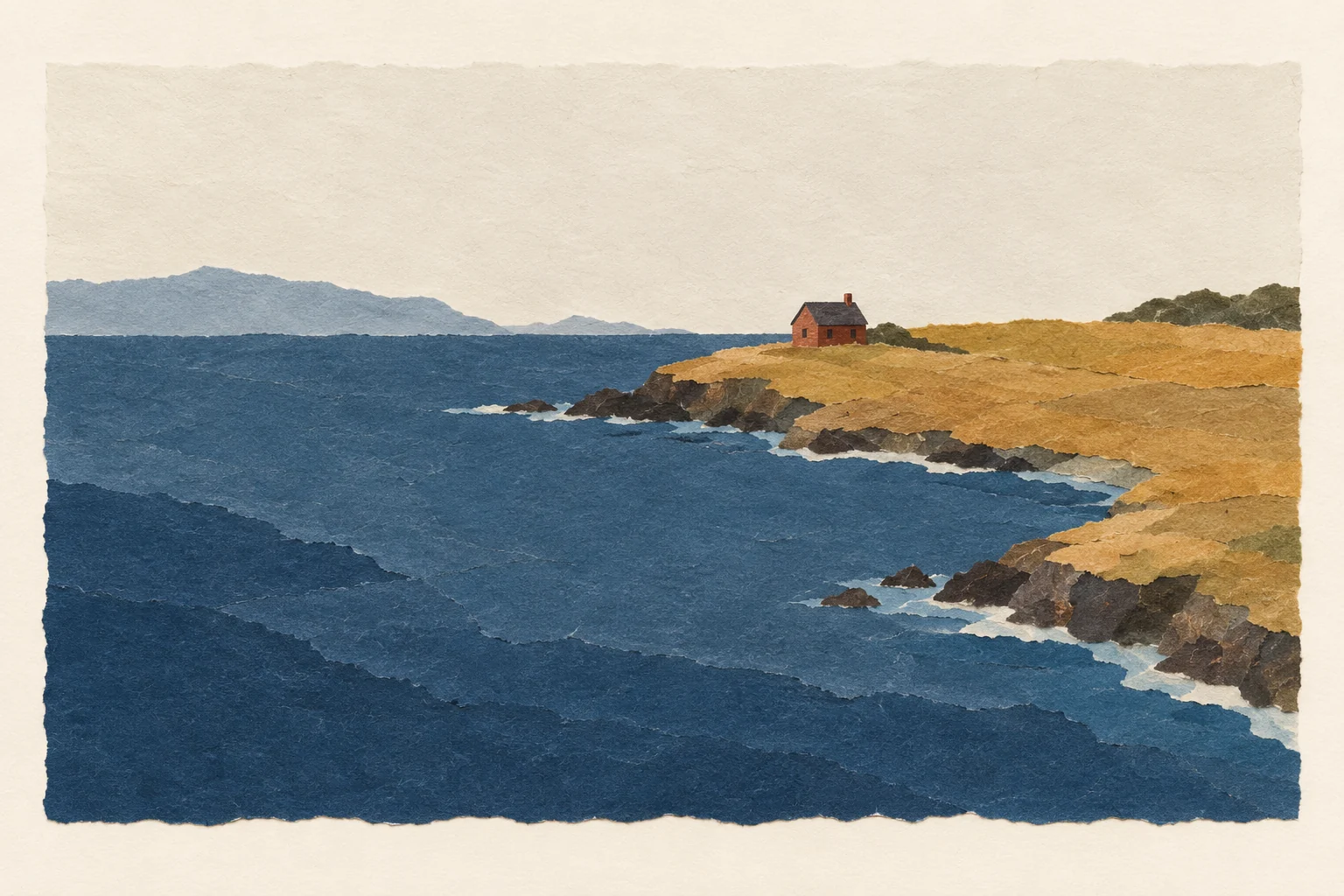
A torn-paper shoreline collage can begin with a particular edge rather than a drawing of a place. For this original plan, I choose an ochre headland beside an open blue bay, with a small rust-colored house on the land. The coast is invented. The arrangement below is a proposed picture made from ordinary loose scraps, not a report of a completed workshop, a geographic map or a test of either notebook offer discussed later.
A ragged paper edge separates the invented headland from its open blue bay.
Begin with the coast this picture needs
Set out a pale background, a broad blue piece, an ochre piece with an already ragged edge and a small house-shaped piece. These are the elements of this authored example, not a required retail kit. Use loose pieces already suitable for your own arrangement. This article plans their positions; it gives no cutting, adhesive, drying, mounting or finishing procedure. The working picture can remain loose while its composition is being chosen.
Give the background a landscape orientation. In this plan, the open water belongs toward the lower left, and the headland comes into the picture from the right. Leave some pale background above them as sky. That initial description is enough to start arranging. It does not require an outline of a real coast, a measured horizon or a correct scale for the house. The picture has no named town or actual building to reproduce.
Choose the ragged land-water edge
Look at the existing ochre edge before adding another mark. For the selected version, I want a section that bends inward and then comes forward again, giving the blue paper a bay-like opening. A straight edge could belong to another image, but it is not the edge I choose here. Turn the loose ochre piece until its irregular section can meet the blue area without needing a drawn line to explain the boundary.
Keep the rest of the ochre piece extending toward the right side of the background. Its far edge does not need to become another coast within the picture. In this arrangement it simply leaves the visible composition at the right. That choice gives the ragged section a clear job. It is the meeting place between the land and water I am inventing, rather than one of several unrelated torn edges scattered across the same page.
Keep the blue bay open
Place the broad blue piece low and left, then bring the ochre piece over its right-hand side. Let the ragged edge turn away from the center before it reaches the headland’s point. The exposed blue opening is the bay in this plan. Leave it connected to the larger blue area toward the lower-left side. I am choosing an open stretch of water, rather than an enclosed blue patch surrounded by land.
Read that loose arrangement without the house for a moment. There is pale sky above, blue water below and an ochre shape coming in from the right. The bay’s opening stays part of the broad water shape. If you want to try a different overlap, move the land while keeping those elements visible. A note saying “make it coastal” would not preserve this choice. Name the change you want: open more blue beside the headland or bring the ochre edge farther across it.
The blue piece does not need drawn waves to qualify as the water in this invented picture. For the selected version, I leave its surface plain. The uneven boundary already gives the composition something specific to follow. Adding a pattern would be another decision, and I do not choose it here. A plain area can remain plain without becoming an unfinished instruction to fill every part of the paper with marks.
Above the bay, the upper blue edge meets the pale background. I leave that meeting relatively quiet in this version, while the ochre edge bends farther into the water. The sky remains the visible background rather than another separate strip. That keeps the plan attached to the pieces already named. I am not adding a sunset, cloud bank or distant village to explain the empty upper area.
Put the small house on the headland
Bring the rust-colored house into the arrangement after the land-water boundary has a position you want to keep. Place it near the headland’s outer part, with ochre showing around its base. In this plan it belongs on the land. I do not put it across the ragged boundary or into the blue opening. Keep its roof and walls as a simple silhouette rather than adding doors, windows or a story about somebody living there.
Try the house slightly farther inland, then near the outer point, using the same loose piece. Keep both positions available while choosing this particular picture. The inland position gives more ochre between the house and the water. The position nearer the point keeps the house beside the edge I selected first. I choose the latter, while leaving enough visible ochre around it that the house is not merely balancing across the shoreline.
Read the complete open-bay arrangement
The pale sheet surrounds a blue water shape that enters from the lower left. An ochre headland extends inward from the right. Its ragged edge bends away to make an open blue bay, then comes forward into a point. Near that point sits the small rust-colored house, with a dark roof and ochre visible below and beside it. Above the water and land, the pale background remains open. This is the complete first arrangement I am comparing.
Keep that whole description beside any small revision. Moving the house inland would change one relationship. Closing the bay with more ochre would change another. Adding a boat would introduce an element this version has not chosen. You can make those other pictures, but do not quietly add them while claiming to compare only the house’s position. The loose arrangement is useful because a choice can be made visibly without requiring an explanation about a piece that is no longer there.
Compare a complete enclosed-inlet alternative
For a second arrangement, turn the same ochre piece so more of it crosses the blue area. The exposed water becomes a narrower inlet near the center, with less of the broad blue opening visible beside the headland. Put the house farther to the right, away from the point. Keep the pale sky and plain blue surface. This gives the alternative a whole composition of its own, rather than describing it only as the first picture with something missing.
In the enclosed-inlet version, the house occupies the larger land area near the right side. The ragged edge still separates the chosen land and water, but the blue opening has become smaller. I can keep that arrangement as a separate possibility. It does not need to be called wrong before I choose the open bay. The selection concerns which picture I want to make from these pieces, not a claim that one arrangement is better for every person or every coast.
I return to the first version because I want the broad blue opening beside the headland and the house near its point. Restore those actual positions before calling the choice settled. Do not leave the land in its enclosed-inlet position while writing an attractive description of the open bay. Let the selected description identify the arrangement you keep, including where the small house stands.
Retain one complete selected composition
The selected picture has a pale landscape background, a broad muted-blue water area toward the lower left and an ochre headland coming in from the right. Its ragged edge leaves the bay open into the larger water area. The small rust house sits near the headland’s outer point, with land showing around its base. The blue surface remains unmarked, and the sky remains pale. There is no boat, path, written place name or additional building in this chosen version.
Write that description as a record of this plan if the loose pieces will be put away. Keep the enclosed-inlet alternative separately if you want to return to it. A record of the chosen composition need not claim that a finished physical collage already exists. It names the image you selected. Any later decision about fixing the pieces, choosing a support or displaying the work belongs to the actual materials and their own requirements.
Leave out the next detail deliberately
The small house can remain a plain shape. In this selected plan, a chimney, doorway and lit window would each add a new mark to a small part of the image. I do not choose them merely because a house could contain them. Likewise, the bay can remain without a boat. Leaving those possibilities aside preserves the composition’s declared elements rather than turning the example into an inventory of everything that might appear on a coast.
If you want to continue another day, begin with the retained arrangement rather than with a list of ornaments to add. Ask whether you still want the open bay and the house near the point. A different answer can become a new complete version. There is no need to invent an improvement report or say that an audience preferred the result. The example records one original visual plan and its alternative, with no claim about another person’s response.
Keep other creative decisions with their own guides
The erasure poem prompt chooses word occurrences from an original sentence while retaining their order. Its deletion rule and complete word selections belong to that writing exercise. The shoreline plan arranges loose visual shapes. It has no source sentence, occurrence positions, hidden answer, numerical pattern or requirement to preserve a sequence of words.
The canvas panel vs stretched canvas guide distinguishes stated support construction from surface preparation. It does not establish a suitable support or adhesive for this loose-paper plan. Choosing an invented bay composition leaves those material questions separate. A visual arrangement is not a priming, bonding, mounting or conservation test.
Actual notebook accounts are separate stationery context
The Roaring Spring Environotes account describes brown three-subject notebooks. Its sole original image shows closed wirebound books with Environotes cover wording and code 13484. The account’s 100-sheet and 2000-page wording remains unresolved here. Neither those counts, the pictured assortment nor environmental wording establishes delivered inventory, internal pages or suitability as a collage material.
The Roaring Spring poly-cover account describes one-subject notebooks. Its sole image shows complete colored wirebound books beside a shipping carton marked as a case. The carton is bulk packaging, not an independently supplied organizer. Closed covers do not verify internal page count or material performance. Neither offer supplies or identifies the ordinary loose scraps in the original shoreline plan.
Keep the chosen edge visible in the final plan
Return to the ragged ochre edge that began the picture. In the selected arrangement it separates the headland from the open blue bay, and the small house remains on the land near the point. Those relationships are enough to identify this particular composition. Keep the complete open-bay plan and its enclosed-inlet alternative distinct. You can finish choosing the image while leaving a purchase, a fixing method and a finished physical artwork undecided.
If you plan to purchase an item on republeq.com, check the particular offer and current checkout before ordering. This guide does not establish that any cryptocurrency payment option is available. If USDT is offered for the intended order, verify the requested asset, network, amount, receiving destination and order reference with the responsible service before authorizing a transfer. Review the actual product identity, selected variant, quantity, delivery details, total charge and applicable terms. Use the confirmed order details when checking the payment instructions. Confirm any fee, conversion term or exchange rate from the current transaction information. Determine the applicable cancellation, return and refund process, including how a refund would be handled for the selected payment method. Keep the relevant instructions and transaction records, with dates and confirmed references. If essential instructions change, ask the responsible service to confirm the change against the exact order. An acknowledgement should identify the order and the agreed details; it does not replace checking whether the selected product is the one you intended to buy. If payment or order status remains uncertain, reconcile that status before considering another transfer. Do not treat an unresolved transaction as evidence that nothing happened. This article supplies no wallet address, transfer guarantee, recovery procedure or assessment of a counterparty. A product enquiry does not authorize a payment or resolve an uncertain order. If support provides an answer, retain the exact question and response so a later reviewer can understand what was confirmed. Decide whether to proceed only when the conditions of the particular transaction are clear, and retain the confirmed transaction information with the exact order.