Home & Living
tilt-out laundry cabinet purchase fit: count the space it consumes
Measure closed and open cabinet space, the basket route and household workflow before deciding whether fixed laundry furniture earns its footprint.
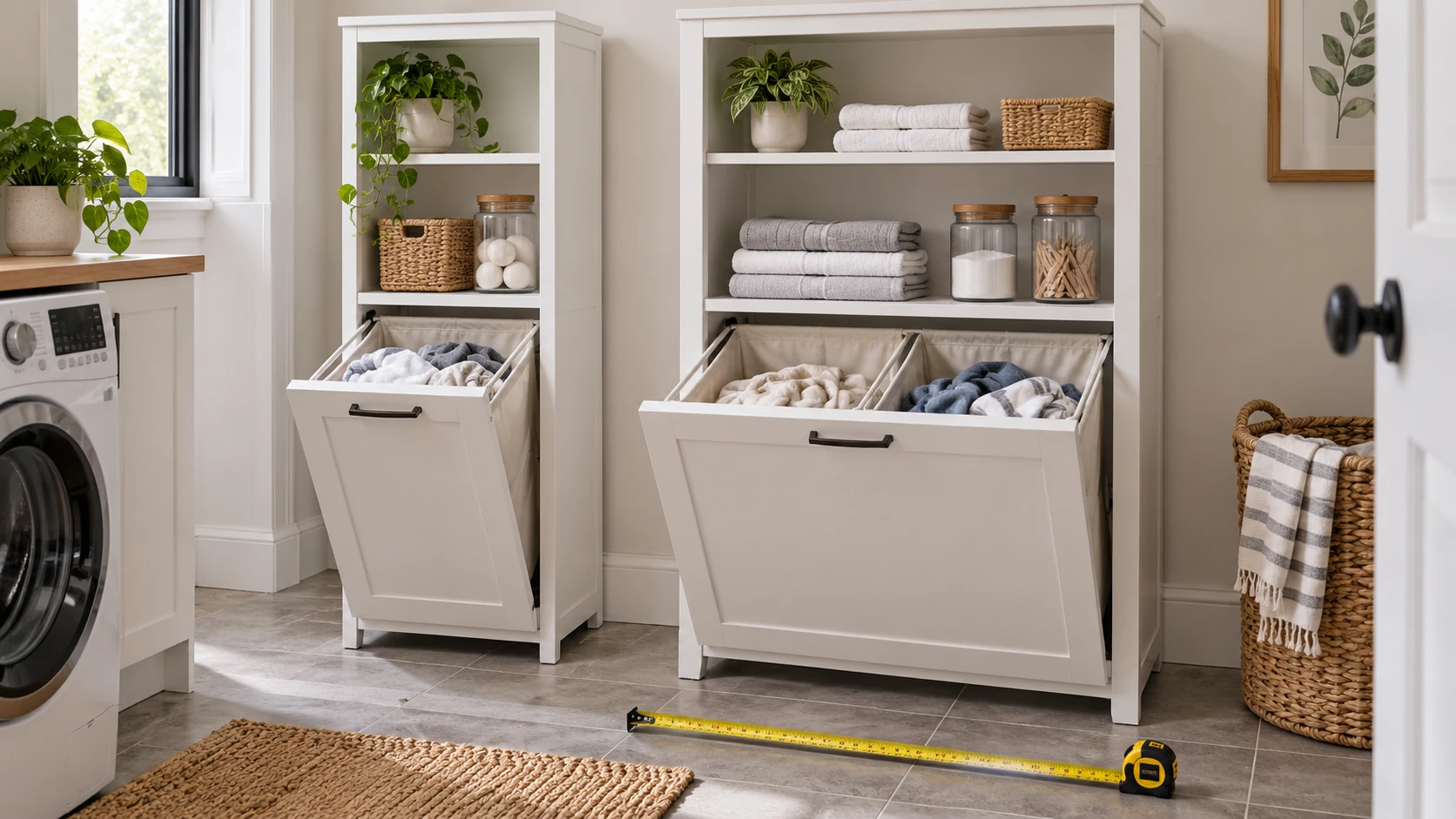
A tilt-out laundry cabinet purchase fit check asks what the cabinet will cost you in usable room before you commit to a fixed piece of furniture. That cost may be a blocked walkway, an awkward basket-removal route, or the work of returning an assembled unit that never fit. The useful comparison starts with the room and the laundry route you already have. Product photos cannot show the door swing, baseboard, and appliance access in your home.
Two listings illustrate different cabinet layouts. The XiHuaZhaoChen white laundry cabinet lists an 11.8-by-11.8-inch footprint, 35-inch height, an open compartment and shelf, and a removable push-pull hamper basket. The freestanding tilt-out laundry cabinet with shelves describes three shelf levels, adjustable shelves on the left, and a tilt-out basket. Its captured description does not supply overall cabinet dimensions. You need those measurements before treating it as a fit for a particular corner.
Measure the floor space you would give up
Mark the proposed cabinet position with paper or painter's tape. Include the outside edges, not only the hamper opening. Walk the normal route between the washer, dryer, sink, door, and place where clean clothes go. Carry a full laundry basket through that path. If the taped outline forces you to turn sideways or set the basket down, the cabinet would change the daily work even while it stores laundry neatly.
The XiHuaZhaoChen listing's stated 11.8-by-11.8-inch footprint gives you a first rectangle to test. It also states a 35-inch overall height and 20.13-pound weight. Those are listing measurements, not a check that the assembled unit will clear your baseboard, wall outlet, plumbing, or cabinet handle. Measure the delivered piece when those details matter. Leave space to reach a wall or appliance panel that you currently use.
For the second cabinet, write “dimensions needed” in the plan. Its shelves and tilt-out basket might look attractive, but the captured description does not give an exact width, depth, or height. Request the manufacturer or seller's dimensions for the exact listing, including any door or basket projection, before purchase. A photograph scaled beside towels is not a measurement. Do not borrow the narrow cabinet's numbers for the larger shelf layout.
Think about the furniture already in the room. A laundry basket on the floor can be moved to reach a panel or clean behind it. A freestanding cabinet may take several steps to shift, especially once shelves hold other items. The floor area given to that cabinet is an ongoing choice. If you must repeatedly empty the shelves to reach the appliance, the apparent storage gain could create work elsewhere.
Take a second measurement with the room in its usual state. A door may be fully open during one task and partly closed during another; a drying rack may occupy the wall only on laundry day. Place the taped cabinet outline while those ordinary items are present. Then check whether the same household member who normally carries the hamper can still do so without moving other furniture. A cabinet should be judged against the busiest version of the room, since that is when a blocked route creates the most work.
Check the opening and basket route
The tilt-out face needs a clear arc. Place a cardboard panel at the proposed cabinet front and swing it through the space where a basket will open. Watch for a door, toilet, washer lid, or another person using the room. The exact hinge and projection must come from the unit's instructions or seller measurements; the cardboard test shows whether the available area is generous enough to keep investigating.
The XiHuaZhaoChen description calls its hamper basket removable and says it can be carried away when full. That feature matters only if the basket has a clear exit path. Stand where you would remove it, turn toward the washing machine, and try the route with an existing basket of similar bulk. Ask whether the path is still clear when the cabinet door or tilt-out front is open. The product listing does not document the removal motion in your room.
The second listing describes a tilt-out basket and three-layer shelving with adjustable left shelves. It does not establish that the basket is removable in the same way as the XiHuaZhaoChen unit. Plan on checking that detail before relying on a carry-away basket routine. Adjustable shelves can help with objects of different heights, but only the actual cabinet's range and openings will tell you which objects fit.
When a family member carries laundry through the room, watch where their hands and basket pass. A cabinet can leave enough floor width for an empty person while still catching a full basket. Check the route at the busiest time you use it. If a hamper can be carried to the machine only after moving a stool or opening another door, account for that repeated detour in the decision.
Count the work of assembly and a poor fit
A purchase can use time even when the listed price is unavailable. Before ordering a cabinet, identify where its carton would arrive, where you could assemble it, and how an assembled unit would enter the laundry room. Measure that path too. The XiHuaZhaoChen listing says assembly instructions, numbered parts, pre-drilled holes and tools are provided. It does not tell you how long assembly will take in your home or guarantee that every carton arrives complete.
The second listing describes 15-millimeter particle board and a 3-millimeter MDF back panel with a melamine finish. Material descriptions do not establish the exact assembled dimensions, required anchoring, or assembly time. Read the current installation and care instructions for the unit you actually receive. If the unit must be secured or handled in a particular way, follow those instructions instead of improvising based on another cabinet.
Put a small pre-purchase checklist beside your measurements: total cabinet dimensions, open-front projection, basket-removal direction, access to outlets and appliances, and the path from delivery spot to final location. Each unanswered item is a reason to seek the exact product information before buying. A return might be possible, but repacking, carrying, and arranging one can consume effort. Do not assume a particular seller's return terms from the product description.
Use the checklist to compare cabinet work with your current setup. If your existing hamper can be lifted directly to the washer and the cabinet would add a turn around an open door, shelving alone may not be enough benefit. If a stable cabinet would consolidate supplies and leave the same clear route, it may earn its footprint. This is a household workflow judgment; the captured listings do not provide a monetary savings amount or payback period.
Ask who would assemble and maintain the cabinet. Someone who has to move it to clean the floor may value easy access more than another shelf. If the basket liner or hamper component will need washing, check whether the actual unit permits removal and how its care instructions treat the material. Keep those questions on the list when the product page leaves them unanswered. The effort of assembly or cleaning is part of the purchase experience, but neither page gives a reliable number of minutes for it.
Keep capacity and mobility questions distinct
Start with the amount of laundry the household actually produces. The laundry sorting capacity guide deals with how many sorting spaces are needed before another hamper is added. This cabinet article assumes you have that need clear and asks whether fixed furniture belongs in the chosen space. Extra shelves should not be used as a substitute for deciding how laundry will be sorted.
If moving a full hamper is the hard part, the wheeled laundry hamper guide addresses that route. A cabinet with a removable basket and a wheeled hamper solve different movement problems. Compare the actual path to the washer before deciding which form helps. Neither linked guide proves that a cabinet will fit your room.
Imagine a narrow bathroom where a basket currently sits near the sink. A resident tapes out the XiHuaZhaoChen footprint, then discovers the tilt-out front would block the door when someone enters. The same person asks for the larger cabinet's full measurements and open-basket projection before ruling it in. They keep using the current basket while checking these details. This is a hypothetical fit exercise, not a reported test of either cabinet.
In another room, a resident has a clear wall between the washer and storage shelves. They lay out the narrow cabinet's listed footprint, carry a full basket along the route, and check that appliance access remains clear. The removable basket could be useful there, provided the actual unit's instructions and dimensions agree with the planned route. The larger cabinet may offer different shelf organization, but its missing dimensions still need to be resolved.
Make the fixed-footprint decision
At the end of the test, keep two notes: what the cabinet would improve and what it would make harder. An improvement might be a defined place for laundry and small supplies. A cost might be a narrower passage, a basket that cannot come out cleanly, or lost access to a wall panel. Give the repeated daily movement more weight than a one-time tidy photograph.
Do not turn a missing price into an invented savings estimate. If you want a financial comparison, use the actual current offer, delivery terms, and any required assembly supplies at the time you shop. Check the return policy directly. This article's decision can still be made without a number: a cabinet that fails the room's basic fit test is a poor purchase for that room, however attractive its storage layout looks.
Before placing an order, write the measurements and unresolved questions on the same note. If a seller answers one question, update only that item and keep the rest visible. This avoids a common mistake: learning the closed width and forgetting that a basket still swings into the doorway. If the second cabinet's size remains unavailable, leave it out of a tight-space purchase decision until the exact dimensions arrive. The time spent checking now may spare the work of unpacking a unit that could never fit.
Choose a fixed tilt-out cabinet only after the full closed and open dimensions, the basket route, and the ordinary laundry path agree. Keep the narrow cabinet's listed measurements tied to that exact listing and leave the second cabinet's missing dimensions unresolved until a reliable source supplies them. If neither passes the layout test, retain the movable hamper and reconsider the room before adding furniture.