Home & Living
plan laundry sorting capacity before buying another hamper
Count real laundry streams and test a three-section collection routine before adding another household sorter.
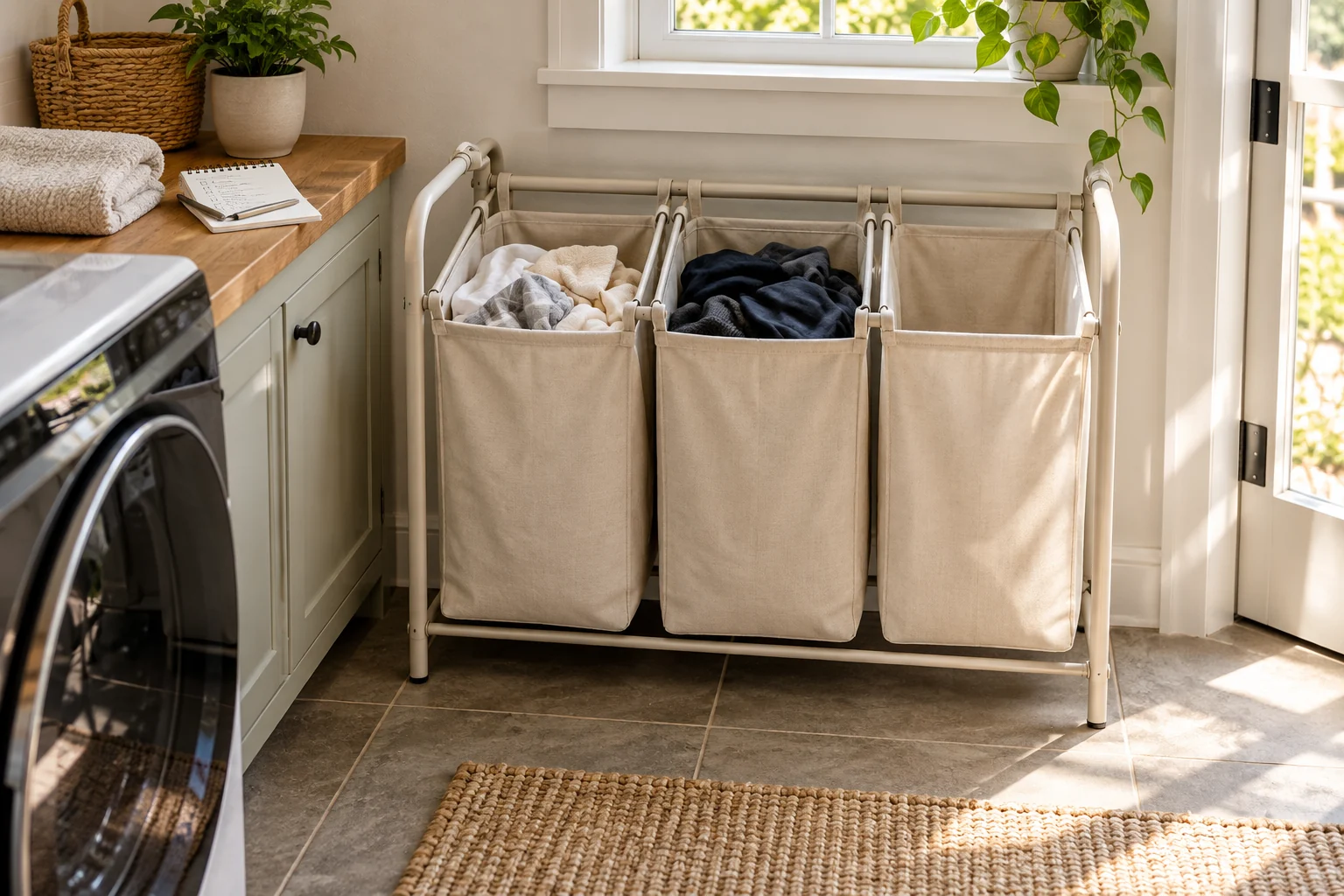
A laundry sorter looks like a simple fix when clean clothes and waiting loads keep crossing paths. Yet another container can take floor space without changing when laundry gets washed. The useful question is how many separate streams your household actually keeps between collection and the machine. This guide helps you plan laundry sorting capacity before buying another hamper by counting real loads, locating the handoff point, and testing whether three sections would earn their space. It is about the sorting decision, rather than the travel route for a wheeled basket or the price of detergent.
Two current store listings show why that distinction matters. The Smart Design three-bag sorter lists three mesh bags on a rolling frame and an overall footprint of about 17.5 by 30.75 inches. The Petoto three-bag sorter also lists three removable bags, but adds a folding top and hanging bar and is listed at about 27.6 by 15.8 by 59.1 inches. Those are listing descriptions, not measurements of a delivered unit or proof that either will fit your room. Their different layouts make a useful comparison: are you paying space and attention for three useful collection streams, or for extra functions you already have elsewhere?
Count laundry collection streams, not people or baskets
Start with one normal laundry week. Write down each load that you actually run separately, using your own garment labels and care instructions as the guide. A household might separate certain colors, delicate pieces, towels, or heavily soiled workwear. Another might wash mixed everyday clothing together and need just one collection bag. Do not create a compartment for a theoretical load that rarely accumulates. A three-bag frame helps only when three collection streams remain distinct long enough to justify three openings.
Make the count at the point where clothes enter the system. If everyone drops clothing into bedroom hampers and sorting happens beside the washer, a large three-bag unit in one bedroom may not reduce handling. If family members already pass a common laundry area, a sorter there may catch the streams before they mingle. Notice whether a small special-care pile needs its own permanent bag or can wait in a labeled washable pouch. That choice can spare a whole compartment for the two loads you run often.
Keep the tally honest for two cycles. Note how often each proposed section fills, whether it can be emptied independently, and whether a section sits mostly empty. A permanent three-way split that is used every wash day differs from a once-a-month exception. The count should reflect garments you own and your laundering routine; do not infer capacity solely from a seller's “loads” estimate. Load size varies with fabric, washer, and how full a bag is before you can lift it comfortably.
Map the handoff before allocating floor space
Draw the short path from where clothing is removed to where it is washed. Mark doors, drawers, walking clearances, and any spot where a hamper would block a cabinet. This map is about placement and sorting access. For a detailed decision about thresholds, parking, and whether wheels are worthwhile, use the separate wheeled laundry hamper guide. Here, the test is whether each sorting bag can be reached and removed in the proposed position without moving other furniture.
Measure the available rectangle at its narrowest usable point, not at the middle of an open floor. Include the space needed to lift a bag out and stand in front of it. The two layouts described above use floor and vertical space differently; neither illustration can prove clearance in your laundry nook. Check the listed dimensions against your own doorway, shelf, outlet, and folding surface before considering either layout. If the location only works after moving a trash can or closing a door halfway, write that inconvenience into the decision.
Place tape on the floor to represent the frame, then use three existing baskets or bags for a week. The temporary trial costs no new floor footprint after it ends and reveals whether people naturally choose the right stream. Ask who will empty each one. When a full bag must be lifted over another bag or through a narrow gap, a divider on paper is less useful in practice. Leave a safe walkway and avoid parking laundry where damp items cannot be handled promptly.
Give each section one clear job
Labels help only when they correspond to decisions at the washer. “Light,” “dark,” and “special care” may work in one home; “everyday,” “towels,” and “uniforms” may work in another. A person should know where an item goes without memorizing a complicated rule. If two labels repeatedly collect the same garments, combine them during the trial rather than buying a fourth section. If a section attracts wet towels, address drying and washing timing instead of treating the bag as long-term damp storage.
A three-section sorter also needs a plan for exceptions. Hand-wash pieces, stained garments awaiting treatment, and clothes that can be reworn should not automatically become extra laundry streams. Keep a separate small holding place when the care action truly differs. Read the garment label before choosing treatment and avoid assuming every delicate item belongs together. The organizer sorts an existing process; it does not decide fabric care for you.
Watch the household's behavior during the trial. A three-way unit may look orderly, but it will not help if everyone still drops clothes beside it. Make openings visible and reachable for the people who use them. If a child or someone with limited reach cannot use a high or narrow opening, choose a placement that works for that person. A routine that everyone can follow is more valuable than an extra compartment that remains decorative.
Compare a three-bag laundry sorter with a combined station
The Smart Design listing describes three removable mesh bags, side handles, a steel frame, and wheels. Its gallery image shows three separate openings. It is a straightforward example of a sorting-first layout. The Petoto listing and gallery show three lower bags beneath a folding top, with a rail above. The description says the top can serve as an ironing surface and the rail can hold garments; verify delivered parts, assembly, and the manufacturer's care directions before relying on either feature. These products have a common sorting role but occupy very different vertical space.
List the functions you already have. If you fold on a counter and hang finished garments in a closet, a top and rail may duplicate those stations. If the washer is in a compact utility room without a clear folding surface, a combined layout might consolidate equipment, provided its height, working clearance, and safe use suit that room. Do not treat a claimed extra feature as automatic savings. It has value only if it replaces a task or object in your actual routine without making the bags harder to empty.
The same logic applies to removable bags. A bag you can carry to the machine may reduce repacking when the station is parked away from it. Check how the bag lifts out, whether handles are comfortable with your typical load, and whether an empty bag can be returned easily. Do this on a delivered product before discarding existing containers. Product images and descriptions are useful for shortlisting, but they cannot establish your comfort, stability on your floor, or long-term durability.
Test the full weekly cycle
Run the proposed three-stream system from collection through wash day using what you already own. On the first day, label three temporary bags. During the week, note whether the categories stay distinct without reminders. On wash day, lift and empty each bag in the order you normally run loads. Mark any bag that is not ready to wash, any load that has to be resorted, and any place where someone sets clothing outside the bags. Repeat once, because an unusually light or heavy week can mislead you.
At the end, ask three practical questions. Did separating early remove a step you otherwise repeat? Did the three containers fit without taking over a useful work area? Could you clean and return them before the next collection cycle? If the answer to any is no, adjust labels or location before buying hardware. A household can often improve its routine with two existing baskets and a small care-item pouch. That is a real outcome of the trial, not a failure to shop.
Keep consumables out of this equipment decision. The separate laundry detergent cost-planning guide addresses counting washes and detergent use. Here, the cost and savings question is whether another physical organizer prevents duplicated handling or replaces an existing station. A sorter cannot lower detergent use by itself, and no listing establishes that it will save money for a particular household.
Account for upkeep and the day after wash day
A sorter is part of a repeatable loop. A bag that is awkward to rehang or left in the laundry room after every wash will leave its section unusable. Check the attachment method in the product photos, then confirm it on the delivered unit. Keep a simple routine for emptying, airing, and cleaning the bags according to the actual materials and care instructions. Do not assume a mesh or fabric bag is machine washable unless its label says so. A damp or soiled bag needs attention before fresh clothing goes in.
Consider what happens when one section is full while the others are empty. If the household waits for every bag to fill, clothing may sit longer than intended. Set wash timing by actual need and garment care, not by the organizer's symmetry. If one stream grows much faster, a permanent equal three-way split may be the wrong layout. A separate spare container or a revised category can handle a temporary surge without adding a larger station.
If a combined unit has a folding top or hanging rail, keep those surfaces clear enough for their stated purpose. Piling folded clothes on top of the bags can make bag removal awkward. Check the delivered unit's instructions for assembly, load limits, and safe use. Do not place a hot iron on a surface merely because a listing uses the phrase “ironing board”; follow the manufacturer's exact guidance for the supplied top. This is another reason to value a feature only after the whole weekly workflow has been tested.
Make the replacement decision from evidence at home
After two ordinary cycles, choose the smallest layout that supports the streams you actually kept separate. If one bag did the job, keep it. If two streams ran reliably and a third was only occasional, two accessible containers plus a small exception pouch may be enough. If three streams repeatedly filled, stayed useful, and had a suitable landing place, compare the listed dimensions and removable-bag details of the two examples with your measured room. Select for the collection and emptying routine, not for the longest feature list.
Before retiring an existing hamper, inspect the new delivered unit for the correct number of bags, sound attachment points, stable assembly, and usable clearance. If the item differs materially from its listing, resolve that with the seller instead of forcing the planned setup. Keep the old container until the new loop has worked through a real wash day. That short overlap is more reliable than assuming that any three-bag frame will eliminate clutter.
The clearest saving is often an avoided purchase. A weekly tally can show that one existing basket and a better label solve the problem. When a three-bag sorter truly removes repeated resorting, the same tally tells you why it belongs in the room and which functions you will use. Let the observed flow decide; the number printed on a product listing is only a starting point.