Home & Living
when a wheeled laundry hamper makes sense
Measure the route, parking space and unloading task before choosing a wheeled laundry hamper.
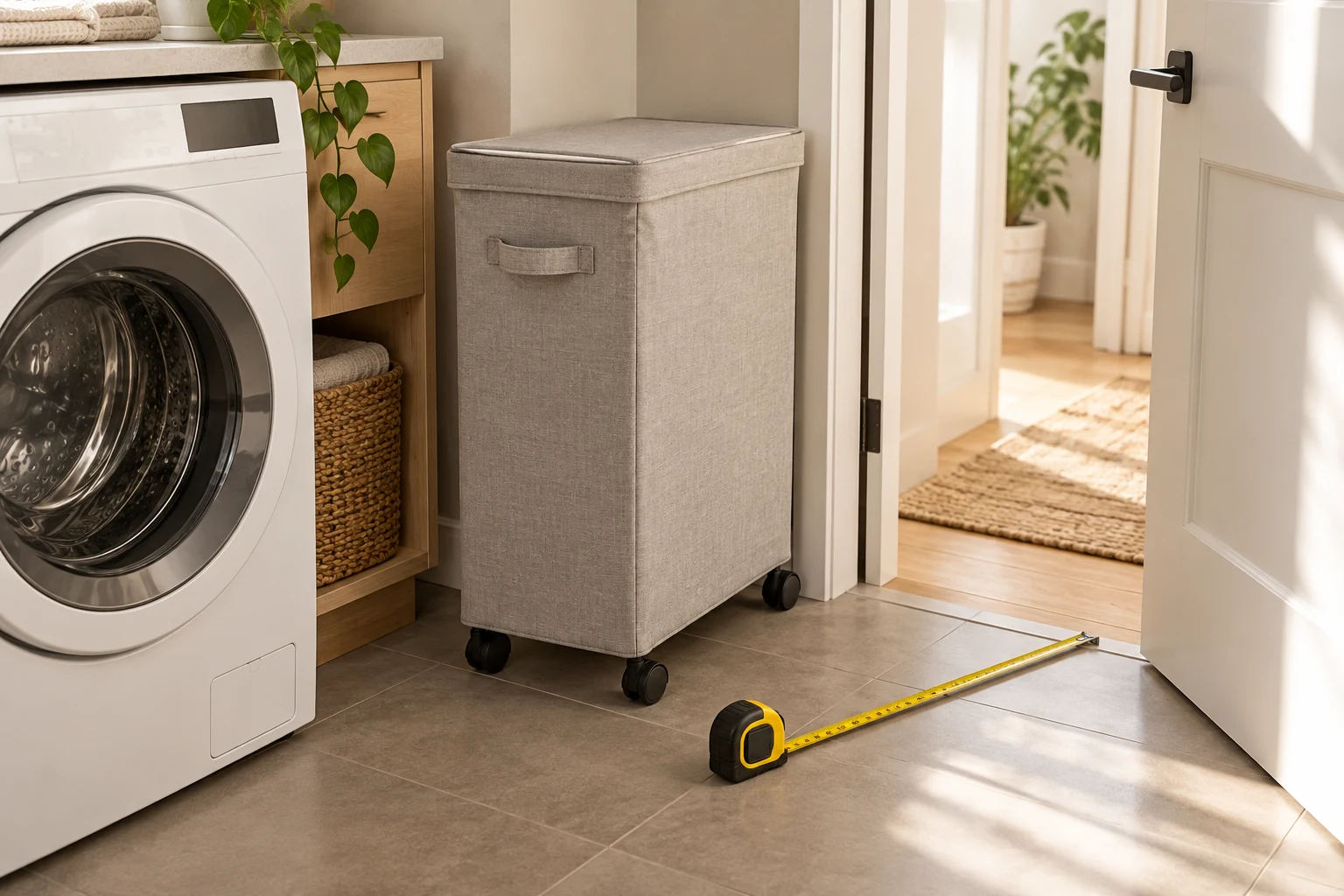
A wheeled laundry hamper sounds helpful until its wheels meet a thick threshold, the lid hits a shelf, or the basket is too wide for the route to the washer. Start with the trip you actually make. Where do clothes collect, where do they get sorted, and how far must a full hamper travel? This guide explains when a wheeled laundry hamper makes sense by checking the route, the space where it waits, and the handling you still have to do at the machine. Wheels can make a level-floor transfer easier, but they do not solve every laundry task.
Two current store listings illustrate different versions of the idea. The YUYAN 100-liter rolling hamper listing describes a lidded fabric hamper with a removable inner bag, side pockets, and an approximately 17.3 by 13.2 by 29.1-inch overall size. The Highcool wheeled hamper listing describes a narrower lidded canvas cart, about 15.3 by 9.8 by 20.7 inches, with four wheels and two brakes. These are listing claims, not tested measurements or guarantees about carrying capacity. Check the delivered dimensions and parts before relying on them.
Trace the laundry route before choosing wheels
Walk from the collection point to the washing machine with an empty basket. Note every door, turn, rug, floor joint, and change in level. A wheeled hamper has the clearest use when most of that route is level and unobstructed. It can be parked in a bedroom or bathroom and rolled to a laundry area without carrying the whole load. If the route includes stairs, the wheels stop being the main benefit. You still need a safe way to lift and carry laundry, and a heavy full hamper may be an awkward choice.
Measure the narrowest opening with the door in its normal open position. The gap beside a vanity may be tighter than the doorway itself. Compare that measured gap with the hamper's assembled width, including any handles or protruding frame parts. Leave room for fingers to steer and for the hamper to turn. A cart that barely fits when empty may snag on a door frame when the fabric sides bulge with clothing. A claimed “slim” design is only useful relative to your own measured route.
Look down as well as across. Small casters may resist a high threshold, deep rug, uneven tile, or cluttered floor. A photograph of a hamper on a smooth studio floor cannot tell you how it will move over your household's surfaces. If you have a loose mat, pick it up or secure it before making the route part of your routine. Do not force a loaded cart over a lip that makes it pitch forward. A lightweight basket carried separately may be simpler for a route with several obstacles.
Try the route with the washer door open. There must be a place to park the hamper while unloading without blocking the doorway or stepping path. If the machine is in a closet, check whether the cart can approach closely enough to make transfer comfortable. Rolling the load across a room helps less if you must then lift a heavy bag above shoulder height or hold a lid open in a cramped corner. Follow the whole movement from collection to machine rather than evaluating wheels in isolation.
Fit the parked hamper to the room
A hamper spends more time standing still than moving. Measure the intended parking spot's floor footprint and height. A narrower footprint may be easier to fit beside a machine, but its exact usable volume is not established by outside dimensions alone. A capacity figure on any listing is a seller claim; avoid treating it as a promise that a specific number of wash loads will fit. Compare the assembled cart with the actual corner where it will stand.
Check the lid's opening path. A lidded hamper beneath a shelf needs clearance above it, and a lid near a wall may need room to swing. If people toss clothes in several times a day, a lid that must be moved awkwardly can become a nuisance. Test the location with a cardboard outline or tape on the floor before ordering. Include the room needed to pull the hamper out, turn it, open the lid, and reach inside. A footprint that fits on paper can still be inconvenient in daily use.
Think about where damp towels and heavily soiled items go. A closed lid does not make wet fabric dry or prevent odor. Follow the garment care label and your normal laundering routine; do not leave damp textiles sealed in a hamper for long. If the household separates delicate items, towels, or very dirty work clothes, decide whether one wheeled bin is enough or whether smaller labeled bags are more useful. Buying a large cart without a sorting plan can simply create a large mixed pile.
If a cart has side pockets, check what actually fits without making it harder to steer. Keep detergent and other products according to their own storage instructions and away from children or pets. A pocket is not automatically a safe place for every household chemical. If a cart has wheel brakes and parking stability matters, test the delivered brakes on the actual floor rather than assuming they hold equally well on every surface.
Decide how the load leaves the hamper
The YUYAN listing describes a removable inner bag. That could let you lift clothes out without tipping the whole frame, provided the bag and its attachment work as described when delivered. A removable liner still has to be carried or emptied, so judge its handles and loaded weight during a small trial. Do not overload it merely because the outer hamper can hold more. If the cart stays beside the machine, you might instead transfer clothes a handful at a time. Choose the method that fits the height and position of your washer.
The Highcool listing describes a foldable canvas cart. Folding can help with storage when the hamper is empty, but it does not mean the frame will remain rigid under every load. Inspect the supports, seams, wheels, and lid after assembly. Push it gently with a modest amount of laundry before using it at full capacity. If the shape leans or a wheel binds, stop and resolve the issue under the seller's return process rather than making a loaded trip through the house. The point of a wheeled hamper is an easier routine, not a new balancing problem.
Do a realistic weight trial. Put in a normal day's or wash day's clothing, then move the hamper along its planned route. Can you steer it around the turn without twisting your wrist? Can you stop it and open the lid without the frame shifting? Can you unload the clothing at the machine without reaching too far? A capacity number tells you little about these movements. The usable amount is the amount you can move and unload comfortably in the actual home.
If the route crosses stairs, compare the empty frame and removable bag separately. A cart that is easy to roll on one floor may be inconvenient to carry upstairs. Never drag a loaded wheeled hamper down steps or rely on wheel brakes as a stair safety device. It may be better to keep a collection basket on each level and use a portable bag for the stair portion. Then a wheeled hamper can still have a role on the level part of the route, without pretending that its wheels solve vertical travel.
Match the cart to the household routine
For a single-person apartment with a short level path, a small cart can keep laundry contained near the washer. For a larger household, a single big cart might reduce repeated trips but make sorting and lifting harder. Ask who moves the laundry, how often they do it, and whether the hamper must be stored out of the way between wash days. A route that works for one adult may be too awkward for someone with limited reach or a different height. The household's actual users should be able to try the movement.
A cart with wheels can also become a temporary staging point for clean clothing, but plan that separately from dirty-laundry collection. Do not put clean clothes into an unclean liner without cleaning or changing it first. The public guide on sharing a household laundry drying rack addresses the coordination after washing; this guide is about the collection and transfer equipment before the wash. Keep those jobs distinct so one hamper is not expected to manage every stage of the laundry cycle.
Try a simple schedule: collect laundry where it normally accumulates, roll or carry it to the machine, unload it, and return the empty hamper to its parking spot. If any step takes extra maneuvering, that is the decision point to address. Maybe the opening is too narrow, maybe the lid is inconvenient, or maybe a removable bag is preferable to moving the whole frame. Do not judge the setup only by how neat the hamper looks in its corner. The round trip is what determines whether it helps.
Cost should follow the use case rather than a claimed load count. A larger hamper is not automatically a money saver if it obstructs a doorway or encourages overfilling. The public guide on counting washes for detergent planning treats supply costs by wash frequency. Here the decision is whether a wheeled container makes moving ordinary loads easier. Estimate how often you would actually roll it; occasional use may not justify a bulky dedicated cart when an existing basket already handles the route.
Inspect the delivered hamper before committing to it
On arrival, compare the assembled product with the listing. Measure its width and height, check that all wheels turn, and verify that the lid and liner operate as expected. Inspect seams, wheel mounts, and any brakes. The listed dimensions may be approximate, and assembly can change the practical footprint. Return or exchange a damaged item through the seller's process. Do not assume a gallery image proves the delivered parts are present or secure.
Move an empty hamper along the planned route first. Then add a modest load and repeat the trip. Watch for caster snagging, tipping at thresholds, a lid that pops open, or a bag that shifts inside the frame. Test parking near the washer and in the storage spot. If the cart succeeds only when empty, it has not met the household's actual need. A brief trial before filling it to its limit is more informative than a label promising large capacity or heavy-duty construction.
Choose a wheeled laundry hamper when the route is mostly level, the assembled cart fits its narrowest opening, and moving a normal load makes the laundry routine easier. Choose a different carrying or sorting arrangement when stairs, tight turns, or awkward unloading dominate the work. The YUYAN and Highcool listings offer different footprints and features, but the final answer to when a wheeled laundry hamper makes sense comes from the measured route and a loaded trial in your own space.