Bedding & Bath
Suction hook keeps falling from smooth tile: isolate the surface and load
A surface-and-load test for a suction hook that falls from smooth bathroom tile, with clear stop points and variant cautions.
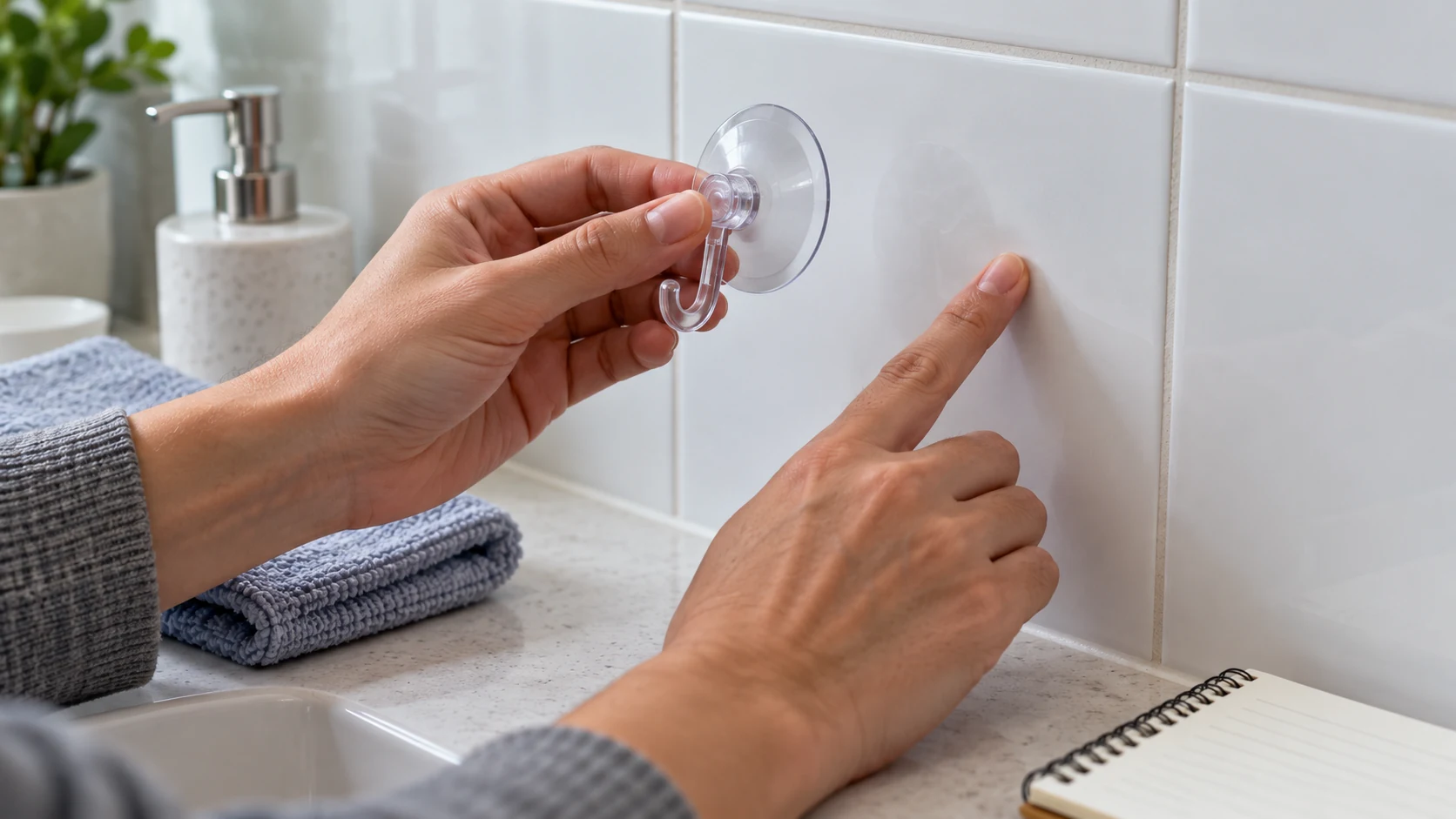
A suction hook that falls from smooth tile is giving you a useful clue, but the fallen object alone does not identify the cause. The tile may be glossy yet interrupted by grout, a raised pattern, or a hairline crack. The cup may be dusty, bent, or worn. Water and soap film can change the contact area, while a towel or bathrobe may pull harder than expected. Start with an empty hook on a clean, dry, continuous patch of tile. Change one condition at a time. If the empty hook cannot stay put, buying a larger hook or testing it with a heavier object will not isolate the problem.
Find the contact failure before changing hooks
Remove the hanging item and look at the circle where the cup touched the wall. A complete, even ring on one tile is a better test location than a cup straddling a grout line. A tile can look smooth from across the room and still have enough relief to interrupt the cup's edge. Run a fingertip over the proposed footprint, looking for a raised motif, a chipped corner, or a slight step between tiles. Do not press over cracked tile or a loose surface merely to prove the hook can stick. Move to another sound, continuous area instead.
Next inspect the cup itself. Check its lip for hair, lint, grit, a nick, or a section that stays curled away from the tile. A hook with a damaged sealing edge may detach even on an otherwise suitable surface. Wash away ordinary residue using the maker's cleaning instructions, rinse where appropriate, and let both cup and tile dry. Avoid solvents or abrasive pads unless the maker specifically permits them; a damaged finish or cup creates a second problem. A cleaned cup is a test of contact, not a guarantee that the hook is suitable for every wall or load.
Press the empty hook as its instructions direct and watch the edge. If a lever or locking part is supplied, use it in its intended order rather than improvising extra force. Note where you placed it and when. An empty hook that slides or drops promptly points you toward contact, cup condition, or mounting technique. One that holds empty and falls only with an item calls for a load and movement check. A hook that stays up on a nearby plain tile but drops on a textured patch has given you a useful surface comparison without making you guess from the packaging.
Separate surface, moisture, and load
Make a small two-location test if the wall allows it. Use the same clean hook, the same mounting method, and two intact tile centers. Record whether either location crosses grout or sits near a water stream. If only one position fails empty, the difference may be the surface or its exposure. If both fail empty, inspect the hook and installation directions before assigning the fault to the room. Do not use a fragile object for this test, and keep people clear of anything that could fall.
Water alone is not a universal explanation. A shower wall can carry soap film, scale, or cleaner residue that is hard to see; it may also be wet during mounting when the particular hook calls for a dry surface. Follow the specific product's mounting and care directions. Clean a test patch without mixing cleaning chemicals, then allow the surface to reach the condition the manufacturer specifies. If the hook holds on the prepared patch but not the old one, the preparation made a practical difference. That observation does not prove the exact contaminant, and it does not promise permanent adhesion.
Now compare an empty hook with its intended item. Hang one modest, low-risk item only after the empty test succeeds. A damp towel may be heavier than a dry one and can tug sideways when someone grabs it. A bathrobe or bag may swing; a hook carrying several items can see a different force from the weight you measured in your hand. Do not turn a seller's headline into a safe working limit. Confirm the exact variant's stated limit and mounting conditions, and leave a margin for normal handling. Never use a suction hook for a load whose fall could injure someone or damage something valuable.
A hook that releases during the act of removing a towel is telling you about direction of force as much as mass. Pulling outward on the hook can break contact even if a static item seemed acceptable. Move the hanging point to reduce snagging, choose a lighter item, or use a more appropriate permanent mount where the surface and tenancy allow it. If the location is a door or a flexible panel rather than rigid tile, movement adds another variable. The practical decision is whether this exact surface and everyday use suit a removable suction mount.
Read the actual product variants cautiously
Republeq's Crawford medium plastic suction-cup hook is listed as a single clear 1.6-inch hook, with a 3-pound capacity claim on its product page. That is a listing claim for that item, not a verified allowance for every tile, temperature, direction of pull, or installation. The page also shows the item unavailable at the time this guide was prepared. If this size seems suitable, confirm current availability and the maker's actual mounting instructions before treating it as a purchase choice.
A separate 12-pack suction-hook listing describes removable, reusable hooks for surfaces such as shower walls and glass, and shows black and bronze color options with a 12-piece size selection. Its “heavy duty” wording is marketing, not a substitute for checking the selected variant's capacity, dimensions, and mounting directions. A larger pack does not fix a tile surface that breaks the seal of one cup. Test surface suitability first, then decide whether you actually need several hooks.
These two listings are examples of the physical role: a suction cup supports a small hanging hook on a compatible smooth surface. They are not interchangeable proof of fit. The Crawford page provides a stated 3-pound claim; the 12-pack page uses broader wording and configurable options. Neither saved page proves long-term hold on your tile. Check the current listing, supplied instructions, and return terms for the exact variant. If a seller image shows an ideal glass panel, do not silently transfer that result to a grout-interrupted or textured bathroom wall.
Look at the entire contact footprint, not just the visible hook. A larger cup needs a sufficiently large uninterrupted tile center. A compact hook might fit between grout lines yet offer a smaller contact area and a different stated load limit. Measure the available flat patch before ordering. If the tile is curved, heavily textured, cracked, or too small for the cup, choose a mounting approach intended for that surface. Trying the same suction design repeatedly in a bad location is more likely to waste time than to change the underlying contact condition.
Use a short, repeatable test
Write down four observations: the exact tile location, whether the surface and cup were cleaned, how the empty hook behaved, and what happened with one light intended item. Leave the test hook in a place where a fall is harmless. Check it over the period recommended by the maker, especially after the wall has been exposed to normal room conditions. Do not call one moment of adhesion a successful long-term installation. Conversely, do not discard a hook solely because it failed on a grout line when an intact tile patch is available for a proper test.
If the empty hook falls at both locations after correct preparation, stop load testing. Inspect for a cup defect and verify the assembly and mounting method. A visible tear, permanent distortion, or missing locking part is reason to replace or return the unit under applicable terms, not to keep pressing harder. If another sound tile also fails with the same undamaged hook, the design may simply be incompatible with that finish. The test supports a choice to change mounting method; it does not establish a hidden manufacturing defect by itself.
If the empty hook holds but the loaded one falls, reduce the item to a weight and motion within the exact maker's instructions. A towel used often may introduce repeated outward tugs; a decorative item may sit still. The distinction matters more than a generic “bathroom hook” label. Consider a mechanically fixed or appropriately rated alternative when the expected load or traffic is high. Follow wall, waterproofing, and tenancy rules before drilling or using adhesive. Do not conceal a failed suction test by placing a breakable object under the hook and hoping it stays.
If the hook releases mainly after cleaning or showering, revisit the surface condition and care directions. Some cups need a clean, dry mounting surface; some products describe a different installation method. Use the instructions for the actual hook, not a universal internet trick. Avoid adding oil, glue, or tape unless the maker specifies it, because those additions can change the cup's behavior, stain tile, and complicate removal. Keep the experiment controlled enough that you can tell whether the surface, method, or load changed.
Keep this diagnosis distinct from other mounting problems
A shower caddy has its own load distribution and may rely on a tension pole or multiple suction points. If that is the object falling, the shower-caddy mounting guide addresses the pole-versus-suction decision and the way bottles change that assembly. A single hook on tile is a narrower problem: find whether one cup makes sound contact and whether the intended item exceeds what that attachment can handle. Do not borrow a caddy's diagnosis as proof that a small hook needs a pole or a different number of cups.
Likewise, weather-stripping that will not stick concerns adhesive and frame fit. A suction hook is held by a different contact mechanism; sanding a tile or applying adhesive simply because weather strip failed would be a category mistake. The useful shared habit is to locate the first failing contact point before buying a replacement. Keep the material and mounting method of the actual object in view.
When replacing the hook, choose for the wall you have, the object you will hang, and the space available for the full cup. Check whether the product is intended for wet rooms, whether the selected variant has a stated capacity, and whether its instructions permit your tile finish. A removable hook may be convenient for a light, occasional item. It is not a substitute for a secure mounting system when a fall presents a hazard. The sensible endpoint is a hook that survives a controlled empty and light-use test under normal conditions, or a decision to use another mounting method.
Finally, keep the successful location and loading rule simple enough to repeat. If a guest will tug on the towel or multiple people will hang items, explain the limit or move the item to a sturdier fixture. Recheck the cup when you clean the wall and whenever it begins to slip. If it releases again, stop using it for that item and revisit the surface and load observations. The goal is not to make a suction cup appear infallible; it is to find a reliable match between this tile, this hook, and a modest real-world use.