Bedding & Bath
Why a shower caddy keeps falling: check the mount before adding bottles
Find the failing contact point, verify the mount’s fit and surface, and stop using a caddy that moves under a modest load.
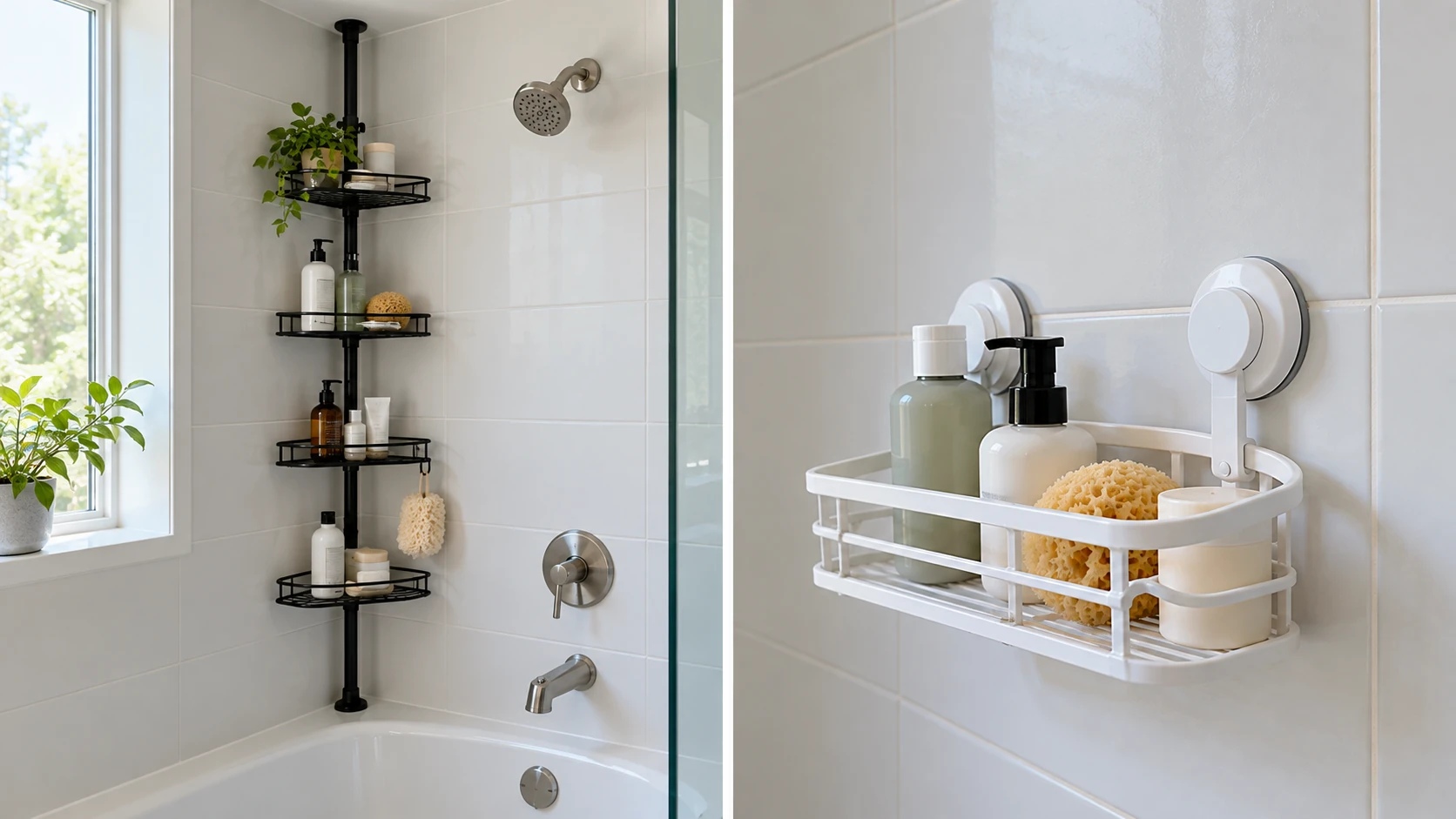
A shower caddy keeps falling for different reasons depending on what holds it up. A spring-loaded pole has to fit the space between two surfaces and stay upright under its load. A suction basket needs a suitable wall surface and a sound seal at every cup. Name the mount first. Then find the precise contact point that has let go.
The two examples here make that distinction concrete. One is a four-tier corner pole advertised for a 47–121 inch span. The other is a removable suction basket whose listing names acceptable wall materials and an initial-installation check. These descriptions tell you how the mounts are supposed to attach; they cannot predict how long either one will stay up in your shower. A caddy that has already fallen should be unloaded before you inspect it; falling bottles and a moving rack are enough reason to stop using that position while you work out the cause.
First tell whether the whole support moves
With a pole caddy, look at the top and bottom contact points while the shelves are empty. If the entire upright shifts, begin at the pole support. A crooked shelf can be a separate problem. If the pole stays in place but a basket moves on its bracket, inspect that shelf's attachment according to the hardware supplied with the exact unit. The listing for the four-tier shower caddy tension pole describes a spring-loaded, tool-free pole and clip-on shelves. It does not supply a universal adjustment procedure for a different pole or a repair method for damaged clips.
On a suction basket, watch each cup as well as the basket. A basket can tilt because one cup has released while another remains attached. A cup that releases immediately after pressing it on calls for a surface and installation check before you put toiletries back. The RoseOcean listing describes a removable basket with TPE suction cups and ABS hooks. That construction is different from a pole squeezed between ceiling and tub or floor; moving a pole instruction over to the suction basket would not address its contact surface.
Measure the tension pole's place before extending it
The pole offer gives a 47–121 inch adjustable-height range. Measure the actual vertical span at the intended corner rather than estimating from the bathroom's nominal ceiling height. A sloped ceiling, raised shower base, or ledge changes the distance at the point where the pole would stand. Check that the contact points can meet the surfaces where you measured, and that the baskets clear faucets, doors and the space where a person stands. The range helps rule out an obvious mismatch. Stability still needs to be checked at the position you measured.
Set the empty pole using the instructions supplied with that pole. The product account says its spring-loaded top support is intended to prevent sliding, but it does not specify a force, compression mark or extra fastener. Avoid adding makeshift wedges or drilling into a surface on the strength of a no-drill listing. If an empty unit cannot stand securely after the specified setup, loading it with bottles is a poor test. Confirm that the parts are complete and ask the seller for the exact installation instructions or a remedy for a missing or defective part.
Four baskets distribute storage up the pole. They also create several places where a tall bottle or projecting hook might meet a door, showerhead hose or person passing through. Decide which objects actually belong there before you position each basket. The listing says each shelf supports up to 22 pounds. It does not say that every bathroom surface, pole extension or shelf layout will hold four fully loaded baskets indefinitely. Treat the number as a listed limit for the product, then keep the load modest while checking stability.
Check the suction surface before the cup
The RoseOcean suction shower caddy listing gives a more specific surface rule. It names smooth, dry, uncracked tile, glass, mirrors, polished metal, stainless steel and acrylic as suitable places, away from grout lines. It excludes painted or dry walls, wood, wallpaper, and rough or cracked surfaces. A seam crossing even part of a cup's contact area deserves attention because the maker asks for a smooth spot away from grout. Choose a position for every cup, not just the basket's center.
Dryness matters at the installation stage described by this offer. A wall may look smooth but still carry a film of water or soap where the cup meets it. Clean and dry the intended patch and the cup according to the supplied instructions before making a fresh attempt. Do not use a rough wall as a test simply because a nearby smooth tile worked. If the surface is cracked, textured or interrupted by grout where the cups must sit, moving to a sound smooth area is more faithful to the listing than repeatedly pressing the same failing position.
The listing says to remove the protective cover and press the suction board until a “PUFF” sound is heard. That is the seller's installation cue for this product, not a measured proof of holding force. With the basket still empty, check that all cups seat at the intended locations and that the unit remains level. If suction fails during initial installation, the listing specifically says to wash the cup, dry it with a hair dryer and test it on smooth glass before selecting another location. Use the supplied directions for heat and handling; the listing does not establish that aggressive heat or another adhesive will repair a damaged cup.
Separate a poor location from a damaged part
A cup that works on smooth glass but releases at a particular tile position points you back to the position: grout, texture, cracks or a surface film are visible questions to check. A cup that will not hold on the smooth test surface after the stated cleaning step needs product-specific help. The page does not describe a replacement cup size or promise that a household adhesive is compatible with its TPE cup. Stop there and request the correct part or seller guidance rather than altering the mounting face.
A pole can also appear to be a bottle problem when its basic placement is wrong. Remove the bottles and see whether its upright remains steady. If it does not, revisit the measured span and exact top and bottom contact places. If it stands empty but moves as shelves are added, examine shelf placement and loading without assuming that the advertised per-shelf figure covers a particular installation. The offer gives no test data for wet-room surfaces or an uneven base. If the pole moves, unload it. A bottle-weight calculation does not make a moving pole secure.
Both examples are sold as no-drill storage, but the support is different enough that switching products may make sense when the room cannot support one method. A smooth wall patch large enough for all suction cups may be absent, while a suitable vertical span may be available for a pole. Another room may have glass or smooth tile in a useful location but no practical corner for a tall pole. Walk the proposed position in your own bathroom. The catalog photograph cannot show your door, controls, ledge or ceiling.
Load a stable caddy in stages
Once an empty mount is stable under its own instructions, put back a small number of ordinary items and observe it before adding more. Heavy or tall bottles near an edge can change how a shelf sits, even though the sources do not quantify that effect. Keep items within the basket and away from a door or hose path. If a shelf or cup begins to move, take the load off and reassess. A sudden failure should end the test; the article cannot tell you that the next loading pattern will make a worn or defective part safe.
The suction-basket listing gives 10 kilograms or 22 pounds as its advertised capacity, while the pole listing claims up to 22 pounds for each shelf. Those values belong to different products and different support systems. Do not add them together or use the pole's per-shelf figure as a target for a suction cup. Neither offer supplies a field test that predicts how long a loaded mount will stay secure in a particular shower. The practical decision is whether your intended contents fit the basket, remain accessible and stay supported without visible movement.
Before moving everything into the shower, sort what needs to be within reach and what can live in a dry cabinet or drawer. The drawer organizer clearance guide uses an actual fit check before choosing a tray; the same habit helps here when you measure a pole span or the wall area needed by suction cups. It does not provide a shower-mount rating. Use its measurement approach for storage planning, then rely on the caddy's own installation directions for the mount.
Allow room to use the shower
A caddy can remain attached and still be a poor fit if it narrows the path into a tub or blocks an existing fixture. Hold the empty basket or pole components in the proposed position before installation and check the door swing, the curtain path, the shower hose and access to controls. The pole photograph shows four corner baskets around a central upright; the suction photograph shows baskets projecting from a wall. Neither image proves the same clearance in your room. Use actual dimensions and the intended contents when choosing a position.
The shoe rack fit guide checks shelf openings and the path people use through an entryway. Its decision is about footwear, yet its access check transfers neatly to a crowded shower: storage should not obstruct the route to a control or force you around a protruding shelf. The entryway lesson is about access and clearance. Follow the caddy directions for the mounting work.
The RoseOcean listing gives its removable basket as 10.8 by 3.7 by 2.9 inches. Measure where the basket would project and where the cups would actually land. Its page also offers variants, and a gallery image shows more than one basket. Do not infer that every selectable variant includes the photographed count. Verify the exact option and included parts before depending on a second shelf or extra cups. For the pole, check the actual package and its clip-on shelf positions instead of treating a styled photograph as a complete installation manual.
When the mount needs a part or a new location
Stop using a mount if a pole slips while empty, a cup cannot hold on a maker-approved smooth test surface, a component is cracked, or a shelf releases under ordinary use. The next step is product-specific documentation or support. Photograph the contact area and record the selected variant, missing hardware, and what happened with the mount unloaded. Those observations help distinguish a placement question from a defective part without claiming a diagnosis the listing cannot support.
If the support holds empty but fails after you add items, remove them and compare your planned use with the exact product limits. The pole offer speaks of a spring-loaded upright and four shelves. The suction offer speaks of smooth, dry surfaces, cup seating and a single basket description with selectable variants. Neither page authorizes modifying a broken mount, exceeding an advertised load, or treating a successful short test as a lifetime guarantee. A different storage location may solve the space problem more reliably than another attempt at the same failing attachment point.
Choose the mount that fits your room before counting shelves. For a tension pole, measure the corner span and test the empty upright. For suction, establish that every cup has an approved smooth patch and follows the product's installation check. Then add only the contents the caddy can hold without shifting or blocking the shower. If that sequence stops at any stage, leave the caddy unloaded and use the exact seller instructions or support route for the unresolved part.