Product Compatibility & Accessories
Shoe rack fit for boots, shelf openings and entryway access
Check actual boots, shelf openings and cabinet access with SONGMICS and Miumaeov examples, keeping body dimensions and published pair counts separate.
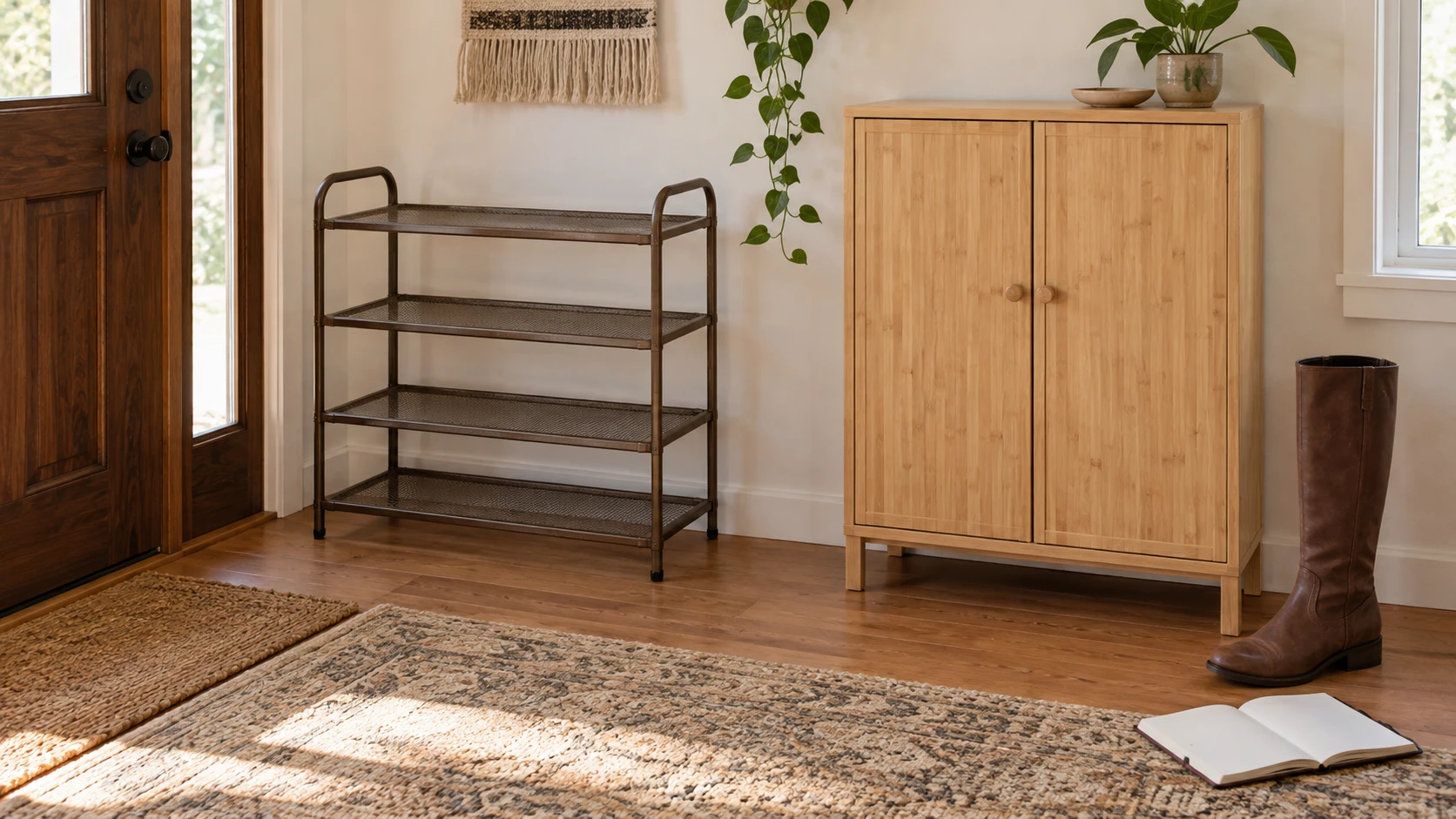
Shoe rack fit for boots starts with the pair you need to store and the opening it will use. Record your footwear measurements separately from the furniture's body size, then add the room position and access questions. The SONGMICS open rack and Miumaeov cabinet below give you different features to investigate. Their descriptions supply some dimensions and leave others open. Keeping those fields separate helps you ask whether a particular boot, box or entryway arrangement works, without treating a published pair count as a measurement of your belongings.
Name the footwear and the intended location
List the actual shoes, boots or storage boxes you intend the unit to hold. Separate a tall pair from a low pair where the opening requirements differ, and name any item that determines whether the arrangement works. Record measurements you can establish for those items, with the units and the orientation used. A general label such as “winter shoes” can leave the decisive size question unanswered. Keep the inventory specific enough to compare with the product's relevant internal information when that information becomes available.
Identify the proposed room position and the objects or routes that will remain around it. Record the available space you can measure rather than treating an entryway description as proof of fit. If the unit has doors or a lid, retain their access as a separate question. A body that fits within a measured area can still leave an unresolved opening arrangement. This guide does not prescribe a universal passage width or certify a location. It gives you a record for the requirements that need answers.
Identify the actual rack or cabinet
The SONGMICS 5-Tier Metal Shoe Rack in bronze is an open metal rack with mesh shelves. Its stated body size is 36.4 inches long by 12.1 inches wide by 41 inches high. The description gives each shelf's length as 36.4 inches and says the shelves can be installed flat or angled. Keep those facts with this exact rack. They do not establish the vertical opening between every shelf or the usable depth for your particular footwear in either arrangement.
The Miumaeov bamboo seven-tier shoe-storage cabinet with doors has a different arrangement to investigate. Its stated body measures 38.6 inches long by 12.6 inches wide by 45.3 inches high, and its product weight is 34 pounds. The description mentions a differently sized space for long boots, suitable storage boxes and a top storage feature with a lid. Those statements do not supply the actual boot-opening dimensions or the space needed for the doors and lid to move.
Keep the open-rack and cabinet identities separate when asking for more information. One product's shelf arrangement should not become another product's feature because both store shoes. The number of tiers also needs its own context. A five-tier or seven-tier name describes the product account, without establishing that every level has identical usable dimensions. If one opening determines whether your boots fit, ask about that exact opening rather than inferring it by dividing the overall height by the tier count.
Begin checking shoe-rack shelf openings
For checking shoe-rack shelf openings, request the usable width, depth and height for the intended footwear position. Keep an external body measurement in a different field from an internal opening measurement. The SONGMICS shelf-length statement can answer a length question while leaving vertical clearance unresolved. The Miumaeov boot-space statement can identify a feature to investigate while leaving its dimensions unresolved. A useful record names both the fact available and the missing measurement, so the next enquiry can request the actual information needed.
Label the orientation beside each footwear and opening measurement. If the shelf has more than one arrangement, ask which one the dimensions describe. For SONGMICS, the flat and angled options are stated, but their complete usable openings are not supplied here. Retain that gap instead of assuming the two positions provide identical space. A reply giving one opening can then be checked against the arrangement and pair you actually asked about. Keep a different position unresolved until its relevant dimensions have an answer.
For the Miumaeov example, ask which compartment the long-boot statement concerns and what its usable dimensions are. Include the actual boot measurements and intended orientation. A statement that a suitable-size box can be stored is conditional: the box still needs to match the relevant opening. It does not approve a particular storage box or supply a missing compartment dimension. Keep the answer specific to the feature you intend to use so a general large-capacity description cannot substitute for the decisive fit information.
Continue keeping shoe pair counts conditional
Keeping shoe pair counts conditional means retaining what the advertised figure actually describes. SONGMICS describes each 36.4-inch shelf as holding up to five pairs of women's shoes or four pairs of men's shoes. Those are the description's category-based counts, not measurements of your actual pairs. They do not establish a universal count for mixed footwear, tall boots or every shoe size. Record the claim if it informs your enquiry, while checking the shoes and opening dimensions that matter to your arrangement.
Do not multiply a per-shelf headline into a guaranteed whole-rack inventory without establishing how your actual footwear uses the available openings. A tall item may raise a different layout question from a row of low shoes, but this guide supplies no rearrangement or installation procedure. Obtain the relevant instructions where a change is proposed. The record should distinguish a stated count, an intended inventory and a confirmed usable arrangement. Leaving one of those unresolved is more useful than treating the largest headline number as a measured result.
The Miumaeov description's seven-tier and long-boot wording needs the same care. A tier count does not state how many of your pairs fit, and a boot feature does not identify every supported boot height. Ask for the actual compartment information before assigning the whole inventory to the cabinet. If your plan includes both footwear and boxes, retain each item's intended location separately. This makes a missing opening measurement visible instead of hiding it inside a general claim that the cabinet has enough storage.
Keep doors and lids separate from the body footprint
For a cabinet position, record which side needs access and request the applicable door and lid information. The Miumaeov description used here does not establish their travel or the complete open dimensions. Do not derive that information from the cabinet's 12.6-inch body width or its external height. A closed body outline answers a different question from an operating access envelope. Keep the proposed position provisional when an unresolved opening requirement determines whether the cabinet can be used as intended.
The open SONGMICS rack does not supply the Miumaeov cabinet's door question, but its access still belongs in your plan. Identify which shelves and footwear positions you intend to use, and retain the relevant room measurements. A photograph with conveniently placed shoes does not measure the route in your own home. If a specific user requirement or established standard matters, obtain the appropriate information for it. This guide does not turn a suggested position into an accessibility assessment or a universal clearance rule.
Keep stacking claims with the exact product type
The SONGMICS description says other 36.4-inch racks of this type can be stacked and names two plastic connectors in the package. Keep that statement and the supplied-item count attached to this particular rack type. They do not establish stacking compatibility with the Miumaeov cabinet, another rack of the same brand or any object that happens to have a similar width. If stacking is part of your intended arrangement, obtain the exact supported configuration and applicable instructions before treating it as established.
This guide supplies no stacking, assembly or fastening sequence. The stated connector quantity does not establish every part needed for a proposed configuration or its supported load. Record the exact units involved and the question the product documentation must answer. A planned stacked arrangement also needs its own complete space and access information. Do not treat the dimensions of one unit as the full arrangement's dimensions or assume the room location is suitable simply because a single rack body fits there.
Separate the footwear plan from other storage uses
The Miumaeov description names suitable boxes and several other possible stored objects. Those use descriptions leave each actual item's dimensions and applicable support requirements to establish. Keep the shoe-storage purpose distinct from a plan to put equipment or decorative objects elsewhere on the cabinet. A product's own weight of 34 pounds is not a supported-load figure. The information used here does not provide a load rating for each shelf or the top, so do not convert the weight entry into one.
Likewise, construction and finish wording does not supply an independent assurance about health, environmental outcomes or support for a particular object. The useful source facts for this fit record are the named arrangement, stated dimensions and specific questions left open. Keep material identity where relevant without extending it into an unverified result. If a requirement concerning care or permitted use determines the purchase, obtain the applicable product guidance. It is a separate information task from measuring a boot opening.
Prepare a focused compatibility request
Start the enquiry with the exact product and the item you want to store. Add the measurements you established and name the missing opening or access detail. A SONGMICS question should identify the flat or angled arrangement, or the exact units in a proposed same-type stack. A Miumaeov question should identify the boot space, door or lid involved. Ask which dimensions and instructions cover that arrangement. A reply about general capacity still leaves your question open if it does not identify the opening or moving part you need.
Keep the response with the product and arrangement it describes. A reply about an ordinary shelf should not silently become an answer about a different boot compartment, and a same-type stacking statement should not expand to another unit. Record which requirement is resolved and which remains open. If your inventory or proposed position changes, revisit the affected question. That makes the record useful for the actual entryway rather than a broad compatibility label disconnected from the footwear you own.
Retain the actual result and its limits
When the relevant product information and instructions are available, record what you can establish for the intended arrangement. This guide does not prescribe assembly, door operation or a load test. Use the applicable instructions for the actual product. A confirmed opening for one pair or box does not establish every other position or item. Keep an untested compartment or unresolved access condition visible, and preserve the dimensions and identities used for any observation you record.
Retain the exact product with the fit record. For SONGMICS, keep the intended shelf arrangement and the conditional pair count beside your actual footwear list. For Miumaeov, retain the boot-opening and door or lid questions until their dimensions are established. Record the room position considered and the information still missing. If footwear or location changes later, revisit those entries before relying on the earlier answer. You can then see which requirements remain supported and which belong to a different arrangement.
The coffee-table room-access guide asks for the selected furniture's actual dimensions and the route people use to enter, sit and leave. A round shape or a room label does not establish that arrangement. The same physical-planning question belongs beside a shoe-rack footprint: retain the real entryway route and the missing access information. The table guide supplies no shoe-compartment size, cabinet-opening clearance or furniture installation method.
The LG and Danby storage-dimension guide distinguishes an appliance's body measurements from its door and placement requirements, while keeping actual household containers separate from broad capacity labels. That helps frame a shoe-storage question: an external cabinet size does not identify a boot opening or door travel. Use the distinction to request the furniture's own measurements. Refrigerator dimensions, ventilation requirements and shelf features do not transfer to either shoe-storage product here.
Conceptual editorial cover for Shoe rack fit for boots: complete generic shoe-storage furniture beside a blank fit-planning notebook; not exact retail products, measured shelf openings or verified entryway placement.