Refrigeration & Freezers
Refrigerator storage inventories and apartment dimensions: LG LRDCS2603S and Danby DFF101B1WDB
Plan refrigerator storage inventories and apartment dimensions with LG LRDCS2603S and Danby DFF101B1WDB: shelves, drawers, door storage and size labels.
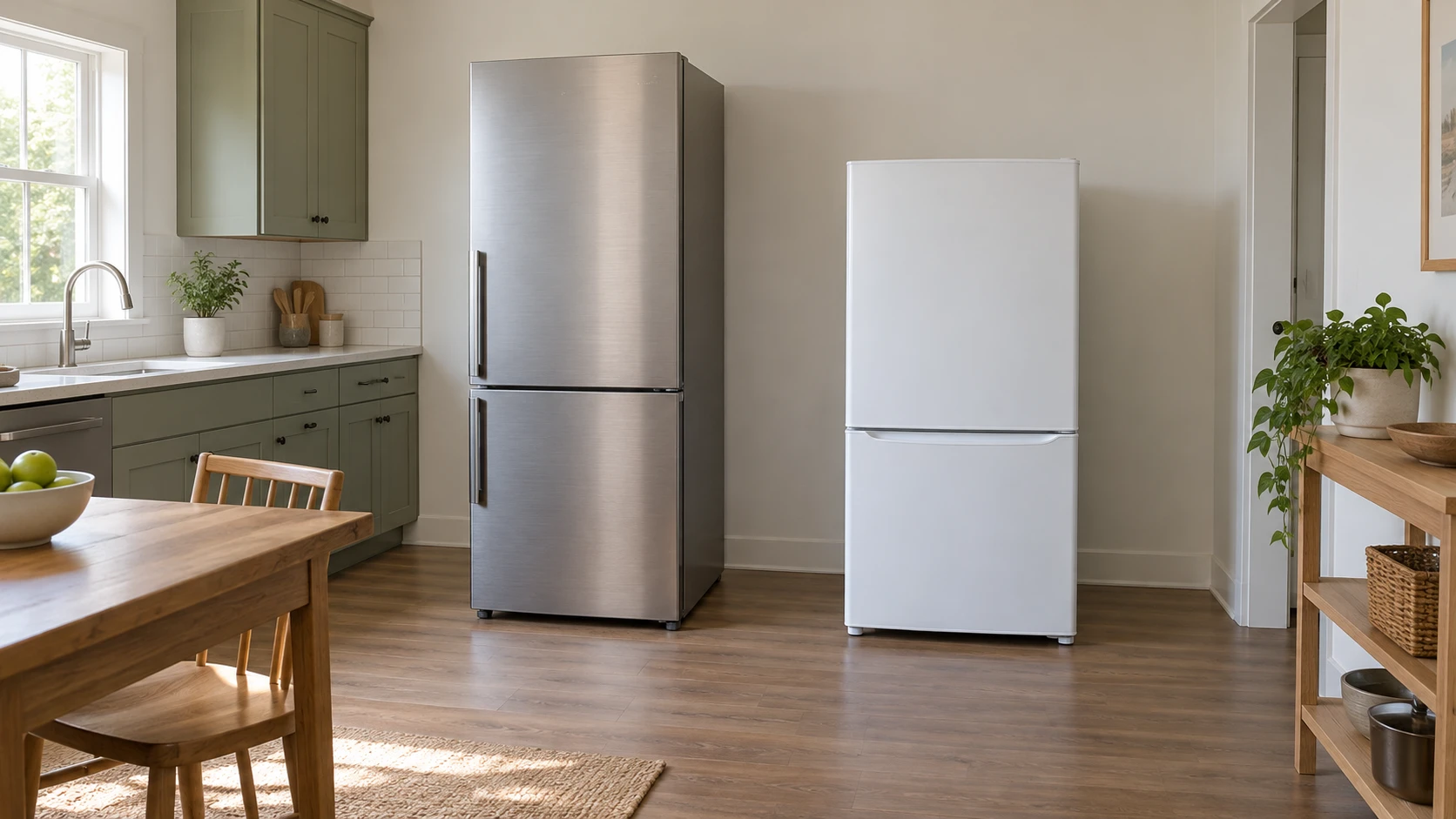
Start the refrigerator purchase with the containers your household buys and the space available for the appliance. Shelves, door storage and drawers describe the interior arrangement; body dimensions answer a separate part of the placement question. For refrigerator storage inventories and apartment dimensions, LG and Danby supply different kinds of information. LG's LRDCS2603S is described as a 26-cubic-foot bottom-freezer refrigerator. Danby's DFF101B1WDB is described as a 10.1-cubic-foot apartment-size fridge with a specific shelf, drawer and dimension list. Use those disclosed features to build the purchase record. Neither description gives a preservation trial or a formula assigning the appliance to a fixed household size.
The LG LRDCS2603S offer identifies a Silver refrigerator with a stainless finish. The Danby DFF101B1WDB offer identifies a White apartment-size refrigerator. Both actual products are listed under Refrigerators. Keep the selected model code with the order and any layout information you obtain. A familiar brand or another refrigerator's photograph does not supply the storage inventory or dimensions for these exact offers.
Refrigerator shelves drawers and door storage need an inventory
For refrigerator shelves drawers and door storage, Danby explicitly names 2.5 adjustable glass shelves. Preserve that literal count. It does not describe three full shelves or explain the shape of the fractional shelf in the saved description. The adjustable label identifies a feature without establishing the number of positions or a particular container's fit. A household can investigate the actual shelf arrangement while retaining the count and material that this offer states.
Danby separately lists five door shelves, including tall-bottle storage. Those are door-storage disclosures rather than extra adjustable glass shelves in the main compartment. A buyer who routinely purchases bottles should compare the actual door arrangement with the bottles in that household's shopping record. The tall-bottle label does not supply a clearance, approved weight or guaranteed fit for a particular bottle. Keep the five door shelves as their own inventory entry alongside the main shelves.
The two clear vegetable crisper drawers are another named group. Count them separately from both shelf lists. Their presence lets a buyer investigate a divided drawer arrangement and its accessibility, without establishing a measured humidity setting or a longer storage life for vegetables. The description supplies no common produce test against LG. A clear drawer is a construction feature; it does not by itself certify which foods should be kept there or the conditions a household will obtain.
LG's shorter description does not enumerate the shelves, door bins or crisper drawers of this selected bottom-freezer model. Do not fill that inventory from Danby's list or a different LG appliance. LG's stated total storage space and bottom-freezer layout remain supported facts, while the exact internal arrangement needs its own product account. A purchase plan can keep those facts visible without presenting an omitted shelf count as proof that a component is absent.
Plan around the containers your household buys
A household's ordinary shopping list gives context for the component inventory. A person who buys several tall bottles has a different fit question from someone whose concern is a wide food container. Danby's stated door storage speaks to the first inquiry, while its adjustable glass shelves give another feature to investigate. Neither label proves that a chosen container fits. Keep the actual container dimensions separate from a generalized impression of roomy or compact storage.
Shared purchases can include containers bought by different people. One person's usual bottle may not have the same shape as another's, even when both hold a similar amount. List the containers the household actually needs to accommodate. Total cubic feet alone do not show their fit or supply a universal shopping allowance. The selected Danby shelf and door-bin account can then be examined against that record. LG needs its own equivalent inventory for the same fit inquiry.
Adjustability may matter when the household changes which containers it buys, but the feature does not identify every possible layout. A buyer can investigate the permitted shelf positions and the actual parts included with Danby. This guide does not give a repositioning method or claim that all compartments can be rearranged. Keep each model's documented arrangement with that model so a practical storage preference does not become an unsupported modification instruction.
The drawers and door shelves give specific components to investigate alongside the total volume label. Someone choosing a refrigerator for a shared kitchen may want to understand which storage components are individually accessible. That is a layout question to investigate alongside dimensions and the supplied inventory. The current descriptions provide no accessibility assessment or task test involving the people who will use either appliance. A component count cannot establish that outcome by itself.
The actual Whirlpool and GE Profile storage-layout guide identifies Whirlpool shelves, door bins, a deli drawer, crispers and a can caddy separately from total capacity. Those named fittings show why a component inventory matters to the household's container questions. Danby's shelf and drawer list needs the same careful reading, while LG's total storage label does not supply an equivalent inventory. The older Whirlpool and GE components remain with their own models; their shelf widths, compartment arrangements and fit conclusions cannot be assigned to these new offers.
Apartment fridge dimensions and capacity labels stay separate
For apartment fridge dimensions and capacity labels, Danby gives a width of 23 inches, depth of 26 inches and height of 60 inches. Its dimensions line also labels the same figures as length by width by height: 26 by 23 by 60 inches. Preserve those labels rather than silently swapping the first two numbers. A reader should retain the width and depth account with the actual offer when comparing the appliance's stated exterior measurements with the intended space.
Those measurements do not establish an installation opening or the clearance required around the refrigerator. The appliance's body dimensions are one part of a placement record. Doors, surrounding surfaces and the actual installation requirements need their own information. This guide does not give a cutout allowance, ventilation distance or approved outlet arrangement. A space can have an apparently suitable body footprint while still needing a separate check of the selected model's documented placement limits.
The Danby description calls the appliance slim and space saving. Keep that as its promotional description alongside the actual measurements. It is not a measured footprint comparison with the LG LRDCS2603S, whose height, width and depth are not given in this saved account. Retain the actual width, depth and height record for the selected model; its capacity describes different information. This comparison therefore does not rank which appliance fits a particular apartment or occupies less of a chosen room.
LG names 26 cubic feet of storage space, and Danby names 10.1 cubic feet. These are total source capacity labels, without identical usable-volume measurements or a breakdown of each compartment in these descriptions. They do not supply a formula for household size, a weekly food allowance or a number of shopping bags. Match the container and layout requirements to the actual selected appliance rather than treating a volume difference as a complete purchase decision.
Keep freezer layout attached to the selected model
LG explicitly identifies the LRDCS2603S as a bottom-freezer refrigerator. That is a stated layout feature a buyer can consider alongside the main refrigerator compartment. It does not supply the freezer's separate capacity, basket count or a drawer-operating method here. A household that wants a bottom-freezer arrangement still needs the actual compartment inventory and dimensions for the selected model. The total 26-cubic-foot label does not fill in those separate details.
Danby's description refers to a fridge with freezer capacity without identifying the freezer's exact position or a separate freezer volume. Do not turn the apartment-size label into an assumed top-freezer layout. Keep the freezer wording as stated while obtaining the actual arrangement relevant to the purchase. The named two vegetable drawers are refrigerator-storage entries in this account; they do not establish how the freezer is divided or accessed.
A household may have a specific freezer-layout preference to record with the purchase. That preference should remain separate from the bottle and shelf record for the refrigerator section. These descriptions contain no matched assessment of reaching, organizing or retrieving items from the two selected appliances. A bottom-freezer label is a real feature to investigate, without proving that it is easier for a particular person or better for every pattern of household use.
Read door and lighting features with their actual scope
Danby describes a reversible handle-free door that can swing to the left or right. This identifies a door-direction feature, without giving the procedure for changing it. A buyer can keep the direction requirement in the placement record and obtain the selected model's actual door account. The description does not establish that every location works with either swing, nor does it provide an opening-clearance measurement. Do not transfer that reversibility claim to LG.
Danby also names interior LED lighting. That is a supplied lighting feature without a measured brightness, visibility or energy comparison in the description. Someone reviewing the interior arrangement can investigate the light together with the shelves and drawers. Its presence does not establish how every container affects visibility or a result for a particular user. Keep the lighting entry with the actual appliance rather than treating an LED label as a complete performance assessment.
The Danby source states a weight of 130 pounds. Retain it as an appliance specification, without inventing a handling crew, delivery route or installation method. An exterior-size and weight record may be relevant when a household obtains the appropriate delivery and placement information. The current account does not certify access through a doorway or a particular building route. Neither the apartment label nor the weight supplies that permission.
The actual JOINSUN and Kenmore storage-job guide examines a compact fridge alongside a full-size refrigerator and identifies Kenmore's foldable or sliding shelf, pantry and crispers as features to investigate for particular containers. It relates the component questions to the storage job the household needs the appliance to do. That is useful when considering Danby's apartment-size label beside LG's bottom-freezer offer. Keep the actual household requirement with each selected model, without transferring Kenmore's shelf features or treating a capacity figure as a household-size formula.
Cooling names do not establish a preservation result
LG says Door Cooling + directs air toward door contents to help keep them fresh. Its Smart Cooling system is described as monitoring conditions to help keep food fresh. These are the selected model's feature claims. They do not give a measured temperature map, a comparison of the door and main compartment or a food-safety test. Keep the two feature names attached to LG's account without promising a storage duration for particular foods.
Danby describes controlled airflow without loss of storage space. That is its own air-distribution claim, without a common cooling test against LG. Neither account establishes that the named systems provide the same conditions or that one will preserve a household's food longer. The component list tells the buyer which storage parts the description names. Assessing cooling performance requires its own evidence. A purchase plan should keep those two kinds of information separate.
Automatic defrost is a feature rather than a complete care plan
Danby advertises automatic defrost to prevent ice buildup and uses maintenance-free wording. Preserve the automatic-defrost feature while treating maintenance free as advertising, not universal permission to omit care. The description provides no complete cleaning or maintenance schedule. It also supplies no common service comparison with LG. A household can investigate the actual model's care requirements without turning a convenience phrase into instructions that every component needs no attention.
The Danby description calls its White design modern and smudge free, while LG names a Silver stainless finish. These are finish and appearance disclosures for the actual offers. They do not establish a matched surface test or permission for a particular cleaning product. A buyer can choose which finish to investigate for the intended room while keeping the product's own care information separate. No durability or ownership-effort winner follows from the color and finish labels.
Keep the appliance record through crypto checkout
Resolve the selected refrigerator's model, component inventory and space requirements before choosing a crypto checkout route. If the order offers USDT at republeq.com, verify its asset and network instructions in checkout. Information from a past transfer cannot identify the receiving details for this purchase. Keep the order confirmation and transaction evidence alongside the appliance identity and the seller's storage answers. The site's cryptocurrency policy excludes refunds for cryptocurrency purchases. A completed payment therefore should not leave a necessary fit or supplied-parts question resting on an assumed cash refund. Exchange requests have separate requirements. The eligibility period is thirty days measured from the original purchase date, and exchanges depend on product availability. The appliance must still be unused and unwashed, with its original condition preserved. Its packaging must be retained together with the original accessories, manuals and tags. Proof that the order was paid is required; the policy accepts examples such as a receipt, order confirmation or transaction hash. Obtain support authorization and the exchange shipping instructions before sending the appliance. An exchange condition about unused goods is distinct from trying the refrigerator in the intended household routine. Inspect the delivery while retaining the record needed for a question about an unexpected component or model. For a defective appliance, shipping damage or an incorrectly supplied item, support must be contacted within seven days after delivery. Replacement or exchange can be offered for those cases at the company's discretion, including when payment used cryptocurrency. Keep photographs and correspondence identifying the delivered appliance with the transaction record. Payment evidence does not establish a shelf's dimensions, a freezer arrangement or an approved placement clearance. A cryptocurrency option concerns the order's payment and refund restrictions; it cannot certify installation, supply an operating method or turn an advertised freshness feature into a proven preservation result.
Build the purchase plan from the disclosed inventory
For refrigerator storage inventories and apartment dimensions, investigate LG's stated 26-cubic-foot bottom-freezer layout with its own compartment and exterior records. Investigate Danby's 10.1-cubic-foot offer through the literal 2.5-shelf count, five door shelves, two clear drawers and labeled dimensions. Keep the household's container and placement requirements separate from advertised cooling claims. Confirm the actual selected appliance and its relevant storage information before ordering, without using either capacity label as a universal household-size recommendation.
Conceptual editorial cover for refrigerator storage inventories and apartment dimensions: two complete generic closed refrigerators in a kitchen, not exact LG or Danby models, verified dimensions, supplied interiors or an approved installation arrangement.