Skills & Planning
Spherical triangle angles: three right angles on one sphere
One exact unit-sphere octant has three right corner angles, totaling 270 degrees. Straight chords through the same vertices form a 180-degree planar triangle.
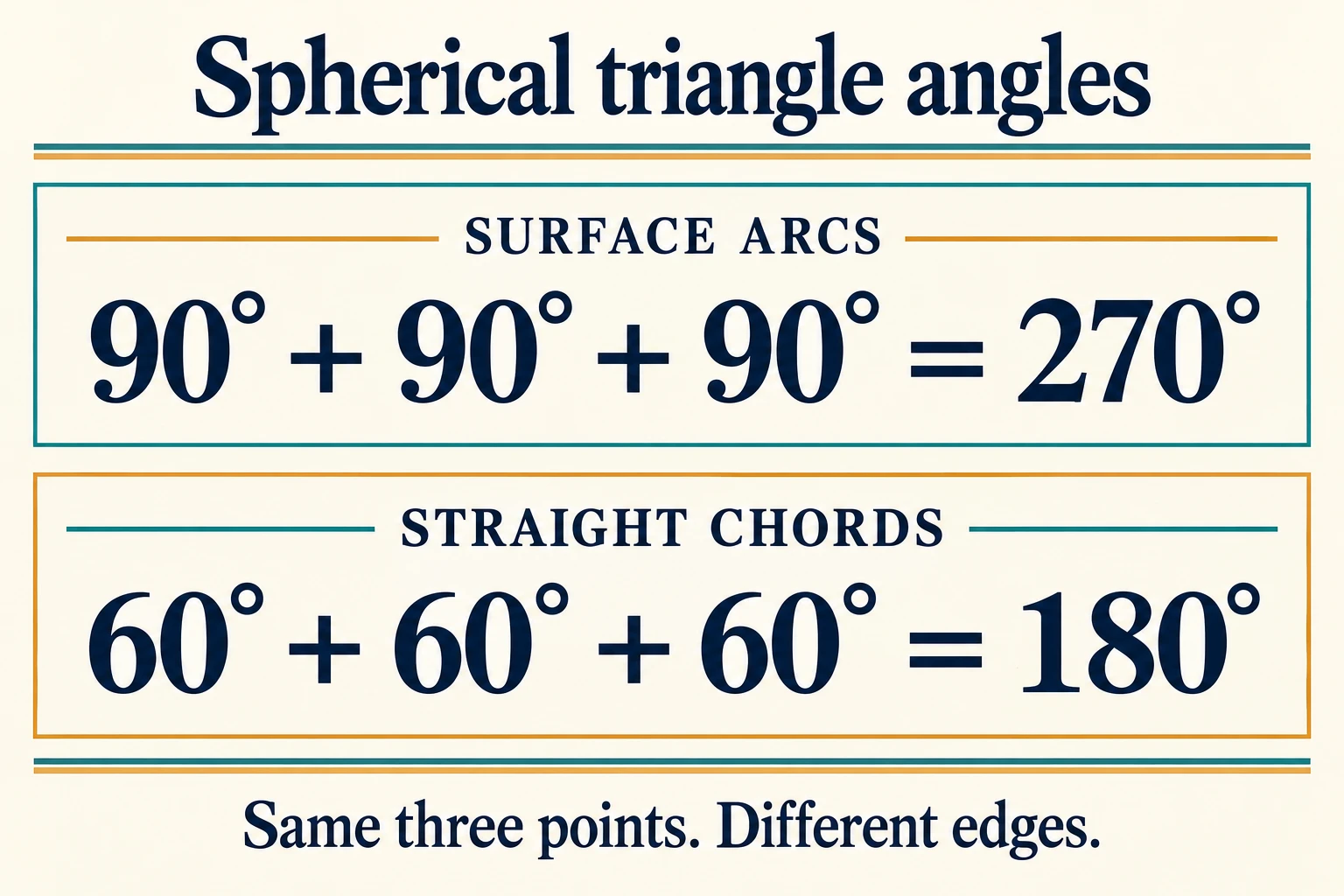
Three points do not settle the angle question
A triangle can have three right angles when its edges follow a sphere. That statement needs a particular meaning of edge and angle. It does not say that three straight segments in an ordinary plane can make three right angles. Here is a complete coordinate example in which the same three vertices support both constructions. The surface version has a 270 degree sum; the straight chord version has a 180 degree sum. Keeping the vertices fixed makes the source of the difference easier to see.
Use ordinary three dimensional Euclidean space throughout. Its unit sphere consists of points satisfying x squared plus y squared plus z squared equals one. Choose P=(1,0,0), Q=(0,1,0), and R=(0,0,1). Each lies on the sphere because its squared coordinates sum to one. These coordinates are declared inputs for an original mathematical exercise. They are not measurements taken from a photograph, a product, a globe, or a physical drawing. The calculation uses the usual dot product throughout.
For the surface triangle, choose the first octant patch: points on that sphere with x, y, and z all nonnegative. Its boundary has three quarter circle arcs. These particular curves, this particular interior patch, and the outgoing tangent definition of an interior angle form the complete construction. Saying only that P, Q, and R are vertices would leave too much unspecified. Many curves can join the same points, and a boundary on a sphere can leave a choice about which region is its interior.
Write down the three surface edges
Parameterize the edge from P to Q as (cos t, sin t, 0), with t running from zero to pi divided by two. At the starting value the point is P; at the ending value it is Q. Every point has nonnegative coordinates and squared norm one. The edge lies in the coordinate plane z=0, which passes through the center of the sphere. It is therefore a positive quarter of the great circle cut out by that plane.
The edge from Q to R is (0, cos t, sin t) over the same interval. The edge from R to P is (sin t, 0, cos t). Their coordinate planes also pass through the center. Together the three arcs enclose the chosen first octant patch. This specification avoids an ambiguity between a shorter positive arc and a longer route around the same circle. It also avoids treating a segment passing through the sphere's interior as though it belonged to the surface boundary.
To measure a corner angle, use two tangent directions based at that corner and pointing away from it along its two boundary arcs. Both directions lie in the sphere's tangent plane at that point. Their ordinary Euclidean angle gives the interior corner angle of this patch. Directions need to point away from the corner on both incident edges. Following one edge into the corner and the other out would change one sign and could produce the supplementary angle in a less symmetric example.
Check every corner locally
At P, the direction toward Q is (0,1,0), found by differentiating the P to Q parameterization at zero. The direction from P toward R is (0,0,1). One can obtain it by traversing the R to P arc backwards from P. These are different coordinate axes, each of length one, with dot product zero. Their angle is consequently 90 degrees. They lie in the tangent plane x=1 through P; treating them as directions means their first coordinate is zero.
At Q, the outgoing direction toward P is (1,0,0), while the outgoing direction toward R is (0,0,1). Their dot product is again zero and both have unit length. The tangent plane here is y=1, and both direction vectors have zero second coordinate. The angle inside the first octant patch is another 90 degrees. This corner has been computed in its own tangent plane, rather than transferred from a flattened picture of the whole sphere.
At R, the outgoing direction toward P is (1,0,0), and the outgoing direction toward Q is (0,1,0). They are the remaining pair of coordinate axes. Their dot product is zero, their lengths are one, and the chosen patch has a 90 degree corner there too. Adding the three local angles gives 90+90+90=270 degrees. Nothing in this computation changed the dot product, distorted a ruler, or introduced a second rule for perpendicular vectors.
The tangent planes are different planes at different locations. The three local right angles therefore do not form the three corners of one flat triangle. A perspective illustration can help identify points and edges, but its visible pixel angles are not the angles just computed. A projected curve may look shallow or steep depending on the view. The coordinates and tangent directions, rather than the appearance of a rendered outline, establish the result.
Join the same vertices with straight chords
Now retain P, Q, and R but replace every arc with its straight segment. These three segments lie in the plane x+y+z=1: each vertex satisfies the equation, and a straight interpolation between two such vertices also satisfies it. This is an ordinary planar triangle inside three dimensional space. Its edges pass inside the sphere except at their endpoints. Changing the edge construction has produced a different triangle while preserving the exact vertex coordinates.
The vector from P to Q is (-1,1,0); the vector from P to R is (-1,0,1). Each has squared length two. Their dot product is one, so the cosine of their included angle is one divided by two. That angle is 60 degrees. At Q, the vectors to P and R are (1,-1,0) and (0,-1,1). They have the same squared lengths and dot product. At R the analogous pair does as well. Each chord corner is 60 degrees.
Thus the chord triangle has three equal sides of length square root of two and three equal angles of 60 degrees. Its sum is 180 degrees. The arithmetic does not refute the surface computation. The vector from P toward Q along a chord is (-1,1,0), whereas the initial tangent along the surface arc is (0,1,0). Those are different outgoing directions at the same vertex. Expecting them to yield the same corner angle would erase the very change made to the edges.
A midpoint test distinguishes the edges
The midpoint of the straight PQ chord is (1/2,1/2,0). Its squared norm is 1/4+1/4=1/2, which is smaller than one. It lies inside the sphere. Its coordinate sum is one, as required by the chord plane. This single point is enough to disprove an assertion that the entire chord lies on the unit sphere. A line drawn between two surface points does not automatically stay on the surface between them.
The halfway point in the chosen quarter arc is obtained at t=pi divided by four: (square root of two divided by two, square root of two divided by two, 0). Its squared norm is one. Its coordinate sum is square root of two, which differs from one, so it does not lie in the chord plane. These checks identify the two curves algebraically without relying on their separation in a drawing. They also give a quick way to catch a mistaken midpoint substitution.
A common shortcut averages the endpoint coordinates and calls the result the surface midpoint. That average gives the chord midpoint above. To reach this arc's midpoint, normalize the nonzero average back to length one, obtaining the two coordinates square root of two divided by two. This correction works for the particular equal positive coordinate pair here. The exercise does not supply a general algorithm for all surface curves, antipodal endpoints, or competing choices of long and short arcs.
Keep the claim as narrow as the construction
The conclusion is that this specified spherical triangle has a 270 degree interior angle sum. It is not a claim that every spherical triangle has that sum. The quarter arcs, mutually perpendicular coordinate directions, and first octant interior are part of the data that made the arithmetic so simple. Changing vertices, edges, or the selected interior region calls for a new analysis. A memorized total should never replace checking which construction a question actually describes.
Nor does this example compare two competing inner products. The ordinary Euclidean dot product measures all six corner calculations: three pairs of surface tangents and three pairs of chord vectors. For a separate discussion of that other decision, see inner product validity in the linked guide below. The distinction matters because changing vectors while retaining a measurement rule and changing the measurement rule are different operations.
Bound the optional catalog context
The catalog names Panda Superstore Journey to the West magnet bookmarks DORIS00232. Its captured gallery shows six printed narrow strips in a front arrangement.
A second catalog account is Panda Superstore DORIS00233 magnet bookmarks, with a different printed front arrangement. Neither gallery demonstrates folding, magnetic strength, clipping performance, or page fit. Maker identity, materials, dimensions, delivered quantity, licensing, and aliases remain unverified. Neither account supplies the sphere model or proof; no purchase is required.
Use adjacent methods for their own questions
For a separate planar coordinate exercise, barycentric coordinate weights concerns expressing a point through weighted vertices. That is a different decision from specifying a surface boundary and measuring its tangent angles. A coordinate expression alone does not tell you which curves were chosen as edges.
The guide on inner product compatibility checks tests positivity for alternative inner products. That separate task concerns the rule used to measure vectors. Here every angle uses the ordinary Euclidean dot product; only the edge curves and their outgoing directions change.
Return to the present example by writing four labels before calculating: surface, edges, interior, and angle convention. Under surface write unit sphere. Under edges write positive quarter great circle arcs. Under interior write first octant patch. Under angle convention write outgoing boundary tangents in the ordinary Euclidean metric. The resulting corner computations lead to 270 degrees. For the chord construction, replace the first three labels with the plane x+y+z=1, straight segments, and their bounded planar interior.
This checklist is useful even when the final arithmetic looks obvious. It exposes a disagreement about the object being measured before that disagreement becomes an argument about addition. If someone reports 180 degrees and someone else reports 270 degrees for P, Q, and R, ask for their edges first. Both answers are correct for the two constructions defined here. The worksheet cover records their sums as text; it is not a geometric measurement instrument or a scaled representation of local spherical angles.
As a final arithmetic check, collect the tangent vectors at each vertex in pairs and verify their squared lengths before using a cosine. A zero dot product only gives a right angle when both vectors are nonzero. Here every listed tangent has squared length one, so that condition holds explicitly. For the chord pairs, squared length two gives a length product of two, rather than a squared length product of four in the cosine denominator. Keeping that distinction visible prevents an otherwise plausible but incorrect angle calculation. The checks establish the stated totals without reading angles off a picture.
Separate any payment question from the exercise
The coordinates and angles above are declared mathematical inputs, not prices or cryptocurrency instructions. If you separately consider an order on republeq.com, read the current checkout information before choosing any payment method. A reference to USDT does not establish that a particular transaction accepts it. Ask whether cryptocurrency is currently available for your proposed transaction and which exact asset and network the displayed instructions specify. Do not infer those details from a familiar abbreviation. Check the complete amount, any displayed charges, the destination, and any timing condition before deciding whether to proceed. Compare the current instructions with the order you intended to place. If anything is unclear, obtain clarification through the site's stated support route before transferring funds. A transfer on a different network can present a different practical situation from the one contemplated in an instruction; this article supplies no transaction directions. Keep any order reference and confirmation that the actual service provides, and check its current terms concerning payment status, cancellations, returns, refunds, and unresolved transfers. These are questions to investigate, not assertions about available methods or promises about an outcome. Verify the recipient information directly from the current transaction interface. Avoid treating a copied address or a past example as approval for a later payment. Decide independently whether the proposed transaction and its terms suit you. There is no need to buy either catalog item to reproduce the coordinate calculations. A product photograph does not verify checkout terms, and a mathematical angle sum says nothing about a payment's status. Resolve item identity and supplied contents separately from payment details. Finish those checks before committing to an order, and retain the actual instructions relevant to the transaction you choose.