Skills & Planning
Triangle weight compatibility: keep every weight nonnegative
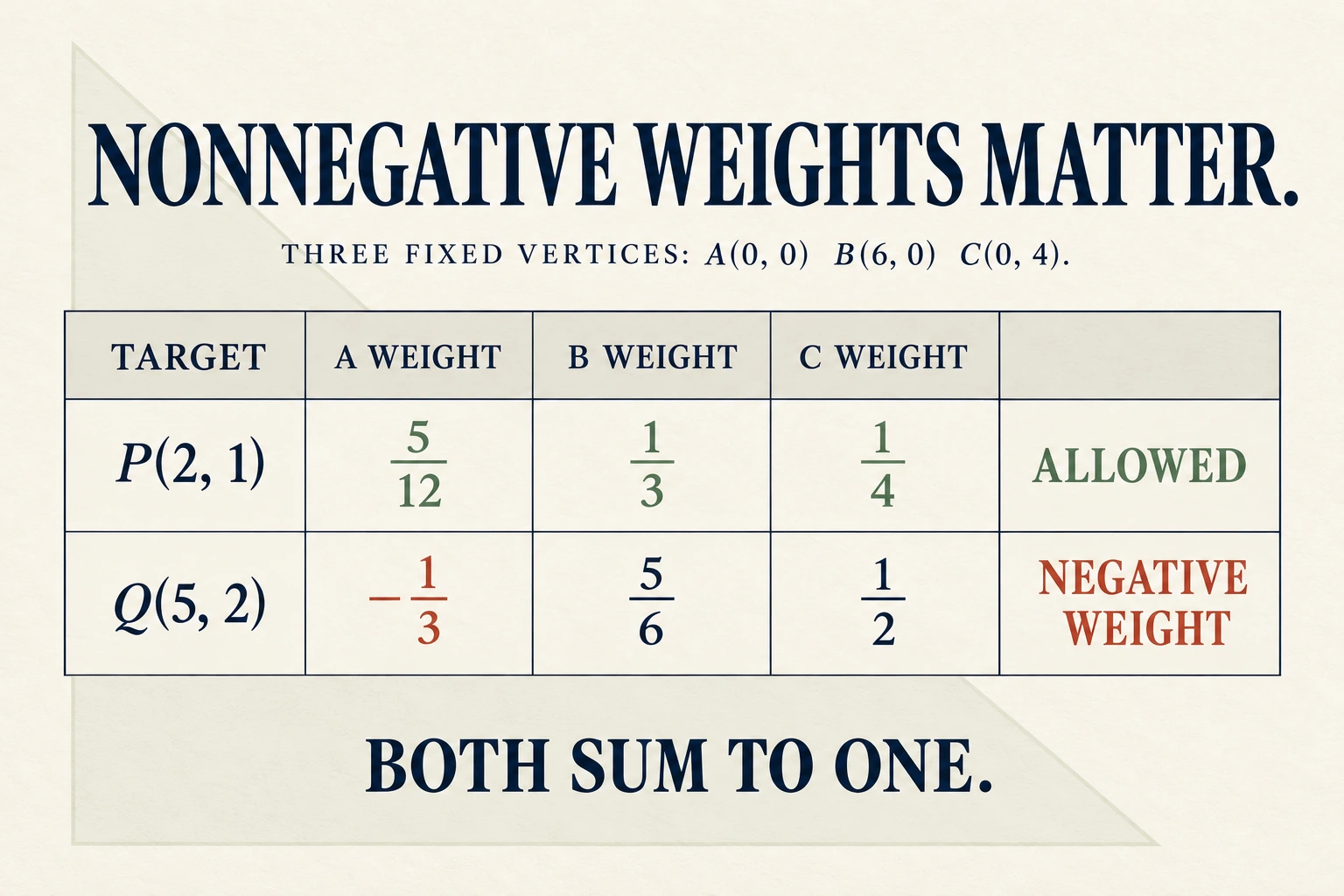
For vertices (0,0), (6,0), (0,4), target (2,1) has permitted weights 5/12, 1/3, 1/4. Target (5,2) reconstructs only with a negative first weight.
Write all three weight requirements
Triangle weight compatibility asks whether a target point can be represented using three fixed vertices under a stated weight rule. For this original paper model, place A at (0,0), B at (6,0) and C at (0,4). Call their weights a, b and c. Every weight must be a real number greater than or equal to zero, and the three weights must sum to one. Zero is allowed.
The resulting point is calculated coordinate by coordinate: multiply each vertex's horizontal coordinate by its weight and add, then do the same for the vertical coordinates. These are invented coordinates in abstract units. They are not measured dimensions, material quantities, product capacities or instructions for combining actual substances. Keep the coordinate rule and the permitted weight domain beside the diagram before testing a target.
Derive the weights from the actual vertices
Only B has a nonzero horizontal coordinate. A weighted combination therefore has horizontal coordinate 6b. Only C has a nonzero vertical coordinate, giving vertical coordinate 4c. A's two coordinates are zero, so its direct contribution to both sums is zero. Its weight still matters because the separate requirement a + b + c = 1 includes it.
For a target (x,y), matching its horizontal coordinate forces b = x/6, and matching its vertical coordinate forces c = y/4. Both divisions use nonzero constants. The sum requirement then forces a = 1 - x/6 - y/4. There is exactly one real candidate triple for any target under these equations. We must still check whether that candidate has the required nonnegative signs.
Construct the permitted target (2,1)
Call the first target P and set P = (2,1). Its horizontal coordinate requires b = 2/6 = 1/3. Its vertical coordinate requires c = 1/4. Subtract those two weights from one to obtain a = 1 - 1/3 - 1/4. In twelfths, that is 12/12 - 4/12 - 3/12 = 5/12.
The candidate weights are thus 5/12 for A, 1/3 for B and 1/4 for C. Each is nonnegative. Their sum is 5/12 + 4/12 + 3/12 = 12/12 = 1. Check the coordinates independently: the horizontal sum is 6 times 1/3, giving two, while the vertical sum is four times 1/4, giving one. Every stated requirement holds for this same triple.
Keep reconstruction and permission separate
The successful triple establishes a construction, not merely a plausible position in a sketch. It also inherits the earlier uniqueness argument: matching P's two coordinates forces b and c, and the sum forces a. A different triple could not represent P while satisfying the same equations. You can retain the exact fractions even if a drawing is only approximate.
Do not use equal weights simply because there are three vertices. Weights 1/3, 1/3 and 1/3 are permitted in the declared domain, but they produce (2,4/3). Their horizontal coordinate matches P and their vertical coordinate does not. Those weights describe another point. A permitted triple and the requested target must be checked together; validity somewhere in the triangle does not establish validity for P.
Test the outside candidate (5,2)
Now make a separate target Q = (5,2), retaining the same three vertices and weight requirements. Coordinate matching gives b = 5/6 and c = 2/4 = 1/2. Their sum is 5/6 + 3/6 = 8/6. To bring the complete sum back to one, a must equal 6/6 - 8/6 = -2/6, or -1/3.
The signed candidate -1/3, 5/6, 1/2 reconstructs Q's coordinates correctly and sums to one. It fails the declared domain because its A weight is negative. This is why a correct sum alone is insufficient. No alternative nonnegative triple remains to try: the coordinate equations already fixed b and c, leaving that negative a as the only value compatible with the sum.
Do not repair the signs by changing the target
Replacing Q's negative first weight with positive 1/3 would give 1/3, 5/6 and 1/2. The coordinate sums would still be five and two, because A contributes zero coordinates. But the three weights would now sum to 2/6 + 5/6 + 3/6 = 10/6 = 5/3. That replacement repairs the sign while breaking the normalization requirement.
Dividing those positive weights by 5/3 restores a sum of one. The resulting triple is 1/5, 1/2 and 3/10. It produces horizontal coordinate three and vertical coordinate 6/5, so the target has changed to (3,6/5). Record this as another constructed point, rather than claiming it solves Q. Sign repair followed by normalization cannot silently discard the original coordinate request.
State the fixed triangle's full test
The candidate formula supplies a concise test for any target using these particular vertices. The conditions are x greater than or equal to zero, y greater than or equal to zero, and x/6 + y/4 less than or equal to one. The first two make b and c nonnegative. The last makes a = 1 - x/6 - y/4 nonnegative.
These conditions work in both directions. Any permitted weights reconstructing a target must satisfy them by the coordinate and sum equations. Conversely, a target satisfying all three conditions supplies nonnegative values through our formulas; those values sum to one and reproduce its coordinates. The argument establishes exactly which points the stated model permits, without relying on how close a drawn dot looks to a thick boundary line.
A separate target (-1,1) shows why the first two inequalities cannot be dropped. Its b is -1/6, c is 1/4 and a is 11/12. The combined quantity x/6 + y/4 is only 1/12, so the upper-bound inequality passes. The negative horizontal coordinate still forces a negative B weight and prevents permission. Checking that one combined expression is at most one would miss this failure. All three stated inequalities belong to the same test.
Keep boundary and vertex cases when zero is allowed
For the target (3,2), the formulas give b = 1/2 and c = 1/2, leaving a = 0. All three weights meet the nonnegative rule and sum to one. The reconstructed point is halfway between B and C. It belongs on their connecting boundary, and its zero A weight is permitted. Excluding it would require a stricter domain than the one originally stated.
For A itself, target (0,0) gives b = 0, c = 0 and a = 1. That vertex also passes. We have not required every vertex to contribute a positive share. A separate exercise demanding strictly positive weights would exclude these two examples, while retaining P's strictly positive triple. Label that as a changed domain before comparing its result with the original.
Know which conclusion changes when negatives are admitted
If the domain instead allowed negative real weights while keeping the sum equal to one, Q's signed triple would be accepted by those changed rules. The earlier calculation would stay arithmetically correct. What changes is the permission attached to its negative value. This does not establish that negative quantities make sense in any physical application; the present model is an abstract coordinate construction.
The derivation also depends on the fixed vertex coordinates. A different triangle requires equations using its own coordinates. In particular, our factors six and four cannot be copied from this page into an unrelated diagram. Keep vertex names, coordinate order and the target with the resulting triple so that a valid calculation does not lose the input that made it valid.
Check an answer with the complete record
Give a reviewer the three vertices, target, domain and candidate weights. They can check the two coordinate sums, the sum of the weights and each individual sign. A check saying only that the fractions add to one leaves Q's failure undetected. A check saying only that the plotted point looks inside supplies neither the exact triple nor the equations behind it.
Retain P and Q as separate cases. P uses nonnegative weights 5/12, 1/3, 1/4 and passes all conditions. Q has the unique signed candidate -1/3, 5/6, 1/2 and fails the original domain. The boundary, vertex and altered-normalization examples explain specific controls; they do not replace either original target or prove a real accessory pairing compatible.
Bound the optional notebook accounts
The Scully pocket notebook account describes Old Atlas Print, while its composite image shows a horse-print cover and an open Scully manuscript book. Exact variant, model, material and size remain unverified. Two poses do not establish two supplied books.
The OUNONA pocket notebook account shows a central hourly pad with a partial spiral notebook and plants in the scene. Its stated six notepads are not independently counted. Staged objects are not verified supplied stock; size, material and performance remain unverified.
Neither account supplies the vertices, weights or proof. Their role is optional paper-workspace context, and the exercise requires no purchase.
Leave other coordinate decisions with their own rules
The grid area count guide assigns fractional coverage to diagonal-cut cells in a fixed triangle. Here no cell area is calculated. The target's coordinates instead force three normalized vertex weights, whose signs determine permission.
The projection drawing spacing guide finds intersections along rays from one viewpoint to an image line. This worksheet has no image line or projected gaps. It tests a normalized combination of three fixed vertices against a target.
Keep any transaction enquiry outside the coordinates
If you separately consider a notebook order on republeq.com, assess the current offer and transaction before choosing how to pay. The coordinates and weights in this worksheet are invented mathematical inputs, not product quantities, prices or cryptocurrency instructions. Before using USDT, inspect the actual checkout and determine what that particular order presents. Check the requested amount and denomination, the receiving destination displayed, any network instruction, and the order status before sending funds. These are questions to resolve, rather than statements that an option exists for either offer. Confirm that the item and intended quantity match your proposed order. Resolve product and supplied-content questions separately from payment instructions. A photograph does not authenticate transaction terms. Keep the current instructions, their date and the result of any action you actually take, distinguishing a pending step from a completed payment. If the selection changes while you are checking, review the resulting transaction instead of carrying an earlier conclusion across automatically. Determine what the merchant currently supplies about delivery, cancellation and any refund process before relying on it. Do not assume a transfer can be reversed or a particular network will be supported. This conditional checklist makes no claim about token acceptance, transfer success or available remedies. You can complete the paper worksheet without buying either offer. A weighted point cannot authenticate a payment destination or show that an order has been accepted. The actual purchase needs its own clear and current order-specific evidence, and its records belong separately from this abstract exercise. Retain unanswered questions beside the proposed transaction.
Save the signs beside the sum
For this triangle, retain b = x/6, c = y/4 and a = 1 - b - c with every target. Record P as permitted and Q as incompatible with the nonnegative domain. Keep Q's signed construction visible so the exact failure remains inspectable. Both coordinate reconstruction and a sum of one can pass while a required sign still fails.