Office Supplies & Stationery
Inner product compatibility checks: test positivity
A real two-by-two matrix rule needs strict positivity beyond symmetry; explicit counterexamples and a determinant proof separate valid and invalid inner products.
Inner product compatibility checks start with a negative square
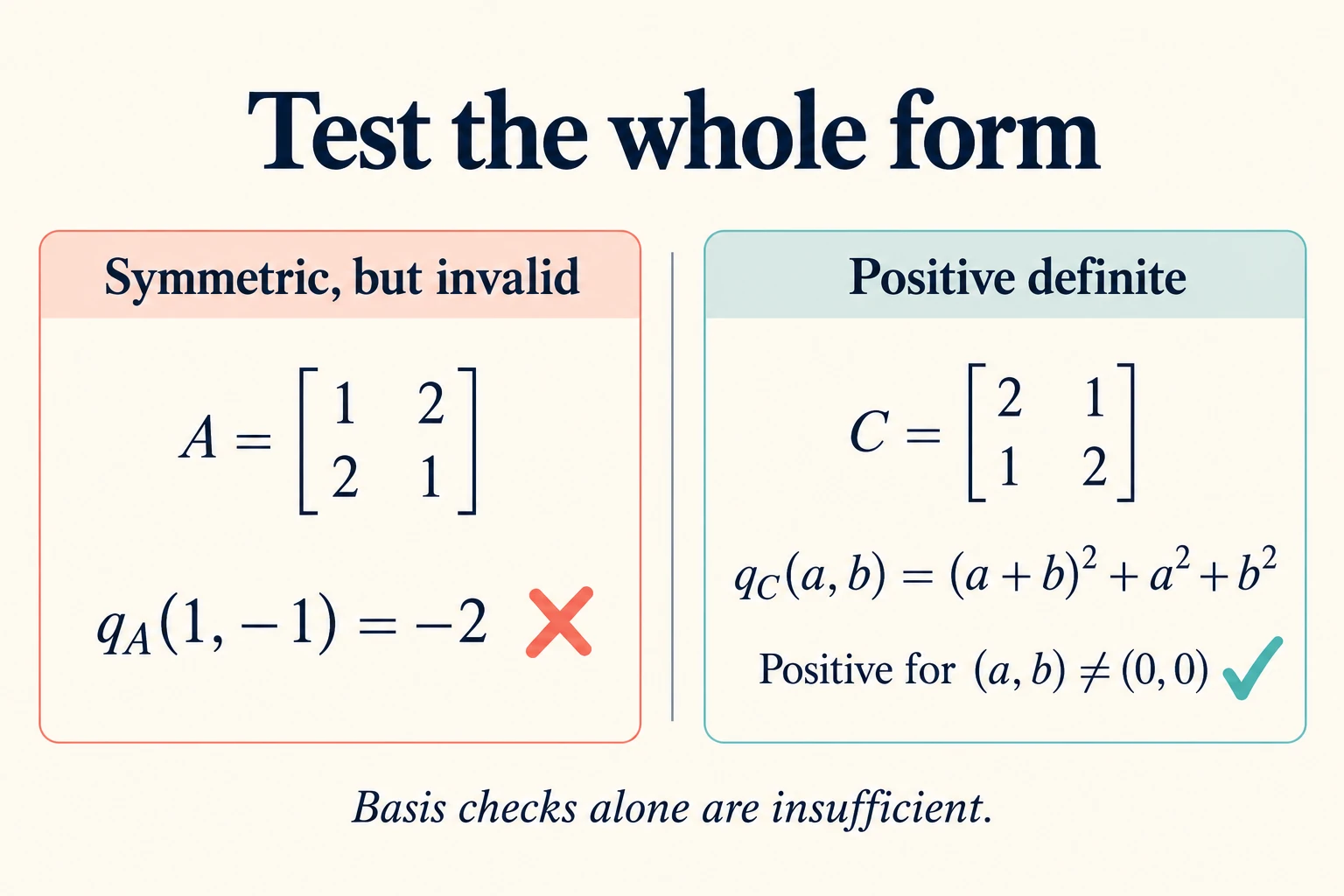
A matrix can have positive entries and still fail to define an inner product. Consider a rule on real two-component vectors: BM(u,v)=uᵀMv, where M is a fixed two-by-two matrix. Before treating BM(v,v) as a squared length, test what it actually produces. For A=[[1,2],[2,1]] and v=(1,−1), the value is −2. A negative number cannot be the square of a real length. That single calculation rejects this rule, even though its matrix looks orderly and symmetric.
The reader decision here is precise: which symmetric two-by-two matrix rules can support real inner-product geometry? We will check the definitions, reject two tempting shortcuts, prove a valid control and derive a complete criterion for this particular setting. The examples are mathematical constructions. They do not describe a shelf, a product dimension, a load rating or a measured physical relationship. Keep the vector calculation separate from any storage supplies used to organize the worksheet.
Separate three requirements before using geometric language
For real vectors, an inner product is bilinear, symmetric and positive definite. Bilinearity means that addition and real scalar multiplication distribute in each argument. Symmetry means B(u,v)=B(v,u). Positive definiteness means B(v,v)>0 for every nonzero v. The zero vector has value zero. The word “every” matters: a few convenient vectors can disprove positivity when one fails, but passing those samples alone cannot prove it for the whole plane.
The matrix construction already gives bilinearity. Expanding a matrix product distributes over vector sums, and a real scalar can be pulled outside either argument. If M is symmetric, transposing the scalar uᵀMv shows that it equals vᵀMu. Thus symmetry is also accounted for. The remaining question is strict positivity of the quadratic expression qM(v)=BM(v,v). Neither the existence of the product nor the symmetry calculation answers that remaining question.
It helps to write separate boxes on a page for these checks. Marking the bilinear and symmetric boxes should not silently mark the positivity box. In particular, a rule can be algebraically well defined and symmetric while producing an impossible squared length. This distinction prevents a valid matrix multiplication from being mistaken for a valid geometric interpretation. We are testing the proposed rule itself before relying on lengths or orthogonality defined by that rule.
A positive-looking matrix that fails
Write a general vector as (a,b). For A=[[1,2],[2,1]], direct expansion gives qA(a,b)=a²+4ab+b². Both standard basis checks pass: qA(1,0)=1 and qA(0,1)=1. Every entry of A is positive as well. These observations are true, but they leave the mixed term untested. When the coordinates have opposite signs, that term can be negative and can outweigh the positive square terms.
At (a,b)=(1,−1), the expression becomes 1−4+1=−2. The vector is nonzero, so this violates positive definiteness immediately. Completing the square exposes the same issue without choosing the witness first: a²+4ab+b²=(a+2b)²−3b². Choosing a=−2b cancels the first square and leaves a negative value whenever b is nonzero. One counterexample was enough; the completed square explains why such examples exist.
Do not repair the result by taking its absolute value and continuing as though the original rule passed. That would change the function being tested and would require its own checks. Nor does a correct value at each basis vector settle the matter: the condition concerns all nonzero vectors, including mixtures of basis directions. The failure belongs to A as a proposed inner-product matrix, rather than to a rounding error or an inconvenient choice of coordinate labels.
A sum of squares proves the valid control
Now use C=[[2,1],[1,2]]. Its quadratic expression is qC(a,b)=2a²+2ab+2b². Rewrite it as (a+b)²+a²+b². Every term is nonnegative. If (a,b) is nonzero, at least one of a² and b² is strictly positive, so their sum with the remaining square is strictly positive. This argument covers every real vector at once. It also gives zero at (0,0), exactly as the definition requires.
C is symmetric and the matrix construction is bilinear, so all three requirements now hold. The sum-of-squares proof is stronger than a table of favorable sample values. A table could miss a direction, whereas the identity applies to arbitrary a and b. Keep the nonzero qualification beside any shorthand statement that qC>0. At the zero vector the value is zero; writing strict positivity without that qualification would incorrectly reject every inner product.
Two controls guard against opposite mistakes
The first boundary control is D=[[1,1],[1,1]]. Here qD(a,b)=(a+b)², which is never negative. Nevertheless, the nonzero vector (1,−1) gives zero. D therefore fails positive definiteness. Nonnegativity is insufficient when a nonzero direction can have zero squared length. This example separates a strict requirement from a weak inequality without relying on the negative-value witness used against A.
The other control is E=[[2,−1],[−1,2]]. This matrix has negative off-diagonal entries, yet qE(a,b)=2a²−2ab+2b²=(a−b)²+a²+b². As with C, a nonzero vector makes at least one of the final two squares positive. E is therefore a valid inner-product matrix. Negative entries do not automatically cause failure, just as positive entries did not establish success for A. The whole expression and the strict condition decide the result.
Derive the complete two-by-two criterion
Take a general real symmetric matrix M=[[α,β],[β,γ]]. Its quadratic expression is αa²+2βab+γb². If this defines an inner product, evaluating it at (1,0) forces α>0. Once that requirement is available, division by α is legitimate. Completing the square gives qM(a,b)=α(a+(β/α)b)²+((αγ−β²)/α)b². This identity is the useful test; do not divide by α before establishing that it is positive.
To prove necessity of the second condition, choose the nonzero vector (−β/α,1). The first square disappears, so its value is (αγ−β²)/α. Strict positivity, together with α>0, forces αγ−β²>0. These are necessary conditions obtained from actual vectors, rather than guessed from the successful control. A proposed symmetric matrix failing either condition cannot define the required real inner product.
For sufficiency, suppose α>0 and αγ−β²>0. In the completed-square identity both coefficients are positive. If b is nonzero, the second term is strictly positive and the first is nonnegative. If b is zero and the vector is nonzero, then a is nonzero and the first term is strictly positive. Thus qM(a,b)>0 for every nonzero vector. Along with bilinearity and symmetry, this proves the rule is an inner product.
The final criterion for this real symmetric two-by-two setting is therefore α>0 and det(M)=αγ−β²>0. The first condition must remain beside the determinant condition. For example, M=[[-1,0],[0,−1]] has determinant 1 but q(1,0)=−1. A positive determinant alone would admit this invalid rule. The proof above establishes the exact pair of conditions and explains the role of each, without importing an unproved rule for larger matrices.
As a final arithmetic check, substitute b=0 into the completed-square identity and recover αa². Substitute a=−βb/α and recover ((αγ−β²)/α)b². These two choices expose the coefficients whose signs control the proof. They also explain why the order of the test is useful: the first establishes a legitimate positive divisor, and the second isolates the remaining obstruction. For a matrix that passes, keep the universal identity as the acceptance evidence. For a matrix that fails, record the specific nonzero witness and its value so another reader can reproduce the rejection without guessing what was sampled.
Use the controls and respect the geometry you chose
For A, α=1 and the determinant is 1−4=−3, agreeing with the negative witness. For C, α=2 and the determinant is 4−1=3, agreeing with its positive sum of squares. D has determinant zero, which matches its nonzero zero-value direction. E again has α=2 and determinant 3. These computations are useful cross-checks on the examples because the general criterion has already been proved, rather than inferred from those examples.
Passing the test does not mean the new geometry equals the ordinary dot product. Let e₁=(1,0) and e₂=(0,1). Their ordinary dot product is zero, but BC(e₁,e₂)=1. They are therefore not orthogonal under the C rule. Once a valid inner product is selected, use that same rule consistently when interpreting orthogonality. This article validates a form; it does not solve a nearest-vector optimization problem or assume that Euclidean conclusions transfer unchanged.
Keep the supporting references separate
The shelf-label holder listing shows a clear clip and card frame mounted around wire shelving. A hand and printed card are presentation context, not established supplied extras. It is an optional worksheet-organization reference; the listing does not establish the mathematical result, a verified pack count, dimensions, material, fit or stock availability.
The label-holder insert listing shows bounded clear rectangular pieces and a blue-backed stack. Its description discusses holding paper labels in shelf channels and moving labels. Do not infer a separate stand, pocket cavity, supplied paper stock, authenticated quantity, dimensions, material, protection performance or channel compatibility from that presentation.
The matrix shape compatibility guide addresses whether a matrix product has compatible dimensions. Our two-by-two products already have matching dimensions; the additional question here is whether the resulting symmetric rule is strictly positive on every nonzero vector.
The closest scalar multiple guide works within a fixed Euclidean geometry. Here we first decide whether a proposed matrix rule defines an inner product at all. Its optimization question should not substitute for the positivity proof required by this worksheet.
A conditional purchasing note
If you choose to buy an organizer after finishing this worksheet, keep the payment question separate from the mathematics. A valid inner product says nothing about a seller, a listing or a checkout. If cryptocurrency is offered for a particular purchase, first confirm the exact item, seller terms, total price, delivery details and return conditions in the current purchasing flow. If USDT appears as an option, check the stated network and destination before deciding whether that option suits you. A token name alone would not settle network compatibility or the treatment of a mistaken transfer. Do not infer availability from this article, from an organizer photograph or from the existence of a product page. Visit republeq.com and inspect the actual current information for the item you intend to purchase. If a payment method is absent or its instructions are unclear, stop and ask for clarification before sending funds. Keep a record of the displayed terms and any confirmation provided by the transaction flow. This conditional note does not report a completed transaction, promise a discount, confirm acceptance of a particular token or establish a refund right. It also makes no claim about transaction speed, fees or price stability. Compare any available payment choice on the terms you can actually verify, rather than treating cryptocurrency as a necessary part of buying a simple storage accessory. The organizer remains optional; the positivity proof can be checked with a pencil and a blank page. No purchase, token balance or account setup is needed to evaluate the matrices, reproduce the counterexample or decide which of the proposed rules defines an inner product.
Finish with a reason that covers every vector
Record the decision beside each matrix: A fails through a negative value, C passes through a strict sum of squares, D fails through a nonzero zero-value vector, and E passes despite its negative entries. For another real symmetric two-by-two rule, establish α>0 and then test αγ−β²>0 using the completed-square proof. A rejected rule needs one valid witness. An accepted rule needs an argument covering all nonzero vectors.