Troubleshooting & Repairs
Smoke alarm maintenance: age, testing and replacement
Check actual alarm age, power arrangement and testing outcome, keeping Kidde30CUD10 service guidance and First AlertPRC710 catalog details separate.
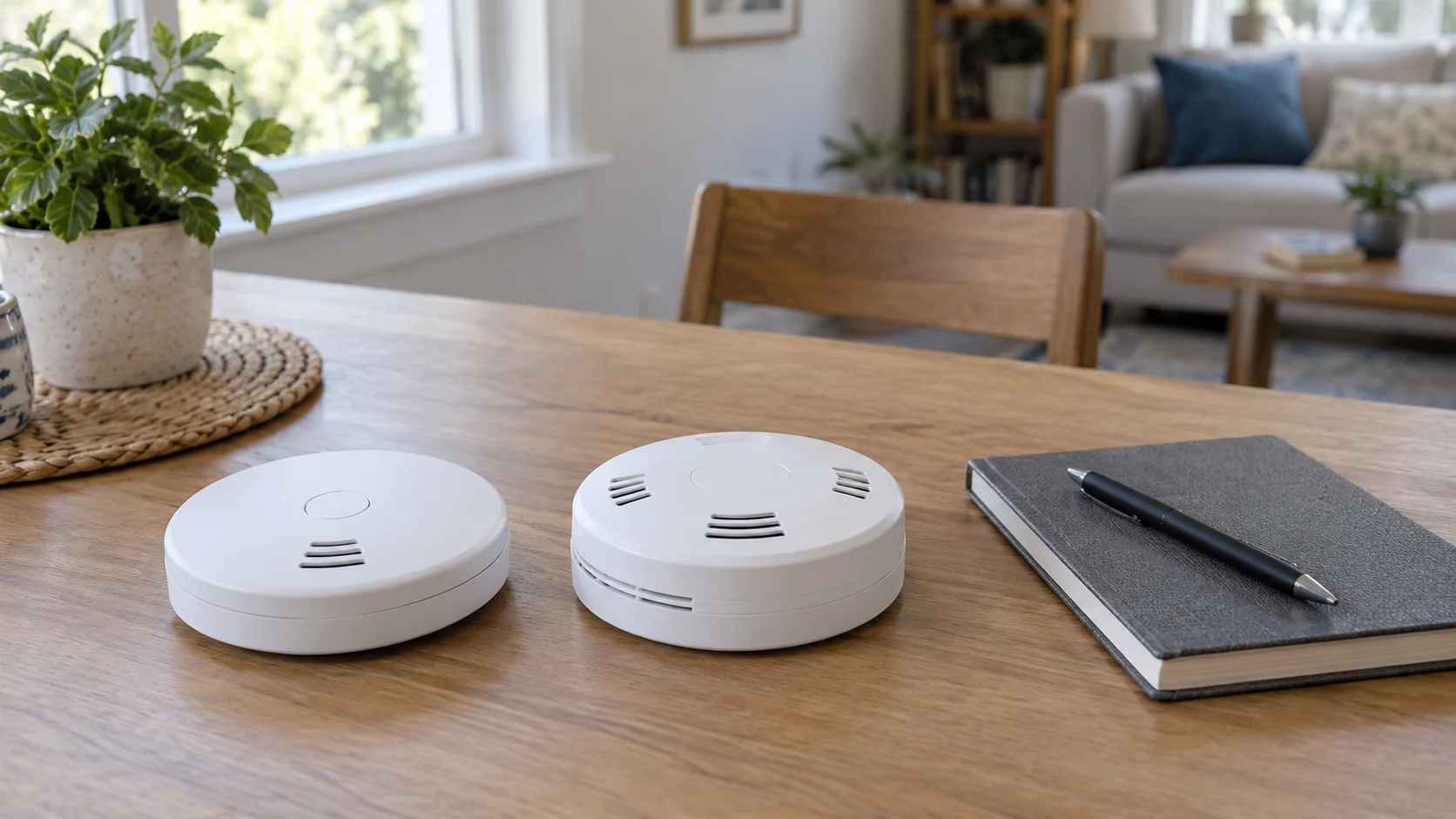
Smoke alarm maintenance starts with the alarm already protecting the room: its model, age, power arrangement and current warning. A new battery is useful only where the applicable instructions call for one. When the battery is sealed inside, opening the case to imitate a familiar battery change can turn a service question into a damaged alarm.
This guide follows the U.S. Fire Administration's household care guidance to organise an age check, testing record and replacement decision. Match service information with the unit actually installed. The goal is a clear action for each location, with unresolved questions carried to the person who can answer them.
Respond to an alarm before starting a maintenance task
Plan maintenance for a safe situation, after any alarm event has been addressed. The Kidde guide's carbon-monoxide response directs occupants outdoors to fresh air and tells them to call emergency responders. An unexplained alarm is not an invitation to stand underneath the unit experimenting with its buttons.
The U.S. Fire Administration explains that carbon monoxide is colourless, odourless and poisonous. Human senses cannot detect it. Looking around the room or deciding that the air smells normal cannot establish that a combination alarm has given a false warning. Keep the emergency response in the applicable instructions available to everyone who uses the home.
For fire preparation, USFA recommends a home escape plan and working smoke alarms. It warns that people may have less than two minutes to get outside after hearing a smoke alarm. Resolve escape arrangements before a scheduled maintenance session; the service process should support a household's response, rather than become the response to a sounding alarm.
Make the smoke alarm age check about the actual unit
For a smoke alarm age check, USFA says smoke alarms need replacement ten years from their manufacture date. A receipt tells you when a purchase happened. It does not, by itself, establish when that particular alarm was manufactured. Read the actual label and retain the model reference alongside the date information.
If the label cannot be interpreted, take its wording to the manufacturer or supplier. Keep a photograph or a written transcription that includes the model and date code together. A date with no associated unit can easily be assigned to the wrong alarm when several similar devices were installed at different times.
Check each location individually. A bedroom alarm bought recently does not establish the age of the hallway unit, and a replaced hallway unit does not update the one in the basement. A simple location list makes the physical check easier: identify the room, the unit's markings, the applicable instructions and the next action for that unit.
Record the observation without turning it into a diagnosis. “Label unreadable” is a useful service problem. “Manufactured on the day we moved in” is an assumption unless you have evidence. When age or identity remains uncertain, ask for the information needed to decide on replacement rather than entering a reassuring date just to complete the list.
Separate removable batteries from sealed battery alarm replacement
Sealed battery alarm replacement concerns the whole device when its instructions require replacement. USFA distinguishes smoke alarms powered by disposable batteries, long-life batteries and the home's electrical system. Its general guidance calls for monthly testing and entire-alarm replacement every ten years. It also says to care for alarms according to the manufacturer's instructions.
USFA's disposable nine-volt example includes replacing the battery at least annually. Its hardwired example includes a backup battery and annual backup-battery replacement. These are descriptions of different power arrangements. Do not turn an instruction for a removable backup battery into permission to open a sealed housing.
Establish the arrangement before buying consumables. Read the label and matching documentation instead of relying on the round shape of the cover. If the instructions describe a sealed power supply, a packet of ordinary household cells is not an equivalent replacement part. Keep the complete model designation when asking for service or a replacement alarm.
Use the Kidde 30CUD10 service account only with that model
The Kidde 30CUD10 combination alarm offer identifies a battery-operated smoke-and-carbon-monoxide unit. Kidde's linked user guide lists 30CUD10 as a sealed-battery model without voice alerts. Do not borrow spoken messages from a neighbouring voice-model description to identify its condition.
The guide separates low battery, sensor faults and end of unit life. For sealed models, its low-battery remedy includes replacement of the alarm. It directs people who are unsure about a fault to product support before discharging the battery or disposing of the device. Keep that question with product support; do not open the sealed battery housing.
Its cleaning section prohibits disassembly and says a fault that remains after the specified cleaning and test needs replacement. The product page distinguishes its ten-year limited warranty from battery performance. A printed duration does not cancel an earlier warning or an unresolved failed test.
Keep the First Alert PRC710 offer separate
The First Alert PRC710 combination alarm offer describes a battery-powered unit with photoelectric smoke sensing and electrochemical carbon-monoxide sensing. It lists an end-of-life chirp and ten-year limited coverage. Those are attributed catalog statements, not a received-unit test or a universal interpretation of its sounds.
Use documentation that names the actual model before acting on its indicators. A manual offered under a similar product name may still identify a different unit inside. Match the document's own model text with the alarm. When they disagree, obtain the correct instructions instead of adapting the other unit's troubleshooting table.
Give testing its own place in the maintenance record
USFA recommends testing smoke alarms monthly and following the maker's care instructions. Put a recurring test date on the household calendar, with the model-specific instructions available when the task is done. A reminder is useful because it leads to a physical check; the reminder itself does not show that an alarm works.
Record what actually happened during the prescribed test. Separate a completed test from one that could not be performed because the unit was inaccessible or the instructions were missing. Keep an unresolved result visible so the next person understands that further action is required.
Where the maker specifies a more frequent routine, retain that routine with the relevant unit. A general household timetable should not erase a model's own requirement. Put the instructions beside the location record so that someone helping with the next check can find the applicable routine without reconstructing it from memory.
A useful service request includes the exact model, date information, observed lights and sounds, when the observation occurred, and what the applicable instructions told you to do. Describe the outcome of that documented action. This gives support concrete information without requiring the householder to invent the name of an internal failed component.
Check coverage while arranging the replacement
USFA calls for smoke alarms inside and outside bedrooms and sleeping areas and on every level of the home. It recommends interconnected alarms so that when one sounds, they all sound. Check the household's existing arrangement when replacing a unit rather than assuming that any alarm sold individually fulfils the whole home's needs.
A combination smoke-and-CO description names two hazards. USFA's separate smoke-sensing guidance discusses ionization and photoelectric technologies and recommends both types, or dual-sensor smoke alarms. Do not confuse two hazard labels on a combination device with a statement that it contains both smoke-sensor types.
USFA also identifies alarms for people with hearing loss, including devices that use flashing strobes or vibration. An audible unit is useful only if the intended occupants can receive the warning. Consider who sleeps in each area when seeking a suitable arrangement, and ask for the appropriate equipment rather than assuming a louder catalog claim answers the question.
USFA's separate carbon-monoxide guidance calls for CO alarms in a central location outside each separate sleeping area and on every level. Keep the two coverage questions visible when considering a combination product. Identify which smoke-alarm location and which CO-alarm location the proposed unit would serve. A product that names both hazards does not supply the floor plan, the mounting decision or the applicable placement instructions. Take those details to the installer or local adviser when the arrangement is uncertain.
Local requirements matter to the replacement choice. USFA advises checking with the local fire marshal about the type of alarm required. It says qualified electricians should install hardwired smoke alarms. If the existing unit is part of a wired installation, arrange appropriate installation support instead of treating the job as an ordinary loose-battery exchange.
Resolve nuisance warnings without sacrificing protection
USFA explicitly says not to remove a smoke-alarm battery because an alarm sounds during cooking or a steamy shower. Disabling the alarm leaves the household without the warning it was installed to provide. Use the applicable nuisance-alarm guidance and investigate the placement or condition that produced the repeated problem.
The agency says to follow the maker's placement instructions and discusses ceiling or high-wall locations. Treat relocation as an installation decision that still has to preserve the required coverage. Moving a troublesome unit somewhere convenient is not a complete solution if the sleeping area loses its warning arrangement.
Power arrangements also matter in ordinary portable equipment. The Logitech G309 and SteelSeries Rival 650 guide keeps the mice's differing power details separate. The Zoom field-recorder guide considers the actual recording setup. Keep the same habit of identifying the device before choosing a battery or service action.
Ask for practical help where access or installation prevents the check
USFA says some fire departments install battery-operated smoke alarms at no cost, and some offer reduced-price or free alarms. It directs residents to the department's nonemergency number for information. An inaccessible unit or an installation question is a concrete reason to ask what local assistance is available; availability must be established with the department rather than assumed from a general program description.
Before that call, collect the locations that need attention and explain what prevents the check. Someone may be able to read an accessible label but still need help reaching a ceiling-mounted unit for the prescribed test. Separating those tasks helps the person arranging assistance understand the work required. Retain the model information you already have and leave the uncompleted task clearly marked.
Finish with the next action attached to each location
A completed maintenance session leaves each unit with a clear outcome: the prescribed test was completed, the documented care action needs follow-up, or replacement or qualified service is being arranged. Keep unresolved age, identity and fault questions attached to the specific location rather than combining them into a single “all checked” note.
When a replacement is required, carry the actual hazard coverage, power arrangement, applicable local requirements and occupant needs into the purchase decision. Then retain the new unit's model and date information with its installation record. Keep that record available for the next scheduled check.