Bedding & Bath
Check shower pump compatibility before choosing contents
Decide whether a proposed formula is within a shower pump’s documented contents restrictions, using the BT1029 warning and a cartridge-system contrast.
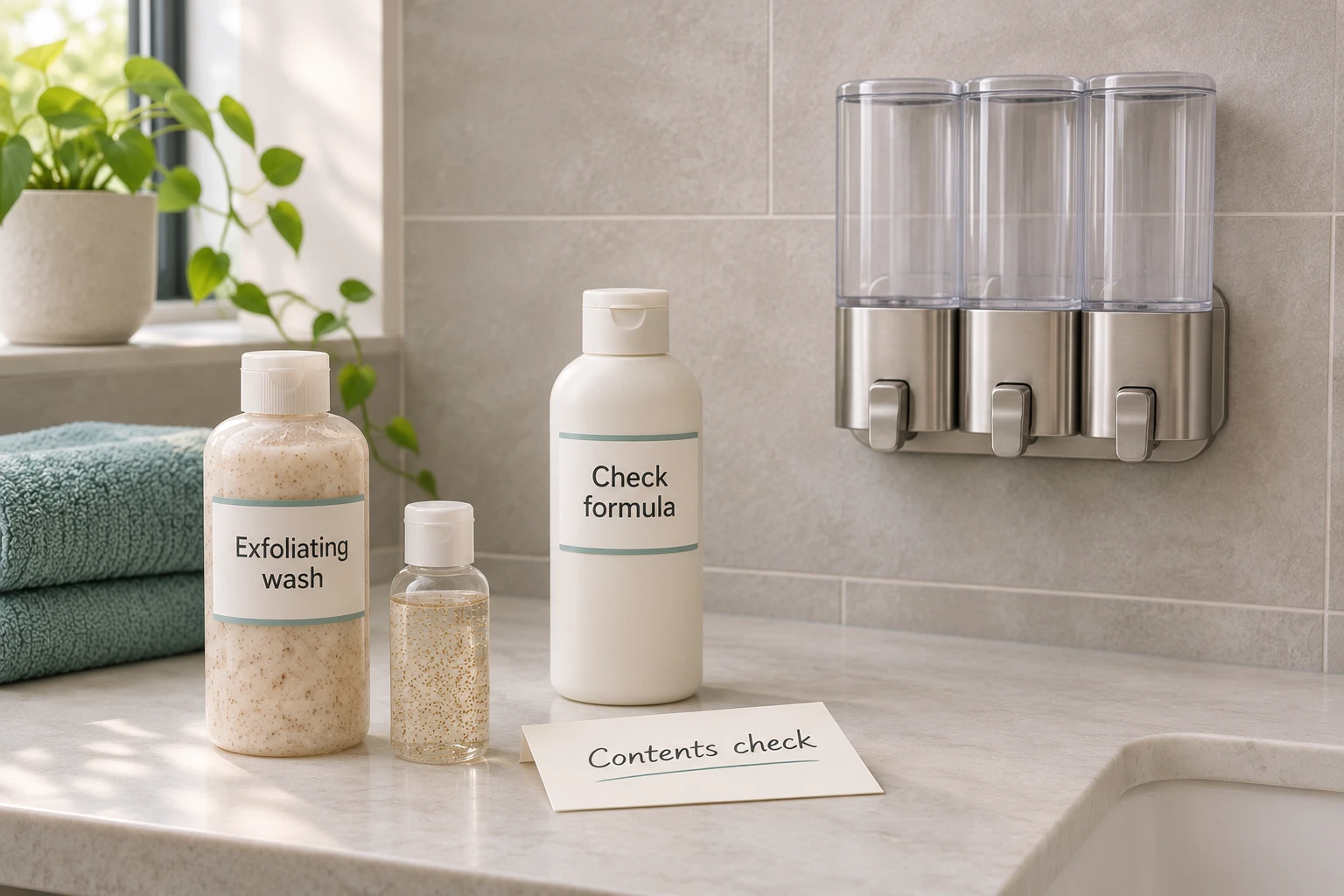
A wash can be suitable for your usual shower routine while leaving a separate question about the dispenser you want to use. Start shower pump compatibility with the exact pump and the proposed contents. A familiar product name, a matching bottle colour or an attractive wall arrangement leaves its formulation restrictions unanswered. Decide what the hardware documentation allows before treating an empty reservoir as a place for anything labelled wash.
This guide addresses contents selection, especially particle additives. It uses an identified shower pump and a separate commercial cartridge dispenser as two bounded examples. It gives no pouring, mixing, dilution, cleaning or installation procedure. It also makes no claim that either product was tested with a particular wash. The useful result is a supported contents decision, or a precise question that remains open before purchase.
Read allowed contents together with their exclusions
The simplehuman BT1029 triple shower pump listing identifies a wall-mounted, three-reservoir product with t-bar levers. It names soap, shampoo and conditioner, while excluding exfoliants, moisture beads and granular scrubs. Keep those restrictions with this exact offer. The broad contents names do not cancel the narrower exclusions in the same description.
Simplehuman’s current triple wall-mount product page identifies BT1029 and describes dispensing shampoo, conditioner or body soap. That establishes the intended product context. It does not identify every formula sold under those general names as acceptable. When two statements differ in specificity, read them together rather than keeping the more convenient statement and overlooking the qualification.
Consider the actual product you plan to use, including its full version name. A line containing both an ordinary wash and an exfoliating version should not become one undifferentiated supply in your decision. The label on the bottle you own matters more than a remembered description of a different bottle from that range. Keep an unresolved version question visible while comparing the hardware.
Buying the pump first does not resolve that question. If keeping a particular wash is essential to you, establish its relevant formulation information before deciding on the dispenser. If changing the wash is an option, evaluate the alternative as its own product. Do not describe the decision as complete merely because you are willing to choose something else later.
Keep the particle warning attached to its actual scope
A branded simplehuman wall-pump instruction booklet, hosted by a retailer, warns that soaps with exfoliants or moisture beads may clog the pumps. Its drawings cover single, twin and triple units. The booklet bears a 2012–2019 copyright and document number 120-0353-05. This is older, retailer-hosted documentation; its warning is consistent with the selected listing, rather than a new test of current stock.
For someone choosing an exfoliating soap, the warning answers a practical purchase question before any reservoir is filled. The fact that the product is a soap does not remove its exfoliating designation. Keep the proposed wash in its own packaging while seeking clarification if the description is unclear. This guide supplies no method for adapting a particle-containing product to the pump.
The word may also matters. A statement about possible clogging is not a measured probability, an expected time to failure or a promise that every use will produce a fault. You can respect the restriction without inventing one of those results. Likewise, a report that another person used a wash successfully would not amend the documentation for your proposed combination.
No particle-size threshold is established here. A distinction such as small beads versus large beads would need applicable evidence before it could guide a purchase. The same applies to judging compatibility by how smooth a product feels. Neither a photograph nor an informal impression supplies a documented exception to a named contents restriction.
Ask about an unclear formulation without inventing approval
A short enquiry can name the dispenser and the exact wash, then ask whether the formulation falls within the documented restrictions. Include the relevant version wording from the package. Ask about the actual product you intend to use rather than requesting a general assurance that the pump handles soap. A broad reply would leave the narrower particle question unresolved.
If the wash description omits the information you need, say that. Absence of an exfoliating claim in a short retail title is not a complete formulation account. You do not need to classify an ingredient yourself from an unfamiliar name to keep the purchase question open. Ask the responsible manufacturer which product information establishes the relevant restriction.
Retain an answer with the combination it identifies. Approval referring to another pump or a different version of the wash should remain attached to that different combination. A reply that addresses only one side of the question can be followed by a specific request for the missing identity. This is especially useful when several similarly named products appear in the same exchange.
If a clear answer remains unavailable, leave the compatibility undecided. You can choose another documented combination or retain the wash in its original dispensing arrangement, as appropriate to its own directions. Neither choice requires claiming that an untried formula failed. The purpose is to avoid committing to an arrangement whose relevant restriction has not been settled.
There can also be a difference between identifying what a wash contains and confirming that it belongs in a dispenser. A formulation enquiry might answer the first question while leaving the second to the hardware maker. State which answer you have received instead of combining two incomplete replies into an approval neither party gave. If you seek a further answer, provide the earlier clarification so the remaining question concerns the same exact product and formulation.
A cartridge dispenser has a separate contents boundary
The Pacific Blue Ultra automated wall dispenser is a different product. Its native gallery identifies model 53590 and names compatible refills 43337, 43716 and 43822, sold separately. The description limits it to Pacific Blue Ultra automated touchless hand-soap and sanitizer refills. This is a named refill-system requirement, not permission to use an arbitrary bottled wash.
Read approved dispenser refills as an exact association rather than a general promise carried by a brand. A refill bearing the maker’s name still needs the applicable dispenser designation. The gallery’s named examples belong with the pictured hardware; they supply no approval for the shower pump. Nor does the shower pump’s broad contents description approve a supply for the automatic unit.
The comparison concerns the boundary of the contents decision. One example has explicit exclusions within broad contents types; the other names a particular refill system. There is no reason to turn that distinction into a performance ranking. This guide does not compare hygiene, reliability, refill economy, battery life or the quality of the resulting wash.
When comparing two refill packages, put their complete item references beside the dispenser identity before considering package size. This guide has not loaded a cartridge, measured a reservoir or established a substitute from its size. A similar quantity description should leave an unidentified combination open for clarification, rather than quietly turning it into the approved choice.
Separate a contents decision from an existing fault
A pump that has stopped delivering its contents presents a different task from deciding what to buy for it. The Moen soap-dispenser cleaning and priming guide concerns an identified manual deck assembly and observed delivery. Its care sequence does not apply to these wall dispensers. Use the matching instructions when an existing unit requires attention.
Do not diagnose an unseen blockage merely because you later notice a restricted product name. You can report what was used and what happened without claiming to know which internal part is affected. A contents restriction remains relevant information for support, but it is not a substitute for examining the actual fault through the applicable service path.
Similarly, discovering an unsuitable proposed formula before purchase is not a failed trial. Nothing needs to be described as repaired or restored. Describe the stage you have reached: a particular combination was considered and has not been established as suitable. That wording gives the next enquiry a clear starting point.
Finish the purchase decision with both identities intact
The paper-towel dispenser refill guide also keeps the supply separate from its housing before discussing compatibility. Its paper formats and core specifications do not apply here. The useful connection is the order of the shopping question: identify the equipment, identify the proposed supply, then establish the relationship between those exact products.
For the shower pump, keep the contents exclusion alongside any general statement about supported washes. For the cartridge unit, keep the complete refill reference beside the dispenser identity. This lets you reject an unsupported substitution without deciding that every similarly named product is unsuitable. A limited answer can still be enough to choose a different, documented combination.
Check the delivered product identification against the combination you selected. If the supplied model or wash version differs, preserve the discrepancy and ask whether the earlier answer applies. A purchase confirmation describes an order; it does not resolve a new contents question introduced by a substitution. Resolve that question against the relevant product information before the intended use.
Buying the selected dispenser with cryptocurrency at Republeq
If you choose to buy one of these dispensers through Republeq.com, keep the exact offer in view while arranging payment. The captured product offers list cryptocurrency among the accepted payment methods. That observation does not establish which coin, token or transfer network will appear for a particular checkout. Read the payment choices actually presented for the order you are placing. If USDT is offered, check the associated network instructions before selecting a route in your wallet. The token name alone does not identify that route. Retain the order reference and the payment information needed to connect the merchant’s record with your transaction. A completed payment does not add evidence that a particular wash belongs in the dispenser, so settle the contents decision separately. Ask the site’s support to clarify any unclear payment instruction before committing funds. If the checkout stops or the transfer state is uncertain, establish the status of the existing order before beginning another purchase. A wallet entry and an order confirmation describe different parts of the transaction; neither should be silently substituted for the other when asking about an unresolved order. This guide quotes no product price, exchange rate, cryptocurrency value or network charge. Review the current order terms and the actual payment request during checkout. Keep any supplier clarification about the dispenser or refill with the product identity it names, even if payment is handled in a separate conversation. Once the purchase is confirmed, consult the supplied product information before use. Paying with cryptocurrency changes the payment path; it supplies no exception to the contents restrictions discussed here.