Musical Instruments & Listening
Choose a second position harmonica key for the song
Keep the requested song key, playing position and actual tuning together before selecting an instrument. A key label alone does not settle a musical pairing.
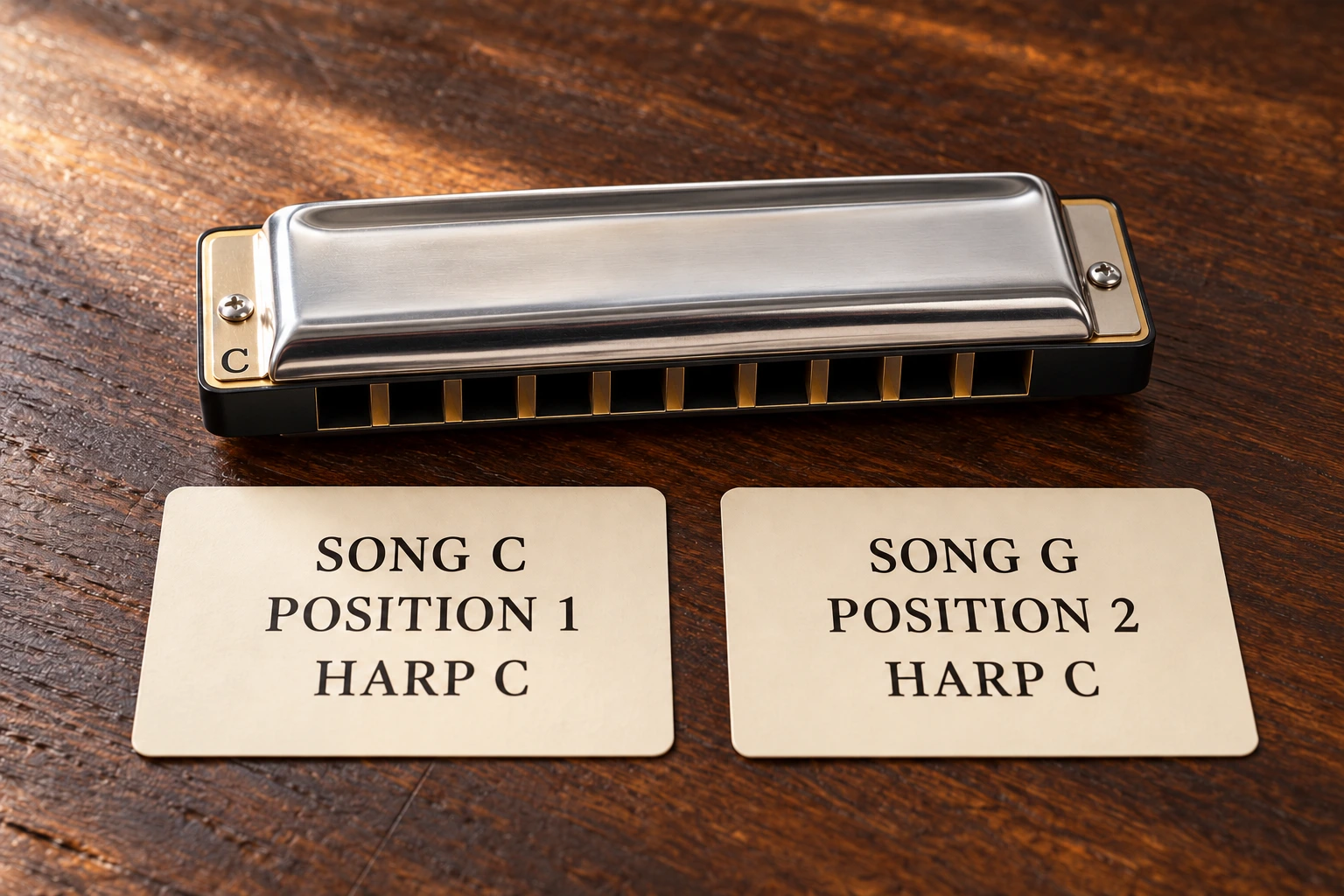
Choosing a second position harmonica key starts with the song and the position you intend to use, not an automatic match between two printed letters. For the standard major-diatonic example used here, a C-labelled harp can serve a song in G when second position is specified. That is a musical relationship with a tuning boundary. It is not a claim that every C instrument can play every G arrangement, or that a three-key set supplies a complete lesson. Keep the actual instrument, its tuning and the requested music together before choosing.
Write down what the music is asking for
Begin with the information the lesson, accompanist or arrangement actually supplies. Record the song key on one line and the intended playing position on another. Add the tuning type of the instrument you plan to use. If one of those entries is missing, leave it visibly unfinished. A person answering your question can then see what remains to be established. Combining everything into a note such as “need a G” conceals whether that letter names the song, the instrument or somebody's shorthand for an exercise.
Ask the person supplying the music what they mean if the request is abbreviated. They may be able to provide a lesson reference or a fuller instruction. Preserve that answer with the music rather than relying on a later recollection. This is preparation for selecting a suitable instrument, without a proposed mouth position, breathing sequence or song transcription. You can settle an ambiguous request before buying anything or attempting to play it. An unanswered question remains useful information when it is clearly identified.
Read the two actual sets without inventing a playing test
The CONJURER three-key diatonic harmonica set has a sparse native description repeating its title. Its complete gallery shows three blue ten-hole instruments; clear end views carry A, C and G labels. Packaging views show the instruments in a case with cloth and leaflet context. Other images illustrate construction and manufacturing claims. These are product-account observations, without an audible tuning check, verified material analysis or promise of playing quality.
The Silver Creek Diamondback three-pack is identified as SC50-3PK, with A, C and G harmonicas in its native description. That account describes ten-hole diatonic instruments. The complete gallery shows three Diamondback harmonicas, including a visible C end label. Descriptive claims about tone, playability and resonance are not tested here. Neither the image nor this article certifies the tuning or condition of an individual delivered instrument.
For a key-dependent lesson, ask for the applicable tuning information if the offer leaves it unclear. Keep the seller's answer attached to the exact set or variant being considered. An attractive photograph cannot supply a missing note layout. Nor does this comparison recommend buying both sets. The examples give two actual product contexts for an instrument-selection question; they do not establish that either package is necessary for someone who already has an appropriate harmonica. Any supplied storage or wiping context is separate from a claim about musical compatibility.
Use the mapping inside its stated tuning
Steve Baker's explanation on HOHNER's site describes cross harp as second position on a diatonic Richter harmonica. In its C example, the blow chord is C major and the draw chord is G7; cross harp takes the draw chord as its starting point. This supplies the basis for selecting a C harp for second-position G. The explanation does not inspect either native retail set, and this article gives no physical playing or bending procedure.
Lee Oskar's first-and-second-position explanation gives a C Major Diatonic for C in first position and G in second position. Its examples also give an A Major Diatonic for A in first position and E in second. Keep the standard major tuning in that statement. The source discusses other tunings separately; its major-diatonic example is not permission to apply one unchanged label rule to every harmonica bearing the same letter.
These references answer the limited selection question in this article. They do not replace instruction for the actual arrangement. Before treating a pairing as ready, establish that the lesson applies to the instrument's tuning and that its stated position is the one you intend to use. If a teacher provides a different arrangement, keep that instruction with its own requirements. A general key relationship cannot prove that a learner can produce every note, follow a particular passage or achieve a promised musical result.
A hypothetical G request needs a position beside it
Imagine Mira receives a music note saying only “G.” This invented situation begins with an incomplete request, not a wrong purchase. Mira asks whether the letter identifies the song key and which position the lesson expects. The reply says that it is a song in G, arranged for second position on standard major-diatonic tuning. Mira now has a specific question to compare with the supported example, instead of guessing from the first letter she received.
Under that stated example, the selection is a C-labelled major-diatonic harp for G in second position. Mira records the answer beside the lesson reference and checks the actual instrument's tuning before proceeding. The result of this fictional exercise is a clear selection note. It is not a report that she played the song successfully, that a retail unit passed a pitch test or that the full arrangement contains no additional demands. Those outcomes would need their own evidence.
Mira also keeps the original abbreviated request. If someone later sends a different lesson, she can see why her note was written as it was. She does not change the instrument entry merely because the new file has a similar title. First she checks what the replacement actually requests. Preserving that small piece of context is useful when several people share music and use different shorthand. It avoids turning one correct answer to a defined question into an unexplained rule applied to everything that follows.
A first-position exercise is a different request
For a second hypothetical note, suppose the supplied exercise explicitly calls for standard major tuning, C and first position. The supported comparison is C on a C major-diatonic harp in first position. The same instrument label appears in both examples, but the requested musical context differs. Keep the position in the written note even when leaving it out would make the selected letter look unchanged.
The note should retain the actual exercise reference as well. Someone reading only the instrument entry cannot reconstruct why it was selected. If a friend borrows the preparation sheet for another piece, ask them to check that piece's requirements rather than copying the final letter alone. The missing context may have been obvious during your conversation and become invisible when the page is passed on. A short explanation gives the next person something concrete to verify without claiming that your exercise is the right method for their music.
Leave an unknown tuning or position open
A third hypothetical player has an instrument with a clear key label but no established tuning information. The label is useful identification, yet the present example has an additional condition. Keep that condition unresolved until applicable documentation or instruction identifies the layout. Do not infer it solely from the number of holes or a familiar exterior. This article has not examined or sounded the player's instrument, and it supplies no test procedure for reconstructing an unknown tuning.
The same approach applies when the song key is known but the intended position is absent. Ask which arrangement or lesson is being followed. The person may decide to use a different approach once the question is explicit. Keep the answer they actually give, including any limitation or request for more information. An open selection is preferable to a confident-looking instrument recommendation assembled from a missing field. Nothing in this planning task requires adjusting reeds or changing an instrument to fit a guess.
Keep neighboring lessons with their own task
The C major harmonica scale guide teaches a specific supported route through holes four to seven, including a breath-direction change. That is physical lesson work with its own instrument qualifications. Selecting a key and position here does not replace that route or create a new scale exercise.
The harmonica call-and-response session arranges a short supported phrase as a two-person exchange. That social activity has different scope from deciding what a song-and-position request means. Its phrase does not become the music for this article's hypothetical examples merely because both involve a harmonica.
Review an order after resolving the musical choice
If the musical question eventually leads to an order and you prefer cryptocurrency, keep that preference separate from the instrument selection. A buyer interested in USDT can ask what the exact order on republeq.com actually offers before deciding whether to proceed. This article's mention of the asset does not confirm acceptance, a supported network, a checkout route or a completed transaction for either set. Retain the selected product reference and any answer about tuning with the buying note. A response about payment would not resolve an unanswered question about the instruments in a package, and a useful tuning answer would not establish the terms of a later transaction. Review the real order information for the chosen item rather than carrying assumptions over from another purchase. If an essential detail is unclear, use the assistance provided for that order to obtain a clear answer before authorizing payment. There is no transfer address, wallet procedure, fee calculation or promised financial advantage here. The instrument decision can remain open while the transaction question is considered, and a lesson can use a suitable instrument already available without requiring a new purchase. If someone else places the order, give them the actual selected offer and the conditions that still matter; the song's key alone is not a complete shopping instruction. Keep any eventual order confirmation with the item actually selected, so later enquiries concern the same purchase. If the set or variant changes, reconsider its contents and the payment information actually presented. Neither choosing USDT nor receiving a transaction confirmation proves musical compatibility, delivered condition or successful performance.
If the music is being prepared for another person, give them the complete selection note rather than a remembered answer. Ask them to confirm that the lesson reference is still the one they plan to follow. They may have changed the arrangement while you were looking at instruments. Record that change before making a new selection. This keeps a shared preparation task attached to the current request and avoids presenting an old answer as though it had been checked against a new piece.
Retain the question beside the selected label
Before closing the selection note, read its three inputs again: the requested song key, the intended position and the actual tuning. Check that the answer addresses those inputs rather than an earlier conversation. Keep the relevant instruction reference and any unresolved limitation with it. You can then explain the choice without treating one letter on an instrument as a complete account of what the music requires. The useful outcome is a supported selection for a defined request, with the playing lesson and any purchase still carrying their own conditions.