How-To Guides & Tutorials
Play a C major harmonica scale: holes 4 to 7
Follow the standard C diatonic hole-four to hole-seven scale, with single-note preparation, the final breath-direction change and actual Hohner offers.
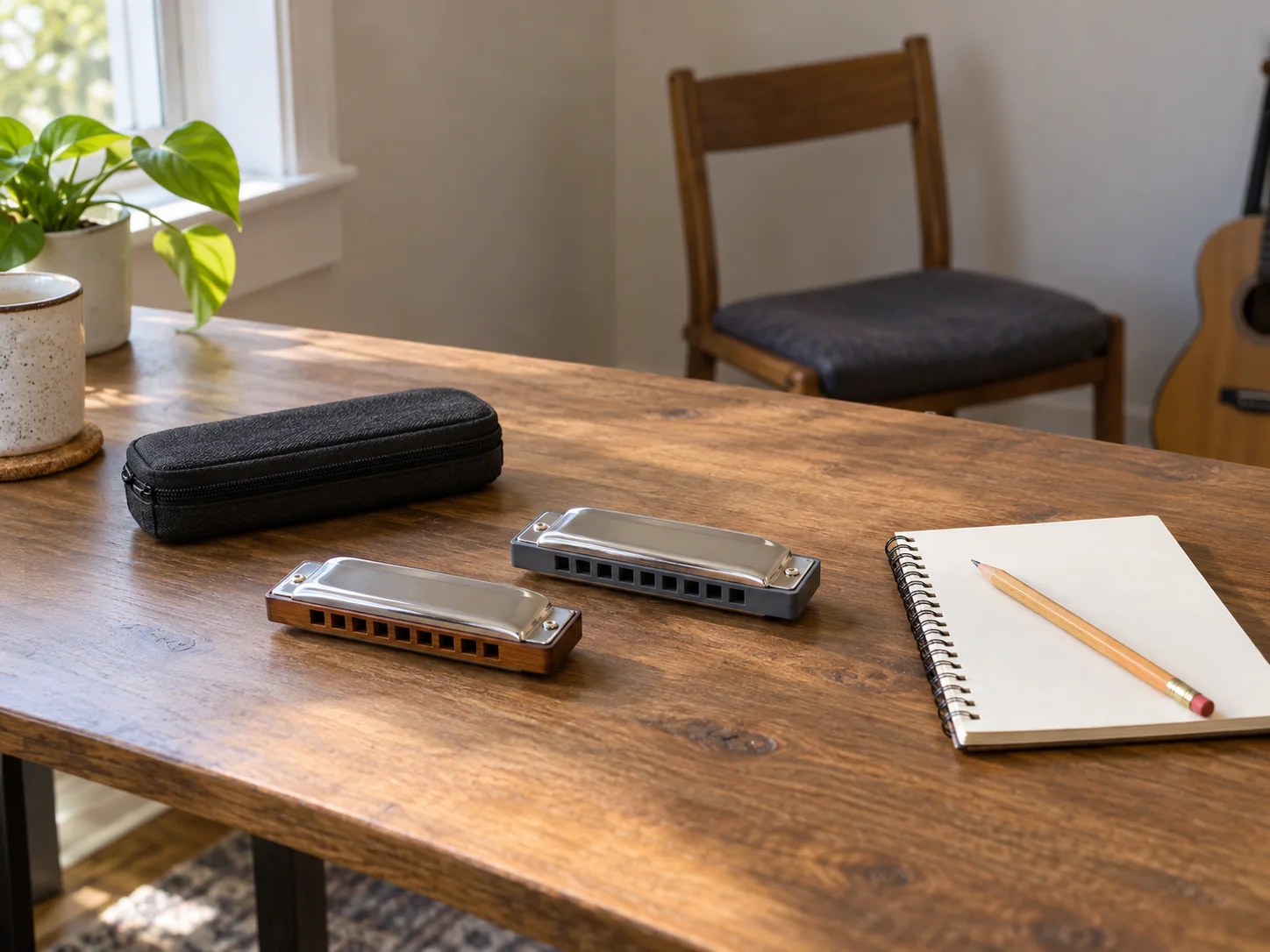
The middle C major harmonica scale uses holes four through seven on a standard Richter-tuned ten-hole diatonic harmonica in C. The notes in this passage are available without bending. The practical challenge is keeping one hole clear, changing breath direction and remembering that the order changes at hole seven.
Work through the preparation before attempting the complete passage. This guide uses Hohner's actual tuning chart and instructor-authored beginner material, with an original practice outline built around those instructions. It reports no playing trial and promises no completion time. It applies to the stated C diatonic layout, rather than a chromatic, tremolo or differently tuned harmonica.
Establish the instrument and its layout
The selected Hohner Blues Harp in C has a retail description naming its wooden comb and metal reeds. Hohner's catalogue places Blues Harp in the Richter MS series and lists C among its keys. Its Richter standard-tuning chart includes all MS instruments. These manufacturer documents establish the model's relevant tuning family without turning the retail sound and comfort claims into a test result.
The Hohner Progressive Rocket C bundle lists a case, pouch and Austin Bazaar polishing cloth. Its native account names recessed reed plates and rounded comb edges. It also describes wide-open cover plates with side vents and larger channel openings, without a measured output here. Hohner's catalogue places Rocket in its Richter Progressive series, and the tuning chart explicitly includes Rocket. Rocket, Rocket Amp and Rocket Low have separate entries; this lesson does not substitute either of the latter models.
Check the identity and tuning of the actual instrument before following the hole numbers. A familiar exterior cannot establish that a modified or differently marked instrument has the chart's layout. Keep a differently tuned instrument with its own instruction. The two selected offers are possible examples of the documented arrangement, without a recommendation to buy both or a claim that one will teach you faster.
Keep three descriptions separate when reading the instrument information. The catalogue lists twenty reeds for each model, while the tuning chart numbers ten holes. The exercise uses those hole numbers. A reed count is therefore not a set of twenty mouthpiece positions to search for. At the same numbered hole, the chart gives a blow note and a draw note, so the breathing instruction is needed alongside the position.
The C key label also does not mean that every channel sounds C. The chart's hole-five pair, for example, is E and F. Follow the note layout rather than interpreting the key name as an instruction to find a repeated sound everywhere. For materials, the catalogue identifies a wood comb for Blues Harp and grey ABS for Rocket. Those product differences leave the documented C scale route unchanged. The Rocket bundle's storage accessories are separate purchasing details, without a measured playing advantage assigned to them here.
Set up a relaxed starting position
Luke's first-lesson guidance at Harmonica.com places the numbered side uppermost, hole one to the left and hole ten to the right. Hold near the back so your fingers leave the mouthpiece available. His common grip forms a C with the thumb and index finger, with the harmonica resting toward their web. Begin with a comfortable hold rather than squeezing the instrument.
Before adding a sequence, locate hole four while the harmonica is away from your mouth. You are finding the starting channel, not memorizing every printed number. Once you bring it into playing position, the numbers will be harder to inspect directly. Take it away and look again whenever you need to reset your place.
Use gentle, controlled breathing. Hohner's FAQ recommends soft early playing and moderate volume rather than forcing the instrument. There is no need to turn a short note into an endurance exercise. Leave ordinary pauses between attempts and stop when you need a break. Keep the sound a reasonable distance from another person's ears, as Hohner also instructs.
Isolating a single harmonica note
For isolating a single harmonica note, Luke's lip-blocking lesson starts with moist, relaxed lips and the harmonica comfortably deep under the upper lip. Keep the lower lip unfolded so its moist inner surface meets the instrument. Bring the mouth corners slightly inward, letting the lower lip narrow the opening while the upper lip stays relaxed.
Begin with a gentle outward breath at hole four. The aim is to hear that channel alone rather than the adjacent holes together. If several notes sound, pause and return to the mouth-position instructions. More force is not the adjustment being taught. Keep the current task to one channel until you can hear the intended isolated sound.
Luke also describes tilting the back of the harmonica upward and gradually lowering it to find the point where a single note sounds. This is a way to explore the lip opening while maintaining a relaxed position. Follow the full technique lesson if you cannot establish it comfortably. You need not add tongue-blocking, bending or another advanced technique to complete this particular scale.
When hole four is clear on the outward breath, remain at that hole and gently breathe inward. These are two different notes at the same channel. Learning that stationary pair first lets you concentrate on breath direction before lateral movement enters the task. It is fine to return to this pair whenever the longer passage becomes confusing.
Read the middle octave as named notes
Hohner's standard Richter chart gives hole-four blow as C and draw as D; hole-five blow as E and draw as F; hole-six blow as G and draw as A. At hole seven, draw gives B and blow gives the higher C. The chart writes B as B(H). Here, B means the natural note between A and C in this scale.
In order, the passage is C, D, E, F, G, A, B, C. The repeated name C marks the beginning and the next octave's endpoint. It does not mean returning to hole four at the finish. Keeping the note names beside the hole and breath direction helps distinguish musical order from movement along the instrument.
Some harmonica notation writes a plain hole number for blow and a minus sign for draw. Read the legend before using somebody else's notation. In this guide, the upward sequence written that way is 4, -4, 5, -5, 6, -6, -7, 7. The signs specify breathing direction; they are not arithmetic operations.
Blow and draw order at hole seven
The blow and draw order at hole seven is the change to watch. Going upward, holes four, five and six each use blow followed by draw. After hole-six draw, move to hole seven and draw again, then blow. Automatically repeating a blow-draw pair at the final hole would put the last two notes in the wrong order.
Try the end of the passage on its own once the single notes are established: hole-six blow, hole-six draw, hole-seven draw, hole-seven blow. Those give G, A, B, C. This short grouping isolates the change from two breath directions at one hole to continuing the inward breath after moving to the next hole.
For the downward passage, begin at hole-seven blow, then draw at seven. Move to six for draw and then blow; continue five draw, five blow, four draw, four blow. The named notes are C, B, A, G, F, E, D, C. Read the complete route rather than assuming every move begins with the same direction.
Build the passage in short sections
The following practice outline is an original arrangement for working through the sourced notes. First use the stationary hole-four pair. Next add the corresponding pair at five and return to four. Leave the rest of the scale aside during that attempt. You are giving yourself a smaller route to remember, without changing the note layout.
Then work on the final four-note grouping described above. When both sections feel manageable, join the complete upward passage. Stop between passages to reset your starting place and ordinary breathing. If the join causes confusion, name the last clear hole and direction, then revisit the relevant short section instead of speeding up every attempt.
Use the written route while you need it. Covering the page is an optional later memory exercise, not a condition for making music. You can also say the hole numbers and directions away from the instrument before playing. That separates remembering the route from producing the notes, so you can identify which task needs attention.
Add a pulse after the route is familiar
For a simple timing exercise, choose a comfortable regular pulse and place one scale note on each beat. This is a proposed practice choice, without a prescribed speed or a promise of improvement. If the route falls apart, leave the pulse aside while you return to the particular connection between notes that needs work.
The metronome tempo and beat-settings guide distinguishes pulse rate, grouping and sound choice. If you later introduce a metronome, establish what its audible signal represents and use its own instructions. An unfamiliar accent pattern can add another reading task before the harmonica passage itself is settled.
Do not judge the whole attempt only by whether you reached the end. Notice which part was clear and which needed a reset. You might have remembered every breath direction while still sounding an adjacent channel at one point, or isolated the notes while losing the route at seven. Those observations point to different parts of the practice outline.
Keep a musical next step small
The published harmonica call-and-response session uses a separately sourced short tune opening for a shared activity. It involves different Hohner offers, including a chromatic alternative whose layout is kept separate. The present exercise concerns a solo scale route. Its hole numbers should not be carried into another tune simply because both activities use a harmonica.
You can finish this session after one clear section. Retain the part you intend to revisit, whether that is the relaxed single note, the move between holes or the direction change at seven. Hohner advises letting playing moisture dry before returning an instrument to its case and warns against soaking harmonicas. Follow the care instructions for your actual model; no disassembly or internal cleaning is taught here.
Return to the C major harmonica scale with the same known layout and a specific next task. The route remains hole four through hole seven, ending with draw then blow at seven on the way up. Let the written note sequence support the physical work until the two become easier to keep together.