Skills & Planning
Reversible line poem: make each line stand on its own
An original six-line poem keeps each complete sentence intact while reversing the order of its lines. A dependent-clause trial shows what needs repair before the wording is fixed.
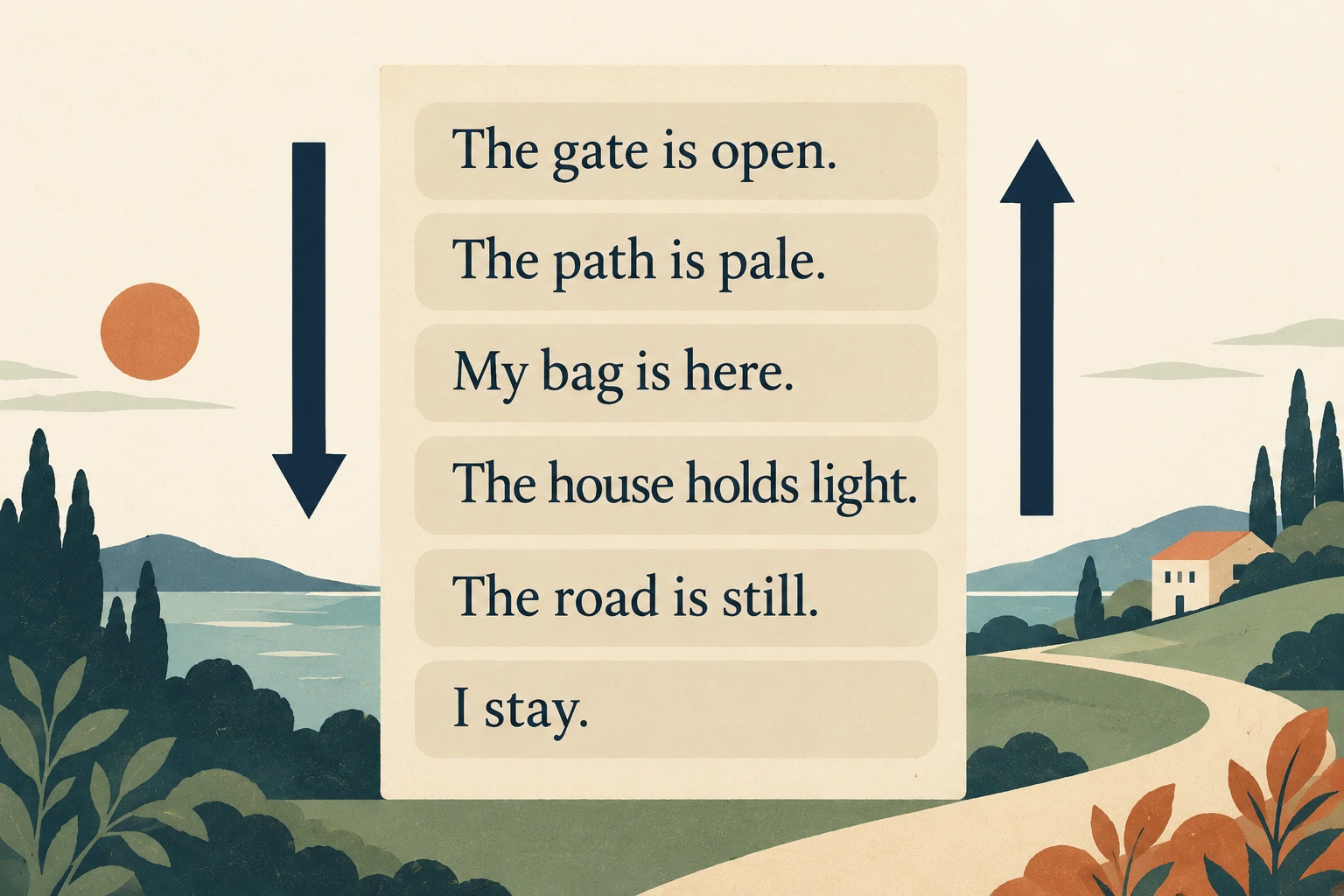
Choose a rule for the units you will reverse
A Reversible line poem can begin with a small writing constraint: make six original lines, each a complete sentence, then read the intact lines in the other order. This exercise keeps the words and punctuation inside each line fixed. It does not reverse letters, reverse the words within a sentence or require the second reading to deliver an opposite message.
The central revision happens before the lines are fixed. Look for a sentence that depends on the following line to finish its grammar. A forward reading may carry that dependency smoothly across a break, while the reverse order leaves a fragment waiting for something the poem no longer supplies. Decide what relationship you want to retain, then make the actual wording support this particular rule.
Keep the optional frame accounts separate
The optional Craig Frames FW177WH account describes an eighteen-by-thirty-six-inch white frame, acrylic facing, backing and wire hanging hardware. Its sole image shows a white frame and Craig Frames display card. The image does not independently calibrate that size or demonstrate a fit for a poem page. The named assembly components are not a separate refill-stock proposal.
The optional Umbra LIRA account identifies a black photo sculpture for four four-by-six prints. Its sole image shows a black four-aperture display with example photographs and Umbra wording. Those observations do not demonstrate the fit of your writing, establish supplied photographs or authenticate a delivered item. Keep its stated print arrangement attached to this offer.
Neither frame account supplies the original poem or its reading rule. No mounting, material-protection or print-fit result is established here. You can complete the exercise on available writing materials without buying either offer.
Read the complete six-line original
The gate is open.
The path is pale.
My bag is here.
The house holds light.
The road is still.
I stay.
Those are the six lines in the selected forward version. Each begins with a capital and ends with a period. The gate is open, the path is pale, the bag is here, the house holds light, the road is still, and the speaker says “I stay.” These are authored statements within a small poem, without a claim that an actual place or person has been observed.
Call the printed lines one through six in private notes if that helps you check them. Keep the labels outside the poem itself. You need a way to identify each complete unit while rearranging the copy, rather than a new requirement that the verse display numbers. In this example, a line means the entire sentence, including its period and the order of its words.
The six statements do not specify a chronological series of actions. They give a gate, a path, a bag, a house, a road and a speaker’s statement. Do not manufacture a departure and return just because the lines can be read in a different order. A more developed poem might establish an event history, but this short version leaves that additional structure unwritten.
Read the same units from the bottom upward
I stay.
The road is still.
The house holds light.
My bag is here.
The path is pale.
The gate is open.
The reverse copy begins with the speaker staying and finishes with the open gate. Every sentence remains exactly as it was. In particular, “The house holds light” does not become “Light holds the house,” and “My bag is here” keeps the same first-person possessive. Reading lines in reverse order is the one operation permitted after this version is fixed.
Compare the copies sentence by sentence instead of relying on a general impression that they look similar. The first line of the reverse copy should match the sixth of the forward copy, the second should match the fifth, and so on. This checks preservation of the line units. It does not decide whether either arrangement is the poem you want to keep.
Read each copy continuously after that check. In the selected version, the sentences are individually complete, so neither direction leaves a because-clause waiting for its missing partner. The resulting sequence can still feel different to you. Record what you notice in these actual readings, without converting your preference into a claim that every reader must find the same emphasis or effect.
Inspect a trial that depends on the next line
Consider an earlier two-line trial: “Because the gate is open,” followed by “I stay.” Read together in that order, the lines make one sentence asserting a reason for the speaker’s staying. The first line ends with a comma. Its because-clause has not become a complete independent sentence merely because the writer has placed a line break after it.
Now read those two intact lines in the other order: “I stay.” followed by “Because the gate is open,” as the second line. That line remains a dependent clause with its original comma. Under this exercise’s chosen rule, that trial fails the complete-sentence condition. This is a judgment about the declared constraint and the printed trial, rather than a ban on fragments or dependent clauses in poetry generally.
You could choose a different exercise that allows the fragment. You could also revise the trial before fixing its wording. For the version developed here, replace the dependent first line with “The gate is open.” Keep “I stay.” as another sentence. The change gives two independent units that retain their internal wording and punctuation when their order is exchanged.
Name the meaning you changed during that repair
Removing “Because” changes more than the grammar at the edge of a line. The repaired pair no longer explicitly says that the open gate is the reason for staying. Both statements remain present, but their causal connection is not asserted by that former connector. A reader may imagine a relationship, while the revised wording leaves it open. Recognize that choice instead of describing the repair as meaning-free tidying.
If the explicit reason matters more to you than this complete-line constraint, keep a version that states it. There is no need to claim that the supplied repair is the only acceptable poem. The particular task here is to choose wording that meets a declared rule while noticing what the revision removes. Save the earlier pair so that the change remains available for comparison.
Make any further revisions before calling the six-line version fixed. You might change a word, replace a sentence or choose a different final line. Each of those choices deserves a new complete forward and reverse copy. Once you start the preservation check, do not quietly improve one sentence only in the reverse copy and then claim that both versions contain the same intact units.
Separate line order from other kinds of reversal
Writing “open is gate The” reverses the words within the first sentence. It is a different operation from moving “The gate is open.” to another line position. Likewise, reversing the letters in gate would change the word itself. Neither change belongs to the fixed-unit reading used here, even if it gives you an idea for another piece of writing.
Changing punctuation only in one direction also breaks the chosen rule. If a comma becomes a period when you turn to the reverse copy, the units are no longer identical. Revise the shared line first, then rebuild both copies from that same version. This keeps a deliberate new draft separate from a copy that appears to pass only because its difficult parts were silently rewritten.
Keep line breaks distinct from sentence wrapping on a screen. A narrow display might wrap one of these sentences onto two visible rows. For this exercise it still belongs to the same authored line unit. Use the six-sentence reference beside the displayed version so that a change in available width does not become an accidental decision to split and reverse part of a sentence.
Compare the two actual endings without demanding opposites
The forward copy ends “I stay.” Its last statement belongs to the speaker. The reverse copy ends “The gate is open.” Its last statement concerns the gate. Those are literal differences in where the reading finishes. You can prefer ending with the speaker’s declaration while retaining the open gate elsewhere in the same poem, or choose the reverse arrangement for your own stated reason.
Nothing in the fixed-unit rule proves that these endings contradict each other. The same six statements can remain present in both readings. In particular, an open gate does not establish that the speaker leaves. This example does not promise two opposite lessons, a hidden revelation or a changed outcome merely because the reading direction changes. Judge what the actual words support before attaching a larger explanation.
Keep nearby writing constraints distinct
The related erasure-poem exercise selects word occurrences by deleting others while preserving their original order. This version retains every complete authored sentence and changes the order of those whole units. Deleting a word from only one reading would therefore create a different draft, rather than another successful copy of the fixed poem.
The related holiday reverse-story game keeps an event chronology while presenting its scenes backward. This poem’s main check is line-level grammatical completeness and unchanged wording in both directions. It supplies no four-event history that must be reconstructed, and a different last printed sentence does not establish a new final event.
Keep a separate purchasing enquiry conditional
If you separately consider a picture-frame order on republeq.com, ask the seller which payment methods apply to that exact order before making any transfer. If cryptocurrency is offered, ask whether USDT is accepted and which network, amount, recipient address and confirmation requirements apply. A familiar token name alone does not answer those questions. Obtain the relevant instructions through a channel you have independently checked, then compare the instructions with the order you intend to place. Ask how any shipping charge, tax, conversion, refund or cancellation would be handled before agreeing to proceed. If a payment provider is involved, ask which party is responsible for confirming receipt and which record you should retain. These are questions to resolve, rather than statements that a particular option exists for either offer. Do not infer a transfer destination from a product photograph or from a line in the original poem. Resolve material product and package questions separately from the payment discussion. Information about one package does not automatically describe another quantity or account, and a changed order may require reviewing the resulting terms again. Keep the agreed terms, the order identity and any instructions together so that you can check what you were actually asked to authorize. If the instructions remain unclear or contradictory, stop and obtain clarification rather than filling in the missing details yourself. You can finish the writing exercise without placing an order. The poem cannot authenticate payment instructions, establish a checkout method or verify supplied stock. Treat the fictional verse as a writing choice, with no bearing on whether a proposed purchase or transfer is appropriate for you.
Keep the fixed poem beside both readings
For this Reversible line poem, keep the six original complete sentences and choose the forward copy as the selected arrangement. Save the reverse copy and the earlier because-clause trial alongside it. You have a checked pair of readings, a specific grammatical repair and a record of the causal claim that repair removed. The poem can finish with “I stay” without requiring the open gate to mean departure.