Learning & Creative
Holiday reverse-story game: tell the ending first
A quiet holiday writing activity presents an original paper-star story in D-C-B-A scene order while retaining its A-B-C-D events, with an explicit continuity check.
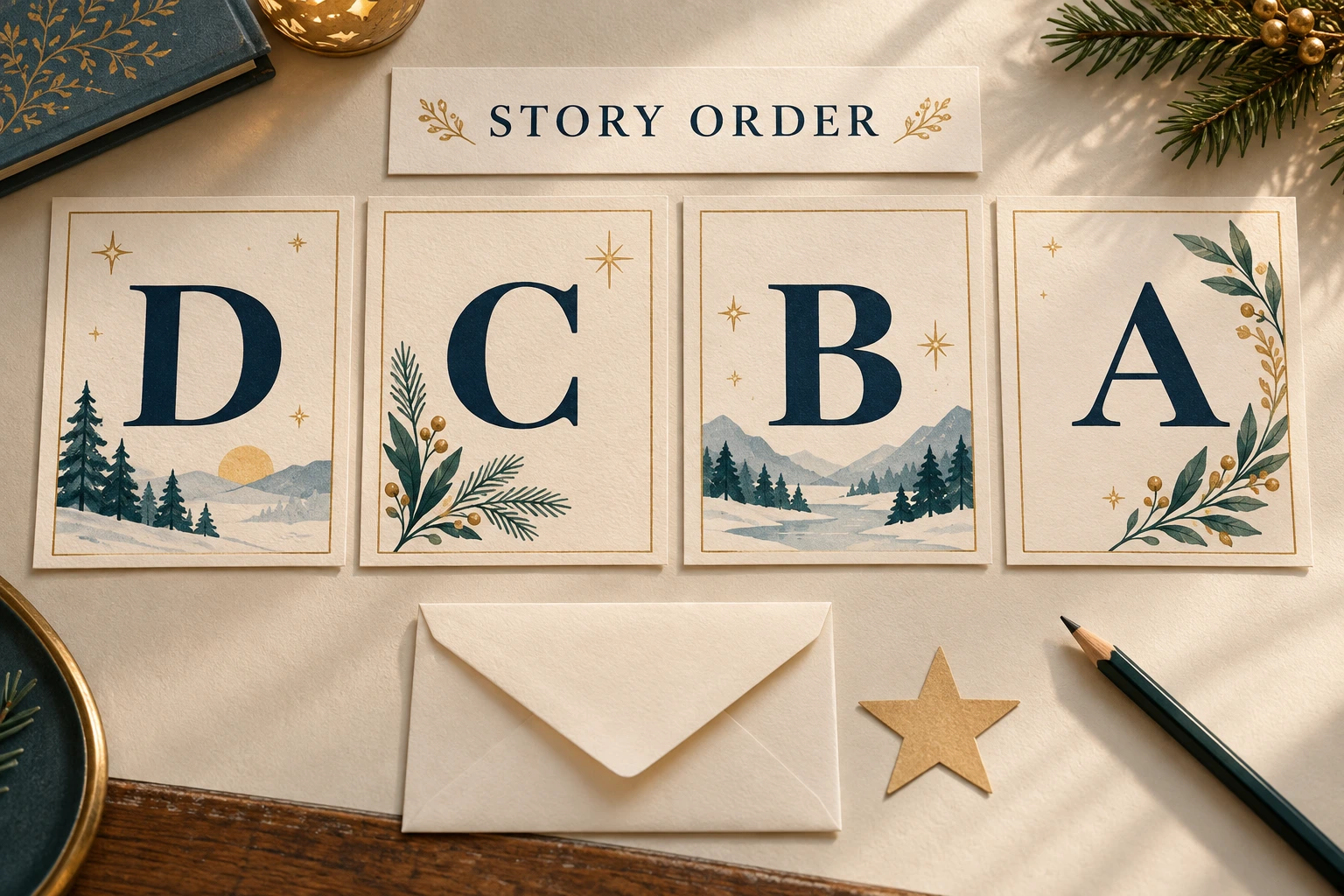
Begin with the envelope, then work back to the blank star
A Holiday reverse-story game can give a quiet seasonal writing session one clear constraint: tell the last scene first while keeping the events themselves unchanged. The original exercise below follows a paper star from a blank surface to an envelope marked Next winter. Its four events happen A, B, C and D. The written scenes appear D, C, B and A.
Use ordinary writing materials already available. Nobody needs to purchase a decoration, disclose a real holiday memory or read aloud. One person can complete the exercise privately, or a willing group can compare separate versions. It is an invented activity with a declared writing rule, not a report of a gathering or a promise about creativity, confidence or anyone's response.
The seasonal setting belongs to the fictional evening and the invitation to write. It establishes no tradition that everyone celebrates. You can leave the month unnamed and keep the star an ordinary paper shape. Participants may choose another wholly fictional seasonal object in a separate version, provided they record that version's events before rearranging its scenes.
Keep the native decorations outside the fiction
The native SJJ acorn squirrel snow-globe account has one image showing a complete winter lantern with squirrels, a tree and an integrated cover and base. Its unusual Restored Tools category does not establish inspected condition or a refurbishment history. The photograph verifies no motor, timer, lighting, material or durability claim. The fictional Jo and Sam do not operate this item.
The native Fox-and-Bear snow-globe account retains Unbranded catalog identity. Its sole image shows a globe with fox, bear and tree figures on an attached white base. No maker, artist, craft process, dimension or material has been independently authenticated. Neither selected scene supplies the characters, message or events in the original paper-star story.
Write four event cards before choosing the first paragraph
Call the first event A: before the visitors arrive, Jo puts a blank paper star on the table. Event B follows A, still before the visitors arrive: Jo writes “Bring this back next winter” on the reverse of the star. These are invented facts. The message is part of the fiction, rather than an instruction directed at an actual guest.
Event C happens during the evening, after B: Sam turns the star over and reads the message. Event D happens at that evening's end, after C: Jo and Sam put the same star into a plain envelope marked Next winter. No event in this exercise takes place the following year. The words on the star express a request within the story; they do not establish that a later return occurs.
Write those four facts on separate slips or in four labeled paragraphs. Keep the record A–B–C–D beside the draft. It is the reference for what happened. The scene letters are editing labels, not the names of additional characters, and the slips are writing aids rather than objects Jo and Sam must encounter.
Choose the presentation D, C, B and A
The reverse version begins at D with the envelope. It then moves to C, where Sam reads, then B, where Jo writes, and finishes at A with the star still blank. That last paragraph describes the earliest event. Finishing the written passage there does not mean the message vanishes after being read or the envelope becomes empty later that evening.
Give each scene an explicit time cue. “At the evening's end,” “earlier that evening,” “before the visitors arrived” and “earlier still” are enough for this short exercise when they accompany the relevant actions. They need not become elaborate dates. Their job is to locate each scene relative to the others, while the event record keeps the exact sequence available.
Read one complete original reverse miniature
At the evening's end, Jo and Sam put the paper star into the envelope marked Next winter. Sam held the opening while Jo guided the points inside. The written reverse was hidden inside. For now, the star was out of sight. Its message remained within this evening's envelope, while the two words outside named a season still to come.
Earlier that evening, Sam had turned the star over on the table. “Bring this back next winter,” the reverse said. Sam read the line once, then set the star down with the writing facing up. Jo was still in the room. Neither of them had found an envelope yet, and the star remained where both could see the message.
Before the visitors arrived, Jo had written that line on the star's reverse. Jo left the other side blank. The words were a request, not a description of something already done. After finishing the last letter, Jo placed the star with its blank side showing. The evening in which Sam would read it had not begun.
Earlier still, Jo had put a blank paper star on the table. Both sides were unwritten. There was no message for Sam to read and no star inside an envelope. Jo left it there before the visitors arrived. At this point in the evening's history, the shape was already present, while the sentence that would connect the later scenes was still unwritten.
Check the chronology without replacing the last scene
Label the miniature's paragraphs D, C, B and A in their displayed order. Then read them in the order A, B, C and D. The star begins blank, receives Jo's message, is turned and read by Sam, and ends inside the marked envelope. Those are the four recorded events. Reading the other way changes how you encounter them on the page.
The miniature adds small physical details to realize the events: Sam holds the envelope open, Jo leaves the blank side showing, and the written reverse becomes hidden when the star goes inside. Keep those details consistent within this version. They do not identify an actual person's motive or a custom that the activity requires anyone to follow.
The final event remains the envelope scene even though it is the opening paragraph. Distinguish “the story's latest event” from “the passage's last paragraph” when discussing a draft. In this exercise, the former is D and the latter is A. Using one word, ending, for both can conceal which part someone proposes to revise.
Repair a changed fact as a changed fact
Suppose a draft of C says Sam reads the star before Jo writes the message in B. That conflicts with the recorded chronology. Merely moving C later on the page would not repair the statement about when reading happens. Restore C's event time to the evening after B, or explicitly create a different event record and acknowledge the larger revision.
A second draft might make Sam the writer in B while the reference still assigns that action to Jo. Reverse presentation does not account for the change of writer. Choose which version you mean, update its actual record and inspect the consequences. For the supplied exercise, retain Jo as writer and Sam as reader.
A third draft might show Jo and Sam opening the envelope next winter. That would add a fifth event and establish a future outcome the four-card version leaves unwritten. You can write that continuation separately. Do not count it as another description of D, which takes place at the end of the same original evening.
Let a reader reconstruct the declared events
If someone wants to exchange drafts, ask permission before reading or annotating their text. Offer one specific task: list the events in the order they happened within the fiction. A reader may point to an unclear time cue without evaluating a real memory or guessing why the writer chose a holiday setting. Private completion remains an equally available way to finish.
Compare the reconstructed list with A–B–C–D. If the lists differ, identify the sentence responsible before making changes. A phrase such as “afterward” may lack a clear reference when scenes move backward. Replace it with the particular relation the event record requires. This is a way to inspect this manuscript, without a claim that every reader will interpret it identically.
Keep optional versions separate
For a shorter version, write one sentence per event and display the four sentences D–C–B–A. Retain the time cues and the same message. This removes descriptive detail while preserving the exercise's event sequence. It does not require four people or four turns, and nobody has to improvise before being ready.
For a group version, let each willing writer use the same four-event record but compose their own four paragraphs. Compare where each version places its time cues and what details it adds consistently. Do not combine one person's B with another person's C without checking the resulting facts. A collaborative version needs its own complete continuity pass.
You can also return the miniature to A–B–C–D presentation and read it beside the reverse version. Record what you notice in the actual passages. Neither order is declared universally better, more suspenseful or more moving. The finished task is a deliberate presentation choice with a reproducible chronology, rather than a guaranteed emotional result.
Separate other writing decisions from scene order
The short-story title comparison holds a completed story fixed while trying different names above it. This activity changes which scene the prose presents first. Choosing a title for the paper-star miniature can be another session; it does not replace the time cues or settle its event order.
The short-play final-action comparison changes where a character leaves a label. That changes an event in its fiction. Here Jo and Sam's final envelope action stays fixed, even when it appears first. A revised outcome would need a revised event record.
Keep a purchase enquiry with the actual offer
If you separately consider a decorative snow-globe order on republeq.com and want to ask about USDT, begin with the exact offer and intended quantity. The original paper-star story supplies no product requirement, checkout amount or cryptocurrency instruction. You can complete the activity with writing materials already available and leave any purchase undecided. Read the payment options and conditions actually presented for the intended transaction, and ask the responsible support contact to clarify essential missing information before deciding whether to proceed. If a cryptocurrency option is offered, establish the specified asset and network, requested amount, any stated validity period and the reference associating payment with the order. Do not infer a transfer destination from a decoration's photograph, a fictional envelope or a message written by an invented character. Resolve material product questions separately from the payment discussion, including actual supplied contents and any relevant power requirements. Ask about applicable delivery, cancellation, return and refund conditions, including the denomination of any approved refund and relevant deductions. Keep the answer with the offer it concerns. Information about one globe does not automatically describe another account or quantity, and a changed order may require reviewing the resulting terms again. This article promises no present USDT availability, fee level, conversion result, confirmation time, refund amount or delivery outcome. A seasonal date in a fictional scene creates no arrival commitment for a real order. Preserve any eventual order acknowledgement and transaction record separately from the draft. Those records concern an actual transaction under its documented conditions; the draft concerns how four invented events are presented. Neither a holiday theme nor an intended payment asset fills a gap in the actual order information.
Finish with the event record beside the draft
Keep A–B–C–D as the fictional chronology and D–C–B–A as the selected presentation. Retain the same writer, reader, message and final envelope action across the two records. The blank star can close the written passage while the envelope remains the latest event. That distinction completes this version of the Holiday reverse-story game.