Garden Care & Watering
Retractable garden hose reel fit: test reach and mounting
Map the lead route and watering reach, then check the wall mount, swivel clearance and exact included accessories.
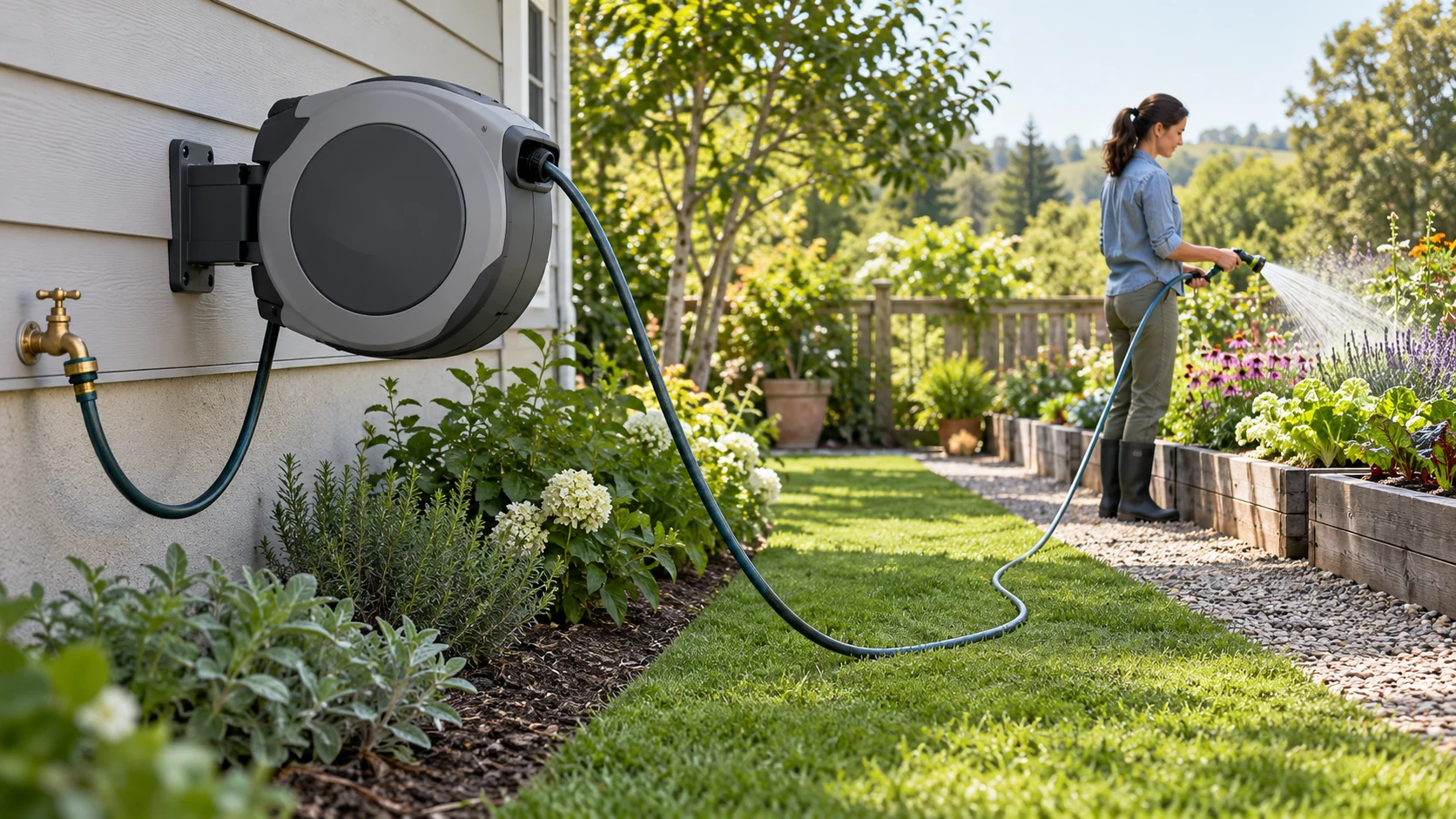
Retractable garden hose reel fit starts with the wall where the reel will hang and the paths you actually water. A long advertised hose can still be awkward if the supplied lead cannot reach the tap, the case cannot swing past a gate, or the mounting wall is unsuitable. Before choosing a model, mark the tap, possible mounting sites, corners, beds, and paths on a simple yard sketch. Walk the longest watering route. Those observations give you a practical way to compare the exact product specifications.
Two current listings illustrate the questions. The KFFKFF 84-foot retractable reel lists a half-inch main hose, a six-foot lead, a length lock, and a wall bracket. The VEVOR NW-S20 65-foot reel lists a half-inch main hose and a six-foot lead. Their stated main-hose lengths differ, but neither listing knows the route around your beds or the construction of your wall. Use them as examples of what to verify for a particular offer, rather than treating either length as a promise of yard coverage.
Map the mount and tap separately
Start by choosing a possible mounting point near the routes you use most often. Look for a location supported by the maker's installation instructions and accessible when you need to pull or retract the hose. Mark the wall material and anything that might block the case, including a door, fence, downspout, or gate. If you have two plausible sites, keep both on the sketch until you have measured them. A central position may shorten the path to several beds, while a position near the tap may make the lead connection easier.
Measure from the tap to the proposed reel inlet along the route the lead hose would actually follow. A straight line across a doorway or through a planted border is not a usable route. Both example listings specify a six-foot lead. That length has to cover the path to the inlet while leaving a workable bend at each end. If it does not, resolve the exact model's supported connection arrangement before buying. An improvised extension adds another connection and may leave a hose across an area people use.
Keep the inlet connection question precise. The VEVOR page describes a three-quarter-inch brass interface; check the current KFFKFF offer and the actual parts in your yard for their exact connection details. Your tap, the lead hose, and the reel inlet are separate interfaces. The published garden hose adapter compatibility guide explains how to identify each interface before selecting an adapter. This article addresses the location and hose-route decision. A fitting that joins two parts cannot make an unsuitable mounting site convenient.
Look at where the lead will rest when the main hose is fully retracted. A short lead can still cross a doorway, a mower route, or a place where people carry tools. Mark ordinary foot traffic on the sketch. If the route is exposed to repeated contact, try another site. Think about the location in its everyday state, with the hose put away, as well as during watering.
Measure the watering route
From each proposed reel position, walk to every regular watering point. Follow the route a hose would take around furniture, bed edges, corners, and gates. At the furthest bed, include the length needed to move the nozzle around the plants rather than merely touch the nearest edge. Record the longest route. You may find that the shorter listed hose works from a central wall, or that the longer listed hose falls short when mounted behind an obstacle.
The KFFKFF listing states an 84-foot main hose, while the VEVOR listing states 65 feet. Those numbers describe named product variants. They do not establish the distance from your intended wall to every plant. Compare each stated length with your measured route and leave practical room for the way you hold the nozzle. A coverage-area claim, if shown on a listing, assumes a shape and access pattern that may differ from your yard.
Write the main-hose and lead-hose distances on separate lines. The lead runs from the tap to the reel; the main hose runs outward from the case. Adding their lengths together would overstate the distance available for watering. On the sketch, draw each segment in a different color or label its endpoints. This simple separation catches a common mistake: choosing a reel because the combined advertised hose lengths look sufficient, even though the main hose alone cannot reach the far bed.
Check the direction of the pull as well as the distance. The KFFKFF title describes a 180-degree swivel bracket, and the VEVOR first gallery illustrates a swiveling wall arrangement. Those descriptions suggest the case can turn, but they do not establish that your chosen spot leaves the whole movement clear. Use verified case dimensions from the current instructions, or make a rough cardboard outline, to check the space beside the wall. Watch for a downspout, door, fence, or storage cabinet where the case would need to turn.
A path that measures well on an empty patio may change when furniture is in its usual place. Test the route with the table, grill, hose cart, and seasonal planters where they normally sit. Check how a gate opens while you are holding the hose. If a corner would force the hose against a sharp edge, consider another mount or route. The goal is a path you can repeat without moving heavy objects each time you water.
Confirm the hose end and included accessories
Both listings describe half-inch main hoses. That size alone does not tell you whether a nozzle, wand, sprinkler, or quick connector you own will attach to the supplied hose end. Identify the accessory you expect to use and inspect its actual connection. Check the current listing or manufacturer instructions for the selected reel's outlet fitting. If the relevant fitting is not specified, ask the seller or maker rather than guessing from its appearance.
The KFFKFF title mentions a nine-pattern nozzle. Check the selected package before relying on that accessory, and check the VEVOR offer separately for its included nozzle and fittings. Product pages can show several variants or accessories in a gallery. A photograph of one bundle does not prove every option includes the same parts. Keep a short list of required accessories alongside the exact model and offer you plan to order.
A half-inch hose size describes the hose, not every connection at its ends. A nozzle may have a threaded coupling, while another accessory uses a quick connector. If you cannot identify a part, the adapter guide linked above provides the interface-by-interface approach. Resolve the actual connection before ordering extras. This article's fit test remains focused on the reel's position, reach, and included package; it does not assume a universal adapter will solve an unknown mismatch.
Be careful when comparing the gallery images. The first KFFKFF image shows a grey wall-mounted case with orange details in a watering scene. The first VEVOR gallery image also depicts a grey-and-orange wall-mounted reel and shows bracket movement. Similar form and color do not make brackets, leads, nozzles, or replacement hoses interchangeable. Save the model name and the specific offer beside your route measurements. Check replacement-part compatibility against that identity if serviceability matters to your purchase.
Check the mounting instructions before choosing hardware
Read the maker's mounting instructions for the wall material, bracket spacing, fasteners, and load before drilling. A reel filled with hose and pulled from an angle puts demands on a mount that a product photograph cannot show. Identify whether the actual support is masonry, wood, a post, or a wall with siding over another structure. Do not assume the hardware shown online suits every surface. If the structure or instructions are unclear, ask a qualified installer to assess the site.
Measure clearance below and beside the bracket. The case needs to turn through the directions you use, and the hose needs to leave it without rubbing against a sharp obstruction. Check whether the installed reel can be accessed for any care or removal described in the manual. A spot that clears the case today may be blocked by a climbing plant or a storage cabinet later in the season. Add those recurring objects to the sketch.
Compare two candidate sites in a small table. For each one, record the tap-to-reel route, the reel-to-furthest-plant route, swing clearance, wall material, and ordinary foot traffic. Use your own measurements rather than an estimated yard width. The 84-foot option may address a main-hose reach problem at one site, while the 65-foot option may be sufficient at another. Either choice still depends on the lead connection, mount, and exact package passing their own checks.
Think about seasonal access. Outdoor furniture, a grill, and storage boxes may move between the start and end of the watering season. A reel behind stored equipment is less useful even if the measured distance remains unchanged. Test the route with movable items in their common positions. If the reel will remain outdoors through cold weather, follow the selected maker's care and storage directions. Do not infer winter suitability from a broad weather-resistance phrase in a listing.
Keep the watering decision separate
A reel stores and delivers a hose; it does not determine how much water a plant needs. The published overwatering and watering-can guide explains how to check plant needs before changing the equipment you use. Its advice still matters when a retractable hose makes a distant bed easier to reach. Plan how you will control the nozzle and observe the plants instead of treating the hose's reach as a reason to water every area the same way.
Before ordering, try the proposed pull route with a measuring tape or length of string. Start at the bracket position, follow the same corners, and stand where you would hold the nozzle. This cannot reproduce hose stiffness, water pressure, or the case's retraction behavior, but it can expose a basic reach error. Repeat the exercise from a second mounting point if the first is short. Keep the route notes with the exact product names so you can explain why a particular length fits your yard.
For the final check, verify the selected variant's main-hose length, lead-hose length, mounting requirements, swing clearance, outlet connection, included nozzle and fittings, and replacement-part route. Compare those details with your sketch and current instructions. Resolve any missing dimension or connection detail before purchase. A suitable reel is the one whose installed position lets its lead reach the tap and its main hose follow your real watering routes.