Problem-Solving Articles
Overwatering with a watering can: check need before choosing equipment
Separate plant needs from watering-can claims using actual houseplant water labels, scoped orchid guidance and two retail descriptions without universal doses.
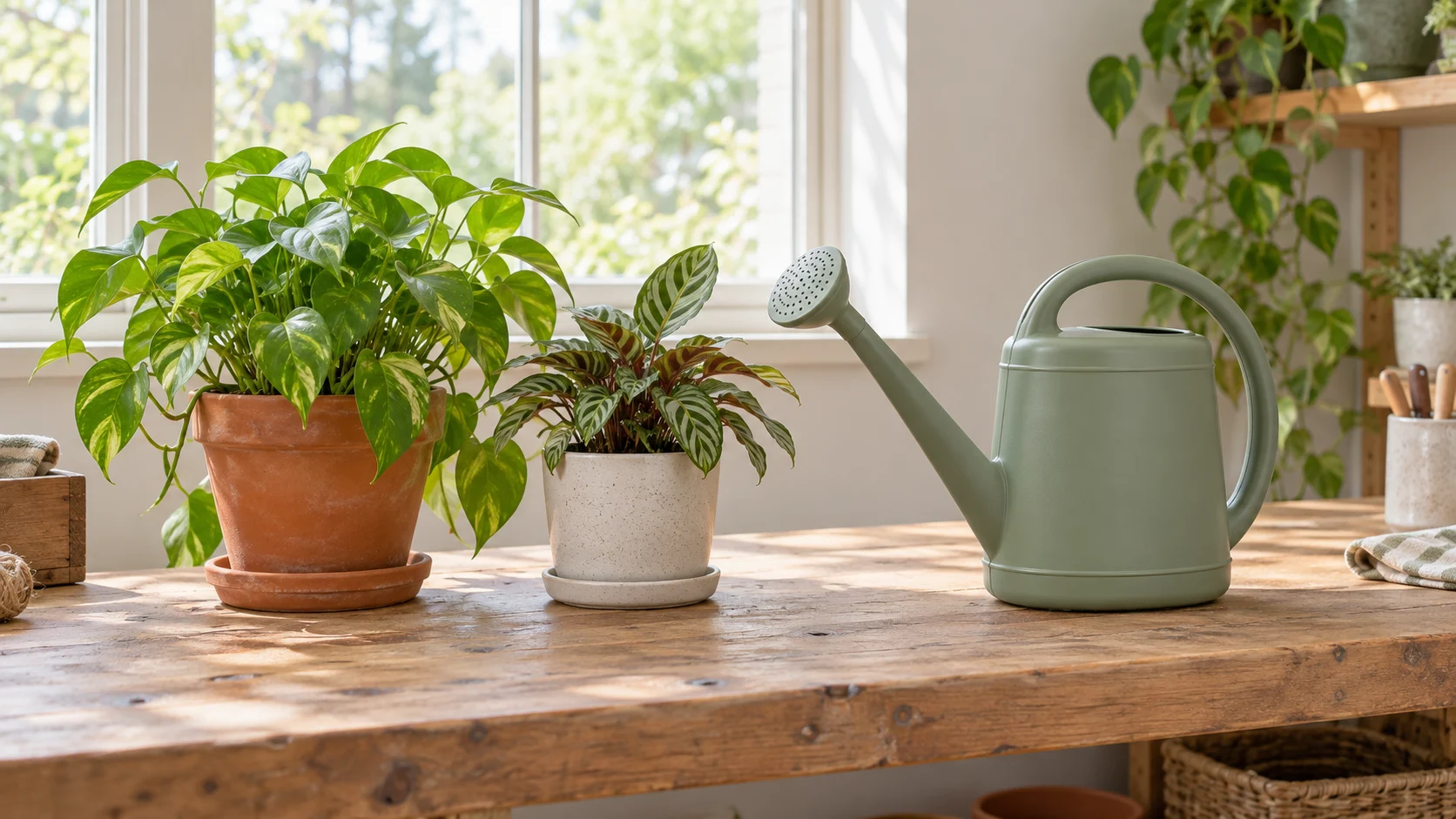
Overwatering with a watering can requires more information than a rose description supplies.
A can's capacity describes the water it can hold. A long spout and a rose describe delivery features. Deciding whether a particular plant needs water is a separate question. Keep that decision ahead of a purchase intended to solve a problem with the current watering routine.
Use the actual plant-care guidance before another pour
Illinois Extension advises checking each plant's needs. Species, size, conditions, container, mix and drainage affect watering. It describes checking soil two inches down: dry soil probably needs water. Its top-watering account includes thorough moistening, drainage and emptying the saucer, without standing water.
Keep plant needs versus watering can capacity distinct
For plant needs versus watering can capacity, a full vessel is available supply, not a requirement to empty it into one pot. A five-litre label does not tell you that a plant needs five litres. It also does not establish how many plants will be served by that amount.
Read the actual five-litre can description
The Unbranded five-litre plastic watering can description names heavy-duty, impact-resistant plastic, a fully wrapping handle, a long spout and a detachable plastic rose. Its capacity statement is five litres. Those details identify the selected product account.
The offer attributes reduced hand and wrist strain, comfortable pouring and a secure wet-hand grip to its handle. It calls the can suitable for gardeners of all ages and abilities. These are retail claims, not an assessment of how a particular person can carry or use a filled vessel.
Its long-spout wording refers to reaching hanging baskets, elevated planters and harder-to-access areas. The description also attributes reduced foliage damage and healthy root growth to its delivery arrangement. This guide supplies no reach measurement, lifting method or approval to work with an inaccessible hanging container.
If reach is your actual concern, identify the container and the position you intend to work from before asking whether the product suits it. The phrase long spout does not supply a numeric length or the clearance of your own arrangement. Resolve those actual details rather than treating the label as a complete reach assessment.
A gentle rose and watering frequency answer different questions
Consider gentle rose and watering frequency as separate questions.
The Unbranded account describes its detachable rose as producing a shower-like spray and claims that it prevents overwatering and root damage. The attachment supplies no documented automatic decision about your actual plant. Its marketing statement does not establish that water is needed whenever the can is available.
Ask what you are trying to change. You may want a different delivery pattern, a different reach or better information about the plant's needs. These are separate purchase and care questions. A product could have the described rose while the household still lacks the information required for its care decision.
This article offers no rose-fitting or removal sequence. The actual equipment instructions govern that work. A detachable component in a description does not establish how every supplied connection is handled or which other attachments are compatible with the selected can.
Describe the observation before choosing equipment
Illinois says wilting can reflect excessive or insufficient watering. Wilting alone supplies no diagnosis.
Describe the observed condition when seeking plant-specific guidance. The can's retail description cannot determine the cause. Its claims about comfortable use or a detachable attachment remain available for a separate equipment decision.
Use the actual plant identity to narrow the care question
The United States Botanic Garden's Houseplants table gives a concrete reason to identify the plant before repeating one routine across a room. It lists snake plant, Dracaena trifasciata, formerly Sansevieria, as low light and low water. ZZ plant, Zamioculcas zamiifolia, also receives low-light and low-water labels. Peace lily, Spathiphyllum species, receives low light but medium water.
Those entries share the low-light label while their water labels differ. The table therefore does not support deciding that every plant suitable for a low-light position receives the same watering. If you have a snake plant and a peace lily, keep their identities with their separate care questions. Their shared location does not erase the difference in the reference.
The table also identifies pothos or devil's ivy, Epipremnum aureum, and Chinese evergreen, Aglaonema species, as low light and low water. These are the Garden's broad labels. They supply no number of days, millilitres or canfuls. Low water does not mean no water, and it does not establish that an unknown plant belongs in that category because its leaves look familiar.
Compare water labels without turning them into a dose
Ponytail palm or elephant's foot, Beaucarnea recurvata, receives medium light and low water in the Garden's table. Corn plant or mass cane, Dracaena fragrans 'Massangeana', receives medium light and medium water. The separate dracaena or dragon-tree entry, written as Dracaena fragrans, is also medium light and medium water. Preserve those actual identities when consulting the account.
Arrowhead plant or nephthytis, Syngonium podophyllum, and rubber tree, Ficus elastica, complete the table's medium-light, medium-water group. That identifies what the reference says about those entries. It does not establish a measured ratio between medium and low. Doubling a low-water amount would invent a numerical meaning the table does not provide.
Start with an identity you can establish, then consult the applicable care requirements and the current observation. If the plant is unnamed, seek identification rather than choosing a category from the can's capacity. If its identity is known but the broad label leaves a practical question open, ask about that particular plant and arrangement. A broad table can narrow the question without answering every part of it.
Keep orchid guidance with orchids and its stated exceptions
The Botanic Garden's Orchid Care Tips gives a more specific watering account. Most orchids, it says, prefer to dry out a bit between waterings, with some exceptions. When watering, it calls for drenching the pot thoroughly and draining completely. It says never to leave the plant sitting in water, prefers tepid water and recommends watering early enough for foliage to dry by nightfall.
Identify the orchid and check whether its applicable care places it among the exceptions. Do not remove that qualification to produce an all-orchids instruction. Likewise, this orchid account supplies no reason to impose the same interval or amount on a snake plant, a peace lily or an unidentified houseplant.
Notice the difference between wetting the pot thoroughly during a needed watering and returning again too soon. The Garden's account includes both drying between waterings and complete drainage. Selecting only its word drench would leave out the rest of the instruction. Selecting only dry out would also omit the qualification and the watering account that follows.
This article does not provide a rescue treatment for an already damaged orchid or a way to judge an unknown root condition. The actual care account helps frame a routine question. A plant that continues to decline still needs an assessment attached to its identity, growing arrangement and observed condition, rather than another purchase based on the can's healthy-root language.
Choose the next action that answers the missing question
If you have only the statement that every pot is watered on Saturday, the missing information concerns the plants and their current needs. The calendar describes what the household has been doing. It does not show that every plant in the room matches one of the Garden's entries, or that each has the same applicable requirement.
For water left beneath a pot, consult the drainage guidance applicable to that plant. For an unknown plant, resolve its identity. For an unconfirmed attachment, ask about the supplied can. Each question needs its own answer.
A capacity comparison becomes useful after the care task is established. For an independently established, entirely hypothetical eight-litre total, a nominal five-litre vessel would require at least two loads: five plus three equals eight. That calculation supplies no allocation to individual plants, suitable fill level or carrying assessment. It answers only a supply question whose input had to come from elsewhere.
The Fiskars account describes another package
The Fiskars EZPWC2.6 dual-handle watering can offer states a 2.6-gallon capacity and a quantity of ten. Its SKU is 5382674049 and its UPC is 363767517113. Keep the quantity-of-ten statement with the actual offer instead of silently treating it as one can.
Its brief description does not identify a rose, a spout length or an ergonomic test. Do not transfer the Unbranded can's detachable-rose, fully wrapping-handle or long-spout claims to this Fiskars account. Dual handle is its own stated feature, without a universal comfort or carrying guarantee.
If you need one household item, resolve the actual sale quantity before ordering a package described as ten. If you have a reason for several items, keep that supply requirement separate from the amount of water an individual plant needs. The number of cans supplied does not establish a watering programme.
Check order quantity before comparing capacities
The Fiskars description's quantity of ten concerns the offer, while 2.6 gallons concerns a can's stated capacity. Treating ten as a capacity would change the meaning of the product account. Treating 2.6 as the number of cans would make a different error. Keep each number beside the thing it describes when asking about the order.
Suppose, purely for a purchasing example, a group needs six separate cans and the supplier confirms that one offered package contains ten. Buying that confirmed package would provide four more cans than the stated requirement. That subtraction does not mean six units can be ordered separately. The supplier would have to confirm a different sale quantity before a buyer could plan on receiving six.
A household seeking one can has a different package question from that group. The same quantity-of-ten wording deserves attention in both cases, even though neither shopper has yet chosen a suitable capacity. Resolve what the transaction supplies before comparing whether an individual item suits the intended work.
Decide whether there is a tool problem to solve
A replacement can may be worth investigating when you have an actual equipment requirement. Name the feature that would change your decision: a documented capacity, confirmed supplied attachment, suitable access arrangement or package quantity. Ask about that feature in the selected offer rather than expecting the product to diagnose the plant.
Equipment already at home may still be relevant to the task. If the unresolved issue is plant identification or care information, a purchase does not have to come first. You can establish that missing information while leaving an unverified capacity or reach claim open for a separate decision.
When someone recommends another can, ask which problem they expect it to address. A recommendation about carrying more supply and a recommendation about controlling delivery concern different tasks. Keep their stated reason with the actual feature evidence so the proposed change remains understandable.
Use measurement guides without borrowing plant prescriptions
The rain-gauge measuring-tube guide explains a wide collecting arrangement and a narrower measuring tube in the actual Stratus seller account. Its calibrated rainfall discussion does not determine an indoor plant's watering requirement. An outdoor rainfall number and a particular pot's condition remain different observations.
The weather station readings guide separates Iris and Atlas quantities, periods and forecasts. A weather display supplies no documented dose for an individual houseplant. Keep each observation with the quantity it actually describes rather than letting one convenient number stand in for the whole care question.
Return to the unresolved cause
Investigate overwatering with a watering can through applicable plant guidance; choose equipment for a confirmed equipment requirement.
Conceptual overwatering with a watering can cover: generic inactive equipment without a demonstrated watering method.