Educational & Explainer Articles
Rain gauge measuring tubes: why the water column looks taller
Understand the Stratus seller-described wide collector and narrow measuring tube, with abstract geometry kept separate from actual gauge dimensions and accuracy.
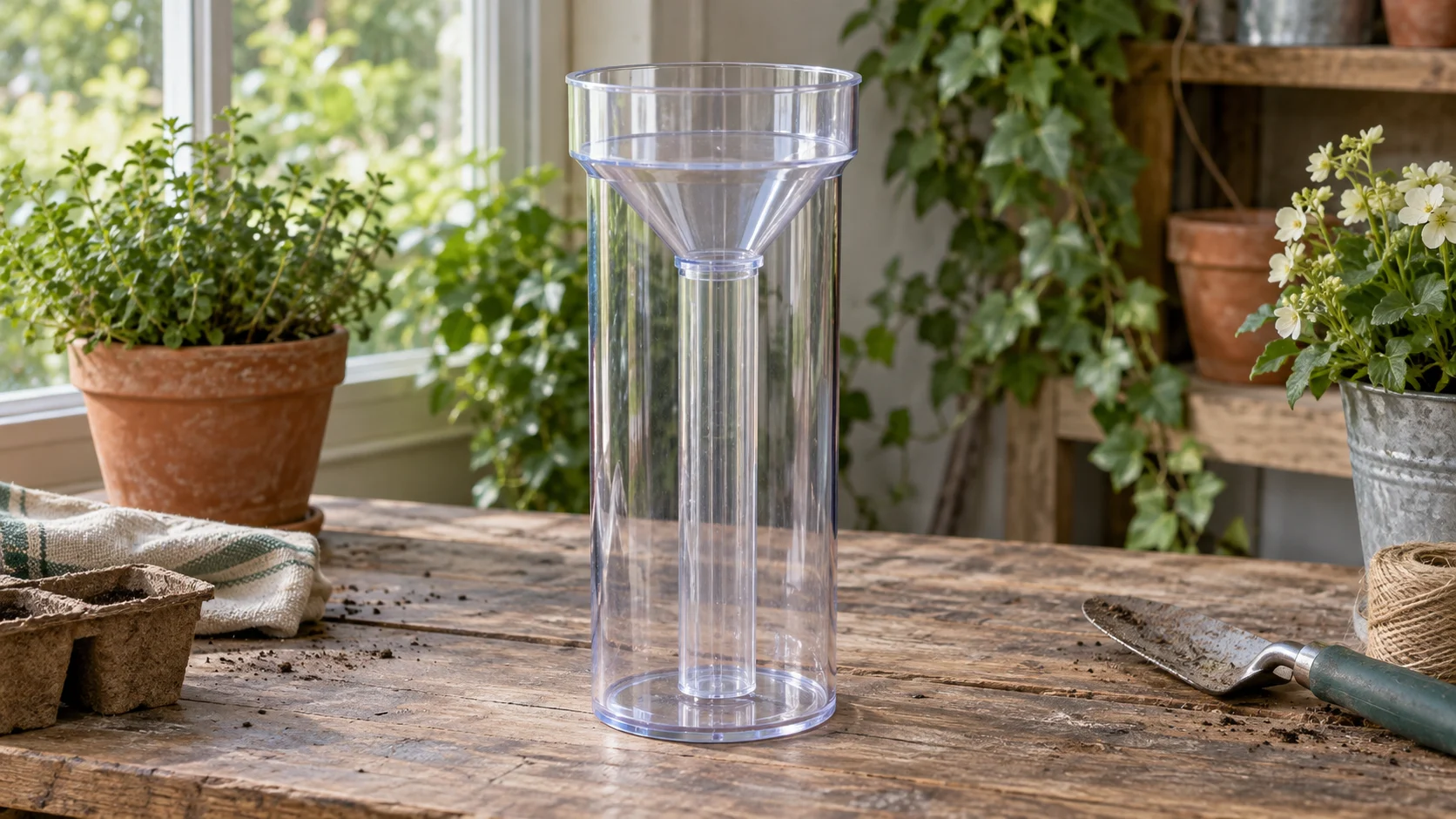
Rain gauge measuring tubes can make a small quantity of collected rain easier to see by holding it in a narrower column. The height of that column and the rainfall value on its calibrated scale are related through the gauge's design. They need not be the same number of ordinary ruler inches.
The Stratus DPRG0001 provides a concrete product account for this distinction. Its partner-brand seller, FLI Products, describes a wide collecting arrangement and a narrower inner measuring tube. Understanding those different roles helps explain why a gauge can have both a large outer cylinder and a separate, finely marked tube inside.
Begin with the named parts of the Stratus account
The Stratus DPRG0001 clear rain gauge offer identifies SKU 15165569954 and UPC 810229025605. Its description names UV-resistant polycarbonate, a transparent cylinder and bold markings. It gives a precipitation statement of one hundredth of an inch and a holding-capacity statement of up to eleven inches.
FLI's Stratus product page identifies the same DPRG0001 and UPC in its item information. The page explicitly calls Stratus a partner brand sold by FLI Products. It describes a clear graduated inner tube, a wide-mouth funnel and a larger outer collecting tube. That is the source for the component arrangement discussed here.
The retail offer and FLI page use accuracy, professional-use and weather-network language. Those remain their claims. This guide explains the described geometry without conducting a field comparison, certifying measurement error or independently establishing an endorsement. Finer scale markings and a tested error limit are separate matters.
A wide collector and narrow tube have different roles
With a wide collector and narrow tube, collection and display happen over different areas. The opening receives water across its collecting area, while the inner tube holds water in a smaller cross-section. The same liquid volume occupies a taller column when confined to a narrower straight-sided vessel.
Imagine two abstract, straight-sided containers with flat horizontal cross-sections. One has an internal area of four square units, and the other has an internal area of one square unit. Put the same volume of water in each imaginary container. Its height in the narrower container will be four times its height in the wider one.
That example is arithmetic, not a Stratus specification. No four-to-one ratio, actual diameter or actual internal area is supplied for the selected gauge in the source used here. The invented containers simply show why changing area changes column height while the amount of water stays the same.
The relationship follows from volume equalling area multiplied by height for this ideal straight-sided example. Four square units multiplied by one unit of height gives four cubic units. One square unit multiplied by four units of height also gives four cubic units. The two containers therefore hold equal volumes at different heights.
Keep rainfall scale versus water height clear
For rainfall scale versus water height, ask what the printed number represents. A rainfall scale is intended to report the collected precipitation according to the instrument's design. A separate ruler would describe the physical height of the visible column. Substituting one for the other discards the relationship built into the gauge.
In the abstract four-to-one example, one unit of uniform rainfall collected over four square units produces four cubic units of water. Transfer that hypothetical collected volume into a one-square-unit measuring cross-section, and it occupies a column four units high. A scale reporting the original rainfall depth would label that height as one rainfall unit.
There is still only one hypothetical rainfall event in that example. Concentrating its collected water into the smaller area did not make four times as much rain fall. It changed the height used to display the collected volume. Keep that distinction when explaining why a narrow measuring tube can spread small rainfall increments farther apart vertically.
These invented dimensions are not instructions to pour water into your actual gauge or draw replacement markings. They demonstrate the principle on paper. The selected product's applicable scale and instructions remain necessary for an actual reading. This article supplies no calibration procedure or independently measured scale ratio.
Follow a second imaginary amount through the same design
Keep the same abstract collecting area of four square units and inner area of one square unit, but imagine half a unit of uniform rainfall. The collected volume is now two cubic units: four multiplied by one half. In the narrower imaginary tube, those two cubic units occupy a column two units high.
The rainfall label for that hypothetical column would represent one half of a unit, not two units of rainfall. The physical column and the rainfall scale still describe related but different quantities. Changing the imagined rain amount did not change the assumed four-to-one relationship between the two areas.
Compare the two examples. One rainfall unit produced four cubic units and a four-unit column. Half a rainfall unit produced two cubic units and a two-unit column. Both use the same invented geometry. Neither gives a real Stratus reading or an instruction for checking a delivered gauge.
This relationship helps identify a useful product question: which scale belongs to the inner measuring tube, and which component is intended for collection? The answer needs the actual gauge's documentation. A ruler measurement of an unfamiliar tube cannot establish that its graduations belong to the instrument you have.
Why a width comparison is not an area comparison
Area is the size of the horizontal cross-section, while width is a distance across it. Those quantities have different units. A circle's diameter is a length; its area is expressed in square units. A statement that one circular opening is twice as wide does not mean it has twice the area.
For an additional abstract comparison, imagine two circular openings with diameters of two and four length units. Their radii are one and two units. Using the circle-area relationship, their areas are pi and four pi square units. Doubling the diameter therefore gives four times the area in this invented pair.
That is why even an actual pair of diameter specifications would need to be interpreted as geometry, rather than simply divided and called a rainfall multiplier. The relevant collection and measuring cross-sections would also need to be identified correctly. An outside body width may describe material and shape beyond the internal space holding water.
Here, the selected Stratus source supplies the qualitative wide-collector and narrow-tube account, without those exact internal dimensions. Keep the explanation at that supported level. The fictional circular openings illustrate the difference between length and area; they are not measurements of the Stratus product, its funnel or the Quest-listed replacement tube.
The larger outer component is not a second identical scale
FLI's page describes a larger outer tube and a precision inner measuring tube, using the narrower tube to explain the magnified reading. Keep those named roles in the product explanation. The fact that two transparent cylinders appear together does not establish that both carry equivalent graduations or can be read interchangeably.
The selected retail description's eleven-inch holding statement belongs to the complete gauge account. It does not identify every physical dimension of its outer cylinder, and it does not establish that the inner tube itself has an eleven-inch rainfall scale. Retain the wording without inventing the missing component specification.
Likewise, a statement that water can be collected outside the inner measuring tube leaves an actual handling question. Follow the applicable instructions for the selected equipment when that question arises. This explanation supplies no overflow-transfer, emptying, reassembly or solid-precipitation procedure.
In a product photograph, identify the collecting opening, outer body and inner tube only to the extent the actual documentation supports them. The picture may help locate the named components, but it does not supply their internal diameters. Reflections and perspective are not a reliable dimensional drawing.
A ten-times accuracy claim supplies no area ratio
FLI compares its hundredth-inch wording with a tenth-inch figure and uses ten-times accuracy language. This article does not turn that comparison into a geometric specification. A difference between advertised numerical increments cannot establish the ratio of the collector's area to the inner tube's area.
The abstract four-to-one example used a ratio chosen solely to make the arithmetic visible. Neither that ratio nor the seller's ten-times comparison is substituted into the selected gauge's design. If an exact magnification factor matters, obtain the applicable technical information for the actual instrument rather than deriving it from marketing language.
Scale spacing, readability and error also ask different questions. A taller column can help explain why a marked increment has more vertical room in a narrow tube. It does not prove that every person can read the tube from every position or establish the error of an installed gauge in changing conditions.
The Quest-listed glass gauge has its own sparse account
The Quest-listed Acurite glass rain gauge offer names a five-inch capacity, replacement tube and mounting hardware. Its actual catalog brand is Quest and its SKU is 17758866662. Keep that catalog identity beside the Acurite wording in the description when asking about the supplied item.
The offer calls the product durable, comfortable to hold and easy to use around the home and yard. Its brief description supplies no collector-to-tube area ratio, matching Stratus inner-cylinder arrangement or numeric measurement-error specification. A replacement-tube mention alone does not establish that it uses the geometry described on FLI's Stratus page.
Ask for the actual item identity and applicable scale information if those details affect your choice. The selected Quest offer's five-inch capacity and the Stratus account's eleven-inch capacity do not answer every question about how either scale is formed. Neither capacity figure independently identifies the component dimensions.
Keep related measurement guides attached to their quantities
The weather station readings guide separates actual quantities, ranges, update intervals and reporting periods in Iris and Atlas descriptions. Here the focus is a physical arrangement that changes visible column height. That earlier guide supplies no Stratus dimensions or Quest scale construction.
The Mitutoyo caliper display guide keeps a selected display reference separate from the full physical measurement question. Its INC and ABS discussion concerns that actual caliper, without providing a rain-gauge procedure. The useful connection is identifying what a displayed number represents before replacing it with a different interpretation.
Use the explanation for the question in front of you
If someone asks why the inner column looks taller than the reported rainfall number, begin with the unequal areas. Use the abstract container example if it helps, clearly identifying its invented dimensions. Then return to the actual gauge's named parts and calibrated scale. Keep the example separate from the product's unpublished geometry.
For a purchasing question, preserve the actual model and the component detail you still need. For an operational question, consult the applicable instructions. Rain gauge measuring tubes make sense when the collecting area, measuring cross-section and intended scale stay connected, without treating the visible column as an ordinary ruler reading.
Rain gauge measuring tubes use a scale matched to the instrument's design; this conceptual cover shows generic inactive collecting equipment without verified retail dimensions, readable calibration or a rainfall measurement.