Garden Care & Watering
Choosing a pond liner size before buying a sheet
Choose a pond liner sheet by its required dimensions and applicable edge guidance, while keeping material, underlay, joining and return questions separate.
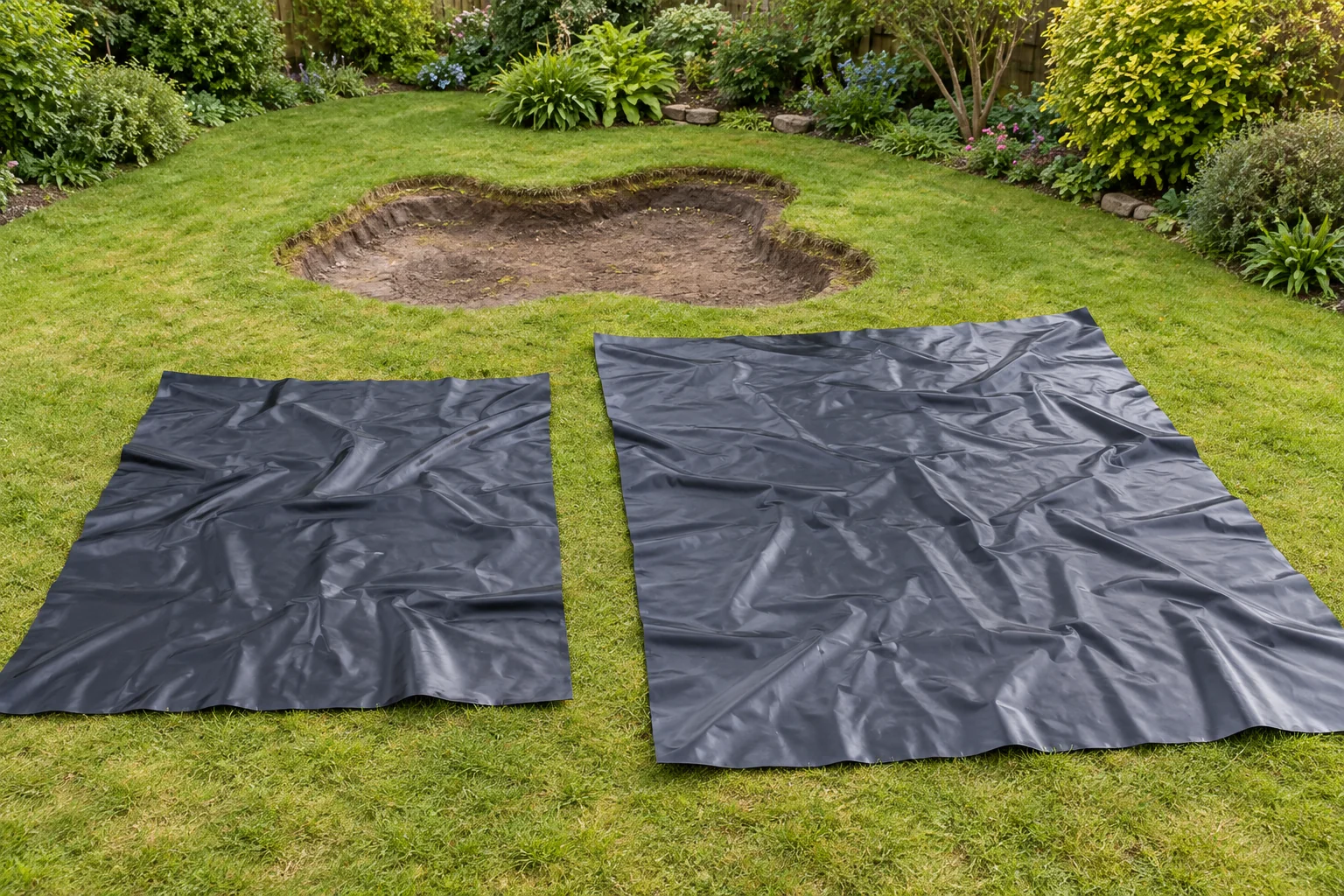
A pond liner size describes a sheet. It does not, by itself, describe the pond that sheet can line. The distance across the finished surface includes more than the visible opening, and the edge needs its own allowance. Buying from the opening alone can leave a sheet short even when its stated area looks generous.
There is a second purchasing trap: treating a larger sheet as the answer to every unanswered question. Extra length cannot establish that a particular material suits the project, that two pieces can be joined with an available method, or that a return remains possible after cutting. Resolve those questions before calling the order economical.
Start pond liner dimensions with the intended surface
The useful starting point for pond liner dimensions is the surface the liner must follow. A flat plan of the water opening answers a different question from a route down one side, across the bottom and up the other. Keep the proposed pond shape attached to its measurements while the project is still being planned.
The Pond Guy's liner calculator guide illustrates this difference by adding twice the maximum depth to each opening dimension, followed by one extra foot for anchoring. Its worked example starts with a pond ten feet long, five feet wide and three feet deep, arriving at a seventeen-by-twelve-foot requirement. The guide then selects a larger available sheet.
That is the guide's calculation and allowance. It is useful context for why depth matters, but its EPDM discussion does not approve an HDPE or LLDPE product for a particular project. A buyer still needs the applicable instructions for the selected liner and the actual edge construction.
Before choosing a sheet, identify which dimensions describe the opening and which describe a required lining span. An unlabeled pair of numbers creates an avoidable ambiguity. A supplier cannot resolve the difference reliably if the question says only that the pond is fourteen feet long.
Keep the pond liner allowance attached to its source
A pond liner allowance needs a stated basis. The selected Pennington offer's package photograph shows a fourteen-by-eleven-foot sheet and an illustrative eight-by-five-by-two-foot pond. Its diagram places an extra foot at each side. That differs from the one additional foot in each overall dimension used by The Pond Guy's example.
Do not average the two allowances or assume that either governs every edge detail. The difference is a reason to obtain the selected product's applicable guidance. The diagram also does not establish that a pond matching its opening and depth will be suitable in every other respect.
It helps to separate the route the liner must follow from the material retained beyond that route. Otherwise a remembered allowance can become hidden inside a measurement, then be added a second time. Equally, an opening measurement can be mistaken for a fully allowed sheet requirement.
If a proposed edge changes, revisit the required sheet before ordering it. Calling an earlier measurement final does not make it fit a revised plan. The money at risk comes from purchasing against a requirement that no longer describes the intended work, rather than from the act of checking it again.
Read the two actual sheet offers
The Pennington 8108012 pond liner offer identifies a fourteen-foot-by-eleven-foot sheet. Its package image describes a twenty-two-mil HDPE liner. Those details identify the offered sheet; the illustrated pond on that package remains a separate example, rather than another set of sheet dimensions.
The VEVOR twenty-by-twenty-five-foot LLDPE pond liner offer describes twenty-mil material. VEVOR's matching-size official listing identifies one liner in the package and gives rounded metric dimensions of six by seven point six metres. It offers a larger rectangle and a different named material from the selected Pennington sheet.
Those differences do not produce a tested quality ranking. This article reports no comparative installation, puncture test, fish-safety assessment or service-life measurement. Select the necessary dimensions and establish material suitability separately, rather than interpreting one of the two numbers as a complete recommendation.
Neither selection supplies a verified complete pond system here. Pumps, stonework, fish and planting in a photograph are scenery unless the actual offer identifies them as included. Avoid planning an order on the assumption that a picture supplies the missing equipment.
Check both directions before calling a rectangle large enough
A sheet requirement has two dimensions that must fit at the same time. A large total area cannot compensate for a short side. This is a useful purchase check even before a particular liner material or edge detail has been approved for the project.
Consider a purely hypothetical finished sheet requirement of fourteen by twelve feet. These numbers are supplied for the rectangle comparison alone. They are not recommended pond dimensions, the result of a site survey or a proposed anchoring method.
A fourteen-by-eleven-foot sheet does not contain that rectangle. Turning it would put eleven feet against a fourteen-foot requirement, leaving another mismatch. The twenty-by-twenty-five-foot sheet exceeds the two stated dimensions in either corresponding orientation, but that observation establishes only a dimensional comparison.
The example explains why the smaller offer cannot be made adequate simply by pointing to its longer side. It also explains why the larger offer still needs a reason for purchase. Enough stated width and length answer the rectangle question without settling the other project conditions.
For a different hypothetical requirement, the answer could change. Keep the comparison tied to the actual proposed dimensions instead of carrying the result forward as a preference for a brand. No site has been measured and no sheet has been fitted in these examples.
Area can be misleading even when the arithmetic is correct. Imagine a different, explicitly hypothetical sheet requirement of sixteen by eight feet, giving one hundred and twenty-eight square feet. The selected fourteen-by-eleven-foot offer describes one hundred and fifty-four square feet. Its greater total area still does not provide a sixteen-foot side.
Turning that sheet exchanges the two stated sides; it does not extend either one. These rectangle examples do not describe how a particular material stretches, folds or performs in use. No stretching allowance has been adopted. The point is narrower: total square footage and the necessary width-and-length pair answer different purchasing questions.
This distinction also helps when comparing a quoted requirement with an order confirmation. If the requirement is a rectangle, keep both sides visible rather than replacing them with their product. A confirmation naming the correct area can still describe an unsuitable shape. Resolve a mismatch before interpreting the order as the intended supply.
Do the same check when an available size changes during selection. A different option needs its own two dimensions and material description. The earlier comparison belongs to the offer it actually examined, even when the replacement appears under a similar product title.
Separate underlayment from the liner itself
The Pond Guy describes pond underlayment as a separate protective fabric beneath the liner. Its own underlayment reference sells a distinct product in ten-foot-wide sections. That separate role should remain visible when considering what an order includes; it does not turn a liner-only offer into a liner-and-underlay package.
Aquascape's liner and underlayment overview likewise treats those as different parts of its pond approach. Its EPDM promotion, guarantees and performance statements concern its own reference products. They do not establish that the selected sheets can use an unspecified substitute beneath them.
Ask which protection the chosen liner's guidance requires and whether it is included in the actual purchase. A missing answer is a project input to resolve, not an item to assume away because the sheet itself appears affordable. This article specifies no underlay material or thickness for either selected offer.
The caulk coverage budget guide explains a different supply problem: translating a specified filled space into material volume and cartridge count. Its arithmetic does not size a pond liner. Here the buying constraint is a sheet that must contain the required dimensions, with the edge allowance established for the intended work.
A second sheet creates a joining question
If one available sheet is short, buying another introduces a new decision. Two product dimensions do not establish a completed watertight lining. Obtain the chosen manufacturer's applicable joining instructions and the required materials before treating multiple pieces as an alternative to a single sufficiently sized sheet.
VEVOR's official listing includes brief questions and answers about glue and welding. Those replies do not provide a complete verified seam procedure for the proposed site. This guide adopts no adhesive recipe, welding setting, overlap dimension or resulting leakproof claim from them.
The same distinction applies to illustrations showing a liner beside a waterfall, pipe or other equipment. A visible arrangement does not establish the details of a penetration or connection. Keep those project-specific questions with the instructions and products that actually govern them.
The garden hose adapter compatibility guide examines the interfaces between hose and coupling parts. It can help distinguish a connection question from a general product label, but it supplies no approved fitting or attachment method for either pond liner in this article.
Plan the order before irreversible work
Aquascape's pond-building guide places perimeter trimming late in its own kit sequence, after filling. It explains that early cutting can leave its liner too short. That instruction belongs to the described Aquascape installation; it is a reason to obtain the selected liner's complete fitting guidance, rather than a replacement for it.
The Pond Guy's separate pond-building guide covers a broader kit arrangement with pumps, filters and plumbing. Those parts of a finished pond cannot be inferred from a liner's size. This article gives no excavation, electrical, skimmer or water-treatment procedure for the two selected sheets.
Keep packaging and order checks ahead of any alteration. Republeq.com's returns policy makes eligibility conditional, including unused and original-condition requirements where applicable. Do not budget on a promise that a cut or installed liner can be returned because its size later proves unsuitable.
VEVOR's own promotional return wording belongs to its own listing. A purchase at republeq.com is governed by the destination's current terms. Read those terms for the actual transaction instead of importing another seller's advertised return arrangement into the cost decision.
Make the size decision specific
A purchase decision can stay open while a required measurement, allowance or material instruction is missing. That is preferable to calling an uncertain sheet requirement a completed estimate. Nothing in these examples demonstrates a discount, a recovered expense or a measured reduction in the cost of a finished pond.
Choose the pond liner size from the required surface and the selected product's applicable edge guidance. Then check both sheet directions, the actual package contents and any separate protection or joining requirements. A well-defined requirement gives the order a purpose; a larger rectangle alone does not supply one.