Cost & Savings Articles
Caulk coverage budget: volume before cartridge count
Build a provisional sealant quantity estimate from the specified filled section and confirmed cartridge volume before comparing a supply order.
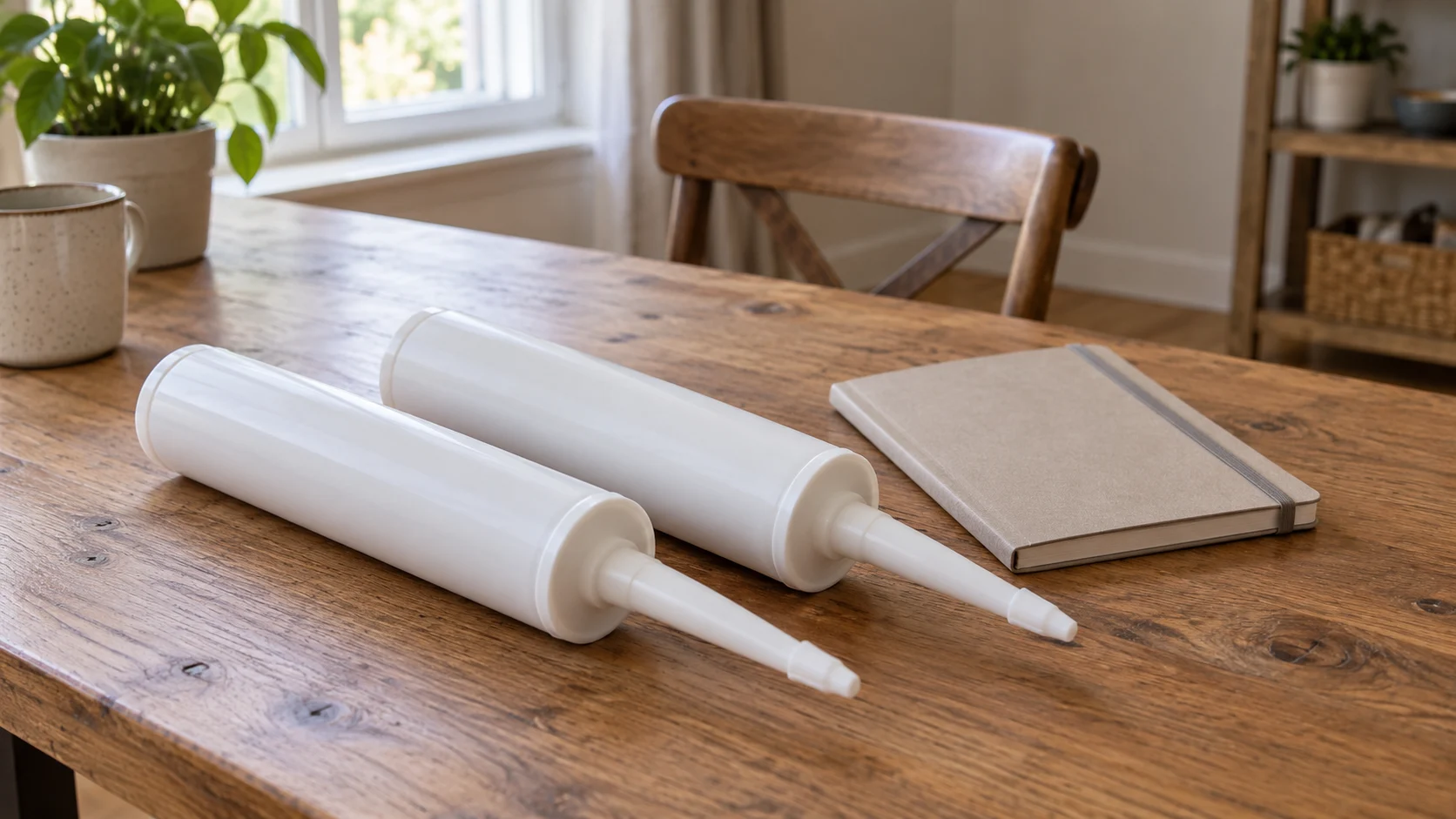
A caulk coverage budget needs the amount of material required by the proposed work before it can tell you how many cartridges to buy. A line described only by its length leaves the filled cross-section unanswered. A cartridge described only in ounces may leave its volume unanswered too. Neither missing input becomes known because an offer contains a large pack.
Imagine Noor preparing a supply estimate for a household job whose appropriate sealant and joint design still need confirmation. Noor is fictional, and no joint has been inspected or filled. The numbers below explain volume arithmetic. They are not recommended joint dimensions, an application method or proof that either selected silicone suits Noor's surfaces.
Begin the joint volume estimate with the specified shape
A joint volume estimate concerns the space that the specified material is intended to occupy. Obtain the applicable design and product guidance before selecting dimensions for the calculation. The worksheet does not specify joint depth, backing material or a suitable chemical product.
For a hypothetical rectangular filled section, multiply its cross-sectional width by its filled depth and its length. With length in metres and both cross-sectional dimensions in millimetres, their product gives millilitres. Converting the length to millimetres and dividing cubic millimetres by one thousand explains the resulting unit. It does not establish that the real section is rectangular.
Suppose an illustrative section is twelve metres long, five millimetres wide and four millimetres deep. Twelve multiplied by five multiplied by four gives two hundred and forty millilitres. Those dimensions were chosen for arithmetic, without a recommendation to construct or fill a joint that way. They describe an assumed space, rather than measured consumption from a cartridge.
If Noor has different sections, calculate their applicable volumes separately before adding them. A narrow run and a deeper run should not silently receive the same assumed section because their lengths are easy to combine. The inputs need enough description that another person can see which part of the proposed work each quantity concerns.
A change in the section changes the quantity
Keep the same hypothetical length and depth while doubling the width to ten millimetres. The calculated volume becomes four hundred and eighty millilitres. Double the depth as well, to eight millimetres, and it becomes nine hundred and sixty. These are consequences of the rectangular model, without a claim that a real job needs any of those dimensions.
This explains why a length-only rule can mislead a buyer. The same length has produced different calculated amounts because the assumed filled section changed. Asking how many metres one tube covers therefore needs more information than the product's name. The relevant section and the usable material quantity must be established together.
Sika's published sealant calculator illustrates that relationship with separate width and depth entries and tables for different pack volumes. It is generic coverage background here. Its capacities are not the stated capacities of the selected DAP or GE offers, and its table does not approve either product for Noor's proposed job.
A shaped or varying section needs an appropriate model instead of an unexplained rectangle. If the applicable instructions define a different profile, obtain the corresponding coverage guidance. Do not enlarge or flatten the planned bead merely to make a quantity estimate convenient. The supply calculation follows the specified work.
Read cartridge volume and pack count as separate inputs
The DAP white silicone sealant offer identifies 08640 in its description, a capacity of 10.1 fluid ounces and a case of twelve. Its actual model field says Does Not Apply. Preserve that field and the offer reference when asking for a capacity or order clarification.
The GE 2812562 clear silicone caulk offer describes a pack of twelve and says each cartridge contains ten ounces. That sentence does not explicitly identify fluid ounces. Do not convert its bare ounce wording into a confirmed volume or assume that it equals the DAP cartridge.
Keep cartridge volume and pack count on different lines. The first concerns material in a cartridge; the second concerns the number supplied by an order. A dozen units cannot settle an unclear capacity per unit. Conversely, a clarified capacity does not establish that a seller offers individual cartridges outside the listed pack.
The selected products also have different named colors. A quantity comparison does not establish that either is appropriate for the same work. Noor must retain the actual product requirement before considering a supply order. This article adopts no advertised waterproofing, adhesion, curing or water-exposure result as a verified property of an installed joint.
Divide by an explicitly assumed capacity
To demonstrate the next arithmetic step, assume a hypothetical cartridge with a confirmed capacity of three hundred millilitres. This is an independent example, without converting either retail description into that amount. The two-hundred-and-forty-millilitre rectangular example would require eight tenths of that capacity in the ideal calculation.
At the same assumed capacity, the wider example would require one and six tenths, while the wider and deeper example would require three and two tenths. Whole-cartridge counts before any justified allowance would be one, two and four respectively. Rounding up concerns the number of complete containers needed for the calculation; it does not certify the material will suffice in practice.
Noor can keep a fractional calculated requirement beside the whole-container count. That makes the rounding visible. Otherwise a note saying only four cartridges would conceal whether the underlying estimate was just over three, exactly four or something else. The difference matters when an input changes and the calculation needs reviewing.
There is still no demonstrated price saving. A calculation supplies a provisional quantity. A current offer and its actual order terms supply the spending question. Neither a fraction of a cartridge nor a rounded count should be reported as money paid, money returned or a measured reduction in the project's outlay.
Decide which volumes can actually be combined
Suppose a separate illustrative plan contains two runs, each calculated to need one hundred and forty millilitres. If the same suitable material can legitimately supply both within the actual work arrangement, their combined ideal volume is two hundred and eighty millilitres. Against the independently assumed three-hundred-millilitre capacity, that combined amount rounds to one cartridge before any allowance.
Rounding each small run to a whole cartridge first would produce two. The arithmetic difference does not establish a real saving or permission to share an opened cartridge across different jobs. It shows why the worksheet needs an explicit grouping decision. Combine only requirements that the applicable product guidance and actual work arrangement allow to be supplied together.
Different products, colors or use conditions can require separate groups even when the geometry looks similar. Keep each group with its own suitable material and confirmed capacity. A total volume across incompatible requirements would be a mathematical sum with no useful purchasing meaning. The same caution applies when separate jobs have different supply arrangements.
For Noor, grouping is another question to resolve before recording a final whole-container count. It is not an excuse to assume every partly used cartridge remains available indefinitely. A count based on shared supply should identify the work it actually covers and retain any relevant conditions, so that a later project change prompts a review of that assumption.
Show allowance separately from the ideal volume
The rectangular examples contain no allowance for material outside the intended filled section or material unavailable for use. They are ideal volume calculations. Actual planning needs the applicable guidance and the conditions of the work. This article assigns no universal waste percentage or usable fraction to either selected cartridge.
If a relevant source supplies an allowance for the actual job, name its basis beside the geometric amount. Another person's remembered percentage from different work is not automatically the right input. An unresolved allowance should stay visible in the worksheet.
Likewise, a partly used cartridge needs its own applicable information before it can be counted as available supply. This article provides no opened-product storage period, reuse permission or test of what remains usable. A container on a shelf is not a measured quantity ready for Noor's particular job.
Separate the material requirement from the order outlay
Once the required product and quantity are established, examine the current order that could supply them. Both selected descriptions name twelve-unit purchases. If Noor's verified requirement is smaller, that difference remains part of the buying decision. The calculation does not establish a smaller package is available or create a future use for every spare cartridge.
The tape-measure numbers guide separates a dimension, its unit and a package quantity. Here, the filled width, filled depth, run length and cartridge capacity each need their own label. The guide supplies no sealant specification or accuracy certificate for Noor's measurements.
The shipping tube budget guide distinguishes container acquisition from quoting the finished parcel. Its postage inputs do not calculate sealant coverage. Its purchasing distinction remains useful: paying for a pack is different from the amount of its contents assigned to one task.
Authorize the particular supply order
Noor's supply estimate can remain provisional while the job specification or capacity question is unanswered. When a particular order is justified, republeq.com accepts cryptocurrency purchases, including USDT. Inspect the payment options and instructions actually presented for that basket before arranging a transfer. The volume examples provide no selling price, exchange calculation, transaction charge or completion time. They also provide no payment address or recommended network. Those details belong to the current transaction. Confirm the selected item reference, the order contents and the actual total together, so that a change of product or package does not pass unnoticed into checkout. If someone else is obtaining the supplies, make clear which order that person is responsible for placing. A shared estimate should not become two unintended purchases because both people believe they are filling the same request. Any supplier answer about capacity belongs with the exact offer it identifies. A reply concerning another cartridge leaves the original question open, regardless of whether the proposed payment route is familiar. Read the current delivery and return terms for the selected purchase and retain the resulting order confirmation as needed. A successful payment establishes a transaction, without confirming joint design, chemical suitability, usable material or completed work. Choosing USDT or another supported crypto option cannot resolve those separate questions. If a checkout detail is unclear, obtain clarification before authorizing that transfer. Keep the record specific enough that another buyer can identify which purchase it concerns. Noor can then keep the actual supply purchase beside the planning record without calling an untested quantity a completed repair or treating unused stock as money already recovered.
Keep the remaining input explicit
A caulk coverage budget should show the specified filled shape, the measured or assumed dimensions, the confirmed cartridge volume and the purchase quantity. For these offers, DAP supplies fluid-ounce wording while GE's bare-ounce statement needs clarification. Resolve the inputs that affect the intended work before relying on the resulting count.