Garden Care & Watering
plant saucer fit: match the pot base to the tray interior
Measure the supported pot base, the saucer interior and the surface, then dry-fit the pair and observe runoff.
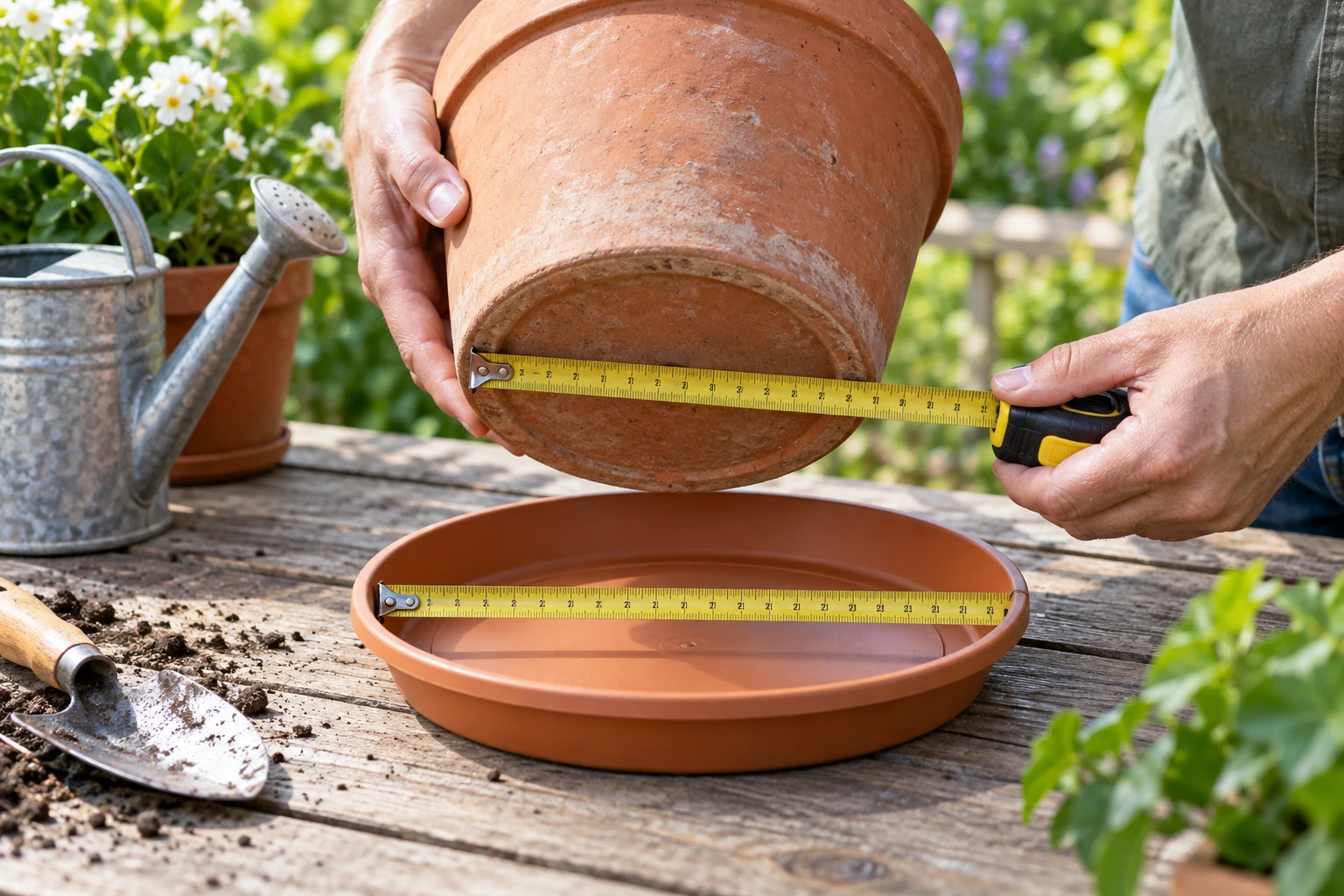
A plant saucer can have the right number on its package and still fail beneath your pot. The rim diameter may be wide while the flat interior is too narrow for the pot's actual base. A curved lip can also make a pot wobble, and a shallow tray may not suit where runoff will go. Match the pot, tray and surface together before treating a pack as compatible. This guide uses a simple dry fit and measurements, without promising that any tray will solve overwatering.
Measure the part that rests on the tray
Lift the empty or safely supported pot and look at its underside. The widest decorative rim is not necessarily the part touching a saucer. Measure across the base or feet that actually bear weight. If there are three small feet, note their outside span and whether each can rest securely on the tray floor. Record the pot's drain-hole position and any raised ring around it. A saucer needs room for the supported footprint, not merely the nominal pot size printed on a label.
For a heavy planted pot, ask someone to help or measure a matching empty pot rather than lifting a load you cannot handle safely. Use a ruler or tape measure while the pot is stable. Do not place fingers beneath an unsupported pot. If the underside is irregular, take a photo with the tape in frame and write the largest footprint that must sit inside the tray. A quick measurement prevents a visual guess from becoming a wobbly setup.
Measure the spot where the saucer will sit. A windowsill, plant stand or narrow shelf may leave less usable width than a floor position. Check the available depth as well as the side-to-side opening. A tray that fits the pot can still overhang a small shelf or interfere with a door. If a planter is near finished furniture, think about where water would go if it spilled beyond the tray, not just whether the tray looks centered.
Read interior width separately from outer width
On the saucer, distinguish outside rim width from the flat floor or stable inner support area. A scalloped or rolled rim adds to the photographed diameter but may not support the pot base. If a listing gives only one size without stating where it was measured, mark that as unresolved and seek a dimension diagram or seller answer. Do not assume the named pot size matches the usable inner floor. Two trays with the same outside diameter can cradle different bases.
The live Ounona plant saucer listing presents a many-piece set of white plastic trays with a waved or lotus-like edge. Its first gallery shows the scalloped interior and a small plant centered in a tray, alongside promotional durability statements. That image establishes the physical role and visible rim shape; it does not provide a trustworthy measurement of the inner supporting floor for your particular pot. Confirm the actual tray size and the pot base before counting any piece as a fit.
The live WMGHA assorted plant saucer listing describes six plastic trays in assorted sizes and asks shoppers to consult a second picture for fit. Its first gallery shows stacks of different colored trays outdoors. The captured text includes strong load and durability claims, but neither a styled stack nor a seller claim proves stability under your filled pot. Resolve the selected sizes, inner widths and actual supported load for the model in hand before relying on it.
Keep a short comparison row for each pot: supported base width, tray inner support width, tray outer width and surface width. Leave a blank rather than guessing a missing listing dimension. A pack with several sizes may contain one good match and several unusable pieces; that is a quantity decision for another article. Here the question is narrower: can the specific pot sit steadily on the specific tray without balancing on its rim or overhanging the surface?
Check the dry fit before adding water
Set an empty or safely handled pot into the dry tray on a level surface. Look from two sides. The base should rest where the tray is designed to support it, not rock on the lip. Gently test stability without forcing or shaking a heavy plant. If the pot tilts, identify whether the tray is warped, the pot has uneven feet, or the supporting surface itself is not level. Do not solve a bad fit by stuffing a loose object beneath one side.
Check whether the drain hole is blocked by a solid mound or whether a raised pot base leaves an opening for drainage. The exact water path depends on the pot and tray geometry. A pot whose drain hole sits flat against the tray may hold water at the base even when the saucer has room around it. A pot with feet may have better clearance but require a wider stable support area. Observe the actual pair rather than assuming every pot drains the same way.
Test the setup in the real location before filling the tray. On a narrow sill, a saucer can catch the window frame when you rotate it or when the pot is moved. On a tiered stand, a tray may touch the rails or block access to the shelf below. The tiered plant stand compatibility guide owns shelf width, pot clearance and stand access. Use its stand measurements when the saucer must share a shelf; this article owns the pot-base-to-tray interface.
Make room for runoff without storing water
A compatible saucer must hold some drainage while allowing you to see and remove excess water. The needed depth depends on how the pot is watered and the plant's actual care, not a universal size rule. A tray can be wide enough but too shallow for the amount of runoff you routinely create. Conversely, a deep tray can tempt you to leave standing water around roots or on a sensitive surface. Observe one normal watering with the paired pot and tray before calling the setup solved.
If the plant or pot label warns against standing water, follow that guidance. Empty excess as needed without spilling onto a finished floor. Do not claim that a saucer by itself prevents overwatering. The plant saucer multipack value guide counts how many trays in an offer are useful across known positions. Its stock calculation depends on compatibility being established for each pot first. This article stops at that fit judgment and leaves pack value to the separate guide.
Watch for a curved bottom that channels water toward one side when the shelf is uneven. A shallow ring of water in an empty tray may show the surface's slope, but do not pour water onto a location where leakage could damage furniture. Test safely over a protected sink or outside when appropriate. A level tray can still overflow if the pot receives more water than it can catch. Your watering routine and the tray capacity have to work together.
Consider material and exposure only at the level actually supported by the source. Both captured listings describe plastic trays, but their promotional language is not a measured lifetime under sun, freezing temperatures or a heavy pot. If the tray will be outdoors, verify the product's intended conditions with the seller and inspect it for cracks before use. A cracked tray loses its water-catching purpose regardless of how closely its diameter matches the pot.
Resolve missing sizes before buying a pack
If an online offer says “assorted,” identify exactly which diameters are inside it and whether those numbers describe the outside or usable inside. The WMGHA page directs shoppers to another image for fit, so do not treat the first gallery stack as a dimension chart. Ask for the selected variant's actual sizes when they are missing. The Ounona waved edge makes the inner-floor question especially visible. A seller photo can show shape but cannot supply a measurement that was never stated.
Do not use a pot's top diameter as a substitute for its base diameter. Many pots taper. A 20-centimeter rim may sit on a much narrower foot, and a broad decorative foot may extend beyond the body. When the exact pot is unavailable, ask for its underside measurement rather than buying a tray that merely sounds close to the listed pot size. A few minutes with a ruler can prevent a bulk pack of near-misses.
If the chosen pack contains multiple tray sizes, label the intended pot next to each confirmed compatible size. Do not count the other trays as useful stock until matched. One may fit a future plant, but a hypothetical future fit should not justify a current purchase. For a household with many plants, repeat the dry-fit row for each actual pot. The process scales through measured pairs, not through a single general rule that all “six-inch pots” use one saucer.
When a pot or tray changes, recheck the pairing. Repotting can increase the base width or move drain holes. A replacement tray may have a different inner floor even when its outer label looks familiar. A changed location may narrow the available surface. Keep a quick photo or measurement note with your plant supplies, but measure again when the physical arrangement changes. Compatibility belongs to the current pair in the current place.
For a hanging pot, use a tray only if the planter and hanging system are designed to carry it securely. A loose saucer balanced below a suspended pot is not the same situation as a stable tray on a table. Check the manufacturer instructions for the whole assembly. The two captured saucer galleries show freestanding tabletop or outdoor trays; they do not certify a hanging application. Do not turn a tabletop accessory into an improvised overhead catch basin.
Keep children and pets in mind when choosing the final location. A wide tray can overhang a stand and be easy to bump. Standing water can invite contact with soil residue or plant treatments. This is a location judgment, not a product-specific safety claim. If a plant is hazardous to a pet or a surface is easily damaged, solve that hazard separately; a correct saucer size does not replace safe plant placement.
A final fit decision needs four observations: the pot's supported underside, the tray's usable interior, the surface footprint and the ordinary runoff path. If one of those is unknown, leave the match open and obtain the measurement before buying. A plant saucer that supports the exact pot steadily and lets you manage drainage is a compatible accessory. A large count on the package or an appealing rim is not enough to prove it.