Garden Care & Watering
plant saucer multipack value: count usable trays, not pieces
Measure current pots and count genuinely usable saucers before treating a large package or assorted sizes as savings.
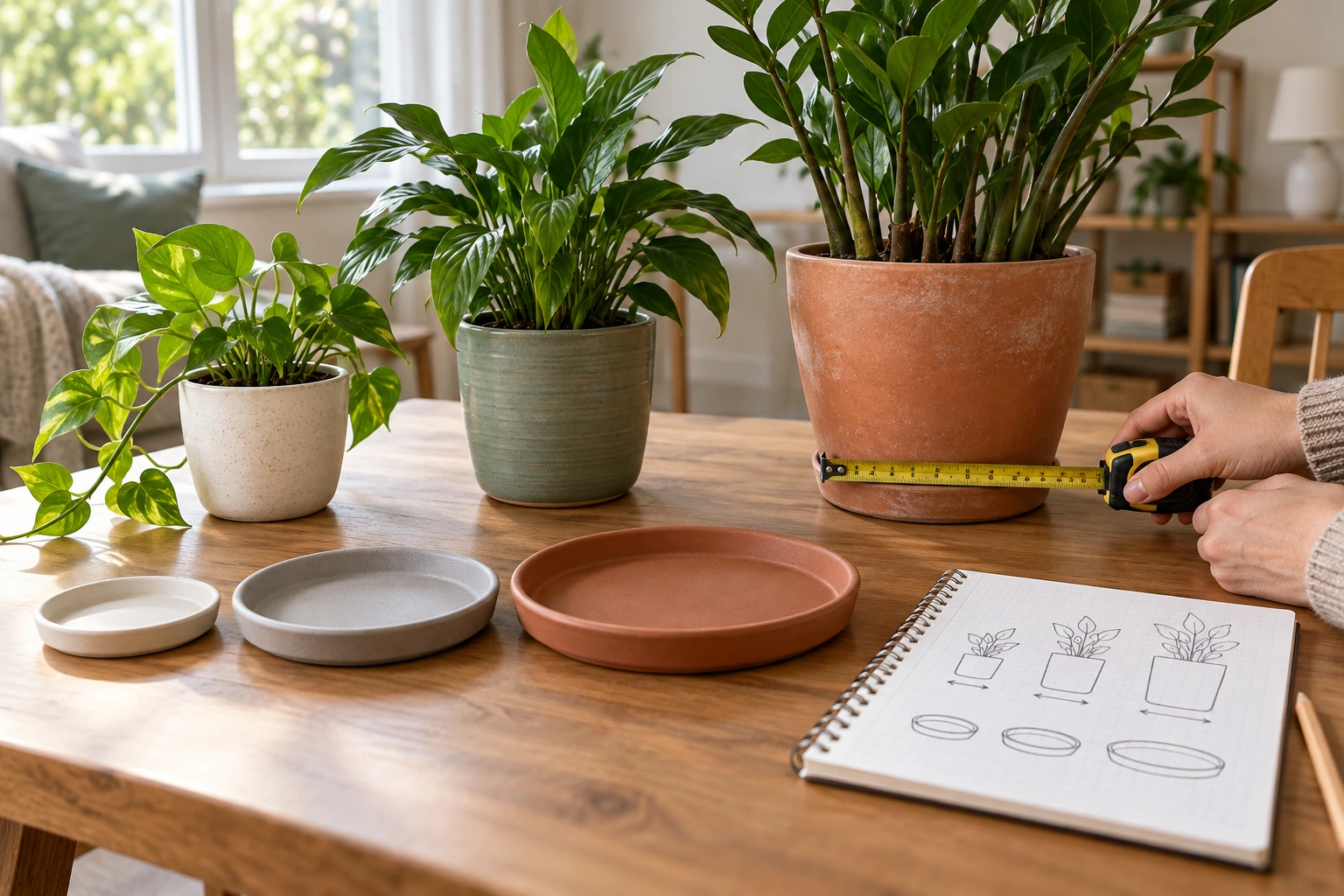
A plant saucer multipack can look convenient until most of its trays do not fit the pots you actually own. The useful unit is not “forty pieces” or “six assorted sizes”; it is a saucer that supports a particular pot and can be emptied safely in the place where that plant lives. This cost-and-savings guide avoids invented prices. It shows how to count genuinely usable trays before buying surplus stock, using two live plant-saucer listings as examples. A saucer may catch some drainage, but it does not determine when a plant needs water or guarantee protection for every surface.
Inventory the pots before the package
Walk through the home and write down each pot that currently needs a saucer. Record the pot's location, whether it has drainage holes, the outside diameter of its base, and the available footprint on the shelf or table. Do not measure the widest lip at the top and assume that number describes the base. A pot can taper sharply. If a pot sits inside a decorative cachepot, note that arrangement separately; the saucer may belong under the inner draining pot or may not be useful at all.
Group pots by their measured base sizes. One tray size may serve several pots at different times, but simultaneous use requires a tray for each pot. If you have three small pots and one large one, a set of forty identical small saucers will not solve the large-pot need. This is the first source of unused stock. Count the actual locations and sizes before looking at seller package counts. A plain table on paper is enough: pot, base diameter, location, and currently suitable saucer.
Measure the space around each pot too. A saucer should support the pot's base while leaving a practical margin for catching drainage, but a very broad tray can project over a narrow shelf or into a walking path. Check cabinet doors, windowsills, and nearby objects. An attractive product photo on a wide floor does not show whether the same rim will fit your crowded side table. The final usable size is limited by both the pot and the surface beneath it.
Look at the furniture or floor material before treating a tray as protection. A shallow saucer can overflow if too much water drains at once; condensation or spills can occur outside its rim. Follow the surface maker's care instructions and empty collected water as appropriate for the plant and container. Do not promise that plastic, ceramic, or a thickened rim is leakproof without a product-specific test. The cost of a tray is not justified if it invites neglect of the underlying surface.
Count usable sizes rather than pictured pieces
The live OUNONA 40-piece plant saucer listing describes round plastic drip trays with a wavy edge and a large total count. Its first inspected gallery graphic shows a stack of white shallow trays and a pot placed over one. The image supports the product's physical role as a pot saucer, but promotional claims of strength or resistance in the graphic are not independent tests. The page does not give you a measured match to every pot in your home.
The live WMGHA plant saucer listing describes a six-piece assortment of plastic trays in different sizes. Its first gallery image shows stacks of trays in several colors and diameters outdoors. The listing tells shoppers to consult a second picture for size information; the first image alone cannot certify the exact diameter of each delivered piece. Treat the six-count and assorted-size description as seller claims to confirm for the selected variant, not a guarantee that six of your pots are covered.
The first example emphasizes a large total quantity; the second emphasizes a variety of sizes. Neither format is automatically more economical. If the forty-piece pack contains many trays too small for your pots, its usable count may be low. If a mixed six-pack contains one matching size and five unusable ones, it can also create surplus. Build a simple count of exact or plausible matches for each listing using published dimensions, then ask the seller where the page lacks the needed measurements.
Keep unknowns visible. A photo can make a saucer seem deep enough, but perspective and a small sample pot obscure the actual rim height and interior area. A product description can say “heavy duty” without a load test relevant to your plant. Do not use either phrase as a substitute for dimensions, stable support, and a trial with the actual pot. If a needed size is not specified, do not count that tray as a usable match in the savings comparison.
Make a no-price usable-stock calculation
For each candidate package, write the promised total pieces in one column and the number of pots you can confidently match in another. Leave uncertain sizes out of the matched column. For a hypothetical home with four pots, a forty-piece pack could still be reasonable for a shared nursery project, yet it is not automatically useful for one household shelf. The example is a planning method, not a statement about the two products' delivered contents or value.
Mark the different kinds of surplus. An extra tray in a size already used may be a practical spare; an extra tray that fits no current pot has a different status. A tray reserved for a future plant is speculative until that pot and location exist. This distinction keeps “maybe someday” from being silently counted as savings. If you want spares, choose a deliberate number and size rather than accepting whatever remains after a bulk purchase.
Consider whether you can redistribute matched sizes within the home. A large tray might fit one pot on a wide floor but be too broad for a narrow sill. A smaller tray may be suitable only when the pot drains modestly and the surface can be observed. Do not solve a mismatch by precariously balancing a pot on a small rim or placing a large saucer where it can be knocked. Practical use matters more than an arithmetic count of pieces.
Before replacing a saucer, inspect any tray you already own. Measure it, check for cracks or distortion, clean it according to its material, and try it under the relevant pot on a safe surface. An existing suitable tray can reduce new purchases without any speculative price claim. A damaged tray should not be reused simply to avoid buying one. The decision is about serviceable stock, not minimizing purchases at the expense of a wet floor or unstable pot.
Check the plant and drainage separately
The overwatering and watering-can guide separates plant-specific water needs from retail can claims. The same boundary applies here. A saucer does not tell you how often to water, how much the potting mix should dry, or whether roots should sit in collected water. Follow the care needs of the actual plant and pot. Use the tray to observe and manage drainage, then empty it as appropriate rather than treating standing water as a universal moisture system.
The white-crust houseplant soil guide
When a new package arrives, verify count and dimensions before distributing trays around the house. Compare them with the saved pot inventory, and inspect each for cracks, uneven bases, or a rim that prevents stable pot contact. Test one matched pot in a place where any drainage can be observed without harming a surface. Do not assume every tray in a multipack is identical merely because the first is suitable, especially when the seller advertises an assortment.
Keep a concise record of the sizes that worked. If you later add a pot, measure it before assigning a leftover tray. A stockpile can be useful when its contents are known; it becomes clutter when every round piece is treated as universal. Store clean extras by size, away from fragile items, and avoid making a second bulk purchase while usable spares remain. This is a practical savings habit grounded in inventory rather than a claim about market prices.
If a seller's selected variant or size chart is unclear, postpone the purchase or choose a listing with enough information for the pots you own. Do not infer dimensions from a styled image, an “assorted” label, or a review of another variation. The pause is productive: it keeps a mismatch from becoming forty pieces of unusable stock. Preserve the exact selected product page and order details so a delivered size discrepancy can be resolved with the seller.
A houseplant may change pots later, so label the inventory with the date and current pot rather than treating the plant name as a permanent size. If a plant is repotted into a larger container, the old saucer may become a suitable spare for another small pot. Measure again before moving it. This prevents both needless replacement and the opposite mistake of placing a larger pot on a tray selected for a former container. The accessory follows the physical pot, not the plant's identity.
Watch how the chosen tray is handled during ordinary cleaning. A pot that must be lifted awkwardly to empty a deep saucer may lead someone to leave collected water in place. A shallow tray may be easy to empty but hold less before overflow. Do not infer an ideal depth from a product name; compare the actual rim and the household's ability to check and empty it. A tray that fits on paper but is inconvenient in practice should not be counted as a fully useful purchase.
Consider other surfaces in the route from watering place to display place. A pot may be watered at a sink and then carried back to a shelf; droplets on its exterior can still reach the furniture even when a saucer is underneath. Wipe or inspect the pot and tray before putting them back. This routine does not make any saucer waterproof, but it makes the accessory's limits visible. Include the household's real watering location in the decision instead of evaluating trays only where the plants are photographed.
Plant saucer multipack planning ends with a small table of real pots, their base diameters, the surfaces they sit on, and the count of trays that actually fit. Compare candidate packages by that usable count, not the largest printed number. Confirm the delivered sizes and inspect the first use for drainage and stability. A saucer is a supporting accessory to a pot and a care routine; it is not a promise of waterproof furniture or healthier plants. The best value is the number of suitable trays you will actually put to work.