Kitchen & Appliances
piping bag tip compatibility: check the cut and coupler
Match a pastry bag to the exact tip and coupler before cutting its narrow end; bag length, material, and brand do not establish accessory fit.
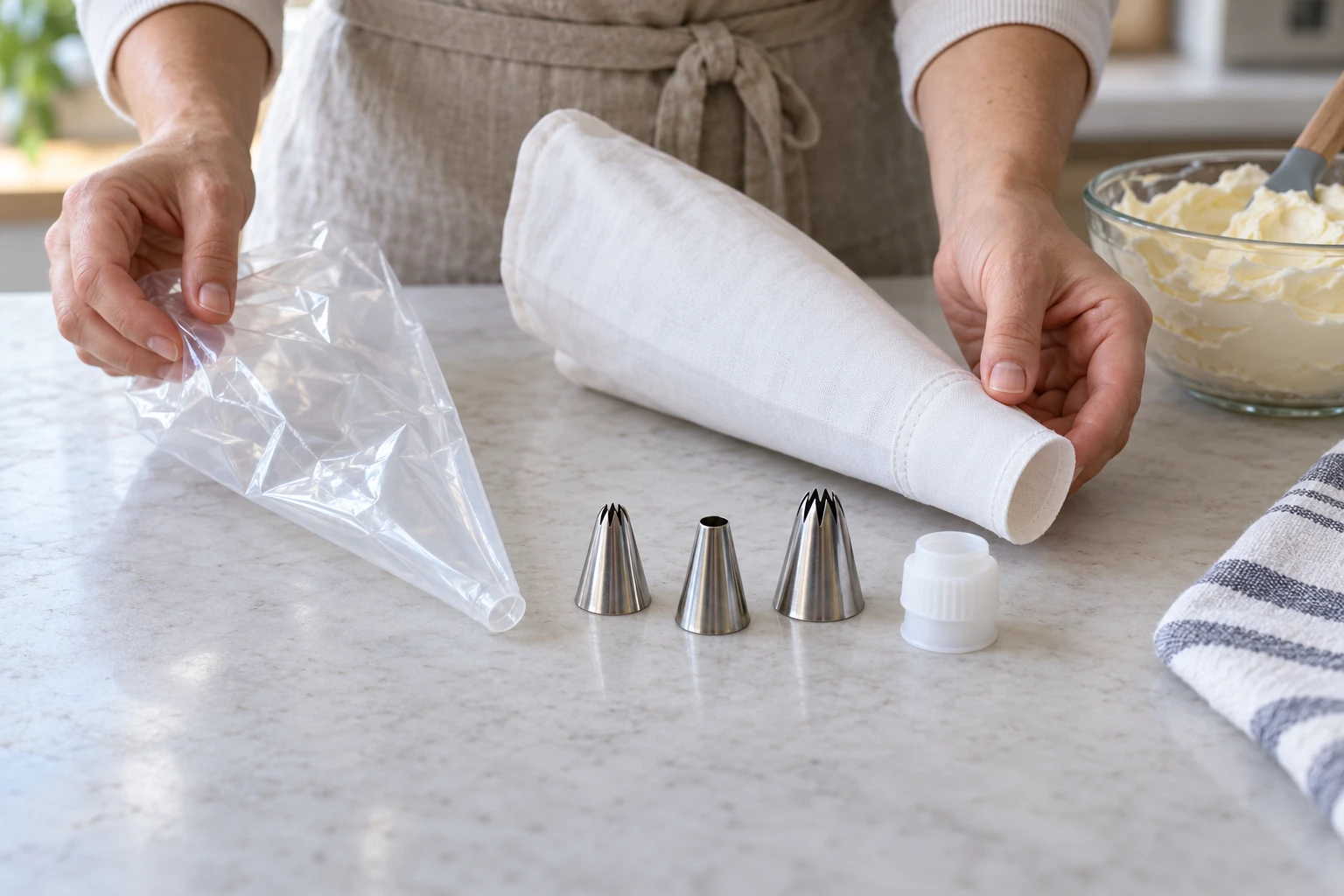
Piping bag tip compatibility starts at the narrow end of the bag, not at the length printed in a product title. A tip or coupler has to fit the opening you actually make, and a filled bag needs enough support that the tip stays in place while you pipe. Do not cut a new bag to match a photograph. Set the bag, tip, and any coupler on the counter first, read their separate instructions, and identify which parts are meant to lock or nest together. A bag sold for frosting is not proof that every decorating tip fits it.
This guide helps you choose between a disposable bag roll and a reusable bag when your accessories include a separate tip or coupler. It does not teach a cookie press's tray layout; the cookie press tray-planning guide owns that different shaping tool. It also does not decide which liner belongs under finished or unbaked decorations; the baking-liner comparison addresses the work surface. A compatible pastry bag assembly comes before choosing a tray pattern or liner.
Identify every part of the assembly
Lay out the bag, decorating tip, and coupler if you have one. A coupler usually consists of a base that enters the bag and an outer piece that secures a compatible tip, but the exact parts and sequence come from that coupler's maker. Some decorators place a tip directly inside a bag without a coupler. Those are different assemblies. Decide which one you intend to use before cutting or filling the bag. A missing outer ring cannot be solved by stretching the bag over a tip and hoping pressure will hold it.
Check the tip's shape and the dimensions specified by its maker, not just a familiar-looking opening. The broad end of a tip and the coupler's seat are the surfaces that must match. A small piping tip may need a different coupler from a larger one even if both are stainless steel. If you own a mixed assortment, sort it into the accessories that the maker says work together. Avoid treating a tip count in a decorating kit as a universal size system; the count says nothing about a separate bag's opening.
Look at the bag before making a cut. A new disposable bag often has a closed pointed end, while a reusable bag may have a prepared opening or a seam at its point. Inspect your actual item. If the end is already open, measure that opening before choosing a tip or coupler. If it is closed, mark a conservative position only after the intended accessory's instructions are clear. Removing too little material may require a careful second cut; removing too much cannot be undone on that bag.
Keep the bag empty during the first assembly check. The parts are easier to see and adjust without frosting pressing toward the opening. Place the coupler base or tip as instructed, then test whether the intended retaining part can engage. Do not pull hard on a sharp metal tip through thin plastic. If the accessory does not seat with the bag between the intended surfaces, stop and find the model-specific sizing information. A loose fit can allow frosting to escape around the connection during use.
Write down the exact tip and coupler identifiers if they are printed on a package. A common name such as “star tip” describes a shape, not necessarily the diameter of the part that seats in a coupler. The bag may have no printed model name once it is removed from its box, so keep its packaging until the first setup works. With those identities in hand, a maker or seller can answer a fit question more precisely. Without them, changing bag material can look like a solution even when the actual mismatch is between the tip and the retaining ring.
Read the two bag listings without assuming a tip size
The current Matfer Bourgeat 165003 disposable pastry bag roll is described as 200 clear, three-layer polyethylene bags measuring 21 5/8 inches. The native description says they are used to pipe icing and frosting onto pastries and desserts. It does not state a universal tip or coupler diameter. The roll quantity and bag length tell you about supply and working capacity, while the cut at the narrow end still has to suit the exact accessory you plan to use.
The separate Matfer Bourgeat 161002-1 reusable pastry bag is described in its native record as a 16-inch bag made of coated polyamid fabric with fused seams. The description says it is reusable, dishwasher safe, and washable in boiling water. Those are model-specific material and care claims; they do not prove compatibility with the disposable roll's tip setup. Its gallery shows an opaque white bag, so you also cannot judge the interior seat of a coupler from its exterior silhouette alone.
Neither listing supplies the exact coupler or decorating-tip match needed for every accessory a reader might own. Do not invent one from the Matfer name shared by both bags. Matching brands can still offer different sizes, materials, and intended ways to prepare the point. If a particular tip must be retained under pressure, obtain the maker's fit information for that tip and the chosen bag. A product photo helps identify the bag you are buying; it is not a scale drawing of the opening you will create.
Match the intended tip or coupler before cutting
Begin with the accessory that has the least flexibility: usually the tip or coupler you already own. Read any size designation on its packaging. If the maker gives an assembly diagram, follow it. The bag material must pass around the intended part without bunching so much that a retaining ring cannot engage. It also must leave enough material around the opening to support the assembly. A loose accessory that drops through the point is not made safe by filling the bag and relying on frosting to wedge it in place.
For a disposable bag, make one small initial cut only when the accessory's instructions say where to cut. Seat the base or tip and inspect the connection while the bag is empty. If the opening is still too small, remove a little more material and check again. Each cut changes that single bag permanently, so do not cut several bags in a roll before confirming the first setup. A roll of 200 offers spare bags but does not remove the need for one careful test.
For a reusable bag, inspect the existing point and any seam before modification. The 161002-1 description emphasizes its coated fabric and fused seams, but it does not give permission to cut through a seam or enlarge a finished opening. If your tip does not fit, check the manufacturer's instructions or select a different compatible accessory rather than trimming the bag by guesswork. A reusable bag is intended to last through more than one session, so an irreversible cut deserves more caution than a test on a disposable unit.
If you use a coupler, assemble it in the order specified by that coupler's maker. A common error is to judge the outer tip alone and overlook the base that must sit inside the bag. Another is to mistake a loose decorative ring for a complete retaining part. Keep every piece visible on the counter, and make sure the tip cannot move free in a gentle empty-bag check. Do not test retention by pulling on a sharp edge. A secure fit is a mechanical relationship among all the parts, not a property of the bag by itself.
Consider material and working volume separately
A long bag gives space for a larger batch but does not guarantee better control for a small detail. A smaller bag may be easier to handle for short lines, yet the appropriate fill level depends on the bag and frosting consistency. The 21 5/8-inch disposable roll and the 16-inch reusable bag differ in size and material. Neither measurement is a tip-size specification. Choose the working volume that suits the batch only after you know how your accessory attaches to the point.
Polyethylene and coated fabric can feel different in the hand. A disposable bag can be discarded after use according to local waste rules and the product's directions. A reusable bag needs cleaning and drying under its maker's care instructions. The listing for the 161002-1 bag makes specific washing claims, but that does not apply to the separate tips or couplers. Remove accessories before cleaning as their own instructions require. Do not leave frosting in a partly assembled bag because the tip fit has not been resolved.
Think about repeated color or tip changes. A compatible coupler can make some tip changes possible without emptying a bag, but only if the exact coupler and tips are designed to work together. The bag listing alone cannot promise that convenience. If you plan several colors, you may need separate bags or a cleaning step regardless of bag material. Decide from the actual decorating plan, not from a broad “professional” description in a listing. The accessory system controls the changeover.
Practice with a small amount of frosting or another appropriate test medium only after the empty fit is secure. Apply modest pressure over a bowl or work surface where a leak will be easy to see. If frosting escapes beside the tip, stop and empty the bag before changing the assembly. Do not tighten an unknown coupler harder in the hope of overcoming an oversize cut. A leak can reflect a mismatch, damaged bag, or incomplete assembly, and the fix depends on which part is responsible.
Notice where a leak begins. Frosting emerging from the intended tip opening is normal; frosting escaping behind the retaining ring or through a bag seam is a different observation. Release pressure before touching the connection. If the bag has torn, move to a sound bag after cleaning the accessories as their makers require. If a reusable bag's seam is failing, do not conceal it with a tighter coupler. A sound connection needs a suitable bag opening and intact material around that opening, so both the mechanical fit and the bag condition matter.
Keep the baking task distinct from the bag decision
A piping bag is a delivery tool for icing or frosting; it does not determine the shape of a cookie made by a press. If your goal is repeated pressed-cookie shapes, use the linked cookie-press guide for tray spacing and batch planning. If your goal is to pipe a border or filling, focus first on the bag, tip, and coupler relationship described here. The same dessert project can involve both tools, but one tool's setup does not verify the other's compatibility.
Likewise, the liner below a baking tray or decorating work area is a separate choice. Paper and silicone surfaces can behave differently, which is why the linked liner article examines them directly. Do not use a liner's thickness or nonstick claim as evidence that a piping tip will fit the bag. Keep the decisions in sequence: assemble a secure bag and tip, plan the decoration, then use a suitable work surface for the food and recipe. That sequence prevents a bag mismatch from being hidden inside a larger kitchen setup problem.
When shopping, keep a short list of exact accessory identities: bag model, tip or coupler model, intended opening size if supplied, and cleaning method. If a seller cannot verify the needed fit, leave the compatibility claim unresolved. The two Matfer bags offer different ways to hold frosting, yet neither native description settles every possible accessory match. A clear list lets you ask a precise question instead of relying on a shared brand or a staged photo.
Finish with one safe, repeatable assembly
Once the empty bag and accessory fit as directed, fill only to a level you can control, close or fold the wide end as the bag maker advises, and test the first small squeeze away from the finished food. Stop if the point shifts or the seam leaks. A small successful test proves only that this exact bag, accessory, and fill are working together now. Record the combination if you will repeat it. Do not extrapolate that result to a different tip size or a new cut position.
Piping bag tip compatibility is an exact parts question. Choose the disposable roll or reusable bag for its material, size, and care requirements, then verify the tip or coupler against the actual narrow end before making an irreversible cut. The product listings establish what those two bags are; the separate accessory maker establishes how its parts should seat. A careful empty-bag fit check gives you a stronger starting point than a product title, pack count, or photograph.