Educational & Explainer Articles
Nonstick baking liners: paper rolls and silicone mats explained
Understand paper-roll measurements, mesh-supported silicone mats, food release, gentle cleaning and intact storage before choosing a baking liner.
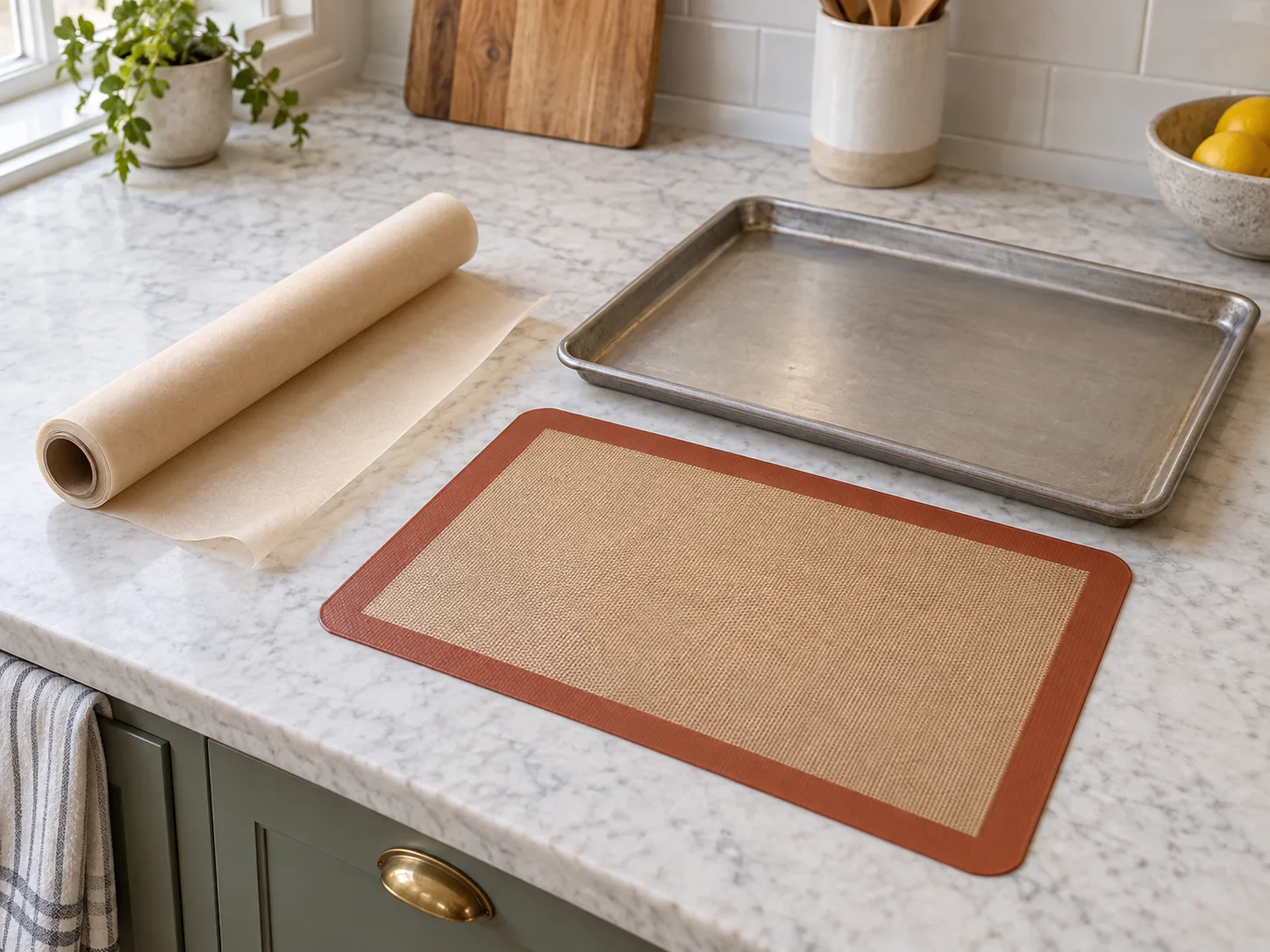
A roll of paper and a flexible mat can both be sold as nonstick baking liners. Each puts a release surface between food and the tray underneath. Their everyday differences become clearer when you look beyond that shared description: one comes as a length of material, while the other arrives as a finished rectangle that needs cleaning and storage. Understanding those formats helps you choose something you can accommodate in your own kitchen before you compare a recipe or a product photograph.
The two offers here are a FULL CIRCLE HOM parchment roll package and an Unbranded listing that describes a Sasa Demarle Silpat mat. They illustrate the questions attached to each format. This explanation covers what their descriptions mean and how the published Silpat care guidance informs ownership. It does not report a baking trial or rank their food results. You can use the distinctions to decide what information matters for the job you actually have in mind.
What the nonstick description tells you
Nonstick describes the food-release function of the surface. The Full Circle description says its paper protects surfaces and releases food; the mat description makes a similar release claim for baked goods. Neither sentence explains the whole product. A shopper still needs to know the format, its dimensions and its applicable use instructions. Those details determine whether the offered liner belongs in the intended setup, even when two descriptions use the same appealing word.
Keep the liner and the supporting cookware as separate objects. A thin sheet covering a tray does not supply that tray's rim, handles or shape. Silpat's care sheet expressly places its mat on a baking sheet, and its brochure depicts mats with supporting equipment. If your shopping list contains a mat, check whether you already have the appropriate support. A photograph showing both objects should not turn an offer for one mat into an order for a pan as well.
Read parchment roll length and width separately
The Full Circle Home 70-foot parchment roll offer names a pack of six in its title. Seventy feet describes a length, not the width of a sheet across a pan. Its short description does not provide that width. Before choosing it for a particular tray, obtain the roll width and confirm the supplied package. A long roll can still leave the crosswise fit question unanswered.
Thinking about parchment roll length and width separately makes a practical shopping note much clearer. Record the opening you want to cover, then ask whether the actual roll supplies the required width. Distinguish a pan's outside measurement from its usable interior when writing that note. A rim or handle can belong to the overall dimensions without being part of the flat area you intend to line. Give both measurements their own labels so the seller can answer the question you mean. Do not replace the missing measurement with a familiar width from another brand. Likewise, the pack quantity describes the offered inventory; it does not tell you whether that inventory suits your available storage or how often you intend to use it.
A roll also leaves you choosing the length of each piece instead of working with one permanent rectangle. That can be useful when your equipment has different footprints, provided the paper's width and actual instructions suit each application. Treat cutting a new piece of paper as a format choice, rather than a claim that one roll fits every vessel. A deep pan, a broad sheet and a small tin present different coverage questions even before food enters the picture.
Paper construction needs the product's own description
PaperChef provides a useful separate example of how a parchment manufacturer describes its own material. Its Premium Parchment page names Genuine Vegetable Parchment and describes a greaseproof release surface, strength when damp and reuse between batches. These are PaperChef's statements about its product. They help explain the kinds of properties a maker may disclose, but they do not establish the construction or reuse instructions for the Full Circle roll selected here.
That distinction is useful at the shelf. Ask which properties the actual package states, rather than treating parchment as one complete specification shared by every roll. If your task depends on shaping paper or reusing a sheet, look for that permission on the chosen product. The Full Circle description's brief release claim leaves those details open. Keep a separate brand's explanation as background knowledge while obtaining the instructions for the paper you intend to buy.
A mesh-supported mat is a finished object
The Unbranded offer describing a Sasa Demarle Silpat mat identifies one mat made in France, with woven glass or fiberglass mesh coated in food-grade silicone. This describes a composite object with a supporting mesh and a release surface. It is different from a supply of paper from which you choose a fresh length. Preserve the offer's Unbranded identity when asking the seller about the exact item.
The stated mat dimensions are 13.58 by 19.5 inches. Its title names a 15-by-21-inch pan, while the description names a 15-by-17-inch Big Sheet pan. Those conflicting pan references need clarification for this offer; this guide does not approve a fit. Compare the actual mat measurements with the relevant usable space on your equipment and obtain the applicable fit answer before relying on either pan name.
A fixed rectangle remains that rectangle between uses. Silpat's brochure says not to cut its mat, and not to use one that has been cut or torn. Choosing a smaller mat is therefore a different decision from trimming this one to make it smaller. If you alternate between pans, consider whether each intended setup can accept the intact mat. The ability to roll it for storage does not create permission to alter its outline.
Temperature and heat source answer different questions
A numerical temperature statement describes only part of an intended use. The appliance, placement and heat source also matter. Silpat's technical guidance prohibits direct contact with heating elements, flames and other direct heat, including grills. This guide supplies no grill method. Check the instructions applicable to the exact retail mat and appliance before use, rather than interpreting a material name or the seller's broad appliance list as a complete operating instruction.
The published Silpat documents consulted here contain different temperature statements, including a professional technical sheet. Their ranges are not substituted for the instructions accompanying this retail offer. The useful consumer habit is to keep the permitted setting and placement together when reading a package or manual. If one of those answers is missing, obtain it for that item. There is no need to turn a disagreement between documents into a guessed universal temperature for silicone.
Silicone baking mat care belongs in the purchase decision
Silpat's care sheet describes rinsing before first use and cleaning with a damp soft sponge, with mild soap when needed, followed by rinsing and air drying. Those actions take place between baking and putting the mat away. When considering silicone baking mat care, picture where that washing and drying will happen in your kitchen. A reusable object needs somewhere to be cleaned as well as somewhere to be stored.
Gentle cleaning tools also belong in that picture. The Silpat brochure excludes knives, scrapers, brushes and cutters on the mat. Keep food cutting and any cutter work on an appropriate separate surface under the relevant instructions. A liner's food-release purpose does not make it a cutting board. If your normal preparation involves a cutter or a sharp utensil, arrange the workspace so that task does not depend on using the mat underneath it.
The care sheet notes that the mat can feel oily after washing and can show discoloration. Read that guidance together with the brochure's instruction against using a cut or torn mat. Surface appearance and physical damage are different observations; neither should be reduced to a vague judgement that it simply looks used. Inspect the object you own and refer an uncertain condition to the maker's applicable guidance before treating it as ready for another batch.
Plan for the shape you need to store
The selected mat description allows flat or rolled storage, and Silpat's published guidance says not to fold its mat. Open a drawer or look at the cupboard where you intend to keep it before buying. A place that only accepts a tightly folded square may not accommodate the actual item under those instructions. Its flexibility helps explain the rolling option, but it does not erase the finished dimensions or the no-fold instruction.
Paper-roll storage presents another everyday question: where the remaining roll and the offered package will go. Start with the quantity you are actually considering and the dimensions the seller confirms. You do not need a predicted number of baking sessions to notice that a package of six and one finished mat are different inventories. Choose with your available space in mind, while keeping future consumption and the mat's eventual service life out of unsupported calculations.
Choose a format around the work you already do
Consider a household that uses several different pans and wants to select a piece of paper for each task. Roll width, the required piece and the paper's own use instructions will decide whether that format works. Another household may have a regular supported tray arrangement and a place to wash and store an intact mat. These examples describe different routines, without promising that one surface cooks better or lasts for a particular number of sessions.
Related equipment questions still need their own answers. The dehydrator accessory guide distinguishes a machine's supplied trays from separately identified sheets and screens. That distinction matters if an appliance description leads you to consider an extra liner. An oven mat's familiar appearance does not identify it as the correct accessory for your dehydrator. Establish the actual machine and accessory relationship for the intended task.
If you are planning shaped cookies, the holiday cookie-shape planning guide addresses the occasion and the cutter assortment. That choice remains separate from selecting the surface underneath a baking task. Agree on the shapes you need, then arrange any cutting on an appropriate separate surface and choose a liner using its own dimensions and instructions. A seasonal assortment supplies no care permission for the mat.
Keep a short record of the chosen liner's identity, usable size, applicable instructions and storage place with the product information. For paper, confirm the width as well as the roll length. For the mat, resolve the pan reference and preserve its intact shape through cleaning and storage. Those concrete answers make the format easier to live with each time you take it out, without needing a promised performance result to justify the choice.