Audio Production
Perfect reconstruction filter bank: alias and transfer conditions
A perfect reconstruction filter bank coordinates alias cancellation and the desired transfer path. Trace branch gains, delay and finite-record boundaries.
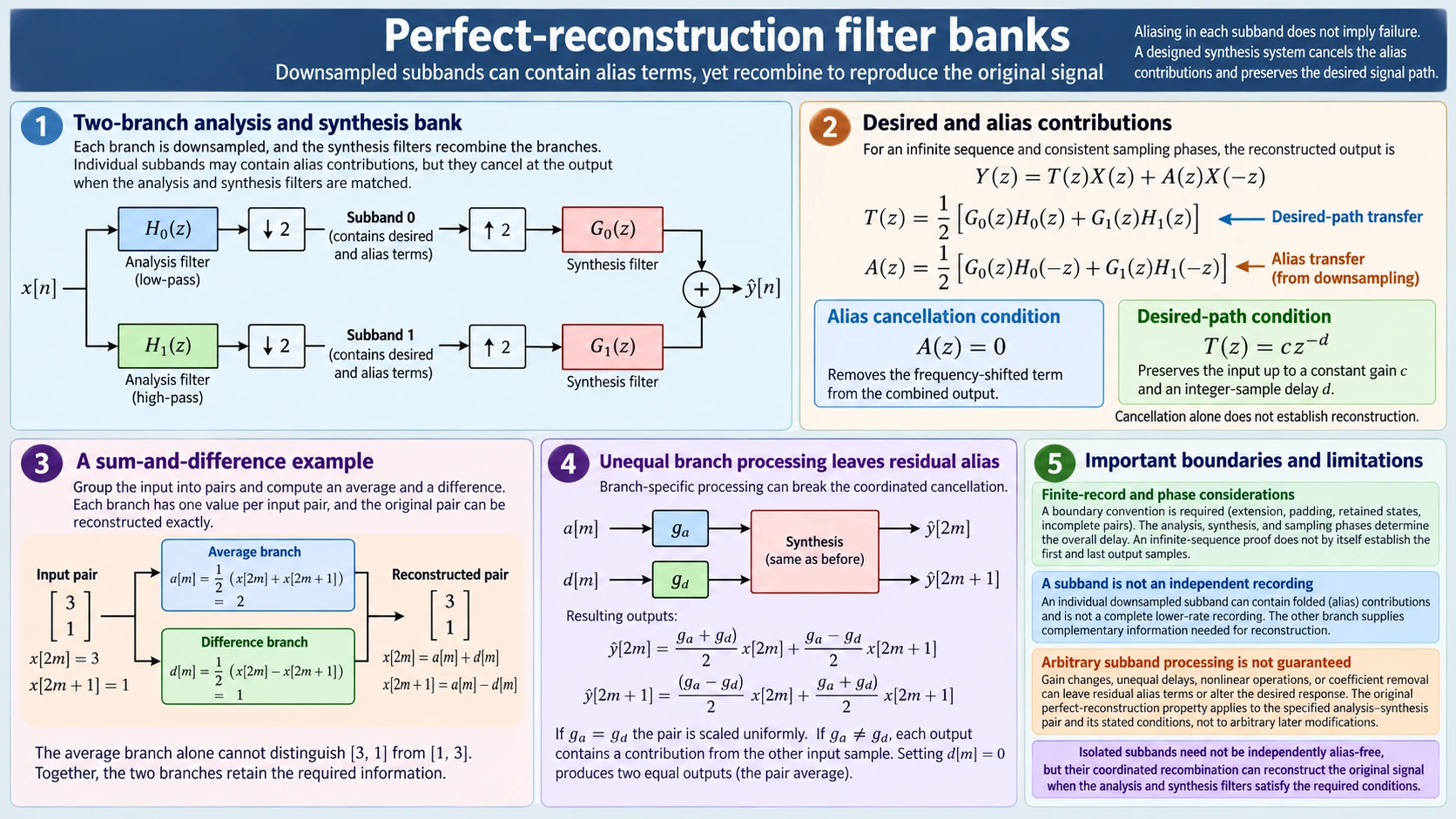
Downsampling can make different spectral components indistinguishable within a reduced-rate sequence. A coordinated filter bank can retain the needed distinctions across its branches and reconstruct the original sequence. The analysis filters and synthesis filters must satisfy the reconstruction conditions together.
A perfect reconstruction filter bank preserves the needed information across the coordinated system. Each branch may contain alias contributions, while the synthesis stage combines the branches so those contributions cancel. The desired signal path must also have the correct transfer response. Cancellation alone does not establish reconstruction.
The guarantee belongs to a specified analysis-and-synthesis pair with stated boundary and timing conventions. It does not automatically apply after arbitrary branch processing, and it does not turn one isolated downsampled branch into a complete recording of the input.
Trace desired and alias paths through analysis synthesis filters
Consider an ideal discrete-time bank with two analysis filters H0(z) and H1(z). Each filtered sequence is downsampled by two. At synthesis, each branch is upsampled by two and passed through its corresponding filter G0(z) or G1(z). Adding the two synthesis outputs produces the reconstructed sequence.
For an infinite sequence and consistent sampling phases, the standard downsample-then-upsample identity separates the output into two contributions. The first multiplies X(z) by T(z) = [G0(z)H0(z) + G1(z)H1(z)]/2. The second multiplies X(−z) by A(z) = [G0(z)H0(−z) + G1(z)H1(−z)]/2.
X(z) denotes the input sequence transform. X(−z) represents the frequency-shifted contribution introduced by the rate change. The factor one half comes from the twofold selection-and-expansion identity. These expressions assume the stipulated branch phases; changing a branch’s sampling phase changes the expressions and must be included in the design.
The desired term and the alias term therefore have different combined transfer functions. In either branch alone, the shifted contribution can be nonzero. When both branches are combined, their alias terms can sum to zero. The cancellation depends on matching the analysis and synthesis responses, including their signs and delays.
This is why visually inspecting one subband spectrum is not enough to assess the complete bank. A subband can contain folded contributions that are expected by the design. The relevant question is whether the other branch and the synthesis operation retain the complementary information needed to remove those contributions at the output.
Alias cancellation is only one reconstruction condition
The first condition is A(z) = 0 over the intended domain. It removes the shifted input term from the combined output. This is alias cancellation. The second condition constrains T(z), the desired transfer path. For exact reconstruction up to a fixed gain and an integer-sample delay, T(z) must equal c z−d, where c is the stated gain and d the stated delay.
A bank can satisfy the first condition and still fail the second. If T(z) attenuates some input frequencies more than others, the output is a filtered version of the input rather than an exact delayed copy. If it has an undesired phase response, the waveform can change even when a magnitude plot looks flat.
Conversely, a desired-path calculation that looks correct is insufficient if A(z) remains nonzero. The output then includes a shifted contribution in addition to the intended copy. Both terms must be evaluated under the same conventions. Passing one condition is not permission to assume the other.
The phrase analysis synthesis filters describes the coordinated filters on both sides of the branch rate changes. Their compatibility is the important property. A pair of individually plausible low-pass and high-pass filters is not necessarily a reconstructing pair, particularly if their delays or synthesis signs were chosen independently.
A sum-and-difference bank makes the retained information visible
A small block example illustrates the information flow without requiring a particular library implementation. Group the input into pairs x[2m] and x[2m + 1]. Define an average branch a[m] = (x[2m] + x[2m + 1])/2 and a difference branch d[m] = (x[2m] − x[2m + 1])/2. Each branch has one value per input pair.
Reconstruct the pair using x[2m] = a[m] + d[m] and x[2m + 1] = a[m] − d[m]. The algebra holds for any pair of input values. Together, the two reduced-rate branches retain two numbers per original pair, so the overall calculation has not simply discarded every other input value.
For a hypothetical pair containing 3 and 1, the average is 2 and the difference is 1. Synthesis yields 2 + 1 = 3 and 2 − 1 = 1. If the pair instead contains 1 and 3, the average remains 2, while the difference becomes −1. The average branch alone cannot distinguish those pairs, but the coordinated branches can.
This elementary bank has a defined pairing convention. A causal implementation must wait until the second member of a pair is available before calculating both branch values. Its buffering and output schedule determine the observed delay. A block equation that reconstructs the indices exactly does not establish zero physical processing latency.
The example also clarifies why aliasing in a branch need not imply failure of the bank. A branch lacks some distinctions on its own. Those distinctions can survive in the other branch and re-enter through synthesis. The complete mapping is invertible even though neither reduced-rate branch is sufficient alone.
Permissible delay and gain must be stated
Many reconstruction designs return a delayed copy of the input. A fixed integer-sample delay preserves the sequence’s shape while shifting its position. The delay should be verified and reported rather than removed silently during a visual comparison. Correcting an alignment in a plot is useful, but it must not conceal unexpected latency or a branch-specific timing mistake.
A known nonzero constant gain can likewise be part of the declared reconstruction contract. If the goal requires unity gain, synthesis must apply the corresponding normalization. A result twice as large as the input may satisfy a gain-two mathematical condition while failing a unity-gain application requirement.
Frequency-dependent gain is different. It changes relative component amplitudes and cannot be represented by one constant c. Frequency-dependent phase beyond the allowed delay is also different. The transfer condition expresses why a smooth output or a plausible spectrum is weaker evidence than an exact reconstruction comparison under the stated contract.
Finite records introduce another requirement: the bank needs a boundary convention. Extension, padding, retained states, and the treatment of incomplete pairs can change the first or last output samples. An infinite-sequence transfer proof does not by itself establish exact behavior at record boundaries. A practical claim must include those samples or explicitly delimit the verified region.
Unmatched branch processing breaks the coordinated cancellation
Return to the average-and-difference example and scale the average branch by ga and the difference branch by gd. Reconstruct using the original synthesis equations. The new even output becomes [(ga + gd)/2]x[2m] + [(ga − gd)/2]x[2m + 1]. The new odd output has the corresponding exchanged coefficients.
If the gains are equal, the pair is scaled uniformly. If they differ, each reconstructed member contains a contribution from the other original member. Setting the difference branch to zero makes both outputs equal to the pair average. The original distinction between the pair members is gone, although the unmodified bank reconstructed it exactly.
More elaborate filter banks show the same principle in their transfer equations. Branch-specific processing changes the terms that originally canceled. A gain change, unequal delay, nonlinear operation, or coefficient removal may leave a residual alias contribution or alter the desired response. The unprocessed bank’s proof cannot be carried over without analyzing the modified system.
Some applications deliberately modify subbands. That can be useful, but the required output behavior is then a new contract. It may permit a changed signal, or it may require processing designed to preserve certain reconstruction properties. Calling the original bank perfect reconstruction does not establish that every later manipulation is safe.
A subband is not an independent full-band recording
The average branch in the small example represents one particular projection of each input pair. Listening to or plotting it alone can provide information about that projection. It cannot recover the difference branch that was never supplied. Treating it as a complete lower-rate record discards the very coordination that makes the bank reconstruct.
Multirate banks can often be evaluated through coefficient phases rather than explicitly forming every expanded intermediate sample. The polyphase-resampling guide explains that execution schedule, useful when implementing the terms required for alias cancellation. Efficient scheduling preserves the stipulated filters; it does not supply a reconstruction design or prove either transfer condition.
Recovering the discrete sequence ends one part of the signal chain. The zero-order-hold guide explains how a DAC's held output shapes continuous-time content and leaves images for an analog filter. That downstream comparison matters when assessing analysis synthesis filters: correct digital reconstruction does not by itself establish an ideal analog waveform at the connector.
Verify the bank under its actual assumptions
A meaningful verification checks the alias term and the desired transfer term, then compares actual reconstructed samples with the allowed delayed and scaled input. Include signals that exercise different frequency regions and sample-pair relationships. A single favorable tone can miss a branch sign error or a boundary defect.
For a physical signal demonstration, the ZT-703S oscilloscope, multimeter and waveform generator combines instruments that can produce and inspect waveforms. Its catalogue also describes storage or export of captures. Such data would need their acquisition timing and analysis conventions recorded before being fed to a software bank. The product listing does not supply a filter-bank coefficient set or a reconstruction result.
Recorded audio samples can provide an input sequence for a software bank demonstration. The Focusrite Scarlett 4i4 fourth-generation interface bundle supplies a recording context through its listed USB-C interface, four inputs and four balanced outputs. The included recording equipment identifies the setup described by the catalogue. Checking the bank still requires its coefficients, branch conventions and actual reconstructed samples; the interface description supplies none of those results.
The evidence for a perfect reconstruction filter bank is the coordinated result under its declared conditions: alias contributions cancel, the desired path equals the allowed gain and delay, and finite-record handling satisfies the same contract. The success of that whole system explains how reduced-rate branches can contain ambiguous contributions while their recombination still returns the original sequence.