Office Supplies & Stationery
Papers slipping from a clipboard: check the clip and stack
Use spare sheets to isolate alignment, thickness and clip contact before replacing a clipboard used for forms in motion.
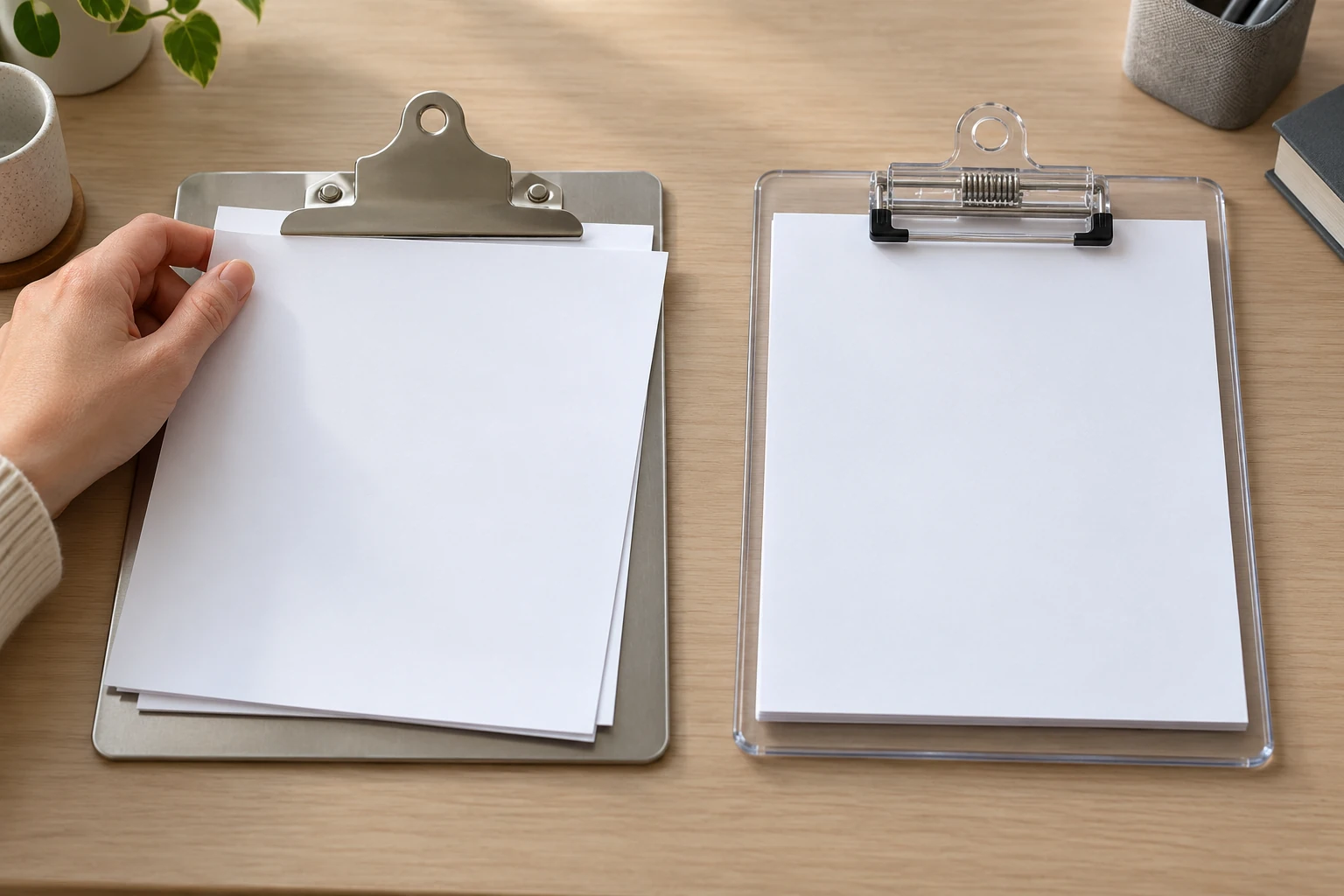
Papers slipping from a clipboard call for a closer look at the stack before you order another board. A sheet may sit partly outside the clip. A thick packet may change how the jaws meet the paper. A loose page that seems secure on a desk may shift when someone walks with the board. Use copies or spare sheets to find the cause, and keep important originals safe while you test.
Two current listings show what a product page can and cannot tell you. The silver A4 metal clipboard listing describes a low-profile metal clip and says it holds about 100 sheets. The Business Source clear clipboard listing describes a plastic writing board with a metal spring clip for forms and other papers. Its captured description gives no comparable sheet capacity. Both galleries show complete boards with clips. Neither measures the grip on your forms or shows what happens to your packet while it is carried.
Protect the actual paperwork first
Before testing, set aside anything that cannot safely be marked, bent or dropped: signed forms, one-of-a-kind records and documents containing private information. Build a test stack from spare pages of similar size and weight. If the working packet includes a cover sheet, folder or carbonless form, use spare versions of those materials too. A test with only thin copy paper may miss a contact problem caused by a stiffer cover.
Note when the paper moves. Does the top page slide while the board lies flat? Does a page work loose only after you lift the board? Does the bottom sheet escape while the rest stay put? Where the slip begins can tell you more than a general complaint that the clip is weak. A small insert may never reach the jaws. A folded page may enter the clip at a different thickness from the rest of the stack. If the board is carried upright, a loose insert may move downward even while the main packet stays attached.
Keep pages that must travel together within the part of the stack the clip actually reaches. If a necessary insert cannot be held there without covering or damaging the form, use a separate holder suited to the task. Record that constraint before comparing replacement boards.
Check where the clip meets the stack
Place the spare packet squarely against the top of the board and close the clip without folding the pages to make them fit. Look from the side. Is the clip pressing across the packet, or touching only a raised corner? If it touches one corner, realign the pages and repeat the same gentle lift. A straight stack gives the board a fair test. If the packet itself is too wide, curled or bulky to sit under the clip, another board with a similar clip may leave the cause untouched.
Start with a thin test stack, then add pages in a recorded sequence. Keep the paper type, board angle and movement the same. Note the first added layer after which a sheet begins to shift. That observation identifies a local threshold for your materials; it is not a rated clip capacity. If the actual packet includes a laminated sheet or folder, test that combination separately. The same number of ordinary sheets will not necessarily behave like a mixed packet.
The metal clipboard seller says its low-profile clip holds about 100 sheets. Treat “about” as the listing's claim; the captured page supplies no paper weight or carrying test. A hundred sheets of one paper stock may not behave like a hundred sheets that include covers and inserts. The Business Source listing names a metal spring clip but gives no sheet count in its captured description. Do not transfer the metal board's number to the clear board or treat a visible clip as proof that it will hold your packet.
If a loose sheet stays put after you align it, record the result and keep the original board in service if it meets the job. If the packet still shifts, repeat the test with fewer sheets. Change one condition at a time. Removing pages, rotating the stack, switching boards and walking farther in a single trial may produce a better outcome without showing which change helped.
Test the movement that causes trouble
A board that holds pages on a table faces a different test in a warehouse aisle, at a service counter or beside a classroom door. Recreate the usual movement with safe spare pages. Lift the board, hold it at the normal angle and take a short route free of hazards. Keep the test short enough to see when movement begins. If a page slides only when the board turns vertical, record the angle. If a hand brushes the bottom edge, record that contact. These details help separate clip contact, page position and carrying method.
Do not make the test more severe than the work requires. Shaking the board hard or loading it far beyond a stated capacity could damage the clip and would not predict ordinary use. A gentle, repeatable trial with the same spare stack offers a clearer comparison. Testing with important records is a poor choice when a dropped page may be hard to replace.
If someone writes while standing, check whether the board gives the form a flat backing and whether their hand can reach the writing area without lifting a corner out of the clip. A clipboard is also a writing surface, so its practical position matters. The product photos show complete metal and clear boards, but they do not establish how either feels in one person's hands or how a clip behaves after extended use.
Compare the two offers after the cause is clear
The metal and clear plastic boards have different stated constructions. The metal listing says the silver A4 boards have low-profile clips and come as a set of five. Its image shows five complete silver boards. The Business Source listing describes compact clear plastic boards with metal spring clips, with 12 clipboards per box bundled as ten boxes. Its image shows multiple clear boards. Use those details to identify the exact offer when asking the seller a question. They do not establish that one clip grips harder than the other.
If the test points to stack thickness, ask for a supported clip capacity for the exact board and paper type. The metal page's “about 100 sheets” claim may be relevant to a packet near that size, but it does not settle a mixed-material packet on its own. The clear board's captured description leaves capacity open. A seller's answer tied to the exact board and packet could help. General words such as “sturdy” would still leave your form stack untested.
If a small insert never reaches the clip, a board with a larger stated sheet capacity will not automatically hold it. One possible repair is to place the insert under a full-size cover sheet or keep it in an appropriate pocket. Check that the arrangement preserves the order workers need. Do not conceal a required field on a form merely to make the stack look tidy.
The storage clipboard guide addresses a different purchase question: whether calculation should stay attached to the board or use a separate tool. A storage compartment or calculator may be useful for a job, but it does not answer whether the paper-retaining clip holds the packet during movement. Keep those decisions separate when comparing listings.
Keep a short test record
For each trial, note the board used, sheet size, paper type, approximate stack thickness, page alignment, board angle and the page that moved. If a board is shared, note the normal carrier and the form packet they use. One successful attempt with an unusually thin stack does not settle a recurring problem. A failed trial with a different packet should not be treated as a result for every worker.
A hypothetical note might read: “Twelve letter-size spare pages plus one stiff cover, aligned under the top clip; the bottom loose page shifted during a short upright walk.” In the next trial, you could place that page fully under the cover while keeping the rest unchanged. If the shift stops, page position becomes a plausible cause for that packet. This is an example of a testing method, not a measured result for either listed board.
When several workers share clipboards, keep the test record close to the actual form packet. A board used for a few sheets at a reception desk may also be taken outside with a thicker work order. Those uses deserve separate notes if the paper stock or movement differs. If the form changes next month, repeat a small spare-page check. A procedure that worked for an older packet cannot establish that a new cover sheet or insert will remain secure.
Check for wear or damage before repeating a test. A bent jaw, missing pad or cracked board may call for replacement rather than more pressure. The captured product pages do not provide maintenance or repair procedures, so follow the maker's actual instructions if they are available. Do not assume that adding tape to a document or clip is acceptable for records you must preserve.
The binder-clip slippage guide focuses on loose inserts inside a clipped paper bundle. It can help identify a page outside the gripped edge. This clipboard check adds the board, its fixed clip and the angle of a carried writing surface. A technique that holds a bundle on a desk still needs a safe trial on the board used in motion.
Decide what needs changing
If simple alignment holds the real packet in a repeatable spare-paper test, make that placement part of the task routine. If thickness is the limiting condition, split the packet only if the work permits it, or seek a board whose clip is specified for that stack. If the clip is visibly damaged, follow the applicable replacement or maintenance instructions. If no tested arrangement retains the pages, keep documents in a safer holder until a suitable board is confirmed. Before ordering a replacement, repeat the winning trial with the same type of form packet on another normal workday. A single calm walk may miss a problem that appears when the carrier stops, turns or writes. Keep the change small and record it: the same paper, the same number of sheets and the same route, with only the board changed. If a second board performs differently, inspect how its clip meets the actual stack rather than assigning the result to metal or plastic as a material. The test supports that packet and task; a different packet needs its own check.
The two listings establish complete clipboard forms and seller-stated features. Your test record should show where the papers moved, which single change stopped the movement and which product details still need confirmation before the next order.