Problem-Solving Articles
Papers slipping from binder clips: check the bundle before sizing up
Check loose inserts, changes to the stack, clip capacity, and folder clearance before replacing binder clips for a slipping paper bundle.
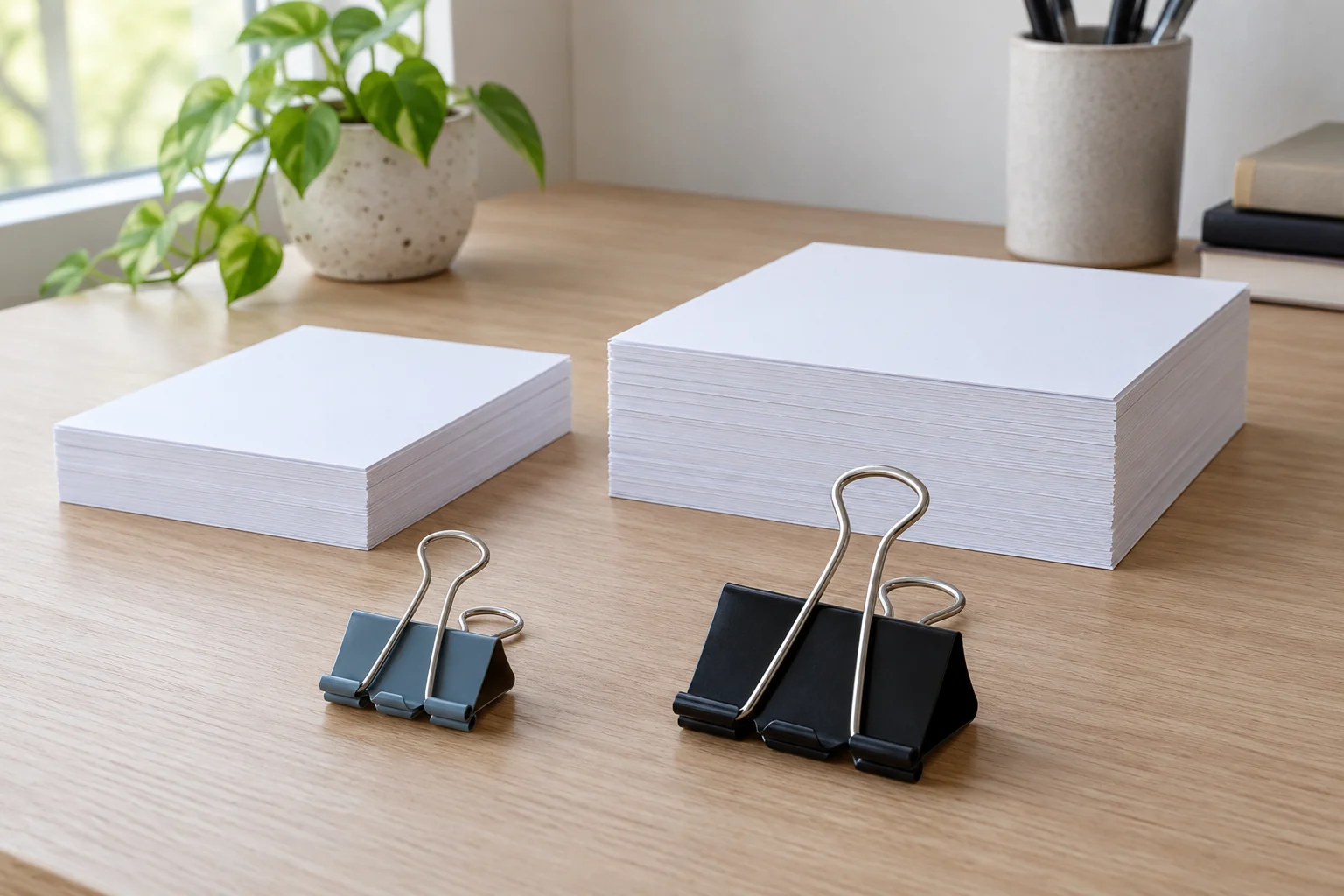
When you find papers slipping from binder clips, check which papers are loose before reaching for a larger clip. A narrow receipt may not share the gripped edge of a wider report, or a finished folder may contain more material than the bundle you first clipped. Work with unimportant copies while examining the arrangement. Identify the actual loose-piece problem before deciding whether the bundle needs a different clip size.
Put the originals somewhere appropriate and collect a spare version of the papers you actually want to keep together. Include the small inserts and covers. Look at the loose item beside the rest of the bundle and ask where the clip was meant to grip it. If you do not have a suitable spare arrangement to examine, resolve the missing capacity or handling information before using important originals as the experiment.
Checking a mixed paper bundle begins with the loose piece
For checking a mixed paper bundle, separate the actual symptom from your first explanation. Did one small item fall out, did several full sheets move, or did the entire clip come away? Those are different observations. Describe the one you actually saw. A general statement that the clip failed can hide whether every sheet was included at the intended edge in the first place.
Put the spare papers into the order you intend to use and look along the edge where the clip belongs. Check where each smaller piece sits relative to that edge. A receipt placed farther inside a large report may not be part of the same gripped area as the report sheets. Find a suitable way to keep that insert associated with its document before assuming a larger clip would reach it.
If the small item needs its own envelope or another suitable filing arrangement, treat that as a document choice. You can keep the enclosure with the report while leaving its contents protected as appropriate. The selected clip descriptions do not certify a particular preservation method. Choose a suitable arrangement for the actual papers instead of trying to make a single clip perform every holding task in a mixed packet.
Check whether the bundle changed after it was clipped
Compare the spare bundle with the version you originally intended to hold. A cover, divider, or collection of additional sheets may have been added later. Keep those changes visible when asking about capacity. The number of printed pages alone does not describe every material in the finished stack, especially when some sheets are used on both sides or have different thicknesses.
Recreate the actual intended arrangement with the spare materials before trying an ordinary handling check. If a candidate clip cannot be used as intended without forcing it, stop and obtain an appropriate capacity answer or another suitable method. This is not an instruction to stretch, bend, or modify a clip. Neither selected retail offer supplies an alteration method or a tested maximum for your particular bundle.
For a working document, decide which version needs a holding solution now. You may need to retain today's pages while the final contents remain undecided. Keep that temporary choice distinct from approval for the eventual packet. When the document changes again, check its actual requirement rather than treating a previous trial with fewer components as a guarantee for the revised stack.
Binder clip size and grip need an actual specification
For binder clip size and grip, read the quantity attached to a number. ACCO's official page for its small A7072020D clip separately lists a three-quarter-inch width and a five-sixteenths-inch capacity. Those are different specifications for that reference product. They do not establish the capacity of either selected offer, even when a size label looks similar.
Ask the seller whether the selected clip has a stated paper-stack capacity and which measurement a size label describes. Include the exact offer and the actual bundle requirement. A reply repeating only that a clip is large or jumbo leaves the capacity question open. A photograph can help identify the product, but it does not supply a missing specification for the thickness you want to hold.
If the answer gives a sheet count, ask what paper and conditions it concerns. Keep any covers or inserts in view. A count of thin printing sheets does not automatically describe a mixed stack of printing paper, envelopes, and stiff covers. The point is to find the applicable limit for the actual task, without converting a familiar size number into a holding result it never stated.
Read the Bybiment pack before assigning a replacement size
The Bybiment assorted metal binder clip offer describes two hundred eight pieces across six size groups. It lists twelve at two inches, twenty-four at 1.6 inches, twenty-four at 1.26 inches, forty-eight at 0.98 inches, forty at 0.75 inches, and sixty at 0.6 inches. The list gives size labels and inventory, without an explicit stack-capacity value for each group.
The description calls the clips metal and presents them for ordinary office, home, school, and craft tasks. Several sentences about material and paper protection are incomplete. They do not establish a particular metal grade or a guarantee that important originals will remain unmarked. Keep those limits with the offer rather than filling its missing words from a claim attached to another product.
If you already own this assortment, identify the actual size you used when reporting a slipping problem. A large pack can contain several plausible candidates. Ask about the one that held the spare bundle, not the entire mixed inventory as though every piece had the same capacity. Use the size list to identify the clip you used when asking the seller about its actual holding capacity.
Resolve the jumbo offer's dimensions before using its title
The Unbranded fifty-piece jumbo clip offer uses three-inch wording in its title. Its description gives approximate dimensions of two by 3.4 inches, with fifty by eighty-five millimetres alongside them. It does not clearly identify which part each dimension measures. Ask for clarification before treating the title's number as a jaw opening, body width, or folder-clearance requirement.
The same description uses strength, rust-resistance, and reusability language and says the clips can hold bulky documents. These remain seller claims, with no independent trial or explicit stack-capacity value supplied here. A bigger-sounding title cannot establish why your particular papers slipped from the previous arrangement. Check the original symptom and the actual required specification before buying a large replacement pack.
The offer also suggests food-bag, clothing, cable, and outdoor uses. Those applications require their own suitability decisions and are outside this paper-bundle check. Keep the enquiry about the actual documents you want to hold. A long list of possible tasks does not resolve a missing capacity or approve a different material or load for your household.
Look at what happens when the folder closes
If the papers stay together on the desk but become loose after filing, inspect the storage arrangement with the spare bundle. Try it in the actual folder, envelope, or tray and check whether the enclosure closes normally. Include the entire clip, not just the paper thickness. A bundle that fits on an open surface can still raise a separate clearance question in a tightly filled enclosure.
Look at adjacent bundles too. The clip may sit beside other papers or near a fold in the folder. Observe whether removing and replacing the spare packet catches anything or changes the arrangement. Describe the movement you actually saw without declaring a mechanical cause you have not established. You can choose a different suitable filing layout while keeping the documents associated.
A visible reference number or a signature area can also affect where the clip belongs. Check the proposed position from the next reader's point of view. If the clip covers information they must see, decide on another suitable position or method before finishing the papers. Moving it simply to uncover text should not leave a smaller insert outside the intended gripped area.
Try the ordinary handling the bundle actually needs
With expendable copies and a suitable actual clip, examine the routine action you need: taking the packet from a tray, carrying it to another desk, or returning it to its folder. Keep the check ordinary and avoid shaking or loading it to invent a maximum. Notice whether the same loose-piece symptom appears. Describe what happened in that ordinary trial; it does not certify the clip's maximum capacity.
Ask the person who will use the papers to try the spare arrangement if they are available. They may need to open it repeatedly, read one section, or remove an insert. Choose a finishing arrangement the person handling these papers can use comfortably. A method that holds a closed bundle but is awkward for the next person's task may need reconsidering, even if a larger clip could be made to surround it.
Keep the result specific when deciding what to change. You might have found that the small insert needs its own enclosure, that the final stack needs an applicable capacity answer, or that the folder arrangement needs more space. Change the part of the plan supported by that observation. An unresolved symptom can stay open while you ask for information instead of becoming a reason to order every available clip size.
Keep the supply identifiable after the problem is resolved
The actual guide to storage-bin label design for shared workspaces uses hypothetical binder-clip bins to explain contents names and distinguishing attributes. Its actual product contexts are a Dell desktop and a handheld printer, not tests of clip capacity. Use the wording idea to identify the clip sizes you actually own, keeping any verified capacity information separate from the size label.
For an assortment, a divided existing container may help colleagues find and return the intended size. Retain the package information if it identifies the group clearly. Do not label a compartment with an invented sheet count simply because one spare packet stayed together during a trial. Someone returning a clip should be able to match its actual size to the supplies without inheriting an unsupported promise.
Choose another finishing system when the document needs one
The actual binding spine compatibility guide considers wire and comb formats, punched holes, and specific supplied spines. Choose wire or comb supplies for the actual binding method the project requires. If the project was intended for such a method, keep the temporary clip separate from the final supply decision. A clip holding a draft does not establish a wire pitch or a compatible spine size.
Finish the check for papers slipping from binder clips with the actual loose-piece observation, the complete intended stack, and its storage arrangement. Ask which size or capacity specification applies to the exact offer you would buy. Choose the change that addresses the observed problem, keeping important originals out of an improvised holding test and leaving an unverified cause unresolved.
Conceptual papers slipping from binder clips cover with whole generic inactive clips and separate paper stacks; no exact retail models or verified holding result is shown.